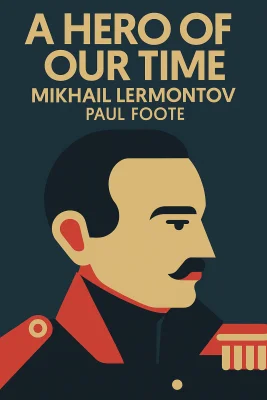
A Hero of Our Time
Categories
Fiction, Classics, Historical Fiction, Literature, School, 19th Century, Russia, Novels, Literary Fiction, Russian Literature
Content Type
Book
Binding
Paperback
Year
1965
Publisher
Penguin Classics
Language
English
ASIN
014044176X
ISBN
014044176X
ISBN13
9780140441765
File Download
PDF | EPUB
A Hero of Our Time Plot Summary
Introduction
The mountain mist swirls around two horsemen descending a treacherous Caucasian pass, their conversation threading through the darkness like smoke from a dying fire. One man speaks of another—a young officer named Pechorin whose very name seems to cast shadows across the austere landscape. The storyteller's weathered face betrays a mixture of affection and bewilderment as he recalls this enigmatic figure who passed through his life like a beautiful, destructive storm. In the harsh frontier of 1830s Russia, where the empire bleeds into the wild Caucasus, men are tested by bullets and betrayal, by love and loneliness. Pechorin emerges from these tales as a creature caught between worlds—too intelligent for his circumstances, too restless for peace, too proud for redemption. His story unfolds in fragments, each piece revealing another facet of a soul that burns too brightly, consuming everything it touches, including itself.
Chapter 1: The Shadow of a Man: Pechorin Through Others' Eyes
Captain Maksim Maksimich shifts uncomfortably in his saddle, his weathered hands gripping the reins as memory pulls him backward through the years. The fortress at Stone Ford rises in his mind—a lonely outpost where Russian soldiers held the line against Circassian raiders, where every sunset might herald death. Pechorin had arrived like a fever dream made flesh. Young, pale, with eyes that seemed to hold secrets darker than the mountain gorges, he carried himself with the languid grace of St. Petersburg nobility despite wearing an ordinary ensign's uniform. Maksim Maksimich, a simple man who found comfort in routine and duty, was immediately drawn to this strange officer who could spend whole days hunting in freezing rain, yet shudder at a creaking shutter. The captain's voice grows heavy as he recalls the Circassian girl, Bela. Beautiful as mountain starlight, daughter of a tribal prince, she became the center of a web of desire and violence that would destroy everything it touched. Young Azamat, her brother, burned with longing for the bandit Kazbich's magnificent horse—a creature of legend with eyes like black diamonds and hooves that barely seemed to touch the earth. Pechorin saw opportunity in the boy's obsession. With casual cruelty disguised as friendship, he orchestrated a devil's bargain: Azamat would steal his sister for Pechorin in exchange for the coveted stallion. The plan unfolded with terrible precision. In a single night, innocence shattered like glass against stone, and Bela found herself trapped in the Russian fort, a caged nightingale whose song would soon turn to silence.
Chapter 2: Dangerous Games: Taman's Nocturnal Secrets
The salt wind off the Black Sea carries whispers of danger as Pechorin arrives in the decrepit port town of Taman. His lodgings perch on the very edge of the world—a ramshackle hut where the land surrenders to restless waves. The old woman who should be his landlady has vanished, leaving only a blind boy whose white eyes seem to see more than they should. Something moves in the shadows of this forgotten place. Pechorin's soldier's instincts prickle as he watches the blind youth slip through the darkness with impossible confidence, following a path only he can see. The mystery deepens when a girl appears—wild and beautiful, with auburn hair that catches moonlight like spun copper and a laugh that rings hollow as a cracked bell. She sings of boats and storms, of treasures carried through dark waters by bold men who fear neither death nor the Devil himself. Her songs are maps written in melody, and Pechorin begins to understand that he has stumbled into a nest of smugglers who use the blind boy as their guide and the girl as their lure. The game grows deadly when the girl realizes Pechorin knows too much. She comes to him in the night, pressing against him with desperate passion, her lips burning with lies and her hands cold as winter stone. But when she leads him to a boat bobbing in the treacherous surf, her caresses turn to claws. She means to drown him like an unwanted kitten, to silence his dangerous knowledge forever. The struggle is brief and vicious. In the end, it is the girl who disappears beneath the dark waters while Pechorin crawls to shore, gasping and changed. He has learned something about himself in those desperate moments—that he can kill without hesitation when death stares him in the face.
Chapter 3: Hearts as Battlefields: The Princess Mary Affair
The elegant spa town of Pyatigorsk spreads before the Caucasus Mountains like a stage set for civilized theater, its manicured gardens and mineral springs offering respite from the brutal frontier. Here, Russian society plays at being European, and young officers in pristine uniforms court pale daughters of nobility while their sabers rust from disuse. Princess Mary Ligovskoy arrives like a vision from another world—cool, cultured, and utterly convinced of her own superiority. She has the kind of beauty that men write poetry about and die for, wrapped in silk and protected by an invisible wall of rank and breeding. Her dark eyes hold intelligence and pride in equal measure, and when she looks at Pechorin, she sees only another provincial officer beneath her notice. But Pechorin has made an art of conquest. He begins his campaign not with flowers and flattery, but with calculated indifference that drives Mary to distraction. He befriends her admirers only to outshine them, rescues her from embarrassment only to walk away without claiming his reward. Each slight is precisely calculated to lodge in her mind like a splinter. Meanwhile, his friend Grushnitski burns with obvious devotion, wearing his soldier's coat like a badge of romantic suffering and competing for Mary's attention with the desperation of a drowning man. The young cadet believes himself the hero of his own tragic romance, never seeing how Pechorin manipulates each encounter to serve his own darker purposes. As Mary's fascination with Pechorin deepens into something more dangerous, another woman watches from the shadows. Vera, his former lover, has followed her husband to the spa, carrying old wounds and new hopes. Her return ignites something in Pechorin that he thought long dead—not love, perhaps, but its bitter ghost.
Chapter 4: Fate's Cruel Hand: The Duel and Its Aftermath
The web of desire and deception tightens around Pechorin like a noose. Mary's proud reserve crumbles as she finds herself drawn to the man who treats her with such maddening indifference. She mistakes his coldness for depth, his cruelty for passion, and begins to believe she has found someone worthy of her intelligence and spirit. Grushnitski watches his dreams dissolve with growing desperation. The promotion he hoped would win Mary's heart only makes him appear more ordinary, while Pechorin's mysterious past and casual disdain make him infinitely more appealing. Driven by jealousy and wounded vanity, the young cadet allows himself to be drawn into a conspiracy by Captain of Dragoons, a man who sees opportunity in others' misery. The plot they hatch is born of cowardice dressed as honor. They will provoke Pechorin into a duel with loaded pistols—but only Grushnitski's weapon will contain a bullet. They expect Pechorin to fire harmlessly into the air, allowing Grushnitski to cut him down with impunity. It is murder masquerading as satisfaction. But Pechorin discovers their treachery through careful observation and cold calculation. When the moment comes, standing on a narrow ledge high above the valley floor with death yawning beneath them both, he offers Grushnitski one final chance for redemption. The young man could confess, apologize, and live to see another dawn. Pride proves stronger than wisdom. Grushnitski fires and misses, his bullet barely grazing Pechorin's knee. When his turn comes, Pechorin does not miss. The young cadet's body tumbles into the abyss, another casualty of Pechorin's terrible gift for survival.
Chapter 5: The Price of Emptiness: Love Lost and Abandoned
Blood has been spilled, and the elegant facade of spa society begins to crack. Pechorin returns to his lodgings to find two letters waiting—one from the doctor who helped dispose of Grushnitski's body, another from Vera that burns his fingers like acid. She knows what he has done. More than that, she understands what it means. Her letter trembles with the pain of a woman who loves a man she cannot save, who sees clearly the monster beneath the angel's mask. She is leaving with her husband, fleeing to safety while she still possesses what remains of her heart. Pechorin rides through the night like a man possessed, whipping his horse mercilessly in a desperate attempt to reach her before she disappears forever. The animal's heart bursts beneath him, leaving him stranded in the wilderness as dawn breaks over the mountains. He falls to his knees in the tall grass and weeps like a child, feeling something essential tear loose inside his chest. When he finally returns to town, Mary waits for him with her mother, their faces bright with expectation. They believe the duel was fought for her honor, that blood was shed in service to her beauty. The old princess speaks of marriage settlements and social connections, painting a picture of the comfortable future that awaits. Mary watches him with shining eyes, ready to forgive everything for love. But Pechorin has nothing left to give. He looks at her and sees only another mirror reflecting his own emptiness. With surgical precision, he cuts away her hopes, telling her plainly that he does not love her, cannot love her, will never marry her. He watches her face crumble and feels nothing but relief that it is finished.
Chapter 6: Testing Providence: The Fatalist's Final Challenge
In a remote Cossack settlement where time moves slowly and death comes quickly, Pechorin encounters Lieutenant Vulich, a Serbian officer whose obsession with gambling has consumed everything else in his life. Dark-eyed and mysterious, Vulich carries himself like a man who has already died but forgotten to lie down. The conversation turns to fate and predestination during a card game that stretches deep into the night. Some believe every moment of their lives is written in the stars, while others insist free will governs all. Vulich listens with the intensity of a man seeking answers to questions that torment his sleep. When challenged to prove his beliefs, Vulich accepts with the calm of a sleepwalker. He takes down a pistol from the wall, chambers a round, and places the muzzle against his own temple. The room falls silent as death itself. His finger tightens on the trigger. The hammer falls with a hollow click. The pistol misfires, leaving Vulich alive but changed. He reloads immediately and fires into a cap hanging on the wall, proving the weapon was loaded and functional. Fate, it seems, has chosen to spare him—but Pechorin sees something else in the man's face, a shadow that speaks of death deferred, not defeated. Hours later, Vulich lies dead in the muddy street, cut down by a drunken Cossack whose blade found his heart with the precision of destiny itself. The irony is perfect and terrible—saved from suicide only to die by random violence, as if the universe were correcting some cosmic error.
Chapter 7: Legacy of Disillusion: The Journey's End
Years pass like seasons in the mountains, and Pechorin's story becomes legend whispered around campfires and in officers' clubs. Maksim Maksimich grows old waiting for news that never comes, while the fortress at Stone Ford crumbles like everything else in this hard country where empires go to die. When they meet again, it is by chance on a dusty road between nowhere and nothing. Pechorin has grown thin and distant, his eyes holding depths that even Maksim Maksimich cannot fathom. The reunion is brief and cold—two strangers wearing the faces of former friends. The old captain watches him drive away, understanding finally that some people are meant to remain mysteries. The papers Pechorin left behind reveal fragments of a soul in constant motion, always seeking something that retreats before each advance. His journal entries read like dispatches from a war against himself, battles fought and lost in the space between heartbeats. He dissects his own motives with the clinical precision of a surgeon, finding only emptiness where others see depth. In the end, word comes that he died on the road from Persia, the circumstances mysterious and somehow fitting. Perhaps he found the peace that eluded him in life, or perhaps death was simply another disappointment in a series that stretched back to his first breath. The mountains keep their silence, and the wind through the passes sounds like laughter—or weeping. In this land where beauty and brutality dance together like lovers, it amounts to the same thing.
Summary
Pechorin's ghost haunts the Caucasus like smoke from a distant fire, leaving behind only questions and the bitter taste of wasted potential. He moved through the world as both predator and prey, destroying others while consuming himself, a man too intelligent for happiness and too proud for redemption. His story becomes a mirror held up to his generation—those caught between old certainties and new doubts, who found themselves citizens of nowhere, believers in nothing. The mountains remain, indifferent to human ambition and human suffering alike. They have witnessed the rise and fall of empires, the birth and death of dreams, and they will outlast the memory of every name carved into their stones. In their shadow, Pechorin's tale echoes like a warning: that consciousness without purpose becomes its own prison, and that the ability to see through everything ultimately leaves one with nothing left to believe in. The hero of our time was no hero at all, merely a symptom of an age that had lost its way and forgotten how to find its way home.
Best Quote
“Love, like fire, goes out without fuel.” ― Mikhail Lermontov, A Hero of Our Time
Review Summary
Strengths: The review highlights the timeless nature of "A Hero of Our Time," emphasizing its exploration of enduring human emotions and societal motives. The novel's ability to evoke introspection and its vivid portrayal of the protagonist, Pechorin, as a complex and flawed character are praised. The narrative's deep psychological analysis and its evocative descriptions are also noted as memorable. Weaknesses: The review criticizes the protagonist, Pechorin, labeling him as selfish, bored, cunning, and arrogant. It suggests that the novel portrays a distorted hero born in a time of moral decline, where genuine values are scarce. Overall: The reviewer expresses a strong admiration for the novel, considering it one of the finest they have read. Despite the criticism of the protagonist, the novel's lasting impact and its profound exploration of human nature are highly valued.
About Author

Mikhail Lermontov
Lermontov delves into the human condition through the lens of Romanticism, embedding themes of alienation, fatalism, and rebellion within the landscapes of the Caucasus and the intricacies of Russian society. His work reflects a deep psychological exploration of individual characters while critiquing social norms, often drawing inspiration from the works of Lord Byron. His literary approach blends poetic lyricism with prose, pioneering the Russian psychological novel and impacting later literature with its complex character studies.\n\nThe author’s early education introduced him to the works of Goethe, Schiller, and Pushkin, shaping his literary voice. Lermontov's major book, "A Hero of Our Time", showcases his narrative mastery by presenting a disenchanted nobleman, Pechorin, whose journey through the novel mirrors the author’s own critiques of society. The poetic works, including "Demon" and "The Angel", further highlight his Romantic style and engagement with Byronic heroes. Although controversial during his lifetime, Lermontov’s bio reveals a career marked by tension between artistic expression and military obligations, often resulting in exile.\n\nReaders and scholars of Russian literature benefit from Lermontov’s rich exploration of individual psyche and societal structures, offering insights into 19th-century Russian life and the Romantic movement. His contributions lay foundational elements for future psychological realism, and his works remain a vital part of literary studies. Despite receiving no formal awards due to his contentious relationship with authority, his posthumous recognition underscores his enduring influence as a successor to Pushkin, ensuring his place in the annals of Russian literary heritage.
Read moreDownload PDF & EPUB
To save this Black List summary for later, download the free PDF and EPUB. You can print it out, or read offline at your convenience.
A Hero of Our Time
by Mikhail Lermontov
