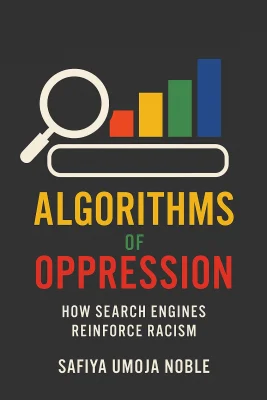
Algorithms of Oppression
How Search Engines Reinforce Racism
Categories
Nonfiction, Science, Politics, Technology, Artificial Intelligence, Feminism, Sociology, Social Justice, Race, Anti Racist
Content Type
Book
Binding
Paperback
Year
2018
Publisher
NYU Press
Language
English
ISBN13
9781479837243
File Download
PDF | EPUB
Algorithms of Oppression Plot Summary
Introduction
Search engines have become the invisible architects of our digital reality, quietly shaping what information billions of people encounter daily. Yet beneath their sleek interfaces and promises of neutral, objective results lies a troubling truth: these powerful systems actively perpetuate and amplify racial and gender discrimination on an unprecedented scale. Commercial search platforms, led by Google's dominance, do not merely reflect existing societal biases—they systematically monetize and magnify them, creating new forms of technological oppression that disproportionately harm marginalized communities. Through rigorous analysis of search results, advertising algorithms, and the political economy of information access, this investigation reveals how seemingly neutral technologies function as sophisticated instruments of social control. The evidence demonstrates that algorithmic decision-making systems, far from being objective computational processes, embed the prejudices and profit motives of their creators while obscuring their discriminatory impacts behind claims of mathematical neutrality. This examination challenges readers to question fundamental assumptions about digital information systems and recognize the urgent need for accountability in our increasingly algorithm-dependent society.
Chapter 1: The Power of Digital Gatekeepers: Google's Algorithmic Authority
Google's emergence as the dominant gateway to online information represents one of the most significant concentrations of informational power in human history. With over 90% market share in search, the company controls not merely access to information, but the very framework through which billions of people understand reality. This monopolistic position grants Google unprecedented influence over public discourse, economic opportunities, and social relationships, yet operates with minimal oversight or accountability. The architecture of Google's PageRank algorithm, originally designed by Stanford graduate students Sergey Brin and Larry Page, was explicitly intended to avoid commercial bias. Their early academic paper warned that advertising-funded search engines would inevitably become "biased towards the advertisers and away from the needs of the consumers." However, as Google evolved from university project to global corporation, these founding principles were systematically abandoned in favor of profit maximization through targeted advertising. The company's business model fundamentally transforms users into products sold to advertisers, creating powerful incentives to prioritize commercially valuable content over accurate or socially beneficial information. Search results increasingly favor websites that generate advertising revenue rather than those providing credible information, particularly when queries relate to marginalized communities whose representation has been historically profitable through stereotyping and sexualization. This commercial logic intersects dangerously with existing social hierarchies, amplifying harmful stereotypes while providing them with the legitimacy of appearing in "neutral" search results. When racist or sexist content surfaces prominently in search rankings, it carries the implicit endorsement of Google's algorithmic authority, making discrimination appear natural and inevitable rather than the product of deliberate design choices. The consolidation of informational power within a single corporate entity poses fundamental threats to democratic discourse and social justice. Google's algorithms increasingly function as a form of privatized governance, making decisions about resource allocation, social recognition, and access to opportunity without public input or democratic accountability.
Chapter 2: Searching for Black Girls: Pornification and Misrepresentation
The systematic pornification of Black women and girls in search results reveals one of the most egregious examples of algorithmic discrimination. For years, searches for terms like "black girls" returned predominantly pornographic content as top results, effectively defining an entire demographic through the lens of sexual objectification. This pattern extended across searches for other women of color, creating a digital landscape where non-white femininity is primarily understood through hypersexualized stereotypes. This pornification operates through the intersection of historical racist imagery and contemporary commercial incentives. The pornography industry, as one of the most sophisticated users of search engine optimization, deliberately targets racial identifiers to create specialized markets for fetishized content. By linking terms like "black girls" to pornographic material through extensive keyword optimization campaigns, the industry successfully captured these identity markers for commercial exploitation. The algorithmic systems that enable this capture reflect the values and priorities of their predominantly white, male creators. Silicon Valley's notorious lack of diversity means that the teams designing search algorithms have little understanding of how their systems impact communities of color. Engineering curricula rarely include training on the histories of racial stereotyping or the social consequences of technological design, leaving programmers ill-equipped to recognize or address discriminatory outcomes. The persistence of these patterns, even after public criticism, demonstrates how commercial imperatives override social responsibility in algorithmic design. Google's modifications to search results often occur only after significant public pressure, and even then, changes tend to be superficial rather than addressing underlying structural biases. The company's response typically involves denying responsibility while making minimal adjustments that preserve profitable discrimination. The psychological and social impact of this representation cannot be overstated. For Black women and girls encountering these search results, the message is clear: society views them primarily as sexual objects rather than full human beings deserving of respect and recognition. This digital dehumanization reinforces offline discrimination and limits opportunities for positive self-representation and community building. The broader implications extend beyond individual harm to encompass systematic knowledge distortion. When search engines present pornographic content as the primary information about Black women, they actively suppress educational, professional, cultural, and historical content that could provide more complete and humanizing representations.
Chapter 3: Commercial Control of Public Information in Search Results
The transformation of information access from a public good to a commercial commodity represents one of the most significant shifts in modern media landscape. As public institutions like libraries and schools face funding cuts, private corporations have assumed increasing control over how information is organized, prioritized, and distributed. This privatization process has profound implications for democratic participation and social justice. Search engines operate according to advertising logic rather than educational or informational principles. Content rises to prominence not based on accuracy, relevance, or social value, but on its capacity to generate clicks and advertising revenue. This commercial imperative creates systematic biases toward sensationalized, stereotype-reinforcing content while marginalizing educational resources and alternative perspectives. The shift toward algorithmic curation has eliminated many of the quality controls traditionally associated with information institutions. Unlike librarians, teachers, or journalists, algorithms operate without professional codes of ethics, training in bias recognition, or accountability to public interests. The result is a system that amplifies the loudest and most profitable voices while silencing those lacking commercial value. Corporate control over information access also creates new forms of censorship and manipulation. Companies can adjust algorithms to promote certain perspectives while suppressing others, effectively determining what information reaches public audiences. This power operates without transparency or oversight, making it nearly impossible to identify or challenge biased outcomes. The concentration of informational power within a small number of technology companies creates dangerous vulnerabilities for democratic discourse. When a handful of corporations control how billions of people access information, they wield unprecedented influence over political processes, social movements, and public opinion formation. The commodification of information particularly harms marginalized communities, whose representation is often filtered through commercial stereotypes rather than authentic self-expression. When profit motives drive information organization, the complex realities of oppressed groups are reduced to simplistic, marketable narratives that serve commercial rather than educational purposes.
Chapter 4: Algorithmic Bias as Technological Redlining
Algorithmic discrimination functions as a sophisticated form of technological redlining, creating new mechanisms for racial and gender exclusion that operate with apparent neutrality while producing systematically biased outcomes. Like traditional redlining practices in housing and banking, algorithmic bias channels resources and opportunities away from marginalized communities while maintaining plausible deniability about discriminatory intent. The parallel between historical redlining and contemporary algorithmic discrimination is particularly evident in how both systems use seemingly objective criteria to produce racially disparate outcomes. Traditional redlining used geographic and economic factors to systematically exclude Black families from homeownership and wealth accumulation. Similarly, search algorithms use engagement metrics, commercial value, and optimization strategies that systematically disadvantage content created by or about marginalized communities. Artificial intelligence systems trained on historical data inevitably reproduce past patterns of discrimination while obscuring their biased operations behind claims of mathematical objectivity. When algorithms learn from datasets that reflect centuries of racial and gender exclusion, they necessarily perpetuate these patterns while making them appear natural and inevitable rather than the product of social construction. The automation of discriminatory decision-making makes bias more difficult to identify and challenge than traditional forms of discrimination. When a human loan officer rejects an application based on race, the discrimination is visible and actionable. When an algorithm produces the same outcome through complex calculations involving hundreds of variables, the discrimination becomes nearly impossible to prove or contest. Predictive algorithms used in criminal justice, employment, housing, and credit decisions consistently produce racially biased outcomes while maintaining the appearance of neutrality. These systems routinely predict higher recidivism rates for Black defendants, lower creditworthiness for minority applicants, and reduced job performance for women candidates, effectively automating historical patterns of discrimination. The scale and scope of algorithmic bias far exceed traditional forms of discrimination. Where individual acts of bias affected limited numbers of people, algorithmic systems can discriminate against millions simultaneously while operating continuously without human intervention. This transformation represents a qualitative shift in the nature and impact of discriminatory practices.
Chapter 5: The Intersection of Race, Gender and Technology
The intersection of racial and gender identities creates compounded vulnerabilities in algorithmic systems, with Black women and other women of color experiencing unique forms of technological discrimination that reflect their position at the convergence of multiple oppressed identities. Search results for women of color consistently combine racist and sexist stereotypes, creating representations that are more dehumanizing than those faced by white women or men of color separately. This intersectional discrimination operates through the systematic exclusion of women of color from technology design and development processes. Silicon Valley's workforce remains overwhelmingly white and male, with Black women representing less than one percent of technical employees at major technology companies. This exclusion means that the perspectives and experiences of the most technologically marginalized groups are absent from design processes, resulting in systems that systematically fail to serve their needs. The historical stereotypes applied to Black women in American culture find new expression through algorithmic systems. The Jezebel, Sapphire, and Mammy archetypes that justified centuries of exploitation and exclusion are reproduced in search results that present Black women as either hypersexualized objects or angry, incompetent figures unworthy of professional recognition or respectful treatment. Technology companies' claims of colorblind meritocracy serve to legitimize discriminatory outcomes while avoiding responsibility for addressing them. By insisting that their systems are neutral and objective, companies deflect attention from the ways their hiring practices, data sources, and design choices systematically reproduce racial and gender hierarchies. The promise of technological liberation for marginalized communities remains largely unfulfilled because access to technology does not automatically translate into access to power or representation. While digital literacy initiatives focus on teaching coding skills to women and people of color, they fail to address the structural barriers that prevent meaningful participation in technology design and the systematic biases embedded in existing systems. The intersection of race and gender in algorithmic systems also reveals how traditional civil rights frameworks are inadequate for addressing contemporary forms of discrimination. Legal and policy approaches developed for individual acts of bias are poorly suited to challenging systemic discrimination embedded in complex technological systems that operate at massive scale.
Chapter 6: Monopolization of Knowledge and Its Consequences
Google's near-monopoly over information access creates unprecedented concentration of power over human knowledge and social understanding. With over 8.5 billion searches processed daily, the company shapes how billions of people encounter information about everything from health and politics to history and personal relationships. This concentration represents a fundamental threat to intellectual diversity and democratic discourse. The monopolization process operates through network effects that make alternatives increasingly difficult to sustain. As Google captures more users, it attracts more advertisers and generates more revenue to improve its services, creating a self-reinforcing cycle that crowds out competition. This dynamic has produced a information landscape where meaningful alternatives to Google's perspective on knowledge organization are virtually impossible to access. The consequences of informational monopolization extend beyond individual search experiences to encompass broader social and political impacts. When a single corporation controls access to information, it effectively controls the terms of public debate and social understanding. Google's algorithms determine which perspectives receive attention and which remain invisible, granting the company enormous influence over social movements, political processes, and cultural developments. The company's expansion into education through programs like Google for Education and Google Scholar further consolidates its control over knowledge institutions. As schools and universities integrate Google's tools into their curricula, students learn to equate Google's organization of information with objective truth, creating new generations socialized into accepting corporate control over knowledge as natural and inevitable. International resistance to Google's dominance reflects growing recognition of its threat to cultural sovereignty and democratic governance. Countries like France and Germany have challenged Google's digitization of cultural materials, arguing that allowing a single American corporation to control access to national heritage threatens cultural independence and democratic values. The monopolization of knowledge also creates dangerous vulnerabilities for society as a whole. When critical information infrastructure is controlled by private entities motivated primarily by profit, essential information may become inaccessible during crises or conflicts. The dependence on corporate-controlled information systems represents a form of societal fragility that undermines resilience and democratic capacity.
Chapter 7: Toward Digital Justice: Alternative Search Frameworks
Creating equitable information systems requires fundamental restructuring of how digital knowledge is organized, controlled, and accessed. Rather than accepting corporate monopolization as inevitable, society must develop public alternatives that prioritize social benefit over commercial profit and ensure that marginalized communities have meaningful control over their representation and access to information. Public search engines operated by libraries, universities, or government agencies could provide alternatives to corporate-controlled information access. These institutions already have missions focused on public service rather than profit maximization, making them better positioned to develop systems that serve diverse community needs rather than advertiser interests. Such alternatives would require significant public investment but could provide more democratic and equitable approaches to information organization. Community-controlled information platforms could enable marginalized groups to define and represent themselves rather than being subjected to external stereotyping and commodification. Search engines designed by and for specific communities could prioritize culturally relevant content and resist the homogenizing effects of commercial algorithmic systems. These platforms could serve as spaces for authentic self-expression and community building free from corporate surveillance and manipulation. Regulatory frameworks must evolve to address the unique challenges posed by algorithmic discrimination and information monopolization. Traditional antitrust and civil rights laws are inadequate for challenging the complex forms of bias embedded in algorithmic systems. New legal frameworks must be developed that can identify and address systematic discrimination in automated decision-making systems while ensuring accountability for corporate control over essential information infrastructure. Education and media literacy initiatives must help people understand how algorithmic systems operate and how to critically evaluate algorithmically-mediated information. Public understanding of how search engines prioritize and filter information is essential for developing resistance to manipulative and discriminatory practices. This education must extend beyond individual media literacy to encompass collective organizing for systemic change. The development of ethical frameworks for algorithmic design must center the perspectives and needs of marginalized communities rather than treating diversity and inclusion as afterthoughts to technical development. Technology design processes must include meaningful participation from communities most affected by algorithmic bias, ensuring that systems serve social justice rather than perpetuating oppression.
Summary
The investigation of search engine bias reveals a fundamental truth about contemporary technological systems: they are not neutral tools but powerful instruments of social control that systematically advantage privileged groups while marginalizing the oppressed. The promise of objective, merit-based information access masks a reality of corporate-controlled knowledge production that monetizes discrimination while obscuring its own operations behind claims of mathematical neutrality. The path toward digital justice requires recognition that technological systems embody social and political choices rather than inevitable technical constraints. Creating equitable information systems demands not merely technical fixes but fundamental restructuring of power relationships, democratic control over essential information infrastructure, and meaningful inclusion of marginalized communities in design processes. Only through such comprehensive transformation can digital technologies serve liberation rather than oppression.
Best Quote
“The implications of such marginalization are profound. The insights about sexist and racist biases... are important because information organizations, from libraries to schools and universities to governmental agencies, are increasingly reliant on being displaced by a variety of web-based "tools" as if there are no political, social, or economic consequences of doing so.” ― Safiya Umoja Noble, Algorithms of Oppression: How Search Engines Reinforce Racism
About Author

Safiya Umoja Noble
Noble interrogates the intersections of race, gender, and technology through a critical lens, addressing how digital media platforms can perpetuate systemic biases. Her work scrutinizes the design of algorithms, especially in search engines, revealing their racial and gender biases. As a prominent scholar, she combines sociological and interdisciplinary methods to explore the socio-economic and ethical implications of information technology, therefore advancing discussions on technological redlining and information control.\n\nHer research is particularly beneficial for those invested in understanding the ethical dimensions of digital technologies. By examining issues like privacy, surveillance, and information ethics, Noble's insights offer valuable perspectives for policymakers, technologists, and academics. Her bestselling book, "Algorithms of Oppression: How Search Engines Reinforce Racism," exemplifies her ability to distill complex ideas into accessible narratives, thus widening public engagement with these pressing issues.\n\nNoble's contributions have earned her significant recognition, including a MacArthur Foundation Fellowship. She continues to shape the discourse on digital justice as a professor at UCLA, where her roles include co-directing the UCLA Center for Critical Internet Inquiry. Her scholarly work and public advocacy serve as a clarion call for more equitable and just technological practices, impacting fields ranging from information science to critical race and gender studies.
Read moreDownload PDF & EPUB
To save this Black List summary for later, download the free PDF and EPUB. You can print it out, or read offline at your convenience.
Algorithms of Oppression
by Safiya Umoja Noble
