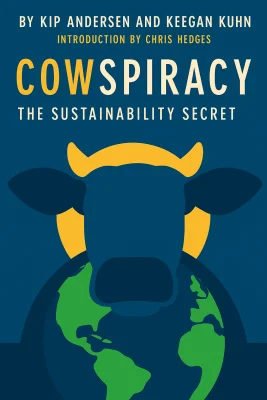
Cowspiracy
The Sustainability Secret
Categories
Nonfiction, Health, Science, Food, Politics, Animals, Nature, Vegan, Environment, Ecology
Content Type
Book
Binding
Paperback
Year
2016
Publisher
Earth Aware Editions
Language
English
ISBN13
9781608878437
File Download
PDF | EPUB
Cowspiracy Plot Summary
Introduction
A young filmmaker's life changed forever when he first witnessed an old-growth redwood forest as a child. Standing beneath those ancient giants, craning his neck to see their towering canopies, he felt something profound stir within him—a deep reverence for the natural world that would shape his entire future. Years later, this same sense of awe would drive him to uncover one of the most inconvenient truths of our time. When Al Gore's documentary shattered his comfortable worldview, this environmentally conscious young man threw himself into every green practice imaginable. He composted religiously, switched to energy-efficient bulbs, took shorter showers, and rode his bike everywhere. Yet despite his dedication and the efforts of millions like him, environmental destruction seemed to accelerate. Something wasn't adding up. The answer he discovered would challenge everything he thought he knew about saving our planet—and reveal why the most well-intentioned environmental efforts might be missing the biggest piece of the puzzle entirely.
Chapter 1: The Awakening: When Environmental Activism Met Inconvenient Truths
The journey began with a simple Facebook post that led to a United Nations report claiming something almost unbelievable: livestock production generates more greenhouse gases than all cars, trucks, trains, boats, and planes combined. For someone who had been dutifully biking everywhere to reduce his carbon footprint, this revelation was staggering. Further research revealed even more shocking statistics—animal agriculture wasn't just contributing to climate change, it was responsible for up to 51 percent of all human-caused greenhouse gas emissions. Armed with these findings, our filmmaker approached the world's largest environmental organizations expecting to find this crisis at the forefront of their campaigns. Instead, he encountered an unexpected wall of silence. Greenpeace, the Sierra Club, and other major groups had virtually nothing about animal agriculture on their websites. When he managed to secure interviews, responses were evasive or dismissive. One official laughed it off as "cow farts," while others refused to comment or claimed ignorance of the data. The pattern became clear: organizations built to protect our environment were avoiding the environmental issue that mattered most. Former Greenpeace board member Will Anderson captured the frustration perfectly, noting how environmental groups refuse to acknowledge that diet is important, that animal agriculture is the problem. The very institutions meant to sound the alarm were keeping silent about the fire consuming our planet. This silence wasn't accidental. As experts revealed, environmental groups are membership organizations dependent on donations. Challenging people's deeply held food choices—something as personal as what they put on their plates three times a day—risks alienating supporters and threatening funding. The result is a movement that promotes feel-good measures like changing lightbulbs while ignoring the elephant—or rather, the cow—in the room.
Chapter 2: Waters Running Dry: The Unseen Footprint of Animal Agriculture
California's historic drought brought water conservation into sharp focus, with residents urged to take shorter showers and fix leaky faucets. Government officials calculated that following all their recommendations would save about 47 gallons per day per person. Meanwhile, a single quarter-pound hamburger requires more than 660 gallons of water to produce—equivalent to two months of daily showers. The math revealed a disturbing disconnect between the conservation efforts being promoted and the real drivers of water consumption. At the California Department of Water Resources, officials acknowledged that animal agriculture has a greater water footprint than other activities, but admitted that recommending dietary changes "won't happen" because of "the way government is set up." The painful look on one official's face suggested he understood the issue but felt powerless to address it. This institutional paralysis persists even as California's aquifers—ancient water sources millions of years in the making—are being drained at unprecedented rates, primarily to support livestock and feed crops. The global picture is even more alarming. The Ogallala Aquifer, one of the world's largest groundwater sources spanning eight states, took millions of years to form but could be depleted by 2030 at current usage rates. Between 50 and 75 percent of water withdrawal from the world's major aquifers goes to livestock and the crops that feed them. We're essentially mining ancient water to support an unsustainable food system, leaving future generations to face the consequences. This water crisis extends far beyond American borders. Countries worldwide are depleting their aquifers at rates up to 250 times their capacity to refill, driven largely by the global appetite for animal products. The extracted groundwater eventually enters the oceans, contributing to rising sea levels while becoming contaminated and unusable. We're simultaneously creating scarcity on land and flooding elsewhere, all in service of a food system that's literally unsustainable.
Chapter 3: The Suffering Equation: Ethics and Economics of Food Production
Behind the sanitized packaging of modern meat products lies a reality most consumers never see. In concentrated animal feeding operations, billions of animals live in conditions that would be considered torture if applied to any other sentient beings. Chickens are packed so tightly in windowless sheds that workers must shuffle their feet to avoid stepping on them. Pigs spend their entire lives in metal crates so small they cannot turn around. The scale is staggering: over nine billion land animals are killed for food in the United States alone each year. The system operates on a logic of pure efficiency, where animals are reduced to production units and their suffering becomes externalized as a "cost of doing business." Standard industry practices include cutting off chickens' beaks with hot blades, castrating male piglets without anesthesia, and confining pregnant sows in gestation crates barely larger than their bodies. These aren't aberrations or abuses—they're considered normal agricultural practices, legally protected as such. Workers in this system suffer too, facing dangerous conditions, repetitive stress injuries, and psychological trauma. Slaughterhouse employees make thousands of knife cuts per shift, leading to chronic pain and permanent disabilities. The facilities themselves are designed more like industrial plants than places where living beings are processed, with line speeds prioritizing efficiency over safety or humane treatment. The economic model underlying this system externalizes its true costs onto society. While a Big Mac may cost four dollars at the counter, an additional seven dollars in hidden costs—environmental damage, healthcare expenses, subsidies—is imposed on taxpayers whether they eat meat or not. This massive subsidy system socializes the costs while privatizing the profits, creating an illusion of cheap food while the real bills are paid elsewhere.
Chapter 4: Silent Giants: Why Environmental Organizations Avoid the Meat Question
The silence of major environmental groups on animal agriculture isn't accidental—it's strategic. These organizations operate as businesses, dependent on membership contributions and corporate partnerships. Challenging people's food choices risks alienating donors and losing funding. As one expert explained, they focus-grouped the issue and found it was a political loser. People will change their lightbulbs, but asking them to change their diet crosses a line most organizations won't approach. This business model creates perverse incentives. Environmental groups partner with the very industries driving destruction, creating an illusion of progress while fundamental problems go unaddressed. The Marine Stewardship Council, supposedly certifying "sustainable" fisheries, was founded by the World Wildlife Fund and Unilever—one of the world's largest fish extractors. In its entire history, the MSC has never denied certification to a single fishery, even as fish populations collapse worldwide. The institutional cowardice runs deeper than funding concerns. Many environmental leaders genuinely seem unaware of the scope of animal agriculture's impact, despite decades of available research. When confronted with data showing livestock's overwhelming contribution to deforestation, water depletion, and greenhouse gas emissions, officials express surprise or claim the information is outside their expertise. This willful ignorance allows them to maintain comfortable narratives about technological solutions while avoiding uncomfortable truths about consumption. The result is a movement that treats symptoms while ignoring causes. Environmental groups campaign against fracking while animal agriculture uses vastly more water and produces similar methane emissions. They fight to save wolves while supporting the ranching industry that demands their killing. They promote renewable energy as a climate solution while ignoring that eliminating animal agriculture could achieve greater emission reductions immediately and at zero cost.
Chapter 5: Health Beyond Protein: Questioning Our Nutritional Narratives
The question "Where do you get your protein?" reveals how deeply meat-centric nutritional myths have penetrated our culture. Yet protein deficiency—called kwashiorkor—is virtually unknown in developed countries except among those literally starving. Meanwhile, the diseases of excess—heart disease, diabetes, cancer—dominate our healthcare system, killing more Americans than all other causes combined. These aren't genetic inevitabilities but largely preventable consequences of dietary choices. The China Study, called the "Grand Prix of epidemiology" by the New York Times, tracked 6,500 people across 65 counties and found that those consuming mostly plant-based diets had dramatically lower rates of chronic disease. Blood cholesterol levels, strongly correlated with animal protein intake, predicted rates of cancer, heart disease, and other "diseases of affluence." The Framingham Heart Study found that no one with cholesterol under 150 had suffered a heart attack in 35 years—yet the average American cholesterol level is 210. Dr. Caldwell Esselstyn's groundbreaking study with heart disease patients showed that a plant-based diet could not only prevent but reverse arterial blockage. Eighteen patients with severe heart disease had experienced 49 cardiac events in the eight years before the study. During eleven years on a plant-based diet, they had zero cardiac events among those who adhered to the protocol. The one patient who strayed from the diet experienced chest pain—which stopped when he returned to plant foods. The protein myth persists despite overwhelming evidence. Gorillas, elephants, and rhinos—some of the strongest animals on earth—are herbivores. A hundred calories of broccoli contains more protein than a hundred calories of steak. The difference is that meat's calories come primarily from fat, while vegetables' calories come from protein. Every major health organization acknowledges that well-planned plant-based diets are appropriate for all stages of life, offering protection against chronic diseases while providing all necessary nutrients.
Chapter 6: Sustainable Solutions: Plant-Based Innovations Transforming Our Food System
While environmental groups debate marginal improvements to destructive systems, entrepreneurs are building alternatives that could make animal agriculture obsolete. Companies like Beyond Meat and Hampton Creek aren't targeting vegans in San Francisco—they're creating products that deliver the taste, texture, and functionality of animal products while using a fraction of the resources. Bill Gates and other major investors back these ventures not from altruistic motives but because they recognize the massive inefficiencies in current food systems. The numbers tell the story: producing eggs requires a 38-to-1 energy conversion ratio, while plant-based alternatives achieve 2-to-1. Hampton Creek's founder, working previously with street children in Africa, saw firsthand how the world's hunger problems coexist with feeding more food to farm animals than to the billion people going to bed hungry each night. These aren't niche health food companies but potential game-changers for global food security. Veganic agriculture—growing food without any animal inputs—offers another path forward. From urban farms in Detroit producing 14,000 pounds of food on two and a half acres to large-scale operations proving that plant-based fertilizers work as well as manure, these systems demonstrate practical alternatives. Veganic farming actually costs less than conventional methods while building soil carbon, improving water retention, and avoiding the contamination risks of animal waste. The transition is already beginning in surprising places. Midwest grain farmers are moving toward veganic practices not from ethical concerns but because cover cropping with plant materials produces better results than animal-based fertilizers. These farmers are motivated by practical considerations—better yields, lower costs, and improved soil health—showing how sustainable solutions can succeed on purely economic grounds.
Chapter 7: Personal Choices, Global Impact: One Meal at a Time
The mathematics of individual impact are startling. Every day, a single vegan saves more than 1,100 gallons of water, 45 pounds of grain, 30 square feet of forest land, the equivalent of 20 pounds of carbon dioxide, and one animal's life. These aren't theoretical calculations but daily realities that accumulate into massive environmental and ethical differences over time. The power of personal choice extends beyond individual impact to market transformation. As Dr. Will Tuttle envisions, if society moved away from animal foods toward plant-based diets, we wouldn't need to kill billions of animals annually, which means we wouldn't need to breed them, which means we wouldn't need to feed them, which means vast amounts of land could return to forest. Rivers would run clean, wildlife would return, air quality would improve, and human health would flourish. This isn't utopian thinking but practical possibility. Every purchase is a vote for the kind of world we want to create. When enough people vote differently, entire industries must adapt or become obsolete. The smoking analogy is apt—a few decades ago, everyone smoked everywhere, and the idea of smoke-free restaurants seemed impossible. Today, we recognize smoking as both personally destructive and socially irresponsible. The environmental movement has focused on changing everything except the choices that matter most. People will install solar panels and drive electric cars while continuing to consume products that dwarf those improvements in environmental impact. As Howard Lyman observed, if the 75 percent of Americans who consider themselves environmentalists simply lived what they profess, we could solve our environmental crisis in a heartbeat. The solution isn't waiting for new technology or government action—it's available three times a day on everyone's plate.
Summary
This journey from environmental awakening to uncomfortable truth reveals how the most destructive industry on our planet has remained hidden in plain sight. Through interviews with farmers, scientists, and activists, we discover that animal agriculture drives more environmental destruction than all other human activities combined, yet environmental organizations maintain a conspiracy of silence around this inconvenient truth. The path forward isn't complicated, though it requires courage to align our actions with our values. Every meal becomes an opportunity to vote for the world we want—one that prioritizes compassion over convenience, sustainability over short-term profits, and life over destruction. As we face unprecedented environmental challenges, the solution lies not in distant technologies or political reforms, but in the choices we make today. The future of our planet truly depends on what we choose to put on our plates, one meal at a time, until we collectively create the transformation our world desperately needs.
Best Quote
Review Summary
Strengths: The review highlights the book's well-structured narrative and Kip's relatable personal journey, which effectively conveys the environmental impact of animal agriculture. The text is described as informative, with shocking statistics and revelations about resource use, sustainability claims, and the benefits of veganism. The book's ability to challenge preconceived notions and provide a comprehensive examination of the topic is emphasized. Overall: The reader expresses a strong positive sentiment, recommending the book as essential reading for its eye-opening insights into the environmental consequences of animal agriculture. The narrative's engaging and informative nature makes it a compelling read that significantly impacts the reader's understanding of the subject.
About Author

Kip Andersen
Andersen interrogates the complexities of environmental sustainability and animal welfare through his impactful documentaries. By establishing Animals United Movement (A.U.M.) Films and Media, he has focused on producing films that unveil the environmental consequences of industrial practices. His documentary "Cowspiracy: The Sustainability Secret" delves into the environmental impact of animal agriculture, whereas "What the Health" challenges viewers to reconsider the relationship between meat consumption and health. These films have gained significant recognition, becoming among Netflix's most-watched documentaries.\n\nHis approach, combining investigative techniques with compelling narratives, aims to alter mainstream perceptions and expose systemic issues. Beyond filmmaking, Andersen's dedication extends to holistic wellness, as he is a certified Jivamukti and Kundalini yoga teacher, reflecting his commitment to spiritual practice. This bio highlights Andersen as more than just a filmmaker; he is an advocate for change, using his work to promote compassion and harmony. His audience, ranging from environmental activists to health-conscious individuals, benefits by gaining a deeper understanding of the interconnectedness of their choices and the planet's health.\n\nIn addition to his notable films, Andersen's contribution to the genre has been recognized with a nomination for the 2018 Cinema for Peace Award for Most Valuable Documentary of the Year. This accolade underscores his influence in shaping public discourse around critical environmental and health issues. As an author of change through visual storytelling, Andersen's work continues to challenge and inspire audiences worldwide.
Read moreDownload PDF & EPUB
To save this Black List summary for later, download the free PDF and EPUB. You can print it out, or read offline at your convenience.
Cowspiracy
by Kip Andersen
