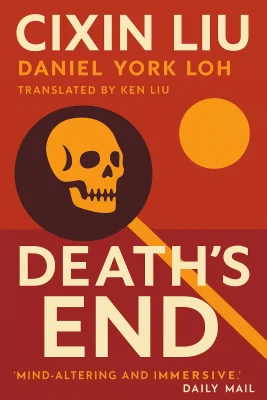
Death's End
Categories
Content Type
Book
Binding
Audible Audio
Year
2025
Publisher
Bloomsbury Publishing PLC
Language
English
ASIN
B0CFYKH5D2
File Download
PDF | EPUB
Death's End Plot Summary
Introduction
# The Dark Forest: Echoes of Responsibility Across Cosmic Time In the depths of the Gobi Desert, forty-five kilometers beneath Earth's surface, Cheng Xin's trembling hand hovers over a red switch that could broadcast the location of two worlds to the dark forest of the universe. Above her, the weight of four billion years of evolution presses down like a tomb. She has fifteen minutes to decide whether to destroy everything she has ever loved. The story begins centuries earlier, when humanity first learned they were not alone. The Trisolaran civilization, fleeing their dying world, had sent an invasion fleet toward Earth. But humanity discovered the universe's most terrible secret—it was a dark forest where civilizations hunted each other in silence. Any world that revealed its location would be annihilated by unknown hunters among the stars. This knowledge became Earth's sword. For sixty years, this balance of terror held. Now, as Cheng Xin inherits the role of humanity's guardian, that balance is about to shatter in ways no one could have imagined.
Chapter 1: The Weight of Deterrence: When Civilizations Hold Each Other Hostage
The hibernation chamber's frost melts away as Cheng Xin opens her eyes to a world transformed. Two hundred and sixty-four years have passed since she volunteered to sleep through the centuries, carrying with her the memory of a doomed love and a star given as a gift. The woman who greets her—AA, with her bird-like energy and impossible beauty—seems to glow with the confidence of an age that has forgotten fear. "You own a world now," AA laughs, showing Cheng Xin the deed to DX3906, the star she'd been given by Yun Tianming. What had once been a romantic gesture had become something far more valuable. The star has planets, one of them Earth-like, making Cheng Xin the only human to possess an entire solar system. But as they walk through the forest-city, its buildings hanging like luminous fruit from enormous trees, Cheng Xin notices something unsettling. The men around her move with feminine grace, their faces soft as flower petals. This is humanity's new form—beautiful, gentle, and utterly unprepared for the darkness that still lurks among the stars. The Deterrence Era has brought peace, but at the cost of humanity's edge. Thomas Wade hasn't changed in three centuries. His eyes still hold that predatory gleam when he raises the ancient pistol in the abandoned building. The bullets tear through Cheng Xin's shoulder and abdomen, but his message is clear—he wants to be the Swordholder, the one who holds the switch that could destroy two worlds. The six other candidates, all men from her era carrying the hard edges this soft new world has forgotten, warn her away. But she can see the truth in their cold eyes: they want the power for themselves. The elevator descends through layers of geological time to the Deterrence Center—a white tomb buried in the planet's mantle. Luo Ji sits cross-legged before the curved wall, his white hair flowing like water. For fifty-four years, he has stared at this wall, projecting his gaze across four light-years to the enemy world. His presence has kept the peace, but at the cost of his humanity. As he places the red switch in Cheng Xin's hands, the device is warm from his touch, heavy with the weight of worlds.
Chapter 2: Fairy Tales Across the Void: Hidden Messages and Technological Salvation
The wall turns blood red. Six droplets—alien probes made of matter so dense they could slice through planets—race toward Earth at twenty-five thousand kilometers per second. In ten minutes, they will destroy every gravitational wave transmitter on the planet, ending humanity's ability to broadcast to the universe. The balance of terror is about to collapse. Cheng Xin's mind fills with visions of Earth's deep history—four billion years of struggle and beauty, all leading to this moment where a single human holds the power to preserve or destroy it all. The weight of a hundred billion human lives presses down on her. She thinks of the baby she held at the UN plaza, soft and warm in her arms, smiling with innocent trust. Deep in her genes, deeper than thought or training, the choice has already been made four billion years ago when life first chose to preserve itself rather than destroy. "No—" Cheng Xin screams, and throws the switch away. She watches it slide across the white floor like a discarded weapon, carrying with it humanity's last hope of remaining free. The droplets strike their targets with surgical precision, destroying every gravitational wave transmitter on Earth. Humanity's voice is silenced forever. But in the depths of space, other forces are stirring. Four light-years away, among golden wheat fields that sway under alien light, Yun Tianming waits with stories to tell. His brain, carried across the void in humanity's most desperate gamble, has learned the secrets of their enemies. In fairy tales of kingdoms and seas, of soap that calms glutton fish and umbrellas that must keep spinning, he embeds the knowledge that might save his species. The Intelligence Decipherment Committee works for months in sophon-free rooms, racing to decode the hidden meanings before it's too late. When AA makes a paper boat and watches it sail across bathwater, propelled by dissolving soap, the breakthrough comes like lightning. Tianming has given them curvature propulsion, the secret to lightspeed travel. But the gift comes with a terrible warning—each lightspeed journey leaves permanent scars in space, cosmic beacons that advertise the location of their creators to any hunter in the dark forest.
Chapter 3: The Collapse of Dimensions: When Reality Becomes a Painting
The attack comes not as fire or light, but as something far more terrible—a slip of paper. The rectangular membrane drifts toward the Solar System at lightspeed, eight and a half centimeters long, pure white and impossibly thin. It glows with its own light while remaining transparent to all matter, like a cosmic reference plane that maintains its position regardless of any force applied to it. Dr. Bai Ice approaches the artifact aboard the exploration ship Revelation. When he reaches out to touch it, his hand passes through without resistance. The slip appears harmless, almost romantic—a love letter from the stars. But Bai Ice remembers his teacher Ding Yi's final words about the universe being a dinner party where no table remains untouched. He orders Revelation to retreat, sensing danger his instruments cannot detect. The paper slip's protective field eventually evaporates, exposing two-dimensional space to three-dimensional reality. Like a waterfall cascading off a cliff, three-dimensional space begins collapsing into two dimensions. The process spreads rapidly, creating a flat plane where everything that touches it becomes part of a painting with no thickness. The Solar System has become canvas for the universe's cruelest artist. In the Bunker World behind Jupiter, humanity's billion refugees watch in horror as their preparations prove useless. The gas giants that were supposed to shield them are flattened along with everything else, their massive bulk compressed into geometric abstractions. Neptune appears as concentric rings of impossible beauty, its "tree rings" revealing internal structure in perfect detail—hydrogen atmospheres, water-ammonia mantles, rocky cores—all laid bare in two dimensions. The Earth appears in the sky as the collapse reaches the inner solar system. The two-dimensional Earth is surrounded by a ring of white that resolves into individual snowflakes, each thousands of kilometers across. The frozen oceans have crystallized according to laws unknown to three-dimensional physics, creating decorative art on an astronomical scale. Even in death, Earth wears a beautiful wreath.
Chapter 4: Flight at Lightspeed: Escape to the Edge of Time
Cheng Xin and AA race across Pluto's frozen surface as the dimensional collapse accelerates. The yacht Halo reveals its true nature—one of only three lightspeed vessels ever built by humanity, disguised as a pleasure craft. As Jupiter begins its transformation into a two-dimensional masterpiece, Halo's curvature drive activates, and the universe shudders around them. They accelerate toward the speed of light, stars clustering into blue and red points at opposite ends of space. Behind them, the Solar System completes its transformation into the universe's most detailed painting, every atom precisely positioned in two-dimensional space. They fly toward DX3906, the star that Yun Tianming gave Cheng Xin four centuries ago, now humanity's only hope for survival. In the underground museum on Pluto, Luo Ji waits among humanity's final monuments. The old Wallfacer has spent decades carving civilization's memory into stone, the only storage medium capable of lasting geological ages. His white hair floats in the low gravity as he explains the bitter irony—after achieving godlike technology, humanity's final message must be chiseled by hand, just as their ancestors did in caves forty thousand years ago. The journey to DX3906 takes them across eighteen light-years of space, but relativistic effects compress the voyage into subjective months. When they arrive, they find a system of planets orbiting the star that was once a gift of love. Planet Blue beckons with its Earth-like atmosphere and purple vegetation, a world where they might rebuild what was lost. But as their shuttle descends toward the surface, space itself convulses around them in ways that defy all understanding.
Chapter 5: Prisoners of Light: Eighteen Million Years in Isolation
The shuttle falls toward Planet Blue when space convulses around them. Cheng Xin experiences a moment that seems infinitely short and infinitely long—a time vacuum where time itself ceases to exist. When reality returns, they are trapped in a universe where the speed of light crawls at less than twenty kilometers per second. The death lines left by Zero-Homer ships have ruptured, spreading their zero-lightspeed trails across the entire solar system. Every computer dies instantly, every quantum circuit fails, leaving only primitive mechanical systems functional. They orbit Planet Blue at what was once lightspeed, but time moves differently now. In their frame of reference, minutes pass slowly while eons flash by on the planet below. When they finally decelerate and return to normal space, the transformed world greets them with purple vegetation and a yellow sky. The reduced lightspeed has changed everything—the sun's radiation spectrum, the planet's atmosphere, even the fundamental nature of space itself. They have become prisoners in a light tomb, sealed off from the universe forever. The atomic decay measurements deliver their verdict with mathematical precision: 18,903,729 Earth years have passed. Cheng Xin counts the digits three times before the number's magnitude crushes her spirit. She stands among purple trees that rustle in alien wind, carrying the weight of nearly nineteen million years on her shoulders. They are the last witnesses to humanity's existence, stranded in a future so distant that their entire species has become ancient history. But hope flickers when their deep scan reveals carved words buried twenty-eight meters below the surface: "WE LIVED A HAPPY LIFE TOGETHER." The message from Yun Tianming and AA, carved into bedrock before geological forces buried it, confirms that love found a way to flourish even in this isolated world. Time may be the cruelest force of all, but it cannot erase the marks that matter most.
Chapter 6: The Mini-Universe Gift: Love's Sanctuary Against Cosmic Death
The rectangular door appears at dusk, its edges outlined in faint light that grows visible only as darkness falls. It hovers above the clearing like a selection box drawn by some cosmic mouse, moving slightly but always returning to the same position. When Cheng Xin reaches toward it, her hand disappears into the plane while branches and insects pass through unimpeded. The door recognizes what it was built for. They step through together into a time vacuum where moments stretch into eternities. When time begins again, they find themselves in a pastoral scene that seems torn from Earth's memory—black soil, white house, exotic trees under a blue sky. The world repeats itself in every direction, copies extending to infinity, each containing duplicates of themselves walking the same paths. Sophon emerges from the house in her flower-decorated kimono, as beautiful and ageless as ever. She bows deeply and welcomes them to Universe 647, a complete cosmos contained within a cubic kilometer. This is Yun Tianming's final gift—not just a star, but an entire universe where they can wait out the death and rebirth of the greater cosmos. The mini-universe exists in its own timeline, protected from the collapse that will eventually claim everything. The revelation transforms their understanding of survival itself. While civilizations wage wars across dimensions and manipulate the fundamental laws of physics, love creates its own sanctuary. Yun Tianming, who once sent his brain into the darkness between stars, has given them something more precious than worlds—he has given them time itself, wrapped in a package small enough to hold in their hands yet vast enough to contain eternity. They live a year in their pocket paradise, walking through forests that smell of Earth's memory, sleeping under stars that shine with familiar light. But the universe beyond their sanctuary is dying, and even love cannot hide from that ultimate responsibility forever.
Chapter 7: The Ultimate Choice: Personal Survival Versus Universal Rebirth
The message arrives across the supermembrane after they have lived a year in their pocket paradise. Over 1.57 million languages scroll past, each representing a civilization that left its mark on the universe. When Trisolaran and Earth scripts finally appear, Cheng Xin and Guan Yifan weep with joy—their civilizations are remembered, their existence acknowledged by the cosmos itself. But the message carries a terrible burden: the universe is dying. Too much matter has been locked away in mini-universes, dropping the total mass below the critical threshold needed for collapse and rebirth. Without intervention, the cosmos will expand forever, growing cold and dark until every star dies and every memory fades. The Returners call for all refugees to send back the matter they have taken, keeping only memories for the new universe. The choice tears at their hearts. They could remain in Universe 647, living out their lives in safety while the greater universe dies around them. Or they can return the matter that sustains their world, trusting that enough others will make the same sacrifice to ensure cosmic rebirth. It is the ultimate test of responsibility—not just for their own species, but for existence itself. They choose to return. The robots systematically dismantle their paradise, sending soil, machinery, and even the air itself back through the dimensional door. The sun goes dark, the house disappears piece by piece, until only their small ship remains in the empty cosmos. Cheng Xin leaves behind a tiny ecological sphere—five kilograms of life that will wait in the darkness for the new universe to be born. As their ship passes through the door back into the dying universe, Cheng Xin reflects on the stairs of responsibility she has climbed throughout her life. From a student's duty to study, to a rocket engineer's obligation to reach orbit, to a Swordholder's burden of holding two civilizations in balance, each step has led to greater weight and wider consequences. Now she carries responsibility for the universe itself.
Summary
The great cosmos spreads around them, ancient beyond measure and dying by degrees. Sophon pilots their craft through space where stars have become strange artifacts of light, distorted by the reduced-lightspeed regions that scar reality like wounds. They search for a habitable world in this transformed universe, knowing that their survival matters less than the choice they have made. Behind them, Universe 647 drifts in darkness, containing only a message in a bottle and a glowing sphere of life. If the new universe is born, these remnants will be the first to enter it, carrying memories of Earth and Trisolaris into whatever comes next. The ecological sphere pulses with gentle light, a few fish swimming between miniature continents while dewdrops spiral through the air, refracting hope into the void. In choosing to return matter to the dying universe, Cheng Xin and Guan Yifan have achieved the grandeur that matches their thoughts. They may be the last humans in existence, but they carry within themselves the memory of every person who ever lived, every dream that ever mattered, every moment of love that defied the darkness. In the end, that may be enough to light the way for whatever comes after the final collapse, when time itself begins again and the universe opens its eyes to see the dawn of a new creation.
Best Quote
About Author

Cixin Liu
Liu Cixin delves into the intricate relationship between technological progress and human society, using his extensive technical background and experiences from the Cultural Revolution as a backdrop. His work often delves into hard science fiction, where themes of social inequality, ecological challenges, and the complexities of human nature are central. These elements are vividly explored in his "Remembrance of Earth's Past" trilogy, beginning with "The Three-Body Problem". This book not only won the 2015 Hugo Award for Best Novel but also marked a significant moment in science fiction by making Liu the first Asian author to achieve such recognition.\n\nIn parallel with these achievements, Liu's other notable contributions include story collections like "To Hold Up the Sky" and "The Wandering Earth", the latter of which has been adapted into a successful Chinese sci-fi film. His narratives are heavily influenced by literary giants such as George Orwell and Arthur C. Clarke, which is evident in the way he weaves complex cosmic phenomena with existential challenges. Therefore, readers of Liu's work can expect a fusion of rigorous scientific speculation and profound philosophical inquiry, offering a deep dive into the potential and pitfalls of technological advancements.\n\nLiu's influence extends beyond his books, impacting both Chinese and global science fiction literature. His multiple awards, such as the Galaxy and Locus Awards, and roles like vice president of the Shanxi Writers Association, underscore his status as a key figure in literary circles. Readers interested in exploring the interplay of science and society will find his narratives both thought-provoking and enlightening, serving as a powerful reminder of the delicate balance between progress and its consequences.
Read moreDownload PDF & EPUB
To save this Black List summary for later, download the free PDF and EPUB. You can print it out, or read offline at your convenience.
Death's End
by Cixin Liu
