
Eyeless in Gaza
Categories
Philosophy, Fiction, Classics, Historical Fiction, Literature, 20th Century, Novels, British Literature, Modern Classics, English Literature
Content Type
Book
Binding
Paperback
Year
2004
Publisher
Vintage
Language
English
ASIN
B00RP78QNE
ISBN
0099458179
ISBN13
9780099458173
File Download
PDF | EPUB
Eyeless in Gaza Plot Summary
Introduction
# From Blindness to Sight: Anthony Beavis's Journey to Authentic Being The dead dog plummeted from the Mediterranean sky like a grotesque messenger, splattering blood across two naked lovers on a sun-baked rooftop. Anthony Beavis, forty-two and emotionally calcified, watched the mangled carcass twitch in its final spasms while his mistress Helen screamed beside him. The year was 1933, and this moment of random violence would shatter the carefully constructed walls he had built around his heart for decades. Anthony had perfected the art of living without truly being alive. A brilliant sociologist who studied human behavior while remaining magnificently detached from his own humanity, he treated relationships like laboratory specimens and emotions like interesting data points. But the falling dog changed everything. As blood soaked into his skin and Helen's cries pierced the afternoon air, memories began flooding back unbidden—fragments of a life lived at arm's length, a catalog of betrayals and missed connections that stretched back to his motherless childhood. The comfortable distance he had maintained from genuine feeling suddenly collapsed, forcing him to confront the wreckage of his choices and the possibility that it might not be too late to learn how to love.
Chapter 1: The Architecture of Detachment: A Life Lived at Distance
Anthony Beavis had constructed his existence like a fortress, with books as battlements and cynicism as his moat. His London flat overflowed with volumes on sociology and psychology, each one another brick in the wall between himself and authentic human connection. At his writing desk, surrounded by half-finished manuscripts about crowd behavior and social decay, he observed the world through the safe lens of academic theory. His affair with Mary Amberley exemplified this approach. She was beautiful, sophisticated, and as emotionally unavailable as he was. Their relationship thrived on intellectual sparring and physical pleasure while carefully avoiding the messy complications of genuine feeling. Mary delighted in orchestrating cruel games among her circle of admirers, treating human emotions as entertainment. Her drawing room became a theater where she manipulated situations for her own amusement, watching with bright, mocking eyes as hearts broke and lives unraveled. Anthony found himself both attracted to and repelled by Mary's callousness. She represented everything he thought he wanted—intelligence without sentiment, pleasure without responsibility. Yet even as he participated in her games, something inside him recognized the spiritual poverty of their arrangement. They were two hollow people amusing themselves with others' pain, mistaking cynicism for wisdom and detachment for strength. The comfortable predictability of this existence cracked when Mary proposed her cruelest wager yet. She challenged Anthony to seduce Joan Thursley, the innocent fiancée of his closest friend Brian Foxe. The bet was presented as a test of Anthony's sophistication, but beneath Mary's laughter lay something darker—a desire to corrupt innocence and destroy the genuine love she had never experienced herself. Anthony's initial resistance gradually crumbled under Mary's mockery of his cowardice and his own need to prove his emotional superiority. The seduction unfolded with tragic inevitability. Joan, starved of physical affection by Brian's moral restraint, responded to Anthony's calculated kiss with desperate hunger. What began as a cruel game became something more intense than either had expected. But the damage was done. Joan confessed her change of heart to Brian, who received the news as final confirmation of his own unworthiness. Unable to face the collapse of everything he had tried to build, Brian walked into the mountains and threw himself from a cliff.
Chapter 2: Blood from the Sky: The Moment That Shatters Complacency
Years later, the memory of Brian's mangled body still haunted Anthony as he lay on that Mediterranean rooftop with Helen Amberley, Mary's daughter. Helen had inherited her mother's beauty but not her cruelty, and in her Anthony found something he had never experienced—the possibility of genuine connection. Their affair had begun as another exercise in sophisticated pleasure-seeking, but it had gradually deepened into something more complex and troubling. The morning of August 30th, 1933, began like any other. Anthony and Helen dozed naked on sun-warmed mattresses, their bodies glistening with perspiration and the aftermath of lovemaking. The Mediterranean stretched endlessly blue before them, and for once, Anthony felt almost content with physical sensation unmediated by intellectual analysis. The sound came first—a low droning that grew steadily louder. Anthony opened his eyes to see a small aircraft passing overhead, probably some wealthy tourist taking aerial photographs of the coast. Then something dark detached itself from the plane's belly and began to fall. For a moment, Anthony's mind refused to process what he was seeing. The object tumbled through the bright air, growing larger and more distinct as it plummeted toward them. The dog struck the roof with a wet, explosive sound that would haunt Anthony for the rest of his life. Blood and viscera erupted across the white mattresses, the pristine sheets, their naked bodies. Helen's scream cut through the morning air as she scrambled backward, her hands and torso painted crimson with the animal's remains. In that instant, all of Anthony's carefully constructed defenses crumbled. The grotesque randomness of the event shattered his faith in the possibility of maintaining distance from life's essential brutality. This was not data to be analyzed or an interesting psychological phenomenon to be catalogued. This was reality in its most raw and undeniable form—messy, violent, absurd, and utterly beyond the control of human reason. For the first time in decades, Anthony Beavis found himself face to face with the truth he had spent his entire adult life avoiding.
Chapter 3: Fragments of Memory: Confronting the Wreckage of Relationships
The blood still warm on his skin, Anthony felt his mind reeling backward through time like a film run in reverse. Memories cascaded unbidden, each one a fragment of the life he had lived at arm's length. He saw himself at eleven, standing in that suffocating country church at his mother's funeral, counting advertising signs from the train window—anything to avoid the crushing reality of loss. Even then, he was learning to retreat from feeling into the safer realm of observation and analysis. His father John Beavis emerged from these fragments as a well-meaning but emotionally incompetent man who spoke in literary quotations and academic jargon, unable to bridge the gulf between himself and his grieving son. After remarrying the plump, affectionate Pauline, John seemed to find the domestic contentment that had eluded him, but Anthony remained forever on the periphery, watching family life as if through glass. The memories shifted to his school days at Bulstrode, where he first perfected the art of intellectual superiority as emotional armor. His friendship with Brian Foxe stood out like an accusation—Brian, everything Anthony both admired and resented, genuinely good, naturally compassionate, unafraid of emotion. During their final term, Brian had stammered out his plans to dedicate his life to service, to realizing the kingdom of God among the poor and suffering. Anthony had responded with cruel mockery, suggesting Brian might wash the feet of the poor and dry them with his hair. One night scene crystallized the contrast between them: they leaned from their dormitory window, sailing a toy boat Brian had carved along the rain gutter. In the darkness, Brian's hand gripped Anthony's wrist as he struggled to express his sympathy for his friend's loss. The physical contact, the stammered words of comfort, the shared silence under the stars—all of it represented a kind of human connection that Anthony found both precious and terrifying. As Helen fled the blood-soaked rooftop, refusing his belated attempts at connection, Anthony was left alone with the dead dog and his shattered composure. The carefully constructed persona of the detached intellectual crumbled, revealing the frightened, lonely child who had been hiding beneath layers of sophistication and cynicism. For the first time in years, he felt the full weight of his isolation, the terrible cost of his lifelong flight from genuine human connection.
Chapter 4: The Weight of Betrayal: Brian Foxe and the Cost of Cynicism
The falling dog had cracked something open inside Anthony, and through that crack poured memories he had spent decades trying to suppress. Brian's face haunted him now—not the broken corpse found at the bottom of the cliff, but the living man who had believed in goodness despite all evidence to the contrary. Brian had possessed something Anthony had always envied but never understood: a capacity for genuine commitment that transcended rational self-interest. Their Oxford years unfolded in Anthony's memory like scenes from a morality play. While Anthony accumulated knowledge about love and suffering without allowing either to touch him, Brian threw himself into political activism and Christian service. The contrast became stark during their final terms—Brian joining the Fabians and working with the poor, while Anthony remained aloof, attending meetings only to observe and critique with elegant skepticism. The seduction of Joan Thursley played out again in Anthony's tortured recollection. He remembered the evening at the theater, watching Othello with Joan while Brian remained at home, paralyzed by his own moral scruples about marriage and money. The passionate tragedy on stage had awakened something in both Anthony and Joan, and in the darkened drawing room afterward, what began as Mary's calculated wager became something more dangerous and genuine. Joan's response to his kiss had surprised him with its desperate hunger. Starved of physical affection by Brian's rigid morality, she had clung to Anthony with an intensity that briefly broke through his emotional armor. For a moment, he had glimpsed what it might mean to be truly needed by another human being. But the game was already in motion, and Anthony lacked the courage to stop it. The letter Joan wrote to Brian, confessing her change of heart, had been like a death sentence. Brian, already fragile from his internal struggles between desire and duty, received the news as final proof of his own unworthiness. Within days, he had walked into the mountains and thrown himself from the cliff. His body was found mangled beyond recognition, leaving behind only questions and guilt that would follow Anthony for the rest of his life. Now, with the dog's blood still staining his skin, Anthony finally understood the true cost of his cynical games. Brian's death was not just a tragedy but a judgment—the inevitable result of treating human emotions as objects of manipulation rather than sacred realities deserving of respect and care.
Chapter 5: Teachers of Truth: Miller's Alternative Vision of Human Connection
The letter from Mark Staithes arrived three weeks after Helen's departure, when Anthony had almost convinced himself that the falling dog incident was merely an unfortunate interruption in an otherwise well-ordered life. Mark wrote from London, describing a pacifist meeting where an elderly man named Dr. Miller had demonstrated something that challenged everything Anthony thought he knew about human nature and conflict resolution. Miller had been speaking about peace as both a political strategy and a way of life when a young communist began heckling him aggressively. Instead of arguing back or calling for security, Miller simply stood there, hands at his sides, smiling with what Mark described as an almost supernatural calm. When the heckler climbed onto the platform and threatened to knock him down, Miller said quietly, "All right, if that's what you need to do." What followed defied every theory Anthony had developed about crowd psychology. The young man, faced with Miller's complete non-resistance, found himself unable to deliver the expected blow. He pushed Miller off the platform instead, but when the old man climbed back up, still smiling, still refusing to defend himself or retaliate, something extraordinary happened. The crowd's mood shifted from excitement to embarrassment to a kind of awed respect. The heckler ended up walking away, completely defeated not by superior force or clever argument, but by something Mark couldn't even name. Anthony read the letter with growing unease. His entire worldview was built on the assumption that human beings were fundamentally selfish, violent, and irrational—that civilization was merely a thin veneer covering essential brutality. Miller's demonstration suggested the possibility of a different kind of human response, one that Anthony's cynical philosophy couldn't accommodate. The image of the old man standing calmly in the face of threatened violence haunted Anthony. It reminded him uncomfortably of his own behavior during the falling dog incident—not his courage, but his cowardice. While Miller had faced aggression with serene non-resistance, Anthony had spent decades fleeing from any situation that might require genuine emotional risk. The letter forced him to confront a possibility he had been avoiding: that his intellectual detachment wasn't wisdom but fear, and that his cynical analysis of human nature was really a justification for his own refusal to engage authentically with life.
Chapter 6: The Practice of Engagement: From Theory to Lived Commitment
The months following Helen's departure brought a strange restlessness that Anthony couldn't analyze away. His work on the sociology of revolution felt increasingly hollow, as if he were writing about a foreign country he had never visited. The comfortable routines that had once provided structure now felt like prison walls, and even the Mediterranean villa's isolation began to seem less like sanctuary than exile. Mark Staithes's letters continued to arrive, filled with descriptions of Miller's work and the growing pacifist movement in London. Mark himself was undergoing some kind of transformation, abandoning his cynical nihilism for what he called the only revolution that might actually change anything—the revolution in how people treated each other. He invited Anthony to return to England, to meet Miller, to discover what it might mean to live according to principles rather than merely analyzing them. Anthony's first impulse was to refuse. The world of committed action seemed foreign and dangerous, full of the kind of emotional risks he had spent his adult life avoiding. But the falling dog had cracked something open inside him, and Helen's departure had widened that crack into a chasm he could no longer ignore. For the first time in decades, he found himself genuinely uncertain about what to do—and that uncertainty felt more alive than all his previous certainties combined. He began writing a different kind of letter to Helen, one that abandoned his usual intellectual sophistication for something approaching honesty. "I think I've been dead for years," he wrote, "and I'm only just beginning to realize it. The dog that fell on us wasn't just an accident—it was a message about the kind of life I've been living. I don't know how to change, but I know I have to try." He never sent the letter, but writing it felt like the first genuine act he had performed in years. The decision to return to London came suddenly, triggered by news that Helen was working with refugees from fascist Europe, helping to organize resistance networks and safe houses. Her words carried a vitality that Anthony recognized as completely absent from his own recent existence. She had discovered something extraordinary—when you stop thinking about life and start living it, when you commit yourself to something larger than your own comfort and safety, you become real in a way previously unimaginable.
Chapter 7: Sight Restored: Choosing Unity Over Separation
The journey back to London felt like a return from exile. As the train carried him through the familiar English countryside, Anthony experienced something he hadn't felt in decades—genuine uncertainty about his future. He had no clear plan, no theoretical framework to guide his next steps. For once in his life, he was acting on intuition rather than analysis, following an impulse he couldn't fully explain or justify. Mark met him at Victoria Station, and Anthony was startled by the change in his old friend's appearance. The cynical sneer had been replaced by something approaching serenity, and his eyes held a clarity that suggested he had found something worth living for. "Miller's expecting you," Mark said simply. "He says there's work to be done, and that you might be ready to do it." Dr. Miller's presence filled the modest meeting hall with a kind of quiet authority that had nothing to do with intellectual brilliance or social position. The elderly physician listened to Anthony's halting confession of his past failures with the same calm attention he might give to a patient describing symptoms. When Anthony finished speaking about Brian's death, about the falling dog, about his years of emotional cowardice, Miller nodded slowly. "The unity you're seeking," Miller said, "isn't something you achieve through thinking about it. It's something you practice, moment by moment, in how you treat the person standing in front of you." He gestured toward a group of refugees gathered in the corner, their faces marked by loss and hope in equal measure. "These people need practical help—food, shelter, documents. But they also need to be seen as human beings rather than problems to be solved." Anthony felt something shift inside him as he looked at those faces. For the first time in his adult life, he saw other people not as objects of study or manipulation, but as fellow travelers struggling with the same fundamental questions of meaning and connection. The falling dog had shattered his defenses, Helen's departure had forced him to confront his isolation, and now Miller was offering him a way forward—not through grand gestures or dramatic transformations, but through the simple practice of genuine care. The work began immediately. Anthony found himself translating documents, arranging safe passage, listening to stories of loss and resilience that put his own suffering into perspective. Each small act of service felt like a step away from the prison of self-absorption he had inhabited for so long. The intellectual gifts that had once separated him from others now became tools for connection and healing.
Summary
Anthony Beavis's journey from cynical observer to engaged participant reveals the terrible cost of emotional cowardice and the possibility of redemption through genuine human connection. The falling dog that shattered his afternoon of pleasure became the catalyst for a deeper reckoning with a life lived entirely in the mind, protected from the messy realities of love and loss by walls of intellectual superiority. Through the wreckage of his relationships—Brian's suicide, Helen's departure, his own spiritual poverty—Anthony finally glimpsed the unity that had always existed beneath the surface of apparent separation. The transformation was neither easy nor complete, requiring him to abandon the comfortable superiority of cynical analysis for the uncertain territory of ethical commitment. Yet in choosing engagement over detachment, service over self-protection, Anthony discovered that the fragments of light he had been seeking were embedded in the most ordinary human experiences—the choice to care for others despite the certainty of loss, the decision to remain open to love despite its inevitable pain. His story suggests that authentic being is not a destination but a practice, not a theory to be understood but a way of living to be embraced, one moment of genuine connection at a time.
Best Quote
“Chastity—the most unnatural of all the sexual perversions, he added parenthetically, out of Remy de Gourmont.” ― Aldous Huxley, Eyeless in Gaza
Review Summary
Strengths: The review highlights the novel's exploration of memory's power and its impact on personal transformation. It praises the book's intellectual depth, poetic and optimistic language, and its intricate narrative structure that spans multiple timelines. The novel is also noted for its cerebral and philosophical nature, offering a complex and engaging reading experience. Weaknesses: The review suggests that the book may be intellectually demanding and not suitable for light reading. The narrative's puzzle-like structure requires effort to piece together, which might not appeal to all readers. Overall: The reviewer holds a positive sentiment towards "Eyeless in Gaza," considering it Aldous Huxley's best work. They recommend it for readers interested in deep, thought-provoking literature that challenges and engages the intellect.
About Author
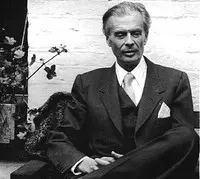
Aldous Huxley
Huxley interrogates the intricate balance between technological advancement and human freedom, a recurring theme throughout his literary career. His notable works, such as "Brave New World," vividly depict dystopian futures dominated by societal manipulation and technological control. Meanwhile, his final novel, "Island," provides a counterpoint by envisioning a utopian society that harmonizes scientific progress with individual autonomy. Huxley's exploration of these contrasting ideals demonstrates his commitment to examining the consequences of human innovation on society, for he was not just an author but also a philosopher who pondered the ethical implications of progress.\n\nBeyond his fiction, Huxley's non-fiction works delve into philosophical mysticism and consciousness. "The Doors of Perception" recounts his personal experiences with psychedelics, providing insights into altered states of mind, whereas "The Perennial Philosophy" synthesizes Eastern and Western spiritual traditions, revealing his dedication to understanding the universal truths underlying human existence. This philosophical inquiry extends his impact beyond literature, as his works invite readers to reflect on the intersection of science, spirituality, and society, offering profound insights into the human condition.\n\nReaders drawn to Huxley's writings benefit from his incisive critique of modernity and exploration of alternative ways of living. His bio serves as a testament to his intellectual versatility, while his books challenge readers to consider the potential and pitfalls of human progress. Recognized with nine Nobel Prize in Literature nominations and honored as a Companion of Literature by the Royal Society of Literature, Huxley's legacy endures, influencing thinkers and writers who grapple with similar existential questions today.
Read moreDownload PDF & EPUB
To save this Black List summary for later, download the free PDF and EPUB. You can print it out, or read offline at your convenience.

Eyeless in Gaza
by Aldous Huxley
