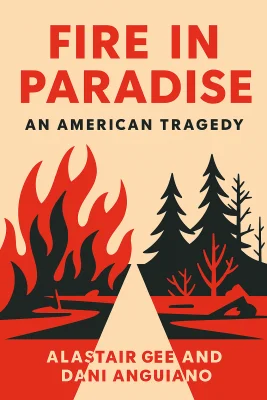
Fire in Paradise
An American Tragedy
Categories
Nonfiction, Science, History, Nature, Audiobook, True Crime, Adult, Historical, Environment, Survival
Content Type
Book
Binding
Hardcover
Year
2020
Publisher
W. W. Norton Company
Language
English
ISBN13
9781324005148
File Download
PDF | EPUB
Fire in Paradise Plot Summary
Introduction
At 8:30 on a November morning in 2018, John Sedwick knocked on his daughter's bedroom door in their century-old cabin on Paradise Ridge. "Fire's coming up over the ridge, Skye," he said, his voice calm but urgent. Outside their window, the California sky had turned an ominous red, and ash was beginning to fall like snow. Within hours, their entire world would be consumed by flames moving faster than anyone thought possible, transforming a thriving community of 27,000 into a scene of unimaginable devastation. The Camp Fire would become the deadliest wildfire in California's recorded history, claiming 85 lives and destroying over 18,000 structures in a single day. But beyond the statistics lies a deeper story of human resilience, community bonds, and the new reality we all face in an era of climate change. Through intimate portraits of survivors, first responders, and families torn apart by disaster, this book reveals how ordinary people respond when the unthinkable happens, and what their experiences teach us about courage, loss, and the strength we discover in our darkest moments. These are stories of heartbreak and heroism that illuminate not just what was lost, but what endures when everything else burns away.
Chapter 1: The Day Paradise Burned: When Fire Devoured a Town
The morning of November 8, 2018, began like any other for most residents of Paradise, California. Parents were getting children ready for school, retirees were sipping their morning coffee, and the autumn air carried the familiar scent of pine needles. But by 6:28 AM, everything changed when a PG&E supervisor spotted flames beneath a transmission line in the nearby canyon. Within minutes, what started as a small brush fire would explode into an unstoppable monster, racing toward the unsuspecting town at speeds that defied every prediction and emergency plan. Rachelle Sanders had given birth to her son Lincoln just twelve hours earlier at Feather River Hospital. Still immobile from her cesarean section, she watched in disbelief as nurses burst into her room announcing an immediate evacuation. Within moments, she found herself being wheeled to the parking lot with her newborn on her lap, loaded into a stranger's car as the hospital emptied around them. The scene repeated throughout Paradise as thousands of residents suddenly faced an impossible reality: their entire world was about to disappear in flames, and they had minutes to escape. Police Officer Rob Nichols had been directing traffic at a key intersection when he realized the magnitude of what was happening. Abandoned cars lined the streets, their occupants fleeing on foot as flames consumed everything around them. Power lines sparked and fell, propane tanks exploded like bombs, and the sky turned pitch black at midday. Nichols and other first responders made split-second decisions to shepherd hundreds of trapped residents into makeshift refuges, using fire trucks as shields against the advancing inferno while helicopters tried desperately to drop water through the choking smoke. Paradise had prepared for wildfire, but no one had imagined this. The fire moved with such ferocity that it created its own weather, spawning tornado-like vortexes of flame that lifted cars and threw burning debris miles ahead of the main blaze. In just hours, a thriving community with schools, businesses, and deep-rooted families was reduced to ash and twisted metal. The Camp Fire revealed a terrifying new reality: that in our changing climate, fires can move faster than evacuation plans, consuming entire towns before residents can even comprehend what's happening. It showed us that the unthinkable is now inevitable, and that our old assumptions about safety and preparedness may no longer be enough.
Chapter 2: Signs Unheeded: Climate Change and Infrastructure Failures
For decades before the Camp Fire, warning signs had been accumulating like dry kindling across California's landscape. Scientists documented rising temperatures, extended drought periods, and earlier snowmelt that left forests tinder-dry well into what used to be the rainy season. The state's fire season, once confined to a few months, had stretched into a year-round threat. Yet despite these clear indicators, the infrastructure carrying electricity through these increasingly dangerous conditions remained largely unchanged, aging steel towers and power lines threading through forests that were primed to explode. PG&E's transmission system told the story of deferred maintenance and calculated risks. The company had identified nearly sixty towers on the Caribou-Palermo line alone that needed replacement, some dating back over a century to California's early electrification. The tower that would ultimately fail on November 8th wasn't even on the priority list for upgrades. Corporate documents later revealed that PG&E executives were well aware their aging infrastructure posed wildfire risks, yet year after year, maintenance was delayed while billions in profits flowed to shareholders. The morning the Camp Fire ignited, weather conditions were extreme but not unprecedented. Red flag warnings had been issued, with winds gusting over 50 miles per hour and humidity dropping to dangerous lows. PG&E had begun implementing "public safety power shutoffs" in some areas, but the ancient Caribou-Palermo transmission line remained energized. At approximately 6:15 AM, a hook holding a high-voltage wire snapped under the strain of the wind, sending the cable to the ground where it sparked against the steel tower and ignited the drought-stressed vegetation below. The convergence of climate change and infrastructure failure at Paradise wasn't an accident waiting to happen, it was an inevitability that had been building for years. The fire revealed how our energy systems, designed for a stable climate, are fundamentally mismatched to the volatile conditions we now face. As extreme weather becomes the norm rather than the exception, the hidden vulnerabilities in the systems we depend on daily threaten to turn routine services into deadly hazards, transforming the very infrastructure meant to power our lives into the instrument of their destruction.
Chapter 3: Escape and Survival: Human Resilience in Catastrophe
When the evacuation sirens began wailing across Paradise, residents faced split-second decisions that would determine whether they lived or died. Christina Taft found herself in a devastating standoff with her mother Victoria, who insisted on waiting until noon to decide whether to leave. "Listen to the voice of reason," Christina pleaded one final time before making the agonizing choice to leave her mother behind. Victoria, a former Hollywood insider who had once rubbed shoulders with celebrities, couldn't grasp the urgency of the moment and remained in their home, methodically packing as if preparing for a routine trip. Meanwhile, Andrew Duran, a carpenter visiting his mother, made the opposite choice. When evacuation orders came, he sent his elderly mother to safety but stayed behind to defend her home with nothing but a garden hose. "You either got to shoot a gun or stab me for me to get concerned," he would later say. For hours, Duran battled the advancing flames alone, watching helplessly as his brother's van exploded and neighbor after neighbor's house ignited. When the water pressure finally failed, he realized even his stubborn determination couldn't stop what was coming. In Concow, Scott Carlin and his family found themselves trapped as fire surrounded Concow Lake. With flames consuming the shoreline and their escape routes cut off, they made a desperate decision to enter the frigid November water. Renee Carlin treaded water up to her neck, holding their autistic son Cody while trying to keep their panicked dog from drowning them both. The family spent hours in the lake, using overturned boats as shields from the burning embers falling around them like fiery snow, their survival dependent on the very water that threatened to freeze them to death. These stories reveal something profound about human nature under extreme duress. When faced with the unimaginable, people don't become paralyzed by fear, they become resourceful in ways they never knew possible. Some, like Christina, find the courage to make impossible choices. Others, like Andrew, discover reserves of determination that defy logic. And families like the Carlins learn that survival sometimes means accepting help from the most unexpected sources, even when hope seems lost. The Camp Fire showed that while we cannot always control the disasters that befall us, we can control how we respond, and that our capacity for both sacrifice and ingenuity emerges most powerfully when everything familiar burns away.
Chapter 4: The Aftermath: Displacement and Community Dispersal
In the days following the Camp Fire, the Walmart parking lot in Chico became an unlikely refugee camp. Andrew Duran, who had lost his mother's home despite his heroic efforts, found himself sleeping in a field of yellowed grass alongside dozens of other evacuees. Tents sprouted up between abandoned cars as families tried to create some semblance of shelter under the smoke-filled sky. The man who had fearlessly battled flames with a garden hose now faced a different kind of challenge: figuring out how to rebuild a life when everything familiar had vanished overnight. Rachelle Sanders, still recovering from childbirth, arrived at a hospital in Chico after eight harrowing hours of evacuation with her newborn son Lincoln. When she finally reached safety, the tears she had held back throughout the ordeal came flooding out. The nurses wrapped her in a pink robe and assured her that both she and Lincoln were okay, but the trauma of nearly losing her child in his first hours of life would stay with her forever. Like thousands of others, she now had to navigate the bewildering process of starting over while processing an experience that defied comprehension. The scale of displacement was staggering. More than 50,000 people had been forced from their homes, with most converging on Chico, a city of 90,000 that suddenly had to absorb more than half its population in evacuees. Hotels filled within hours, rental prices skyrocketed, and emergency shelters struggled to accommodate the endless stream of families arriving with nothing but the clothes on their backs. The Walmart became more than a parking lot; it became a community where people shared resources, information, and comfort as they tried to piece together what had happened to their neighbors and their town. The dispersal of Paradise's residents revealed how quickly a community can be scattered to the winds when disaster strikes. FEMA tracked evacuees who ended up in places as far-flung as Vermont, Puerto Rico, and Micronesia. Families were separated across state lines, children enrolled in new schools hundreds of miles away, and elderly residents found themselves in unfamiliar cities without the support networks that had sustained them for decades. The fire didn't just destroy buildings and landscapes; it shattered the invisible bonds that hold communities together, showing how modern disasters create ripple effects that spread far beyond the original site of destruction.
Chapter 5: Rebuilding Lives: Finding Hope Among the Ashes
Five months after the fire, Iris Natividad stood in what used to be the home she shared with her partner Andrew Downer for twenty-eight years. The lot had been cleared of debris, leaving only a blank expanse of dirt and a few skeletal trees. Gone was the collection of uranium glass that had caught Andrew's eye, the 80,000 marbles he had lovingly sorted, and the memories embedded in every antique they had rescued and restored together. "It doesn't even look like I live here," she whispered, staring at the concrete stain where Andrew had died waiting for help that never came. Yet in the midst of this devastation, small acts of resurrection began to appear. Paul Lyons reopened his oil change shop just weeks after the fire, becoming one of the first businesses to welcome residents back to Paradise. Despite losing his own home, he set out donuts and coffee for customers and found that people drove dozens of miles just to support him. "I guess I've always been the kid with the shovel," he said, "and I know there's a pony underneath that pile of horse manure." His faith in Paradise's future became a beacon for others struggling to envision life beyond the ash. Skye Sedwick, still grieving her father's death in their family cabin, found herself living in a FEMA trailer in an agricultural town hours away from everything she had ever known. The 300-square-foot space felt impossibly small after a lifetime in the mountains, and some days she couldn't bring herself to get out of bed. But gradually, she began to paint again, creating artwork that captured both her loss and her connection to the Ridge. When people asked about her plans, she had one clear answer: she would rebuild on her father's land, creating a fireproof home that honored both his memory and the lessons the fire had taught. The process of rebuilding revealed something remarkable about human resilience. It wasn't just about replacing what was lost, but about reimagining what was possible. People didn't simply want to recreate Paradise as it was; they wanted to build something better, safer, and more connected to the realities of their changing world. In therapy groups and community meetings, survivors shared not just their trauma but their visions for the future. They spoke of fireproof materials and defensible spaces, but also of closer relationships with neighbors and a deeper appreciation for the simple act of being alive. The fire had taken everything they owned, but it had also revealed what truly mattered, creating space for hope to grow in the most unlikely of places.
Chapter 6: Seeking Accountability: PG&E and Environmental Justice
Federal Judge William Alsup had spent years overseeing Pacific Gas & Electric's probation for previous safety violations, but nothing had prepared him for the scale of devastation he witnessed in Paradise. Standing in a courtroom filled with fire attorneys, regulators, and survivors, he didn't mince words: "PG&E is starting these fires." His voice carried the weight of someone who had seen too many preventable tragedies unfold due to corporate negligence. The company's pattern of deferred maintenance and prioritizing shareholder profits over public safety had finally resulted in the deadliest consequence imaginable. The evidence was damning. Internal documents revealed that PG&E executives knew their aging transmission system was "dangerously outdated," with some towers over a century old and well past their intended lifespan. The Caribou-Palermo line alone had nearly sixty towers in need of replacement, yet the company had delayed upgrades for years while paying billions in dividends to shareholders. When Judge Alsup asked why the company couldn't reduce wildfire risk to zero, PG&E lawyers argued that such safety measures would be impossibly expensive, a response that rang hollow to families who had lost everything. The legal reckoning was swift and unprecedented. Thousands of Camp Fire victims filed lawsuits, forcing PG&E into bankruptcy for the second time in eighteen years. The company ultimately agreed to pay $13.5 billion to individual victims and hundreds of millions more to affected communities. For Paradise alone, the settlement of $270 million guaranteed the town could survive financially, replacing the tax base that had been reduced to ash. Yet money couldn't restore the 85 lives lost or undo the trauma that would haunt survivors for years to come. The fight for accountability revealed deeper questions about environmental justice and corporate responsibility in an era of climate change. As extreme weather becomes more frequent and severe, the hidden vulnerabilities in aging infrastructure threaten to turn everyday conveniences into deadly hazards. The Camp Fire showed that when companies prioritize profits over public safety, the consequences fall not on executives in boardrooms but on vulnerable communities living in harm's way. True justice requires not just financial compensation for past harm, but fundamental changes to ensure that essential services protect rather than endanger the communities they serve, creating systems resilient enough to handle the challenges of our rapidly changing world.
Chapter 7: The New Normal: Climate Adaptation in Fire-Prone Regions
Two years after Paradise burned, the question wasn't whether another catastrophic fire would strike California, but when and where. The 2019 Kincade Fire in Sonoma County, also sparked by PG&E equipment, forced the evacuation of 200,000 people. Across the state, utilities began implementing widespread power shutoffs during dangerous weather conditions, leaving millions without electricity for days at a time. What had once seemed unthinkable in modern America, entire regions going dark to prevent fires, had become routine. The infrastructure that powered the California Dream was revealing itself to be incompatible with California's climate reality. For those brave enough to return to Paradise, rebuilding meant confronting this new normal head-on. The town required all new construction to meet strict fire-safe standards: metal roofs, ember-resistant vents, and defensible space cleared of flammable vegetation. PG&E committed to burying power lines underground, a process that would take decades and cost tens of billions of dollars. Emergency planners redesigned evacuation routes and communication systems, though they acknowledged that no infrastructure could handle the simultaneous evacuation of an entire region if conditions were severe enough. Ken Pimlott, the former head of Cal Fire, understood the stakes better than most. Building his own home in the fire-prone Sierra foothills, he implemented every safety measure possible: fire-resistant materials, multiple escape routes, and a private water reservoir for protection. Yet even with all these precautions, he harbored no illusions. "I guarantee there will be another fire out there," he said, watching the horizon for smoke each day. His approach represented the kind of clear-eyed realism required to live safely in the new California: accepting risk while doing everything possible to minimize it. The transformation of Paradise from a quiet retirement community to a laboratory for climate adaptation reflects a broader shift happening across the American West. Communities that once felt insulated from environmental threats are discovering that geography alone can no longer protect them. The new normal requires not just better technology and planning, but a fundamental change in how we think about risk and resilience. It demands that we build not just for the climate we remember, but for the climate we're creating, designing communities that can bend without breaking when faced with forces beyond our control. Paradise's story is ultimately about more than one town's tragedy and recovery; it's a preview of the choices all communities will face as the effects of climate change intensify.
Summary
The Camp Fire that destroyed Paradise in 2018 marked a turning point in our understanding of wildfire, climate change, and community resilience. Through the stories of John Sedwick's final heroic stand, Iris Natividad's journey through grief and recovery, and hundreds of other residents who faced impossible choices, we see how ordinary people respond when the unthinkable becomes reality. Their experiences reveal that while we cannot prevent every disaster, we can choose how we prepare for them, how we support each other through them, and how we build back better in their aftermath. The lessons from Paradise extend far beyond fire-prone regions to every community facing the accelerating impacts of climate change. The fire showed us that our aging infrastructure is increasingly mismatched to extreme weather, that emergency plans must account for worst-case scenarios, and that true resilience comes not from technology alone but from the strength of human connections. Most importantly, it demonstrated that even in our darkest moments, people find ways to care for each other, to rebuild what was lost, and to create hope where none seemed possible. Paradise may have burned, but the spirit of its people, their determination to support one another and face an uncertain future with courage, offers a blueprint for how all of us can navigate the challenges ahead.
Best Quote
“She looked up. The horizon was red but the entire rest of the sky was black--it was hypnotic and beautiful and very, very wrong. She jogged the rest of the way to her daughter's, spilling the remaining tea, and said: "We have to get out of here.” ― Dani Anguiano, Fire in Paradise: An American Tragedy
Review Summary
Strengths: The review highlights the book's compelling narrative, particularly the vivid descriptions and personal survivor stories, which are considered the book's strength. The authors, Alastair Gee and Dani Anguiano, are praised for their outstanding work in capturing the emotional depth and various perspectives, including those of first responders and political leaders. The inclusion of broader themes such as climate change and PG&E's role adds depth to the narrative. Overall: The review conveys a deeply emotional and personal connection to the book, reflecting on the tragedy of the Paradise fire. The reader finds the book to be heartbreaking yet essential, recommending it highly for its raw and riveting portrayal of the event.
About Author

Alastair Gee
Gee delves into the complexities of social issues and environmental disasters through his investigative journalism. As the Guardian US homelessness editor, he has honed a focus on the systemic challenges surrounding homelessness in America, a theme that permeates much of his editorial work. His background, including degrees from Cambridge University and experience in international reporting in Moscow, provides him with a robust framework for exploring these multifaceted topics. Therefore, his work is not only informative but also pivotal in shaping public discourse on these pressing issues.\n\nIn his literary contributions, Gee has authored and co-authored books that reflect his investigative acumen. His book, "Fire in Paradise: An American Tragedy," co-authored and published in 2020, delves into the catastrophic US wildfire, positioning him as a significant chronicler of environmental calamities and their human impact. Meanwhile, his articles have appeared in prestigious publications like The New York Times and The New Yorker online, showcasing his diverse writing skills and commitment to impactful storytelling. This bio underscores his role in raising awareness about critical social and environmental concerns.\n\nReaders of Gee's work benefit from his insightful analysis and comprehensive reporting. His journalism not only informs but also challenges readers to engage with complex realities, offering a deeper understanding of the societal structures and natural events that shape our world. As a recognized journalist and Falling Walls fellow, Gee continues to contribute meaningfully to both national and international conversations, making his work essential reading for those interested in the intersection of social justice and environmental sustainability.
Read moreDownload PDF & EPUB
To save this Black List summary for later, download the free PDF and EPUB. You can print it out, or read offline at your convenience.
Fire in Paradise
by Alastair Gee
