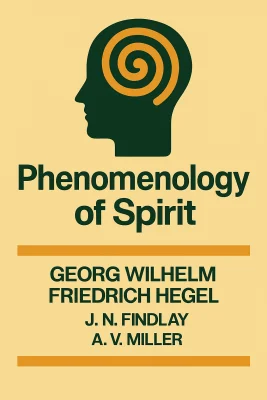
Phenomenology of Spirit
Categories
Nonfiction, Psychology, Philosophy, History, Politics, Classics, German Literature, 19th Century, Theory, Metaphysics
Content Type
Book
Binding
Paperback
Year
1976
Publisher
Oxford University Press
Language
English
ASIN
0198245971
ISBN
0198245971
ISBN13
9780198245971
File Download
PDF | EPUB
Phenomenology of Spirit Plot Summary
Introduction
# The Phenomenology of Spirit: Consciousness to Absolute Knowledge How does human consciousness evolve from its most basic sensory experiences to the highest forms of self-knowledge and spiritual understanding? This fundamental question drives one of philosophy's most ambitious systematic explorations of the mind's development through increasingly complex stages of awareness and recognition. The work presents a comprehensive theoretical framework that reveals consciousness not as a static faculty but as a dynamic, dialectical process that must work through contradictions and limitations to achieve genuine self-understanding. This phenomenological approach demonstrates how individual consciousness necessarily develops through specific stages, each building upon and transcending the previous one, ultimately recognizing itself as both subject and object of knowledge. The analysis shows how personal development and collective human understanding are interconnected aspects of a single spiritual reality, offering profound insights into the nature of freedom, recognition, and the relationship between individual identity and universal truth.
Chapter 1: From Sense-Certainty to Understanding: The Objective Dialectic
The journey of consciousness begins at its most elementary level with what appears to be the most reliable form of knowledge: immediate sensory experience. This initial stage, known as sense-certainty, represents consciousness's naive confidence that it possesses the richest and most concrete knowledge when it directly encounters objects through the senses. The mind believes it can simply point to something present and declare "this is here" or "this is now," assuming such immediate awareness provides unmediated access to truth. However, this apparent certainty quickly reveals its fundamental limitations through careful examination. When consciousness attempts to articulate what it knows with such confidence, it discovers that language necessarily involves universal concepts rather than pure particulars. The "this" that seemed to capture a unique object actually applies to any object, while the "now" that appeared to grasp a singular moment flows endlessly into other moments. What seemed most concrete and particular dissolves into abstract universality, revealing that even the most basic knowledge involves conceptual structures. This internal contradiction forces consciousness to advance to perception, where it recognizes objects as complex things possessing multiple properties and existing in relationships with other objects. A piece of salt, for instance, is simultaneously white, cubic, sharp-tasting, and cohesive. Perception attempts to reconcile the unity of the thing with the multiplicity of its properties, but encounters new contradictions as it oscillates between viewing objects as simple unities and as collections of distinct qualities. The failure of perception to provide stable knowledge drives consciousness toward understanding, which seeks to grasp the underlying forces and laws that govern appearances. Understanding recognizes that the perceived world points toward something deeper: a supersensible realm of forces operating according to universal laws. Yet this inner world proves empty when separated from the appearances it supposedly explains, leading to the crucial recognition that the truth lies not in some hidden realm but in grasping the self-contradictory nature of phenomena themselves. This progression illustrates the dialectical principle that apparent failures become productive moments driving consciousness forward. Each stage contributes essential insights while revealing its own limitations, preparing consciousness for the recognition that the truth of objectivity ultimately lies in subjectivity itself. The movement from immediate certainty through perceptual complexity to conceptual understanding demonstrates that genuine knowledge emerges through working with and beyond contradictions rather than avoiding them.
Chapter 2: Self-Consciousness and the Master-Slave Recognition Dynamic
The transition to self-consciousness marks a revolutionary shift where consciousness discovers that its true object is itself rather than external things. This reflexive structure creates a new form of certainty based on self-awareness, but this certainty remains abstract until it achieves concrete realization through encounter with other self-conscious beings. Self-consciousness cannot simply assert its own reality; it must prove and establish its freedom through relationships with others who are equally free and self-aware. Initially, self-consciousness manifests as desire, attempting to confirm its reality by negating and consuming external objects. Through desire, consciousness seeks to demonstrate its primacy over the external world, showing that things exist merely for its satisfaction. However, this strategy proves inadequate because lifeless objects cannot provide the recognition that self-consciousness truly requires. Only another self-conscious being can offer the acknowledgment that validates one's freedom and self-sufficiency. The encounter between self-consciousnesses creates the famous master-slave dialectic, beginning with a life-and-death struggle where each seeks recognition while refusing to grant it to the other. This struggle is not motivated by material needs but by the spiritual requirement for acknowledgment of one's freedom. Each consciousness must demonstrate its willingness to risk everything for recognition, proving that it values freedom more than mere biological existence. The outcome establishes an asymmetrical relationship where one becomes master and the other slave. The master appears to achieve the desired recognition and independence, enjoying the fruits of the slave's labor without engaging in productive work. The slave, having chosen life over freedom, seems trapped in dependence and self-negation. However, the dialectical development reveals that this apparent resolution contains its own contradictions that will ultimately reverse the relationship. The master's recognition proves worthless because it comes from someone who is not recognized as free and equal. Recognition from a non-free being cannot validate one's own freedom, making the master dependent on the slave's acknowledgment and labor. Meanwhile, the slave undergoes profound transformation through fear, service, and work. The fear of death creates genuine self-consciousness by forcing recognition of finitude and dependence, while labor develops skills, discipline, and creative power that provide authentic self-recognition. This reversal demonstrates that genuine freedom cannot be achieved through domination but only through the development of one's capacities and the recognition of mutual interdependence. The master-slave relationship represents a necessary but unstable stage pointing toward more adequate forms of recognition based on reciprocity and mutual respect rather than domination and submission.
Chapter 3: Reason as Observer and Active Self-Realization
Reason emerges when consciousness recognizes its fundamental unity with reality, discovering that the rational structure of thought corresponds to the rational structure of the world itself. This stage represents a new confidence in consciousness's capacity for knowledge, based on the insight that reality is inherently intelligible and that consciousness possesses the ability to comprehend this intelligibility completely. Reason approaches the world not as something alien but as something it can understand because both share a common rational foundation. Observing reason initially seeks to discover itself in the external world through systematic scientific investigation. This scientific consciousness examines natural phenomena with the expectation of finding rational laws and structures that mirror its own rational activity. It develops increasingly sophisticated methods for understanding physical processes, organic systems, and even attempts to find consciousness reflected in external phenomena through disciplines like phrenology, which claims to read character from skull shape. However, observing reason encounters fundamental limitations when it treats consciousness as merely another object among objects rather than recognizing its unique status as the source of objectivity itself. The attempt to reduce human reality to natural categories fails because human beings involve freedom, purpose, and meaning in ways that transcend purely natural determination. This recognition forces reason to move beyond passive observation toward active engagement with reality. Active reason begins with various attempts at individual self-realization, from hedonistic pleasure-seeking through moral idealism to the pursuit of virtue. Each strategy seeks to actualize reason's certainty that it is all reality, but each fails because it remains trapped within an individualistic framework that cannot adequately account for the social nature of consciousness. The pursuit of individual satisfaction encounters the resistance of necessity, while moral idealism struggles with the gap between intention and achievement. The resolution emerges through the recognition that rational self-consciousness is inherently social and that individual reason achieves its truth only through participation in a community of rational beings. This insight transforms the entire framework, revealing that reason discovers itself as all reality not as isolated individual consciousness but as the universal structure of spiritual life that manifests through the interactions of free, rational beings. The movement from observational to active reason reflects the broader pattern of human development from trying to understand the world as it is toward recognizing our responsibility to participate in making it what it ought to be. This transition marks the emergence of ethical consciousness and the recognition that reason involves not just theoretical understanding but practical engagement with social and political reality.
Chapter 4: Spirit in Ethical Life and Cultural Formation
Spirit represents consciousness that has moved beyond individual self-concern to recognize itself as part of a larger social and historical reality. In immediate ethical life, this takes the form of natural identification with the customs, laws, and institutions of one's community. Individuals understand themselves primarily through their social roles and relationships, finding meaning and purpose through participation in shared practices and traditions that embody the community's spiritual substance. This stage achieves remarkable harmony between individual fulfillment and social integration. People naturally act in accordance with ethical norms because these norms express their own deepest nature as social beings shaped by and finding identity within ethical communities. The conflict between personal desire and social duty largely disappears because individuals have internalized the values and practices that constitute their social world. This represents a form of beautiful ethical life where duty and inclination coincide. However, this immediate ethical harmony proves unstable as individuals develop greater self-awareness and begin to question traditional authorities. The emergence of individual conscience and personal moral reasoning creates tension with established customs and institutions, leading to the breakdown of immediate ethical life. This dissolution is not mere decay but a necessary stage in the development toward more sophisticated forms of social organization based on explicit laws and individual rights. Cultural formation represents the complex process through which spirit develops through this breakdown and reconstruction of social life. Individuals must now navigate between their particular interests and universal principles, learning to act as both private persons pursuing personal goals and citizens committed to common welfare. This creates new possibilities for freedom and self-development, but also new forms of alienation and conflict as people struggle to integrate their various roles and commitments. The process involves ongoing negotiation between individual autonomy and social solidarity, requiring institutions that can evolve and adapt while maintaining their capacity to provide meaning and direction. Modern societies must find ways to preserve the benefits of ethical life while accommodating individual freedom and moral development. This tension drives the continued development of spirit through various forms of cultural and political organization. The framework illuminates how healthy communities balance individual freedom with social cohesion, showing that genuine ethical life emerges not through the suppression of individuality but through the creation of institutions and practices that enable individual development to contribute to collective flourishing. This insight remains crucial for understanding contemporary challenges in building sustainable democratic societies.
Chapter 5: Religion and the Path to Absolute Knowing
Religion emerges as consciousness seeks to understand its relationship to the absolute reality that underlies all particular experiences and relationships. Religious consciousness recognizes that finite human existence points beyond itself toward something infinite and eternal that gives ultimate meaning and purpose to the whole of reality. This represents consciousness's attempt to grasp the fundamental ground of its own existence and development, moving beyond the limitations of finite understanding. Initially, religion takes the form of immediate feeling or intuition of the divine, often expressed through natural symbols, artistic representations, and ritual practices. These early forms of religious consciousness capture important truths about the spiritual nature of reality but remain limited by their dependence on particular cultural expressions and their inability to articulate their insights in adequate conceptual form. They rely on imagery, narrative, and symbolic representation rather than clear conceptual understanding. The development of religion involves progressive clarification of the relationship between finite and infinite, human and divine consciousness. This process moves through various stages, from natural religions that identify the divine with natural forces, through art-religion that represents the divine in beautiful forms, to revealed religion that recognizes the divine as spirit. Each stage contributes essential insights while pointing toward more adequate forms of religious understanding. The culmination comes with the recognition that absolute spirit is not something separate from human consciousness but rather the ultimate truth of consciousness itself. The divine is revealed not as an external object or distant authority but as the very process through which consciousness develops toward complete self-understanding. This insight transforms the entire relationship between human and divine, showing that religious experience properly understood represents not escape from rational inquiry but its fulfillment. Absolute knowing represents the final stage where consciousness recognizes itself as the movement of spirit coming to know itself through the entire journey of development. At this point, the distinction between subject and object, finite and infinite, human and divine is overcome not through elimination but through recognition of their essential unity within the self-developing process of absolute spirit. This framework provides a comprehensive account of how human consciousness relates to ultimate questions of meaning, purpose, and truth, showing that genuine religious insight and philosophical understanding ultimately converge in the recognition that absolute reality has the structure of self-conscious spirit achieving complete self-transparency through finite consciousness.
Chapter 6: Freedom, Reconciliation and the Dialectical Method
The dialectical method reveals how consciousness progresses through the systematic resolution of internal contradictions rather than through simple accumulation of information or external compulsion. Each stage of development contains tensions that cannot be resolved within its own terms, forcing movement toward more comprehensive forms of understanding. This process follows the internal logic of consciousness's own development, showing that genuine solutions emerge through working with contradictions rather than avoiding them. Freedom develops through this dialectical process as consciousness recognizes that it is not bound by external authorities or natural limitations but is capable of determining its own nature and destiny. However, genuine freedom proves to be not arbitrary choice or pure negativity but the capacity to act in accordance with rational principles that consciousness both discovers and creates. True freedom emerges through the recognition of necessity as the rational structure that makes freedom possible. The concept of reconciliation becomes crucial as consciousness learns to recognize itself in what initially appeared as its opposite or enemy. This recognition transforms both parties in any relationship, creating new possibilities for cooperation and mutual development that were not available from either original position. Reconciliation does not eliminate differences but creates frameworks within which differences can be productive rather than destructive. Forgiveness represents a crucial breakthrough in this development, as consciousness recognizes its own fallibility and extends the same understanding to others. This capacity proves essential for moving beyond cycles of blame and retaliation toward relationships based on mutual recognition and support. Forgiveness creates space for transformation and growth beyond past failures while not ignoring the reality of wrongdoing. The dialectical method shows how apparent opposites often prove to be necessarily related moments in a larger development. Individual and universal, freedom and necessity, particular and general achieve their truth not through one-sided assertion but through recognition of their essential interconnection. This insight provides a framework for understanding how genuine solutions to human problems emerge through creative engagement with contradiction. These insights illuminate the conditions necessary for healthy relationships, communities, and political institutions, showing how genuine peace and cooperation emerge not through the elimination of conflict but through the development of capacities for recognition, forgiveness, and creative engagement with difference. The framework offers guidance for addressing contemporary challenges from personal relationships to international conflicts through processes that honor both human freedom and rational principles.
Summary
The complete journey of consciousness reveals that genuine knowledge emerges not through passive reception but through active engagement with contradictions inherent in any particular perspective, ultimately leading to the recognition that absolute knowledge is consciousness's complete understanding of its own nature as the very process through which reality achieves self-awareness. This comprehensive framework offers profound insights into human experience, knowledge, and freedom that remain vital for understanding contemporary challenges in education, politics, and personal development. By tracing consciousness's necessary development through stages of increasing self-understanding, the work provides a roadmap for both individual growth and social transformation that honors human freedom while recognizing the rational structure underlying all genuine development and the essential interconnectedness of individual and universal consciousness.
Best Quote
“It is solely by risking life that freedom is obtained; . . . the individual who has not staked his or her life may, no doubt, be recognized as a Person; but he or she has not attained the truth of this recognition as an independent self-consciousness.” ― Georg Wilhelm Friedrich Hegel, Phenomenology of Spirit
Review Summary
Strengths: The review highlights Georg Hegel's debut novel as a thrilling and complex narrative, praised for its masterful storytelling and dynamic character development. The book is noted for its exploration of philosophical themes, such as religious fanaticism and systematic racism, and its ability to synthesize diverse perspectives. Weaknesses: The reviewer criticizes the book's challenging syntax and inhospitable style, which detracted from their enjoyment. They found the narrative implausible and struggled with the dense philosophical content, suggesting that personal enjoyment may not be a suitable criterion for evaluating this work. Overall: The reader acknowledges Hegel's philosophical contributions, particularly in advancing concepts of mediation and totality, but expresses difficulty in engaging with the book. The recommendation level is low for those seeking pleasure in reading, but it may hold value for those interested in philosophical advancements.
About Author

Georg Wilhelm Friedrich Hegel
Hegel reframes the understanding of reality through his philosophy of absolute idealism, where he delves into the dialectical unfolding of the Absolute. His method focuses on resolving contradictions through synthesis, which he applied to various domains such as ethics, government, and religion. Influenced by Kant's transcendental idealism and Rousseau's politics, Hegel's dialectical process, often simplified as thesis–antithesis–synthesis, goes beyond simple resolution, offering a comprehensive system for interpreting historical and rational development. In works like "Phenomenology of Spirit," Hegel maps the evolution of consciousness and reason, illustrating how the human spirit comes to know itself in the context of history.\n\nWhile his intricate system challenges readers, it provides profound insights into the nature of freedom and historical progress. For students of philosophy and political theory, Hegel's exploration of the unity of opposites and the integration of nature, mind, and spirit offers a valuable framework for understanding complex social and philosophical issues. His ideas have significantly influenced continental philosophy, including postmodernism, and were notably transformed by Karl Marx into a materialist ideology. This bio captures Hegel’s impact, emphasizing his role as a pivotal figure in German Idealism and his enduring influence on philosophical thought.\n\nHegel's intellectual journey included significant academic appointments, most notably as the chair of philosophy at the University of Berlin, which was a testament to his esteemed status in the field. His major books, such as the "Science of Logic" and "Philosophy of Right," continue to be essential reading for those interested in the philosophical underpinnings of modern society. Though he received no formal awards during his lifetime, his legacy as a philosopher is firmly established, and his work remains a cornerstone for scholars exploring the intersections of history, consciousness, and reality.
Read moreDownload PDF & EPUB
To save this Black List summary for later, download the free PDF and EPUB. You can print it out, or read offline at your convenience.
Phenomenology of Spirit
by Georg Wilhelm Friedrich Hegel
