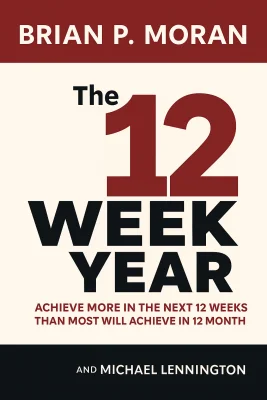
The 12 Week Year
Categories
Business, Nonfiction, Self Help, Psychology, Leadership, Productivity, Audiobook, Management, Personal Development, Buisness
Content Type
Book
Binding
Nook
Year
2009
Publisher
SB Press LLC.
Language
English
ASIN
B0DM8VNDGW
File Download
PDF | EPUB
The 12 Week Year Plot Summary
Introduction
Have you ever wondered why some people seem to accomplish extraordinary things while others struggle to reach their potential? The difference isn't talent, luck, or even hard work—it's execution. Most of us live two lives: the one we're currently living and the one we're truly capable of living. The gap between these two lives isn't bridged by new ideas, better connections, or more knowledge. It's bridged by consistent, focused action on what matters most. Traditional annual planning creates a dangerous illusion of time abundance. When December feels eleven months away, urgency dissolves into procrastination. But what if you could harness the energy and focus of year-end pushes throughout the entire year? What if every week counted as much as a month, and every day carried the weight of a week? This fundamental shift in thinking transforms not just your timeline, but your entire approach to achievement, creating breakthrough results in a fraction of the time.
Chapter 1: Redefine Time: Why 12 Weeks Equals a Year
The calendar year is your enemy. This might sound shocking, but annual thinking breeds complacency and dilutes urgency. When you believe you have twelve months to achieve your goals, you unconsciously give yourself permission to postpone the critical actions that drive results. By March, you're slightly behind but not worried—after all, there are still nine months left. This pattern continues until November, when panic sets in and you scramble to salvage the year. Consider Ann Laufman, a financial advisor with Mass Mutual in Houston who had always performed well but felt capable of more. When her firm introduced the 12 Week Year system, everything changed. Ann didn't start working with more affluent clients or expand her target market. Instead, she focused on consistently executing the same activities she'd always known were important—but now with relentless focus over 12-week periods. The result was a 400 percent increase in production, making her the first female associate of the year in the company's 103-year history. Ann's transformation happened because she escaped annualized thinking. In a 12-week year, you can't afford more than one or two bad weeks and still achieve greatness. This reality forces you to confront your execution daily and weekly, where real performance actually occurs. The arbitrary deadline of December 31st is replaced by a much nearer finish line that maintains constant urgency. The magic of 12 weeks lies in periodization—a concept borrowed from athletic training where athletes focus intensively on one skill for 4-6 weeks before moving to the next. This concentrated effort maximizes capacity development. In business and life, 12 weeks provides enough time to accomplish meaningful goals while maintaining the urgency needed for consistent action. Every 12 weeks, you get the excitement of a fresh start. If you've had a challenging period, you can regroup and begin again without waiting for an arbitrary calendar year to end. If you've succeeded, you can build momentum into the next cycle. This creates four opportunities annually to celebrate progress and reset your trajectory. Remember that breakthrough results don't happen at the finish line—they're created in the daily moments when you choose growth over comfort. The 12 Week Year brings this truth into sharp focus, making every day count toward your ultimate vision.
Chapter 2: Create a Compelling Vision That Drives Action
Vision is not soft and fluffy—it's the ignition switch of high performance. Without a compelling reason to push through discomfort, you'll default to comfort every time. The most important actions are often the uncomfortable ones, and your vision provides the emotional fuel needed to choose growth over ease. This is why vision must be personally meaningful, not just professionally appealing. Sal Durso learned this lesson powerfully when his financial services firm lost key advisors and their revenue. Rather than playing victim to circumstances, Sal turned to his vision during a reflective trip to Alaska. While rafting the Kennicott River, he witnessed a mountainside covered in purple "fireweed"—nature's first sign of regeneration after a forest fire. This moment crystallized his vision for rebuilding his company stronger than before, providing the emotional anchor needed to guide difficult decisions and inspire his remaining team. The fireweed became a metaphor for Sal's vision of organizational renewal. He spent weeks talking with team members about what made their firm unique and what they wanted for the future. This vision-crafting process created shared ownership and direction that carried them through uncertainty. One year later, everyone agreed the firm was better because of what they'd endured and built together. Your brain actually changes when you regularly connect with a compelling vision. The prefrontal cortex—the part responsible for planning and goal pursuit—strengthens when you imagine greatness for yourself. Conversely, the amygdala, which resists uncertainty and change, can hijack your progress if you don't intentionally engage your vision regularly. To craft an effective vision, start with what you want your life to look like in all areas—spiritual, relational, physical, financial, and professional. Your business vision should align with and enable your personal vision, creating emotional traction. Ask yourself: What legacy do you want to create? What level of freedom and fulfillment do you seek? Get specific with numbers, timelines, and vivid details. Share your vision with others to increase accountability, keep it visible daily, and update it as it becomes more clear and compelling. Most importantly, connect your daily actions to your long-term vision through your 12-week goals and plans. When the work gets difficult, reconnect with your vision to remember why the temporary discomfort is worth the lasting transformation.
Chapter 3: Build Your Strategic 12 Week Plan
A vision without a plan is merely a dream, but a well-crafted plan transforms dreams into step-by-step reality. Most annual plans fail because they're too vague, too numerous, and too distant from daily action. Twelve-week planning eliminates these problems by creating laser focus on the critical few activities that drive breakthrough results. Patrick Morin discovered this power when facing a seemingly impossible challenge. His healthcare startup had been struggling to raise capital for six months, burning through internal resources and testing everyone's patience. The economic climate was dismal, and investors were scarce. In early July, Patrick gathered his team for a crucial meeting where they committed to completing their Private Placement Memorandum and raising funding within 12 weeks—or face the company's demise. Using the battle cry "every day is a week," Patrick's team finished their 100-page document in the first week. They got legal approval in the second week and immediately shifted to intensive investor outreach. By focusing on just one critical outcome with specific weekly actions, they created unprecedented momentum. The energy became infectious, drawing attention from investors, employees, and board members alike. On October 10th, exactly within their 12-week window, they closed their first funding round. The success extended beyond the immediate goal—the company's new cadence of focused execution became their standard operating procedure for all future projects. This demonstrates how 12-week planning creates sustainable high performance, not just one-time wins. Effective 12-week plans start with specific, measurable goals that represent meaningful progress toward your vision. Each goal should be both realistic and a stretch—achievable but requiring your best effort. Break down each goal into tactics: specific, actionable steps with clear deadlines and assigned accountability. Your tactics must be executable as written, starting with action verbs and containing enough detail that anyone could complete them. Focus on the minimum number of tactics needed to achieve your goal—resist the temptation to include every possible action. Remember, you're trying to be great at a few things, not mediocre at many. Before finalizing your plan, honestly assess what will be most challenging to execute and prepare strategies to overcome those obstacles. The best plans acknowledge difficulty upfront and build in support structures for success.
Chapter 4: Master Execution Through Weekly Control
Having a brilliant plan means nothing without consistent execution, and execution requires structure that makes following through easier than giving up. This is where process control becomes essential—creating tools and routines that support your success even when willpower wavers. Lezlee Liljenberg discovered this when she implemented weekly accountability meetings with her team. Initially, each team member focused on a specific area of interest with clear action plans. But the real breakthrough came when they used their weekly check-ins to examine how they actually spent their days. By evaluating weekly achievements and time allocation patterns, they identified massive time drains and low-value activities that were masquerading as important work. This weekly assessment process revealed tasks that consumed enormous time while producing minimal return on investment. Armed with this data, Lezlee's team made tough decisions to eliminate activities that weren't worth the effort. The weekly meetings kept everyone focused on high-impact actions and prevented drift back into busy but unproductive patterns. The team discovered that abandoning annual thinking created healthy urgency—they had to hit numbers quickly, and their weekly accountability meetings became the mechanism for maintaining that focus. As Lezlee noted, the leader's responsibility is ensuring the team stays on track with their vision and plan, and weekly meetings provided the perfect forum for course corrections. Your weekly routine should include three essential steps: score your previous week's execution, plan the upcoming week's priorities, and participate in a Weekly Accountability Meeting with peers. This isn't about punishment or consequences—it's about creating transparency and mutual support for consistent action. Your weekly plan translates your 12-week strategy into immediate actions. It's not a glorified to-do list but rather the critical strategic activities needed this week to stay on track with your goals. Spend 15-20 minutes each Monday morning reviewing the previous week and preparing for the current one. Don't attempt this transformation alone. Research shows that peer support increases success rates by up to seven times. Form a group of 2-4 committed individuals who meet weekly to report progress, share challenges, and encourage consistent execution. The power isn't in holding each other accountable—it's in fostering individual accountability through collective support and shared commitment to excellence.
Chapter 5: Measure What Matters: Accountability and Tracking
Measurement is the anchor of reality in execution. Without objective feedback, you're flying blind, unable to distinguish between effective and ineffective actions. Sports are inherently motivating because we constantly keep score—imagine watching a game where nobody tracked points, time, or statistics. The same principle applies to personal and professional achievement. Adam Black exemplified this when he created a simple daily measurement system for his key activities. As a Type A personality who sometimes missed important details, Adam used the 12 Week Year to slow down and systematically track what mattered most. He created a visual 12-week calendar that tracked both his daily lead indicators—prospecting calls and client meetings—and his lag indicators—revenue and units sold. Every evening, Adam knew exactly where he stood relative to his 12-week goals. This daily clarity eliminated guesswork and created immediate feedback loops for course correction. The result was a 65 percent increase in both unit and dollar volume, qualifying him as a Top Producer and earning him a coveted company reward trip. Adam's success demonstrates that measurement doesn't need complexity to drive results—it needs consistency and relevance. His simple tracking system connected daily actions to ultimate outcomes, making every day's efforts feel significant and purposeful. The most critical measurement is your weekly execution score—the percentage of planned tactics you actually completed. This lead indicator is more valuable than any result metric because you control your actions more than your outcomes. If you consistently execute 85 percent or more of your planned tactics weekly, you'll almost certainly achieve your 12-week goals. Track both lead indicators—the activities that drive results—and lag indicators—the end results themselves. For weight loss, lead indicators might include daily workouts and calorie intake, while lag indicators include pounds lost and body fat percentage. This combination provides comprehensive feedback for intelligent decision-making. Be prepared for productive tension—the uncomfortable feeling when your scores reveal execution gaps. This discomfort is valuable feedback, not failure. You can either eliminate the tension by abandoning measurement or use it as fuel for better execution. High performers choose the latter, leveraging productive tension as motivation for consistent action toward their most important goals.
Chapter 6: Take Ownership of Your Results and Commitments
Accountability is not consequences—it's ownership. This fundamental misunderstanding keeps most people trapped in victim thinking, waiting for external circumstances to change before they can achieve their goals. True accountability means recognizing that while you don't control circumstances, you absolutely control your responses to them. Danny Fuentes learned this lesson when technical difficulties prevented him from accessing the 12 Week Year system for ten days. With the holidays approaching, he felt behind before even starting and noticed himself falling into old excuse-making patterns. The delayed access seemed like a perfect justification for postponing his commitment to change. But Danny caught himself in this victim thinking and realized that after 23 years in his profession, he'd been telling himself he deserved not to do the difficult but necessary activities. The external obstacle—system access issues—was just another excuse in a long pattern of avoiding uncomfortable growth actions. Danny's breakthrough came when he accepted complete ownership of his success or failure, regardless of circumstances. He recognized that if he wasn't willing to maintain daily discipline, nothing would change and his vision would remain just a dream. This shift from blame to ownership transformed his entire approach to challenges. This mirrors the story of Dustin Carter, who as a young boy lost both arms and both legs to a rare blood disease. Faced with perhaps the ultimate excuse for limitation, Dustin instead chose wrestling—one of the most physically demanding sports imaginable. Through relentless training and ownership of his choices, he became a highly accomplished wrestler and inspiration to millions. True accountability requires four key actions: resolve never to be a victim again, stop feeling sorry for yourself, willingly take different actions to create different results, and associate with other accountable people who model ownership thinking. Focus on what you control—your thinking and your actions—rather than what you cannot control. Every situation offers choices, even if those choices aren't particularly attractive. The quality of your choices determines the quality of your life, and recognizing your power to choose is the foundation of personal freedom and achievement.
Chapter 7: Implement Your First 12 Weeks Successfully
Your first 12 weeks will determine whether this becomes a life-changing system or another abandoned initiative. Success requires full engagement from day one, not cautious experimentation. Casey Johnson learned this the hard way when he initially dabbled with the concepts without full commitment and saw minimal improvement. Three months later, with results well below his capabilities, Casey hired a coach and committed to full engagement with the system. He set a meaningful stretch goal focused on driving weekly business-building activities: asking for referrals in every client meeting and conducting six face-to-face sales calls weekly. More importantly, he built the habits of weekly planning and honest self-scoring. Casey's transformation was remarkable. During his first 12 weeks of full engagement, he established the execution habits that would drive long-term success. By his second 12 weeks, he had closed more business than in the previous year and a half combined. He became the fourth-ranked agent nationally in his experience category—a dramatic leap from not even appearing on the previous year's top performer list. Casey's breakthrough happened because he learned to value his time as a precious, limited resource with real opportunity costs. Every moment not spent on high-value activities now felt like lost money and progress. This shift in thinking, combined with consistent execution, created exponential results. Structure your first 12 weeks in three four-week phases. Weeks 1-4 focus on fast starts and establishing the weekly routine of planning, scoring, and participating in Weekly Accountability Meetings. These foundational practices must become habitual before you can achieve consistent high performance. Weeks 5-8 represent the crucial middle phase where initial enthusiasm may wane but the end still seems distant. This is when many people abandon new systems, so recommit to the process even if results aren't yet obvious. Focus on improving your execution scores toward the 85 percent threshold. Weeks 9-12 are your opportunity to finish strong, regardless of whether you're ahead of or behind your goal pace. Finishing strong builds confidence and momentum for future cycles while demonstrating that you can sustain focus through completion. Use week 13 for celebration, reflection, and planning your next 12-week cycle.
Summary
The gap between the life you're living and the life you're capable of living isn't bridged by new ideas, better circumstances, or more time—it's closed by consistent execution of what you already know matters most. As Thomas Edison observed, "If we did the things we are capable of doing, we would literally astound ourselves." The 12 Week Year provides the structure, urgency, and accountability needed to finally act on your capabilities rather than just dream about them. By redefining your year as 12 weeks, you create sustainable urgency that transforms every day into a meaningful opportunity for progress. Combined with compelling vision, strategic planning, process control, measurement, and personal accountability, you have everything needed to achieve more in the next 12 weeks than most people accomplish in 12 months. Stop waiting for perfect conditions and start where you stand—greatness is created in the moment you choose to do what needs to be done, regardless of how you feel.
Best Quote
“It’s not enough to be busy; so are the ants. The question is: What are we busy about?” —Henry David Thoreau” ― Brian P. Moran, The 12 Week Year: Get More Done in 12 Weeks than Others Do in 12 Months
Review Summary
Strengths: The book serves as a motivational tool to encourage productivity under tight schedules. It offers practical tips for individuals with straightforward tasks, such as sales representatives needing to make calls, to avoid procrastination and achieve goals. Weaknesses: The book is criticized for being oversimplified and repetitive. It lacks utility for those with complex, unpredictable work situations or multiple responsibilities. The approach may not be helpful for those who need guidance on identifying actionable steps toward their goals. Overall: The reader finds the book to be a basic motivational resource that may inspire some to develop personal planning systems. However, it is not recommended for those seeking comprehensive strategies for complex or unstable work environments.
About Author

Brian P. Moran
Moran extends his influence in the productivity field by championing the "12 Week Year" methodology, where execution is prioritized over mere idea generation. This approach transforms annual goals into manageable 12-week cycles, fostering a heightened sense of urgency and commitment. His work, particularly in "The 12 Week Year: Get More Done in 12 Weeks than Others Do in 12 Months", demonstrates that focused execution within a shorter timeframe can significantly enhance efficiency and goal attainment, providing a robust framework for both personal and organizational success.\n\nHis career, marked by leadership roles in major corporations like UPS and PepsiCo, informs his pragmatic and motivational style. Moran’s method involves strategic goal implementation, empowering clients like Tiffany & Co. and New York Life to optimize performance through disciplined execution. His focus on actionable strategies rather than abstract ideas resonates with those seeking tangible results, positioning him as a sought-after consultant and speaker in the corporate world.\n\nFor readers and professionals eager to boost their productivity, Moran's book and bio offer valuable insights. By adopting his disciplined approach, individuals and teams can achieve more in less time, making it an essential read for those aiming to refine their strategic execution skills. Recognized as a New York Times bestselling author, Moran’s contributions to leadership literature are substantial, offering transformative techniques that shift focus from planning to impactful execution.
Read moreDownload PDF & EPUB
To save this Black List summary for later, download the free PDF and EPUB. You can print it out, or read offline at your convenience.
The 12 Week Year
by Brian P. Moran
