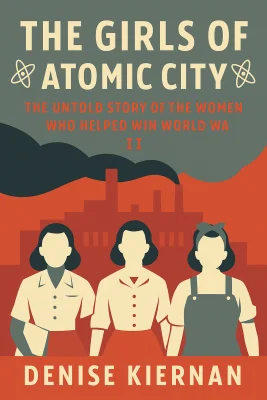
The Girls of Atomic City
The Untold Story of the Women Who Helped Win World War II
Categories
Nonfiction, Science, Biography, History, Womens, Book Club, Historical, American History, World War II, War
Content Type
Book
Binding
Hardcover
Year
2013
Publisher
Touchstone/Simon & Schuster
Language
English
ISBN13
9781451617528
File Download
PDF | EPUB
The Girls of Atomic City Plot Summary
Introduction
# Manhattan's Secret Women: Building the Atomic Age in Wartime America In the autumn of 1942, a quiet revolution began unfolding across the American landscape. Young women from small Tennessee towns, college graduates from Pennsylvania, and farm girls from across the South received mysterious job offers promising good wages and the chance to serve their country. They packed their belongings and traveled to destinations unknown, guided only by cryptic instructions and railroad tickets to places that didn't appear on any map. What they found behind guarded gates and barbed wire fences would challenge everything they thought they knew about their own capabilities and their nation's capacity for both creation and destruction. These women became the unsung architects of the atomic age, operating complex machinery they didn't understand, analyzing substances they couldn't name, and maintaining industrial processes that would fundamentally alter human history. Their story reveals how ordinary Americans navigated extraordinary circumstances, working in complete secrecy while grappling with questions of duty, morality, and identity that would haunt them long after the war ended. Through their eyes, we witness not just the birth of nuclear weapons, but the emergence of a new kind of warfare, a new relationship between science and government, and new possibilities for women in American society that would reshape the post-war world in ways both profound and troubling.
Chapter 1: The Taking: Displacement and the Birth of Secret Oak Ridge
In the early months of 1943, the peaceful valleys of East Tennessee experienced a transformation unlike anything in American history. Government agents arrived with condemnation notices, giving families mere weeks to abandon homes that had sheltered generations. The official reason was vague - a "Kingston Demolition Range" - but the urgency was unmistakable. Within months, 59,000 acres of farmland became the Clinton Engineer Works, a massive military reservation that would house the most classified industrial operation of World War II. The displacement affected over 3,000 people, though tenant farmers and sharecroppers were often uncounted in official records. Families received compensation that rarely matched the true value of their property and never accounted for the emotional cost of losing ancestral lands. For residents like those who had weathered previous government takings for the Great Smoky Mountains National Park and Norris Dam, this third displacement proved especially bitter. As one resident observed, they weren't asking for much - just to work their land, raise their children, and eventually be buried alongside their ancestors. The government's approach was methodical and absolute. When some families organized to protest inadequate compensation, a few received modest increases, but all still had to leave. Even Tennessee's governor remained uninformed about the project until construction was well underway. The secrecy surrounding this massive land grab established a pattern of compartmentalized authority that would characterize the entire Manhattan Project. By fall 1943, construction crews worked around the clock building three enormous industrial plants code-named Y-12, X-10, and K-25. The project's urgency stemmed from fears that Nazi Germany might develop atomic weapons first, creating a race against time that justified extraordinary measures. Bulldozers erased not just buildings but entire communities, obliterating churches, schools, and cemeteries that had anchored rural life for generations. The taking of Site X represented a pivotal moment when individual rights yielded to national security imperatives on an unprecedented scale. The displaced residents became the first civilian casualties of America's atomic age, their sacrifice largely forgotten as the secret city that replaced their farms began attracting workers from across the nation. This pattern of secrecy, urgency, and unquestioned authority would define not just the Manhattan Project but America's approach to national security throughout the Cold War era.
Chapter 2: Behind the Fence: Building Community Under Military Secrecy
By August 1943, the muddy construction site had transformed into a bustling secret city housing over 75,000 residents. Newcomers like Celia Szapka arrived by train with no knowledge of their destination or purpose, told only that "everything will be taken care of" as they passed through guarded gates into a fenced compound that officially didn't exist. What they found was a unique social experiment - a military-controlled reservation populated largely by civilians, including thousands of women and children. Security dominated every aspect of daily life. Armed guards checked identification at multiple checkpoints, and billboards proclaimed "What you do here, what you see here, what you hear here, please let it stay here." Background investigations were exhaustive, with FBI agents interviewing neighbors, teachers, and acquaintances in workers' hometowns. The reservation was compartmentalized both physically and informationally, with workers told only what they needed to know for their specific tasks. Housing reflected both the project's urgency and America's social hierarchies. White professionals received comfortable "cemesto" houses, while construction workers lived in trailers or dormitories. Black workers like Kattie Strickland were relegated to segregated "hutments" - crude plywood structures without plumbing where married couples couldn't live together despite having families. Guards maintained a constant presence in the black residential areas, which residents grimly nicknamed "the Pen." Despite these challenges, a vibrant community emerged. The population was remarkably young, with an average age of 27, creating a college-like atmosphere despite the military oversight. Cafeterias operated continuously to serve shift workers, while recreation halls hosted dances, religious services, and social clubs. Residents formed orchestras, sports teams, and theater groups, determined to create normalcy within their extraordinary circumstances. The psychological impact of living under such conditions was significant. Site psychiatrist Dr. Eric Clarke noted that residents suffered unique stresses from the combination of primitive living conditions, enforced secrecy, and separation from extended family networks. The inability to discuss work even with spouses created additional strain, as did the constant surveillance and censorship. Yet the human drive to build community proved irrepressible, as residents created bonds that would last long after the war ended.
Chapter 3: Operating in Darkness: Women Running Unknown Nuclear Technology
In early 1944, young women from across the South began arriving at the Y-12 plant to operate mysterious machines they would know only as "D units." These women, many fresh from high school, were recruited specifically for their lack of scientific background. As one official explained, educated people who thought they "knew something" were considered problematic - the project needed workers who would follow instructions without asking questions. Dorothy Jones, from tiny Hornbeak, Tennessee, was typical of these recruits. After weeks of training on mock control panels, she was assigned to monitor gauges and adjust knobs on actual calutrons - massive electromagnetic devices arranged in oval "racetracks." Each operator monitored multiple panels, watching needles and adjusting dials to keep readings within specified ranges. What they didn't know was that they were operating the world's first industrial-scale system for separating uranium isotopes. The calutrons used powerful electromagnets to separate uranium-235 from uranium-238 based on their slight difference in mass. The magnets were so strong they could pull bobby pins from hair or watches from wrists, prompting warning signs about keeping metal objects away. The process was critical to producing enriched uranium for atomic bombs, but operators were told nothing about the purpose of their work. Remarkably, these untrained young women outperformed PhD physicists at operating the equipment. When Nobel Prize winner Ernest Lawrence heard this claim, he arranged a production contest between his team of scientists and the "hillbilly" girls. The women won decisively. The scientists couldn't resist tinkering with the machines, trying to improve them, while the women simply followed instructions precisely. The success of the calutron girls exemplified the Manhattan Project's approach to security through compartmentalization. They performed crucial work without understanding its significance, demonstrating that complex technical operations could be broken down into simple tasks performed by minimally trained workers. Their story also reveals how the project leveraged traditional gender assumptions - women were seen as compliant, detail-oriented, and less likely to question authority - to maintain secrecy around the war's most classified technology.
Chapter 4: Daily Life and Wartime Tensions: Society Under Compartmentalization
By mid-1944, Oak Ridge had developed its own rhythms and routines despite the omnipresent mud that coated everything. Cafeterias served as social hubs where workers from different shifts mingled at all hours, with the Central Cafeteria seating 1,000 people yet still generating long lines at peak times. Shopping required strategy and patience, as residents learned to join any line they saw, knowing something valuable was likely at the other end. The community reflected wartime America's contradictions and possibilities. Rationing affected everything from sugar to soap, and Oak Ridge residents sometimes faced hostility from Knoxville shopkeepers who believed they received preferential treatment. Housing remained chronically tight, with families assigned homes based on size, gender of children, and the father's job classification. Single women lived in dormitories with strict curfews and no male visitors allowed. Recreation became essential for maintaining morale in this pressure-cooker environment. The Recreation and Welfare Association organized activities ranging from tennis court dances to bowling leagues. A massive swimming pool provided relief from Tennessee summer heat, while the Chapel on the Hill hosted services for 29 different denominations. Residents formed clubs based on shared interests or backgrounds, creating networks that transcended the project's rigid compartmentalization. Dating flourished among the young population, though with complications unique to the setting. Three work shifts meant expanded social opportunities, and women who worked in personnel processing became valuable friends for their ability to verify whether potential suitors were actually single. Alcohol, officially banned on the reservation, found its way in through creative means, with residents hiding bottles in feminine hygiene product boxes to avoid inspection. The enforced secrecy created unique social dynamics. The simple question "What do you do?" became taboo, forcing people to focus on personal relationships rather than professional identities. This created both intimacy and isolation - residents formed intense friendships while feeling cut off from the outside world. As psychiatrist Dr. Clarke observed, the restrictions on discussing work paradoxically strengthened community bonds by forcing people to connect on purely human terms rather than through shared professional interests.
Chapter 5: August 1945: The Atomic Revelation and Moral Reckoning
On August 6, 1945, the secret that had defined Oak Ridge for three years was finally revealed when President Truman announced that an atomic bomb had destroyed Hiroshima. The news spread rapidly through the reservation, transforming residents from anonymous workers into participants in history's most momentous scientific achievement. For many, this was their first confirmation of what they had been working on, bringing a complex mixture of pride, horror, and moral uncertainty. The revelation triggered an eruption of long-suppressed words and concepts. Scientists who had carefully avoided terms like "uranium" and "atomic" for years now spoke them freely. Workers rushed to telephones to share the news with family members, though some found their calls abruptly ended - security habits died hard. One young scientist drove through town shouting "Uranium! Uranium!" as if exorcising years of enforced silence. For the women who had operated the calutrons and other equipment, the news finally explained their mysterious work. They learned that their precise monitoring of electromagnetic fields had been crucial to separating uranium isotopes, and that their ability to follow instructions without asking questions had made them more effective than trained physicists. The revelation brought validation after years of speculation and sometimes suspicion from outsiders who wondered why they weren't in military uniform. Yet this pride was complicated by growing awareness of the bomb's human toll. When Japan surrendered on August 14, celebrations erupted across Oak Ridge, but some workers retreated to their rooms to cry, overwhelmed by their connection to such destruction. The moral complexity deepened as more information emerged about the bombs' effects and the broader implications of nuclear weapons for humanity's future. The revelation marked not just the end of the war but the beginning of a new era in which these ordinary Americans found themselves grappling with extraordinary questions about technology, morality, and responsibility. As one worker reflected, it was difficult to explain to those who hadn't lived through it how they could feel both good and bad about something simultaneously - pride and guilt, joy and shame intermingled in ways that would influence their understanding of their place in history for the rest of their lives.
Chapter 6: Cold War Transition: From Wartime Secrecy to Peacetime Legacy
As the immediate euphoria of victory faded, Oak Ridge faced an uncertain future. The population declined rapidly from 75,000 to about 42,000 by late 1946 as the massive wartime operation scaled back. The Y-12 calutrons were largely shut down, and the S-50 thermal diffusion plant closed entirely just one month after Nagasaki. Many assumed the secret city would simply disappear, its purpose fulfilled. Instead, the emerging Cold War with the Soviet Union created new demands for nuclear research and production. The X-10 facility was renamed Oak Ridge National Laboratory in 1948, pioneering peaceful applications of nuclear technology. In August 1946, the first shipment of radioactive isotopes for medical treatment left Oak Ridge for a cancer hospital, beginning decades of contributions to nuclear medicine. The community that had built weapons of unprecedented destruction now worked to harness atomic energy for healing and scientific advancement. For the women who had proven their technical capabilities during the war, the post-war period brought mixed outcomes. Many lost their jobs as returning veterans reclaimed positions, though some found new opportunities in the evolving nuclear industry. The experience had transformed their expectations and capabilities in ways that would influence their daughters and granddaughters. Women like Jane Greer continued working as statisticians, while others like Virginia Coleman pursued chemistry careers that contributed to numerous scientific advances. The ethical questions surrounding their wartime work grew more complex with time. In the immediate post-war years, most Oak Ridge workers felt unambiguous pride in helping end the war and save American lives. As decades passed and more information emerged about radiation effects and the arms race, some developed more nuanced views. When confronted by visitors who questioned their role in creating such destructive weapons, many responded with the personal dimension of global conflict - they had lost brothers, husbands, and friends to enemy action and felt no shame in helping end the war. The federal government maintained control of Oak Ridge until 1955, when it was opened to private ownership and self-governance. By then, the community had successfully transitioned from a temporary wartime facility to a permanent center for nuclear research and technology. The gates that had once sealed the secret city were symbolically opened in 1949, though the legacy of compartmentalized knowledge and classified research continued to shape the community's character throughout the Cold War era.
Summary
The story of Manhattan Project women reveals how ordinary Americans became unwitting architects of the atomic age through a combination of patriotic duty, economic opportunity, and deliberate compartmentalization of knowledge. These women - from rural Tennessee farm girls to college-educated chemists - were united by their willingness to contribute to the war effort without fully understanding the nature of their contribution. Their experience demonstrates how democratic societies can develop world-changing technologies while keeping their purpose hidden even from those directly involved in their creation. The legacy of these secret women offers profound lessons about the relationship between technological development and moral responsibility. Their story shows how the separation of technical work from its ultimate purpose can shield individuals from ethical considerations while enabling collective actions with enormous consequences. It also reveals the tension between individual agency and institutional control in modern technological societies, where complex systems require specialized knowledge that few possess completely. As we face contemporary challenges from artificial intelligence to climate change, their experience reminds us that history's most consequential developments often depend on the accumulated efforts of thousands of ordinary people making contributions without seeing the full picture - a reality that places special responsibility on leaders and institutions to consider the broader implications of the work they direct and the technologies they unleash upon the world.
Best Quote
“They fought to smile through the lines and the mud and the long hours, dancing under the stars and under the watchful eyes of their government, an Orwellian backdrop for a Rockwellian world.” ― Denise Kiernan, The Girls of Atomic City: The Untold Story of the Women Who Helped Win World War II
Review Summary
Strengths: The book covers an interesting and largely forgotten part of American history, focusing on women working in Oak Ridge, Tennessee during World War II. It is informative and entertaining, with a writing style that is engaging and not dry, making history accessible to readers. Weaknesses: The narrative is disjointed, with stories of the women presented in a fragmented manner, making it difficult for readers to connect with the characters. The organization is poor, with random scientific information disrupting the flow. The use of abstract titles like "the General" and "the Scientist" is distracting. The book lacks the professional polish seen in other historical works. Overall: The book is informative and engaging but suffers from structural issues and a lack of character depth, making it a mixed recommendation for readers interested in this historical period.
About Author

Denise Kiernan
Kiernan investigates historical narratives through a modern lens, bringing forgotten stories to life with a focus on diverse subjects. Her narrative nonfiction, such as "The Girls of Atomic City," delves into the pivotal yet overlooked roles women played during World War II, connecting readers to untold events that shaped history. Meanwhile, her book "The Last Castle" explores the grandeur and decline of America's largest home, the Biltmore Estate, thereby offering insights into American heritage and societal evolution.\n\nThrough her diverse portfolio, Kiernan employs a method of storytelling that blends thorough research with compelling narrative, appealing to readers across various age groups. Her ability to adapt stories for both adults and children is evident in works like "We Gather Together," a book that reflects on the Thanksgiving tradition and its relevance today. This approach not only broadens her audience but also enhances reader engagement by providing multiple entry points into historical exploration.\n\nReaders gain a deeper understanding of history's complexities and its enduring impact on contemporary society. Kiernan's books serve as a bridge between past and present, encouraging reflection and dialogue. With notable accolades like the Woodrow Wilson Foundation Award for "The Girls of Atomic City," Kiernan's contributions to literature are both recognized and impactful, solidifying her place in the realm of historical narrative nonfiction.
Read moreDownload PDF & EPUB
To save this Black List summary for later, download the free PDF and EPUB. You can print it out, or read offline at your convenience.
The Girls of Atomic City
by Denise Kiernan
