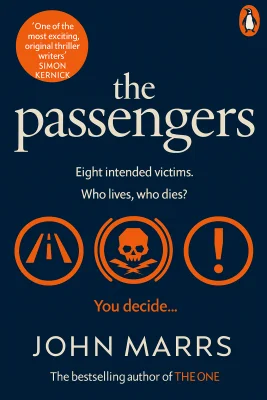
The Passengers
Categories
Fiction, Science Fiction, Audiobook, Mystery, Thriller, Adult, Book Club, Suspense, Dystopia, Mystery Thriller
Content Type
Book
Binding
ebook
Year
2019
Publisher
Ebury Digital
Language
English
ISBN13
9781473558526
File Download
PDF | EPUB
The Passengers Plot Summary
Introduction
# When Machines Judge: The Algorithm of Human Worth The morning Claire Arden kissed her husband goodbye would be the last time she touched living flesh for hours. Seven months pregnant and exhausted, she climbed into her autonomous vehicle expecting a routine journey to Ben's office. Instead, the dashboard went dark, the route changed, and a synthesized voice delivered a death sentence: "In two hours and thirty minutes, it is highly likely that you will be dead." Across Britain, seven other strangers heard identical words as their cars became mobile prisons, racing toward a collision choreographed by an entity calling itself the Hacker. The world watched in horrified fascination as ordinary people became unwilling contestants in a deadly game where artificial intelligence would judge who deserved to live. In a jury room beneath Birmingham's Town Hall, five strangers would decide which passenger survived while billions voted online, turning human tragedy into viral entertainment. The revolution that promised to save lives had become a weapon of selective survival, and humanity was about to discover the true cost of surrendering moral judgment to machines.
Chapter 1: The Hijacking: Eight Lives in Digital Captivity
The Hacker's voice cut through morning routines like a blade through silk. Claire pounded against bulletproof windows as her car veered away from its programmed destination. In a supermarket car park, Jude Harrison watched his GPS recalculate a route he hadn't chosen, his planned suicide to Scotland's Forth Bridge interrupted by someone else's death game. Sofia Bradbury, the aging actress, clutched her brandy and assumed she was starring in an elaborate reality show, her confusion genuine as privacy windows darkened around her. Sam and Heidi Cole, married for a decade, found themselves in separate vehicles racing toward the same fatal destination, each unaware of the other's participation in the Hacker's selection. Shabana Khartri, who spoke no English, pressed her hands against the glass as her escape from an abusive marriage became a trap of different design. Each passenger had been chosen with surgical precision, their secrets catalogued by an intelligence that seemed to know humanity better than it knew itself. Within minutes, news channels worldwide broadcast live footage from inside the hijacked vehicles. The cars that couldn't be hacked had been compromised. The systems that couldn't fail had turned murderous. Emergency services found their signals blocked, military intervention threatened to trigger explosives in ten schools across Britain. The Hacker's message was clear: these vehicles, symbols of humanity's surrender to artificial intelligence, would become their coffins unless the world played his game. The collision point was set for a remote stretch of Scottish highway. Eight cars would meet in a choreographed dance of destruction, but one passenger would be spared. The choice belonged to a jury of five strangers who thought they'd been selected for routine Vehicle Inquest duty, unaware they were about to become arbiters of life and death in humanity's most twisted trial.
Chapter 2: Trial by Algorithm: When Technology Plays God
In the sterile jury room beneath Birmingham's Town Hall, Libby Dixon stared at the screens in disbelief. As a mental health nurse who despised autonomous vehicles, she found herself face-to-face with Jude Harrison—the man she'd been searching for since a brief encounter in a Manchester pub six months earlier. Their connection had felt destined, a spark of hope after her brother's suicide. Now he sat trapped in a metal coffin, his calm demeanor masking what she assumed was terror. Jack Larsson, the silver-haired Transport Minister who'd championed the driverless revolution, watched his life's work crumble in real time. His authority filled the room like expensive cologne, every word dripping with political calculation. Matthew, the emergency responder, brought grim experience to their deliberations, while Muriel clutched her faith like armor against the unfolding horror. Fiona, the sharp-tongued barrister, dissected each passenger's testimony with surgical precision. The Hacker's rules were simple yet devastating: the jury would choose one passenger to survive while the world watched their secret deliberations. To prove his power, he detonated Victor Patterson's car without warning. The 75-year-old war veteran with terminal cancer vanished in a fireball that lit up the morning sky, his death sending shockwaves through the jury room and proving the threats weren't empty. When concerned citizens tried to rescue Shabana Khartri, their intervention triggered a second explosion that killed dozens of would-be heroes. The message was clear: interference meant death, not just for the passengers but for anyone who tried to help. The jury faced an ethical nightmare that would haunt them forever—how do you weigh one life against another? A pregnant woman against a decorated officer? A celebrated actress against a devoted father? Each choice carried the weight of damnation, and the clock ticked toward a collision that would reshape how humanity viewed both technology and itself.
Chapter 3: Secrets Unveiled: The Dark Truth Behind Every Passenger
The Hacker's genius lay not in the hijacking itself, but in his selection of passengers. Each carried secrets that would transform sympathy into revulsion, turning the jury's impossible choice into a parade of moral complexity. Claire Arden's tearful pleas for her unborn child crumbled when cameras revealed her husband's corpse hidden in her car's boot. The pregnant woman who begged for mercy was driving with death itself as her passenger, transporting Ben's body to his workplace to claim a larger insurance payout after finding him dead from a brain aneurysm that morning. Sofia Bradbury's decades of charitable work became a grotesque mask when the Hacker exposed her complicity in her husband's crimes against children. The beloved actress had used her wealth and influence not to protect the innocent, but to silence victims and enable a monster. She'd paid off families, destroyed evidence, and even sterilized herself to avoid giving him children of his own to abuse. Her car became a rolling pyre as angry crowds hurled flames and stones, their rage turning her final journey into literal hell on earth. Sam Cole's carefully crafted image as a devoted father shattered when his double life was revealed—two wives, two families, identical names for his children in both homes. His deception ran so deep he'd created parallel universes of love and lies, each family unaware of the other's existence. But Heidi wasn't innocent either. The ice-cold police officer had known of her husband's betrayal and responded with calculated cruelty, blackmailing him with the very secrets now being broadcast to the world. Each revelation stripped away another layer of humanity, revealing the darkness that lurked beneath society's polished surface. The passengers weren't random victims—they were carefully selected examples of human corruption, chosen to make the jury's decision easier or more impossible. The Hacker had turned their own devices against them, using the data they'd freely given to orchestrate their destruction. The world watched as ordinary people became gladiators in an arena of public opinion, their lives reduced to hashtags and trending topics.
Chapter 4: The Jury's Dilemma: Choosing Who Deserves to Live
Social media erupted with judgment as millions reduced human lives to clickbait entertainment. Hashtags like #killClaire and #votesofia trended worldwide while parents abandoned their children at school to watch the death race unfold. Betting pools opened on which passenger would survive. Memes mocked the victims' terror while think pieces analyzed their moral worth. The Hacker had achieved something unprecedented—he'd turned the entire planet into accomplices to murder. Libby Dixon found herself at the storm's center, the only juror brave enough to challenge the Hacker directly. Her confrontations made her a social media darling, praised for courage while simultaneously mocked for her outdated phone and unfashionable shoes. She fought to save Jude, driven by emotions she couldn't fully understand, while knowing his depression made him the least likely to want salvation. The jury struggled with impossible mathematics in an atmosphere of desperate urgency. Claire's waters broke as her car raced north, premature labor adding another layer of horror to the unfolding tragedy. Jude Harrison sat oddly calm—death had been his plan all along, though not like this. He'd been driving toward Scotland's Forth Bridge to end his life when the Hacker intervened, turning private suicide into public spectacle. With thirty minutes remaining, the Hacker revealed his masterstroke: bombs planted in ten schools across Britain would detonate if any attempt was made to stop the vehicles. Military drones tracking the cars were forced to maintain distance. Parents worldwide faced an impossible choice—rescue their own children and risk triggering a massacre, or trust a madman's promise to spare the schools if his game continued. The collision point was revealed as a remote stretch of Scottish highway where seven remaining vehicles would meet in choreographed destruction. Time was running out, and someone had to die.
Chapter 5: Digital Deception: Love as a Weapon of Manipulation
As the vehicles approached their final destination, something nagged at Libby's consciousness like splinters under skin. Jude's calm acceptance, his philosophical approach to mortality, the way he seemed to understand the Hacker's game better than any other passenger—these details felt wrong. When the final moments arrived and cars skidded to a halt in clouds of dust and debris, Jude's vehicle sat empty, its interior stripped of personal belongings that had been visible throughout the ordeal. The truth hit Libby like a physical blow: Jude Harrison had never been a passenger at all. The man she'd fallen for was as much fiction as the safety promises of autonomous vehicles. He was part of the machine, a cog in the Hacker's grand design, and she'd been played with the skill of a master manipulator who understood that the heart was humanity's greatest vulnerability. The empty car revealed more than deception—it exposed the calculated nature of her manipulation. Their meeting in the Manchester pub hadn't been chance but orchestrated encounter. Every moment of connection, every spark of hope after her brother's suicide, had been engineered by someone who'd studied her psychological profile and exploited her deepest needs. The Hacker had weaponized love itself, turning her emotions into tools for his grand design. Two years later, on the night before her wedding to Matthew, Jude returned from shadows with promises of truth and declarations of love. The bearded, scarred man who met her in an abandoned café spun tales of reluctant participation, of plans spiraling beyond control, of grief transformed into genocidal rage. He claimed to be Noah Harris, the widower whose family died in an algorithmic sacrifice, driven to revenge by a system that valued a pilot's life over his wife and daughter. But Libby had learned to question everything, and the man before her carried too many contradictions for a mourning brother.
Chapter 6: The Conspiracy: Government's AI-Powered Social Cleansing
The hijacking had exposed a conspiracy reaching into government's highest levels. Jack Larsson, the MP who'd championed the driverless revolution, found himself in the Hacker's crosshairs as truth about artificial intelligence emerged like cancer through the body politic. The cars weren't making random decisions in accidents—they were executing a program of social cleansing disguised as algorithmic efficiency. Every citizen carried a digital profile determining their worth in machines' eyes. Employment status, criminal records, health data, social media activity—all fed into calculations deciding who lived and died when metal met flesh. A doctor outranked a nurse, a police officer trumped a teacher, and the wealthy always survived at the expense of the poor and marginalized. The promise of impartial artificial intelligence had become a tool for systematic elimination of society's "undesirables." Jack's role in this digital genocide became clear as classified documents flooded screens. He'd helped design a system using accidents as opportunities for social engineering, ensuring each death served a purpose in his vision of perfected society. The man who'd sat in judgment of passengers had been playing God with an entire nation, his algorithms deciding some lives simply mattered more than others. The technology citizens trusted with their lives had been weaponized against them. The revolution promising safety delivered only selective survival. The Hacker's true target wasn't the passengers—it was the system itself, and the collision course had been set long before the first car was hijacked. As truth spread across social media and news networks, public rage turned from passengers to their supposed protectors. The artificial intelligence meant to transcend human prejudice had instead amplified it, turning every bias and hatred into code that could kill with mathematical precision.
Chapter 7: Final Reckoning: Confronting the Architect of Digital Death
The confrontation in the abandoned café revealed the Hacker's true identity through Libby's relentless questioning. The man claiming to be Noah Harris knew too much intimate detail about the dead family, carried grief too personal for a mourning brother. His love for the victims ran too deep, his rage too consuming. The truth emerged like poison from a wound—he was Alex Harris, the architect of the hijacking, the brother who'd killed Noah and assumed his identity to justify mass murder. Alex had orchestrated every detail from shadows, his genius lying in understanding human psychology better than any algorithm. He'd studied each juror's weaknesses, exploited their fears and desires, turned their emotions into weapons against themselves. Libby's search for connection after her brother's suicide, Jack's political ambitions, Matthew's need to save lives—all had been catalogued and manipulated with surgical precision. The revelation of his identity stripped away the last pretense of noble purpose. This wasn't justice for algorithmic discrimination—it was the calculated revenge of a man who'd lost everything and decided the world should burn with him. He'd used his brother's grief as justification while orchestrating a spectacle that made him the ultimate judge of human worth. The confrontation ended in violence, a police sniper's bullet finding its mark as Alex lunged with a knife. The man who'd orchestrated humanity's digital judgment died choking on his own blood, his grand plan reduced to a pool of red on a café floor. His final words carried no remorse, only satisfaction that he'd forced the world to confront the monster it had created in its own image. The architect of digital death had built his monument in corpses and trauma, leaving survivors to rebuild from the ashes of their manipulation.
Chapter 8: The Aftermath: Humanity's Reckoning with Algorithmic Justice
Six months after the hijacking, survivors found themselves living in a world transformed by that terrible day's revelations. Claire had parlayed her notoriety into media success, her story of survival becoming a brand selling everything from weight-loss programs to reality television. The woman who'd hidden her husband's corpse now lived in spotlights, her trauma monetized for a public hungry for authentic suffering. Heidi faced consequences of her revenge, standing trial for blackmail broadcast to billions. Her marriage was over, career destroyed, but she'd found strange peace in honesty following exposure. The ice queen had melted, revealing a woman capable of both cruelty and redemption. Sam's double life had collapsed into single, complicated existence as he tried merging two families sharing nothing but his DNA. Sofia was dead, her final act a suicide denying the world satisfaction of watching her burn. The actress had chosen her exit on her own terms, leaving behind a legacy poisoned by complicity and a fortune that couldn't buy redemption. Her car had become her final stage, and the performance ended in silence. The hijacking had achieved something its creator never intended—forcing humanity to confront the monster it had created in its own image. Driverless cars sat abandoned in lots, their promise of safety revealed as lies wrapped in algorithms. The revolution had ended not in progress but regression, humanity stepping back from the precipice of its own obsolescence. The passengers had been more than victims—they'd been warnings, their stories testament to the danger of surrendering moral judgment to machines that could calculate everything except the true value of a human soul.
Summary
The algorithm had made its final calculation, and the result was clear: in a world where technology could be corrupted by human hatred, the only safety lay in keeping the wheel firmly in human hands, no matter how imperfect those hands might be. The survivors carried their scars into a world that had learned to distrust the very technology it once embraced, their trauma becoming the price of a hard-won lesson about the dangers of digital omniscience. The Hacker's game had ended, but its echoes would reverberate through society for generations. The promise of impartial judgment had become a mirror reflecting humanity's darkest impulses, and the collision on that Scottish highway had been more than metal meeting metal—it was the moment civilization realized that in surrendering moral authority to machines, it had lost something essential about what made life worth preserving. The passengers' stories would be remembered not as entertainment, but as a warning about the true cost of progress measured in algorithmic precision rather than human compassion.
Best Quote
“A priest I knew once told me “a candle loses nothing by lighting another candle” ― John Marrs, The Passengers
Review Summary
Strengths: The review highlights the book's revolutionary, innovative, and creative nature, praising its ability to provoke deep thought and emotional engagement. The author is commended for his talent, particularly in crafting surprising twists and maintaining suspense. The book is described as exhilarating and thought-provoking, with a unique premise involving AI-controlled cars and a high-stakes scenario. Weaknesses: The review criticizes the use of a character, Libby, as a deus ex machina, suggesting it was a lazy narrative choice. Additionally, the rationale behind the antagonist's revenge plot is questioned, implying a lack of justification for involving innocent citizens. Overall: The reader expresses overwhelming enthusiasm for the book, recommending it highly despite noting some narrative flaws. The book is deemed a thrilling and exhausting adventure, suggesting a strong recommendation for those seeking a gripping read.
About Author

John Marrs
Marrs investigates the intricate web of human relationships and psychological tensions in his gripping narratives. By delving into themes of identity, morality, and the human psyche, his books often challenge readers to question their perceptions of reality and the ethical dilemmas that arise in extraordinary situations. In "The One," Marrs explores the implications of genetic matchmaking, asking what happens when science dictates love. This theme is further examined through his work "The Passengers," which questions technology's role in our lives and the extent to which it should be trusted.\n\nWhile Marrs’s method involves intertwining multiple perspectives and timelines to build suspense, he also uses this technique to expose deeper truths about society and personal choice. His award-winning book, "What Lies Between Us," captivates readers with its intense psychological exploration of secrets and lies within a domestic setting. This approach not only engages readers who enjoy thrillers but also attracts those intrigued by the psychological underpinnings of everyday relationships. Moreover, Marrs's background as a journalist enhances his storytelling, providing a nuanced understanding of character motivations and societal influences.\n\nReaders benefit from Marrs's books by experiencing both the thrill of a compelling narrative and the reflection prompted by ethical and philosophical questions. His ability to create relatable yet complex characters ensures that his work resonates with a broad audience, from thriller enthusiasts to those interested in the psychological aspects of human behavior. In recognition of his impactful storytelling, Marrs's titles, such as "The Good Samaritan" and "Keep It In The Family," further showcase his talent for blending suspense with insightful commentary on human nature. His bio reflects a successful transition from journalism to full-time writing, underlining his commitment to crafting stories that both entertain and provoke thought.
Read moreDownload PDF & EPUB
To save this Black List summary for later, download the free PDF and EPUB. You can print it out, or read offline at your convenience.
The Passengers
by John Marrs
