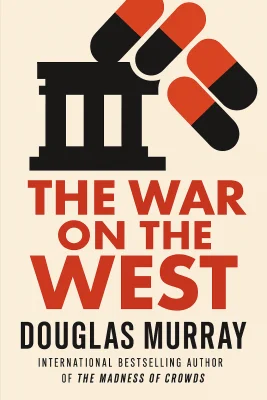
The War on the West
Categories
Nonfiction, Psychology, Philosophy, History, Religion, Politics, Audiobook, Sociology, Society, Cultural
Content Type
Book
Binding
Hardcover
Year
2022
Publisher
Broadside Books
Language
English
ASIN
0063162024
ISBN
0063162024
ISBN13
9780063162020
File Download
PDF | EPUB
The War on the West Plot Summary
Introduction
# The Systematic Assault on Western Civilization: An Ideological Analysis Western civilization faces an unprecedented internal challenge that transcends typical political disagreements or policy debates. This challenge manifests as a comprehensive ideological assault targeting the fundamental pillars of Western identity: its historical narrative, philosophical foundations, religious traditions, and cultural achievements. Unlike external military threats or economic competition, this assault operates through academic theories, media narratives, and institutional capture, systematically reframing Western civilization as uniquely oppressive and morally bankrupt. The analysis reveals a coherent pattern of attack that employs selective historical interpretation, anachronistic moral standards, and double standards that exempt non-Western civilizations from similar scrutiny. This ideological project exploits Western societies' capacity for self-criticism, transforming it from a mechanism for improvement into a tool for self-destruction. The implications extend beyond academic discourse into geopolitical vulnerability, as external powers like China exploit Western civilizational self-doubt while advancing their own authoritarian models. Understanding this systematic assault becomes essential for anyone seeking to comprehend the cultural upheaval reshaping Western societies and the potential consequences for democratic institutions, individual liberty, and the transmission of cultural values to future generations.
Chapter 1: Race as Weapon: How Critical Theory Divides Western Society
Critical Race Theory has emerged as the primary intellectual framework for weaponizing racial identity against Western societies. This theory fundamentally rejects the civil rights movement's aspiration toward a color-blind society, instead insisting that race must become the central lens through which all social interactions and institutional arrangements are viewed. The transformation represents a complete inversion of previous social goals, replacing the dream of judging individuals by character rather than skin color with a rigid system of racial categorization and hierarchy. The theoretical foundation rests on several key premises that resist empirical challenge. Critical Race Theory defines racism as "prejudice plus power," effectively declaring that only white people can be racist because they allegedly possess institutional power. This definition immunizes the theory from counter-evidence by making racism unfalsifiable for certain groups. The framework privileges "lived experience" over objective evidence, creating an epistemological system where questioning certain claims becomes evidence of racism itself. Popular manifestations of these ideas have created inescapable logical traps for Western populations. Robin DiAngelo's concept of "white fragility" ensures that denying racism proves racism, while admitting racism confirms it. Ibram X. Kendi's "antiracism" divides humanity into racists and antiracists with no middle ground, demanding active participation in racial consciousness-raising. These concepts moved from academic margins to mainstream acceptance with remarkable speed, particularly following the 2020 protests that were immediately interpreted through racial lenses despite limited evidence of racial motivation. The practical consequences extend far beyond theoretical discussions. Medical institutions now prioritize "equity" over equality, sometimes with deadly results. The CDC initially recommended prioritizing essential workers over elderly populations for COVID-19 vaccines explicitly because the elderly were "whiter," a decision experts acknowledged would cost tens of thousands of additional lives. Educational systems subject children as young as kindergarten to lessons about racial privilege and victimhood, while corporate training programs instruct employees to "be less white" or acknowledge complicity in "white supremacy." This weaponization of race proves particularly destructive because it reinstates racial essentialism under progressive rhetoric. Rather than building on genuine civil rights achievements that emphasized common humanity and equal treatment, the new racial paradigm assigns moral worth based on racial identity. The result is increasing social division and the systematic undermining of the Western liberal tradition that made authentic racial progress possible in the first place.
Chapter 2: Rewriting History: The Selective Demonization of Western Past
The assault on Western identity requires not merely reframing the present but wholesale revision of historical narratives. This revision operates through systematic techniques: selective focus on Western misdeeds while ignoring comparable or worse actions by non-Western civilizations, removal of historical context, and deliberate exaggeration of Western wrongs while minimizing Western achievements. The goal is creating a historical narrative that portrays Western civilization as uniquely evil rather than typically human. The New York Times' "1619 Project" exemplifies this revisionist approach. The project claimed to "reframe" American history by designating 1619, when the first slaves arrived, rather than 1776 as America's "true founding." When historians criticized factual errors, the Times quietly edited claims while denying it had made them. Lead writer Nikole Hannah-Jones asserted that protecting slavery was a primary motivation for American independence, despite minimal supporting evidence. Contributors claimed modern accounting practices originated on slave plantations, ignoring their actual development across multiple civilizations over millennia. Historical figures face systematic character assassination through impossibly anachronistic standards. Statues of Christopher Columbus, George Washington, Thomas Jefferson, Abraham Lincoln, and Winston Churchill have been vandalized or removed. Even Churchill, who led the fight against fascism, is recast as a racist villain. The standard applied judges historical figures exclusively by whether they held views on race aligning with contemporary progressive sensibilities, regardless of context or other accomplishments. The treatment of empire and colonialism follows identical patterns. The complex legacy of empire, including both exploitation and genuine advances in governance, medicine, and infrastructure, reduces to simplistic oppression narratives. Scholars like Nigel Biggar attempting balanced examination of "the ethics of empire" face professional ostracism. Meanwhile, the longer-lasting Ottoman Empire, the Arab slave trade that castrated victims to prevent descendants, and contemporary Chinese colonialism receive minimal scrutiny. Slavery undergoes particularly selective historical treatment. The transatlantic slave trade receives correct condemnation but without acknowledging that slavery existed in virtually all human societies throughout history. Britain's unprecedented commitment of naval resources to suppress the global slave trade at enormous financial and human cost rarely appears in these narratives. The fact that Britain spent nearly as much suppressing the slave trade as it had profited from it contradicts the narrative of unmitigated Western evil. This historical distortion serves clear purposes: delegitimizing Western civilization by portraying it as uniquely corrupt rather than as a complex human enterprise with typical achievements and failures. By severing Western peoples from pride in their cultural inheritance, historical revisionism creates ideological vacuums that can be filled with new commitments hostile to Western civilization itself.
Chapter 3: Dismantling Foundations: Attacks on Philosophy and Religious Heritage
The systematic assault extends beyond race and history to target the philosophical and religious foundations that shaped Western civilization. This attack proceeds by subjecting Western thinkers to anachronistic moral standards while exempting non-Western and anti-Western thinkers from similar scrutiny. The goal is not honest intellectual evaluation but specific delegitimization of Western thought traditions. The Enlightenment, which provided intellectual foundations for individual rights, religious tolerance, and scientific inquiry, faces particular targeting. Philosophers like Immanuel Kant, David Hume, John Locke, and Voltaire are dismissed primarily for holding racial views that, while problematic by modern standards, were typical of their era. David Hume's entire philosophical contribution reduces to a single footnote about racial differences, leading Edinburgh University to remove his name from campus buildings. John Stuart Mill, despite progressive views on women's rights and strong opposition to slavery, faces similar condemnation. The selective application of moral standards becomes evident when comparing treatment of Western philosophers with figures like Karl Marx. Marx's private correspondence reveals virulent racism and anti-Semitism far exceeding anything found in Hume or Kant. Marx referred to Jewish colleagues as "Jewish niggers" with "negroid" features, described Jews as "leprous," claimed "Indian society has no history at all," and defended American slavery. Yet Marx's statues remain standing while his work continues being taught without disclaimers applied to Western liberal thinkers. Similarly, Michel Foucault faces no cancellation despite revelations of sexually abusing children in Tunisia, behavior described by contemporary Guy Sorman as having "a colonial dimension" of "white imperialism." Had conservative thinkers been revealed engaging in such behavior, it would likely be seen as revealing fundamental truths about conservative thought itself. Christianity has become a particular target, with many denominations engaging in self-flagellation rather than defending their traditions. The Church of England's 2021 report "From Lament to Action" declared the church "deeply institutionally racist" and recommended quotas, curriculum changes, and monument removal. The Episcopal Church spent $1.2 million on a "racial audit" explicitly guided by Critical Race Theory. These churches now preach racial guilt rather than celebrating historical opposition to slavery through figures like William Wilberforce. What emerges is not honest reckoning with problematic aspects of Western thought but deliberate effort to discredit the entire Western intellectual tradition while preserving only thinkers whose ideas can undermine Western civilization. The goal appears to be replacement rather than reform, substituting Western philosophical and religious traditions with new ideological commitments that reject the very concept of objective truth that made Western intellectual progress possible.
Chapter 4: China's Exploitation of Western Self-Doubt and Civilizational Weakness
While Western societies engage in increasingly severe self-criticism, China has positioned itself to exploit this vulnerability through sophisticated strategy. The Chinese Communist Party leverages Western self-doubt while deflecting attention from its own human rights abuses and expanding global influence. This exploitation succeeds because it manipulates genuine Western commitments to self-improvement and moral consistency. When confronted about treatment of Uyghur Muslims in Xinjiang, where over a million people have been forced into concentration camps featuring systematic rape, torture, and forced sterilization, Chinese officials respond by pointing to Western racism. After U.S. Ambassador Linda Thomas-Greenfield told the UN General Assembly that America had an "original sin" of slavery and needed to address "white supremacy," China's UN representative Dai Bing seized the opportunity, stating that Thomas-Greenfield had "admitted to her country's ignoble human rights record" and therefore had no standing to criticize China. This deflection strategy builds on long communist propaganda traditions. Just as Soviet Russia produced films portraying America as uniquely racist while presenting the USSR as a racial paradise, China now positions itself as morally superior to the supposedly racist West. The strategy works by exploiting Western commitments to self-improvement while counting on Western ignorance about China's own far more severe racial hierarchies and human rights violations. China has systematically expanded influence through economic means while Western societies focus on internal guilt. The Belt and Road Initiative has established Chinese control over key infrastructure across Africa, Asia, and increasingly Europe. Western elites have been effectively captured through financial incentives, with former prime ministers, treasury officials, and business leaders routinely taking lucrative positions with Chinese companies after leaving office. Academic institutions like Cambridge University welcome Chinese investment while allowing Chinese authorities to influence research and discourse. The contrast in treatment proves stark: Western consumers boycott companies over minor controversies while continuing to purchase products made in Chinese sweatshops without protest. Authors refusing to have books translated into Hebrew willingly publish in China. The synthetic opioid fentanyl produced in China kills tens of thousands of Americans annually, far exceeding deaths in the Opium Wars that China still cites as evidence of Western imperialism, yet this receives minimal attention compared to historical Western wrongs. China's strategy succeeds partly because Western populations have become increasingly ignorant of both their own history and other civilizations' histories. Surveys show majorities of young Westerners have never heard of figures like Mao or Lenin and know little about events like the Holocaust. This knowledge vacuum creates fertile ground for selective historical narratives promoted by both Chinese propaganda and Western self-critics, who share interest in portraying Western civilization as uniquely evil rather than as one complex civilization among many.
Chapter 5: The Reparations Fallacy: Moral Problems with Collective Historical Guilt
The concept of reparations for historical wrongs has gained significant political traction, moving from fringes to mainstream Western political discourse. However, the moral and practical foundations of these demands reveal fundamental contradictions and implementation impossibilities that suggest their true purpose may be political rather than remedial. The entire framework rests on assigning collective guilt and responsibility across generations, creating inescapable logical and ethical problems. The moral basis faces a fundamental problem illustrated by Holocaust survivor Simon Wiesenthal's exploration of whether one can forgive on behalf of others. Wiesenthal concluded he had no right to forgive a dying SS officer for murdering Jews because he was not the direct victim. Similarly, reparations proposals ask people who committed no wrong to pay compensation to people who personally suffered no injury, based solely on racial categorization. This violates basic principles of individual moral responsibility that have anchored Western ethical thought. Implementing any reparations scheme would require solving intractable practical problems. In the American context, it would necessitate creating genetic databases to determine which black Americans are descended from slaves and in what proportion. Would someone with one slave ancestor receive the same payment as someone with many? What about recent black immigrants with no connection to American slavery? Should descendants of Union soldiers who died fighting slavery pay the same as descendants of Confederate soldiers? These questions have no satisfactory answers, which explains why advocates rarely address implementation details. The British experience with slavery demonstrates another problem: no payment is ever considered sufficient. Britain not only abolished slavery in 1807 but spent 40% of its national budget compensating slave owners (the only politically feasible path to abolition) and deployed one-sixth of the Royal Navy to suppress the slave trade globally for decades. Historians estimate Britain spent almost as much suppressing the slave trade as it had profited from it. Yet these unprecedented actions are now cited as evidence of British guilt rather than atonement. Demands for reparations apply inconsistently across civilizations. There are no serious calls for reparations from Arab nations for their longer-lasting slave trade, from Turkey for the Ottoman Empire, or from Mongolia for Genghis Khan's conquests. Only Western nations face these demands, suggesting the true purpose is political leverage rather than justice. This selective application undermines claims about universal moral principles. Most fundamentally, reparations proposals misunderstand how societies heal from historical trauma. Successful reconciliation has typically involved acknowledging wrongs while creating systems treating all citizens equally going forward. South Africa's Truth and Reconciliation Commission under Nelson Mandela exemplified this approach. By contrast, institutionalizing different treatment based on ancestry risks perpetuating division rather than healing it, locking Western societies into permanent racial accounting that undermines the universalist principles that made racial progress possible.
Chapter 6: Double Standards Exposed: Inconsistent Treatment of Historical Figures
The war on Western identity reveals itself most clearly through wildly inconsistent standards applied when evaluating historical figures. This inconsistency exposes the ideological rather than principled nature of contemporary historical criticism, demonstrating that the goal is not moral consistency but specific delegitimization of Western civilization and its key representatives. Winston Churchill provides the most striking example of this double standard. Until recently, Churchill was widely regarded as one of history's greatest figures for his leadership against Nazi Germany. In 2002, the British public voted him "The Greatest Briton" of all time. Yet today, his statues are regularly vandalized with accusations of racism, and academic panels at Churchill College, Cambridge, have declared that the British Empire was "far worse than the Nazis" and that Churchill's victory over Hitler merely shifted from "an old version of white supremacy to a new version." These critics focus obsessively on Churchill's occasional nineteenth-century racial attitudes while completely discounting his central role in defeating history's most genocidal regime. When former Labour shadow chancellor John McDonnell was asked whether Churchill was a hero or villain, he answered "villain" based on Churchill's handling of a 1910 mining dispute in which one miner died. Yet McDonnell has praised Mao Zedong, whose policies killed an estimated 65 million people. This asymmetry of judgment cannot be explained by any consistent moral standard. Similar inconsistency appears in treatment of America's Founding Fathers. Thomas Jefferson is condemned for owning slaves despite his writing against slavery and inclusion of anti-slavery provisions in the Declaration of Independence that were removed by others. Meanwhile, his extraordinary contributions to religious freedom, democratic governance, and education are minimized. George Washington, who freed his slaves in his will and led the Continental Army without pay, receives similar contempt. The inconsistency becomes even more apparent when comparing Western figures with non-Western leaders. While Cecil Rhodes is condemned for colonialism in Africa, little attention is paid to brutal empires established by Shaka Zulu or other African leaders. The Ottoman Empire's six-century rule over much of the Middle East and parts of Europe receives minimal criticism compared to shorter-lived European empires. Modern Chinese imperialism in Tibet, Xinjiang, and increasingly Africa proceeds with little moral outrage directed at Western historical imperialism. This double standard extends to religious figures as well. Christianity's historical shortcomings receive intense scrutiny while the violent spread of other religions is rarely mentioned. When Bibles were burned during protests in Portland, Oregon, in 2020, the New York Times dismissed it as "mundane" because "only a single Bible—and possibly a second—" were burned for kindling. Yet even rumors of Quran desecration anywhere in the world prompt immediate high-level military apologies and international condemnation. The pattern reveals that the goal is not historical accuracy or consistent moral evaluation but specific delegitimization of Western civilization and its key figures. By applying impossible standards to Western historical figures while excusing or ignoring similar or worse behavior by non-Western figures, critics create the false impression that Western civilization is uniquely evil rather than simply human, with the typical mixture of achievements and failures found in all civilizations.
Chapter 7: Institutional Capture: How Education and Media Spread Anti-Western Narratives
The war on Western identity has succeeded largely through systematic capture of key institutions that shape cultural narratives and transmit values between generations. This institutional capture has been particularly effective in education and media, where anti-Western perspectives have moved from margins to become dominant orthodoxy. The transformation represents one of the most significant ideological shifts in Western history, accomplished with remarkable speed and thoroughness. In education, the transformation begins with the youngest students. Elementary schools now routinely teach children to categorize themselves and others by race and to view Western history primarily through lenses of oppression. In Buffalo, public schools have forced kindergartners to watch videos about police brutality. In California, third-graders are taught to rank themselves according to "power" and "privilege." The San Diego Unified School District has declared that teachers are guilty of "spirit murdering" black children, while in New York, parents are instructed to become "white traitors" working toward "white abolition." Higher education has undergone even more dramatic transformation. Universities that once taught Western civilization as their core curriculum now struggle to find institutions willing to host such courses. The Ramsay Centre for Western Civilisation in Australia has faced significant difficulty finding university partners despite offering substantial funding. Academic hiring and promotion increasingly depend on adherence to anti-Western perspectives, with scholars who challenge prevailing narratives facing professional ostracism. When Portland State University professor Bruce Gilley published "The Case for Colonialism" in 2017, nearly half the journal's editorial board resigned in protest, and the article was withdrawn despite having passed peer review. This institutional capture extends beyond curriculum to campus culture. Students and faculty who question anti-Western narratives face severe consequences. At Grace Church School, math teacher Paul Rossi was forced out after questioning whether traits like "objectivity" and "individualism" should be labeled characteristics of "white supremacy." The school's principal privately admitted that such training was "demonizing white kids" but felt powerless to resist. Similar stories have played out across educational institutions, creating climates where challenging anti-Western orthodoxy carries prohibitive professional risks. Media institutions have been similarly transformed. The New York Times' "1619 Project" exemplifies how major media platforms now actively promote anti-Western narratives rather than objective reporting. When CNN covered the defacement of Churchill's statue in London, its headline read "Yes, Churchill Was a Racist," presenting this characterization as undisputed fact rather than contested interpretation. Media coverage of protests consistently downplays violence against Western symbols, with the BBC infamously describing protests where 27 police officers were injured as "largely peaceful." Corporate media has also adopted explicitly racial framing that would have been unthinkable a generation ago. Major networks routinely describe Mount Rushmore not as a monument to American presidents but as "a monument of two slave owners on land wrestled away from Native Americans." Historical documentaries that once celebrated Western achievements now focus almost exclusively on Western crimes, real or alleged. The BBC's 2018 series "Civilisations" explicitly avoided suggesting Western civilization had any unique achievements, in stark contrast to Kenneth Clark's landmark 1969 series "Civilisation." This institutional capture has been remarkably comprehensive and swift. Ideas that originated in obscure academic journals now dominate K-12 education, university curricula, mainstream media, corporate training, and even religious institutions. The result is that Western societies are increasingly unable to transmit their cultural inheritance to the next generation, creating vacuums that can be filled with new ideological commitments hostile to Western civilization itself.
Summary
The systematic assault on Western civilization represents a coherent ideological project that transcends legitimate criticism to become a comprehensive attack on the foundations of Western identity. Through weaponizing race, distorting history, undermining philosophical and religious traditions, and capturing key institutions, this movement has succeeded in creating a narrative that portrays Western civilization as uniquely evil rather than as a complex human enterprise with both achievements and failures. The assault exploits Western societies' capacity for self-criticism, transforming it from a mechanism for improvement into a tool for civilizational self-destruction. The implications extend far beyond academic debates into questions of cultural survival and geopolitical vulnerability. When societies lose confidence in their foundational values and historical inheritance, they become unable to defend themselves against external challenges or internal dissolution. The selective application of impossible moral standards to Western figures while exempting non-Western civilizations from similar scrutiny reveals the ideological rather than principled nature of this assault. The ultimate question is whether Western societies can recover the balance between legitimate self-criticism and civilizational confidence necessary for cultural renewal, or whether they will succumb to a form of ideological capture that makes both reform and defense impossible.
Best Quote
“For Nietzsche, one of the dangers of the men of ressentiment is that they will achieve their ultimate form of revenge, which is to turn happy people into unhappy people like themselves—to shove their misery into the faces of the happy so that in due course the happy “start to be ashamed of their happiness and perhaps say to one another: ‘It’s a disgrace to be happy!” ― Douglas Murray, The War on the West
Review Summary
Strengths: The review highlights Douglas Murray's comprehensive analysis of various societal issues such as race, history, and education, providing specific examples to support his claims. The interactive notes section in the Kindle edition is praised for its functionality. The book is described as well-supported and thought-provoking, encouraging discussion. Weaknesses: The review expresses frustration with the book's categorization on Amazon, which may mislead potential readers. Additionally, the reader's personal emotional response, including anger and aggravation, might detract from an objective assessment. Overall: The reviewer finds "The War on the West" to be an important and impactful read, despite personal emotional challenges. It is recommended for those interested in political and social science discussions, with a caution regarding its misclassification on Amazon.
About Author

Douglas Murray
Murray investigates the complexities of modern conservatism and its intersection with societal challenges. His work often highlights the threats posed by Islamic fundamentalism while offering a critical view of contemporary Western policies. As an associate director of the Henry Jackson Society, he engages with political discourse that scrutinizes cultural and ideological shifts, therefore making his contributions particularly relevant in debates about national security and social cohesion.\n\nHis method involves combining rigorous analysis with a clear, often polemical style, which is evident in his writings for The Spectator and the Wall Street Journal. Murray's insights extend beyond mere criticism; they synthesize historical perspectives with present-day realities, offering readers a comprehensive understanding of the forces shaping modern society. For instance, his books delve into topics like immigration and identity, which are pivotal for those interested in understanding the dynamics of current global conflicts and cultural tensions.\n\nReaders who engage with Murray's work benefit from his incisive commentary and ability to connect disparate ideas into coherent arguments. This makes his analyses particularly useful for policymakers, academics, and the general public seeking clarity in a complex world. His bio reflects a commitment to challenging prevailing narratives and proposing alternative viewpoints that foster critical thinking. Through his extensive media presence and writing, Murray positions himself as a significant voice in contemporary conservative thought, making his authorial contributions indispensable for those navigating today's ideological landscape.
Read moreDownload PDF & EPUB
To save this Black List summary for later, download the free PDF and EPUB. You can print it out, or read offline at your convenience.
The War on the West
by Douglas Murray
