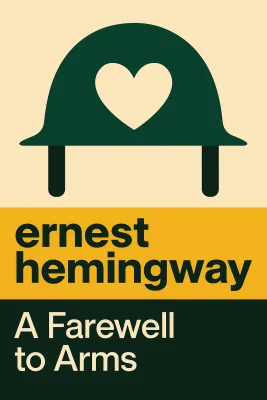
A Farewell to Arms
Categories
Fiction, Classics, Historical Fiction, Romance, Literature, American, Historical, Novels, War, Classic Literature
Content Type
Book
Binding
Paperback
Year
2003
Publisher
Arrow Books
Language
English
ASIN
0099910101
ISBN
0099910101
ISBN13
9780099910107
File Download
PDF | EPUB
A Farewell to Arms Plot Summary
Introduction
Rain drummed against the hospital windows in Milan as Lieutenant Frederic Henry watched the woman he loved slip away from him. The war had taken everything else—his comrades, his illusions, his faith in humanity. Now it reached for Catherine Barkley with bloody fingers, demanding the ultimate sacrifice. Their love story had begun in the shadow of Austrian artillery, flourished in stolen moments between bombardments, and would end in a sterile room where prayers fell on deaf ears. Henry had come to Italy as an American ambulance driver, carrying wounded soldiers from the trenches of the Isonzo front. The war seemed distant then, almost theatrical. He drank with Italian officers, visited brothels, and watched the ancient dance of advance and retreat with the detachment of a tourist. But war has a way of closing its trap slowly, drawing men deeper until escape becomes impossible. When shrapnel tore through his legs during a mortar attack, Henry found himself in a Milan hospital where he met Catherine, an English nurse carrying her own invisible wounds from losing her fiancé at the Somme. What began as a game of mutual consolation transformed into something desperate and real, a love that would demand they abandon everything they had known for a chance at happiness together.
Chapter 1: The Italian Front: A Soldier's Detachment
The autumn rain turned the roads to mud and the soldiers' faces to gray masks of exhaustion. Lieutenant Frederic Henry sat in the officers' mess at Gorizia, watching his Italian comrades argue about the war with the passion of men who had never quite convinced themselves of their own words. Outside, the Austrian guns flickered like distant lightning against the mountains, a deadly aurora that had become as familiar as sunrise. Henry served as an ambulance driver, ferrying broken bodies from the front lines to field hospitals. The work suited his temperament—necessary but removed, close enough to the war to feel useful, distant enough to maintain perspective. He was an American in an Italian uniform, a tourist of tragedy who spoke the language but never quite felt the soil under his fingernails the way his companions did. The mess hall filled with cigarette smoke and bitter laughter as the men tormented their chaplain, a gentle priest who absorbed their cruelties with the patience of a man accustomed to carrying other people's sins. They spoke of whores and wine, of leave time in distant cities, of anything but the approaching winter and what it might bring. Captain Rinaldi, Henry's roommate and closest friend among them, displayed his surgical hands like a magician showing off his instruments. He claimed to love three things: his work, his pleasure, and Henry himself, though he wasn't entirely sure in what order. The war had become routine, almost comfortable in its predictability. Men died, others took their places, the line shifted back and forth across the same scarred ground like dancers in some macabre waltz. Henry had learned to sleep through artillery barrages and wake refreshed. He had learned to distinguish between the whistle of incoming shells and the harmless passage of their own ordnance heading toward Austrian positions. Most importantly, he had learned not to think too deeply about any of it. When the priest suggested Henry spend his leave in the mountains of Abruzzi, among clean snow and simple people who still removed their hats when greeting strangers, Henry smiled and agreed. But when the time came, he went instead to Milan, Naples, Florence—to cities where the war was a distant rumor and pleasure could be purchased without complications. He returned to find the priest's disappointment like a weight on his conscience, though he couldn't quite explain why he had chosen smoke-filled cafés over mountain air, temporary companions over genuine hospitality. The front settled into its winter rhythm of watchful waiting. Henry resumed his duties with the mechanical precision of a man who had found his place in the machine, driving his ambulances through familiar routes while Austrian snipers took their measured shots at anything that moved. He thought himself immune to the war's deeper corruption, protected by his foreignness and his carefully maintained emotional distance. But the trap was already closing around him, invisible as morning mist in the valleys below the fighting positions.
Chapter 2: Wounds of War and Healing Hands
The shell came without warning, a sudden rupture in the fabric of an ordinary evening. Henry had been sharing cheese and wine with his drivers in their dugout when the world exploded around them. The blast lifted him out of himself and deposited him back in a body he no longer recognized—legs shattered, consciousness floating somewhere between life and whatever came after. Through the ringing in his ears, he heard Passini screaming for his mother, saw the man's legs twisted at impossible angles before death mercifully claimed him. In the field hospital, doctors worked with the detached efficiency of mechanics repairing complicated machinery. They dug metal fragments from Henry's flesh with delicate instruments, catalogued his wounds in clinical language, and debated whether he would walk again. The answer seemed less important than the process itself, as if the war demanded precise documentation of its handiwork. Henry drifted in and out of consciousness, aware that he had crossed some invisible boundary from observer to participant, from tourist to casualty. The train to Milan carried him away from the immediate danger of the front lines, but the journey felt like dying in slow motion. Wounded men lay stacked like cordwood in overcrowded cars, their bandages seeping through despite the doctors' careful work. The man on the stretcher above Henry bled steadily through the night, each drop marking time like a metronome counting down to some inevitable conclusion. By morning, the bleeding had stopped, but so had everything else. At the American hospital in Milan, Henry encountered a different species of efficiency. The building had been a wealthy German's villa before the war, its rooms now converted to serve the broken remnants of various armies. The staff moved with purposeful haste, transforming chaos into routine through sheer professional competence. Henry found himself assigned to a room with tall windows overlooking gardens that remained stubbornly beautiful despite the war's best efforts to make everything ugly. It was there that he met Catherine Barkley, an English nurse with blonde hair and eyes that held depths he couldn't immediately fathom. She had come to Italy with the romantic notion that war might somehow be clean and noble, that wounded men arrived with picturesque bandages wrapped around heroic injuries. The reality had educated her quickly, but she retained something untouchable at her core, a reserve of warmth that the war hadn't yet managed to freeze solid. Their first encounters carried the artificial quality of a stage performance. Catherine spoke of her dead fiancé with the rehearsed precision of someone who had told the story too many times, while Henry played the role of sympathetic listener with the skill of a man accustomed to giving people what they expected. But beneath the performance, something genuine stirred between them, a recognition that they were both refugees from lives that had ceased to make sense. In the sterile environment of the hospital, surrounded by the machinery of healing and the constant reminder of mortality, they began to construct something real from the debris of their separate disasters.
Chapter 3: Retreat and Desertion: Escaping the Chaos
The Italian offensive collapsed like a house built on sand. What had been orderly advances and measured retreats transformed overnight into something resembling the end of civilization itself. Henry, barely recovered from his wounds, found himself manning an ambulance during the great withdrawal from Caporetto, part of a massive human river flowing away from the Austrian breakthrough. The roads clogged with soldiers, civilians, artillery pieces, and the accumulated detritus of a war that had suddenly lost all pretense of organization. Three ambulances under Henry's command carried wounded men through the chaos, their drivers—Aymo, Bonello, and Piani—men from the industrial north who spoke of socialism and home with equal longing. They had never believed in the war's grand rhetoric, but they believed in each other and in the simple necessity of getting their charges to safety. The retreat tested even these modest convictions as roads became impassable, supplies ran out, and the careful distinctions between friend and enemy began to blur. When their vehicles finally mired hopelessly in mud, the small group continued on foot toward the Tagliamento River, hoping to cross before the Austrian advance cut them off entirely. They moved through a landscape emptied of meaning, past abandoned villages and fields where the dead lay in poses of eternal surprise. The retreat had become something larger than military withdrawal—it felt like the dissolution of the world itself, as if the war had finally succeeded in destroying not just armies but the very idea that human beings could organize themselves into anything resembling civilization. At a blown railway bridge, hidden among trees and waiting for nightfall, they encountered German bicycle troops moving with mechanical precision through the Italian countryside. The enemy soldiers appeared almost supernatural in their efficiency, ghosts in gray uniforms who belonged to a different species of war entirely. Henry watched them pass and understood that his side had been fighting children's games while their opponents practiced something approaching art. The realization carried no bitterness, only a cold recognition of facts. The killing came suddenly and without explanation. Italian rear-guard forces, terrified by rumors of German infiltrators, opened fire on anything that moved without proper identification. Aymo fell with a bullet in his skull, killed by men supposedly fighting on the same side. Bonello vanished into the countryside, choosing capture over the chaos of continued retreat. Henry and Piani pressed on alone, two men walking through the collapse of everything they had once considered permanent. At the river crossing, Italian military police had established a summary court to root out deserters and enemy agents. They questioned officers separated from their units with the cold precision of men who had found their own way to make sense of chaos: through violence organized as justice. Henry watched them execute a lieutenant colonel whose only crime had been surviving when his men did not. When his own turn came, he ran, diving into the flooded river as rifle shots cracked behind him. The current carried him away from the war, away from his uniform and his obligations, away from everything except the simple necessity of staying alive long enough to reach the woman who had become his only reason for continuing to exist.
Chapter 4: Sanctuary in Switzerland: Building a Life Against Time
The train to Stresa carried Henry in civilian clothes that felt strange after months in uniform, as if he were wearing a costume for a play he had forgotten how to act. He had deserted completely now, crossing that invisible line between soldier and fugitive with the finality of a man stepping off a cliff. The war continued without him, and he discovered that this absence felt less like freedom than like death of a particular kind—the death of all the versions of himself he had been before Catherine. At the Hotel des Iles Borromées, he found her waiting with her companion Helen Ferguson, who treated his arrival as a personal catastrophe. Ferguson had watched Catherine transform from competent nurse to lovesick girl with the horror of someone witnessing a friend's descent into madness. She knew what Henry was before Catherine admitted it to herself: a man who brought destruction wherever he went, who left wreckage in place of the careful life Catherine had constructed around her losses. But Ferguson's warnings fell on deaf ears. Catherine had moved beyond the reach of practical advice into a country where only Henry mattered. When she told him about the pregnancy—"I'm going to have a baby, darling. It's almost three months along"—she delivered the news with the calm of someone who had already accepted whatever consequences might follow. The war had taught her that happiness came in small portions that had to be seized immediately, before circumstances could intervene. They fled across Lake Maggiore in a stolen boat, rowing through the darkness toward Switzerland while rain lashed their faces and the current fought their every stroke. The crossing felt like a passage between worlds, from one where they were fugitives to another where they might possibly be free. Henry's hands blistered and bled on the oars, but he kept rowing through the night, following the wind and the stars toward a distant shore where different laws might apply. In the mountains above Montreux, they established a life that felt almost normal. Their rooms looked out over the lake toward the French Alps, and on clear days they could see the snow-covered peaks where other people's wars seemed as distant as mythology. Henry grew a beard and learned to play chess. Catherine knitted baby clothes and read novels and grew rounder with each passing week. They invented routines and private jokes, small domestic rituals that felt like prayers against the chaos they had left behind. The peace couldn't last, of course. Peace never lasted during wartime, not even for those who had removed themselves from the immediate danger. But for a few months, in the winter snow of neutral territory, they managed to construct something that resembled happiness. Henry learned to forget the war for hours at a time, to think in terms of seasons rather than battles, to imagine a future that extended beyond the next day's survival. Catherine bloomed in the mountain air, growing more beautiful as she grew larger, as if pregnancy had revealed some essential truth about who she had always been meant to become.
Chapter 5: The Price of Love: Facing the Inevitable End
Spring rain melted the snow and turned their mountain paradise into something approaching reality. As Catherine's time drew near, they moved down to Lausanne, where the hospital waited like a mouth preparing to swallow whatever happiness they had managed to accumulate. The city felt different from their mountain retreat—busier, more connected to the larger world and its ongoing catastrophes. Here, the war returned to them through newspapers and conversations, a reminder that their temporary refuge had been exactly that: temporary. Henry tried to prepare himself for fatherhood, but the concept remained abstract, a future event that might or might not arrive depending on variables he couldn't control. Catherine seemed more real to him than their unborn child, more precious and more fragile with each passing day. He watched her move through their hotel rooms with increasing difficulty, her body adapting to accommodate the new life growing inside her, and felt helpless in the face of natural processes that owed nothing to his desires or fears. The labor began on a night when rain drummed against their windows like fingers tapping out some urgent message. Catherine woke him with the calm announcement that the time had come, as if she were discussing the weather or plans for lunch. But her composure cracked as the hours passed and the pain intensified beyond anything they had anticipated. The gas meant to ease her suffering proved inadequate against the reality of childbirth, and Henry watched her transform from the woman he knew into something primal and desperate. The doctor finally decided on surgery, explaining the risks with the clinical detachment of a man accustomed to making life and death decisions. Henry consented because he had no choice, because doing nothing seemed worse than accepting whatever outcome the operation might bring. They wheeled Catherine away on a stretcher, and he waited in the hallway like any other expectant father, listening to sounds he couldn't interpret and trying not to think about all the ways things could go wrong. The baby was born dead, strangled by its umbilical cord before it could draw its first breath. Henry felt nothing when they showed him the small body, no connection to this child that had never been alive in any meaningful sense. But Catherine hemorrhaged after the delivery, bleeding internally from complications the surgery couldn't prevent. Henry sat beside her bed and watched her slip away with the same terrible inevitability as a sunset, as if her death were simply another natural process that had to run its course. She died as quietly as she had lived, without drama or last-minute revelations, simply present one moment and absent the next. Henry remained with her body for a while, trying to find some final words that might serve as farewell, but silence seemed more appropriate. When he finally left the hospital and walked back through the rain to their empty hotel room, he carried nothing with him but the certainty that love, like war, eventually consumed everything it touched.
Summary
The hospital corridor stretched before Henry like a path to nowhere, its polished floors reflecting nothing but emptiness. Catherine was gone, taking with her the brief illusion that they could escape the war's gravitational pull. Their child had never drawn breath, and now she too had been claimed by forces as implacable as artillery. Henry walked out into the Swiss rain understanding finally that geography meant nothing against the machinery of loss that had been grinding through his life since the first shell exploded in that Italian dugout. The war would end eventually, of course. Wars always did. Men would return to their families, borders would be redrawn, and the dead would be buried with appropriate ceremony. But for Henry, the real war had been fought in hospital rooms and mountain retreats, in stolen moments between bombardments and the final, desperate hours when love revealed itself to be just another casualty. He had deserted his army only to discover that there was no deserting the larger conflict that consumed everything—hope, faith, the possibility that any story might end well. Walking alone through the darkness toward whatever came next, he carried with him the knowledge that some battles could never be won, only survived, and that survival itself was just another word for learning to live with loss.
Best Quote
“Maybe...you'll fall in love with me all over again.""Hell," I said, "I love you enough now. What do you want to do? Ruin me?""Yes. I want to ruin you.""Good," I said. "That's what I want too.” ― Ernest Hemingway, A Farewell to Arms
Review Summary
Strengths: The reviewer appreciates Hemingway's succinct style, honest diction, and sense of humor. They acknowledge his ability to break conventional writing rules with a certain level of admiration. Weaknesses: The review criticizes the book for extreme run-on sentences, overuse of qualifiers, and lack of clarity in dialogues. The story and characters are described as unengaging, with the protagonist and his girlfriend being particularly unappealing. The reviewer also notes a lack of discernible theme or point in the narrative. Overall: The reader expresses a generally negative sentiment, rating the book as merely "okay." They find the story and characters uninteresting and are critical of Hemingway's stylistic choices, suggesting the book lacks a compelling theme or purpose.
About Author

Ernest Hemingway
Hemingway interrogates the essence of human courage and existential struggle through a prose style that emphasizes economy and precision. His narratives, such as "A Farewell to Arms" and "For Whom the Bell Tolls," often delve into themes of war, love, and the human condition, providing readers a profound exploration of life's inherent conflicts. By situating his characters in environments ranging from the Italian Front during World War I to the plains of Africa, Hemingway connects the visceral experiences of his protagonists with broader existential questions. \n\nHis commitment to this minimalist style not only defined his own literary voice but also influenced countless writers of the 20th century. While his book "The Old Man and the Sea" secured him the Pulitzer Prize, his overarching impact on narrative form led to his receipt of the Nobel Prize in Literature. Readers benefit from Hemingway’s approach as it invites them to engage actively with the text, uncovering deeper meanings beneath the surface. This short bio reveals how his own adventurous and tumultuous life, marked by his experiences as a war correspondent and his personal struggles, shaped his work, offering a window into the complex interplay between life and literature.
Read moreDownload PDF & EPUB
To save this Black List summary for later, download the free PDF and EPUB. You can print it out, or read offline at your convenience.

A Farewell to Arms
by Ernest Hemingway
