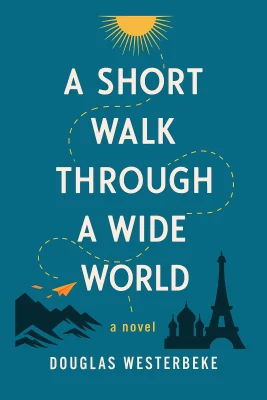
A Short Walk Through a Wide World
Categories
Fiction, Audiobook, Mystery, Historical Fiction, Fantasy, Adult, Book Club, Historical, Magical Realism, Adventure
Content Type
Book
Binding
Hardcover
Year
2024
Publisher
Avid Reader Press / Simon & Schuster
Language
English
ISBN13
9781668026069
File Download
PDF | EPUB
A Short Walk Through a Wide World Plot Summary
Introduction
# The Wanderer's Curse: A Journey Through Worlds Unseen Blood spatters across white paper as nine-year-old Aubry Tourvel collapses in a Parisian marketplace, her body convulsing with an illness no doctor can name. The year is 1885, and this small girl clutching a wooden puzzle ball has just discovered the terrible truth that will define her existence: she can only survive when moving, and she can never return to any place she's been before. What begins as a desperate flight from suffering becomes something far stranger—an epic journey across continents and through impossible doorways, guided by a voice in her head that hungers to see the world through her eyes. The sickness speaks to her in whispers, driving her forward across decades of exile. She will learn to hunt with a spear, love men she must abandon, and discover libraries that exist between worlds. Her curse will transform her from a frightened child into one of history's greatest wanderers, carrying the weight of human experience across the globe. But the true nature of her affliction—and the entity that shares her consciousness—will only reveal itself when her endless journey finally leads her home.
Chapter 1: The Well of Refusal: Origins of an Endless Journey
The curse begins with a choice. In a shadowy Parisian courtyard, three sisters discover a well carved into the shape of a grotesque face, its stone mouth gaping wide with teeth like broken promises. Pauline sacrifices her gold chain for world peace. Sylvie throws in her childhood doll to cure the syphilis ravaging their neighborhood. But when Aubry's turn comes, she cannot bear to part with her mysterious puzzle ball—a wooden sphere that appeared in her life like fate itself, rolling toward her from a dead man's yard. That same evening, the first attack strikes during dinner. Blood pours from every opening in her head as convulsions wrack her small body. Her father catches her as she falls, and Dr. Homais is summoned with his leather bag of useless remedies. But the moment they carry her from the house, her symptoms vanish completely. The pattern becomes clear and merciless: she can only be well when moving, and returning to any previous location means certain agony. For months, the Tourvel family moves from hotel to hotel around Paris, staying two or three days at most before the sickness finds them. Aubry's education ceases, their money dwindles, and her mother ages years in mere weeks. The spiral leads them out of Paris, through France, into Italy, then Croatia. Newspapers begin following their story, fascinated by the girl who cannot stay still. One night in a nameless inn near the Adriatic coast, twelve-year-old Aubry makes the hardest decision of her young life. She leaves a note on the pillow beside her sleeping mother and disappears into the darkness, unable to watch her family destroy themselves trying to save her. By dawn, she is climbing mountain trails with nothing but her puzzle ball, her coat, and the terrible knowledge that she can never go home again.
Chapter 2: Blood and Motion: Learning the Price of Stillness
The voice first speaks to her in the forests of Germany, where she nearly starves learning to hunt rabbits with sharpened sticks. "I need to see," it whispers, and Aubry understands with growing dread that she has become a vessel for something beyond her comprehension. The frightened child who once played with dolls now carries a spear taller than herself, her muscles lean from constant travel, her instincts sharp as any predator's. Greek fishermen take pity on her youth and teach her their trade, but she cannot stay long enough to master their lessons. The sickness drives her relentlessly forward, a passenger in her own body, hungry for new sights and experiences. She learns languages from necessity, navigates by stars, and develops an ability to read strangers that keeps her alive in dangerous places. Each attack grows more violent, each recovery more miraculous. By the time she reaches the deserts of North Africa, Aubry has transformed into something between human and force of nature. She trades fresh meat for supplies and passage, her spear finding its mark with deadly precision. The puzzle ball remains her only constant companion, sometimes rolling ahead to choose directions when she cannot decide. She catches it moving on its own, as if alive with purpose, whispering secrets in languages she almost understands. The newspapers continue tracking her impossible journey, documenting appearances that defy conventional travel. She is spotted in Morocco one week and Constantinople the next, with no ship's manifest bearing her name. Scientists propose theories about psychological conditions and mass hysteria, but none can explain how a teenage girl survives alone in places that kill experienced explorers. The truth is simpler and more terrible: whatever force controls her fate has made her into something that can endure what would destroy others.
Chapter 3: Doors Between Worlds: Discovery of the Hidden Libraries
In a North African port city, pursuing her escaped puzzle ball through narrow alleys, Aubry finds herself before a building of horseshoe arches that seems to breathe with darkness. The puzzle ball rolls inside, and she follows without hesitation into shadows that swallow her whole. She emerges into a vast library unlike anything in the waking world, its endless shelves stretching into darkness, filled with books containing no words—only pictures that tell stories of civilizations, discoveries, and wonders beyond imagination. The air itself seems alive with knowledge. Fresh food appears on tables when she hungers, candles light themselves against the darkness, and time moves like honey through her fingers. She spends what feels like days or weeks wandering through chambers that defy physics, reading visual narratives of human achievement and loss. The books show her individuals whose small acts of courage or cruelty rippled across centuries, civilizations that rose and fell before history began. When she finally finds a door back to daylight, she stands in the same city but somehow changed. The library has shown her glimpses of a world far stranger and more wondrous than she ever imagined. More importantly, it has taught her that her curse might be connected to something larger—that the doors between worlds open only for those willing to keep moving, never looking back. These impossible libraries appear throughout her journey, always when she needs them most. She enters through a shipwreck in Arctic ice and emerges from a tree hollow in Madagascar. She steps into an abandoned mine shaft in the Sahara and walks out of a cave in the Amazon. Each time, she discovers new stories, new perspectives on the human experience. The voice in her head grows stronger in these places, more conversational, and she begins to suspect that the libraries exist because of her, that her journey is creating them as much as discovering them.
Chapter 4: Hearts Along the Path: Love and Loss Across Continents
In the remote mountains of Tibet, Aubry encounters Pathik, a nomadic hunter whose eagle circles overhead like a living omen. Despite sharing no common language, they communicate through gestures and shared glances, their connection immediate and profound. Together they hunt a massive prehistoric bird that attacks them in the darkness, their combined strength barely enough to survive the encounter. For seven precious days, she rides behind him on his horse, her arms wrapped around his chest, feeling almost normal for the first time in years. His family welcomes her with wonder and fear—this pale stranger from an impossible distance. She learns their words, shares their meals, and for a moment believes she might stay. But blood on her pillow one morning tells a different story. The sickness has found her again, and she must flee before it destroys these kind people who have shown her love. She leaves in the darkness, carrying their memory like a wound that will never heal. Years later, aboard the Trans-Siberian Railway, she meets Lionel Kyengi, a brilliant accountant whose dark skin and gentle manner hide a sharp intellect. Their shared compartment becomes a sanctuary of intimacy and intellectual connection. When the train breaks down in the Russian steppes, they have three perfect days together, making love and planning impossible futures. But the sickness finds her even there, in the middle of nowhere, and she is forced to walk into the vast grasslands alone, leaving him broken-hearted on the empty prairie. The pattern repeats across continents and years—brief connections severed by her relentless condition. In Japanese fishing villages, she finds temporary family among people who accept her strangeness without question. In Tibetan highlands, she hunts monsters with nomads who teach her that some bonds transcend language. Each time, she is forced to leave just as love begins to bloom, carrying the weight of abandoned connections like stones in her heart.
Chapter 5: The Voice Within: Understanding the True Companion
In the deserts of North Africa, Aubry meets Uzair Ibn-Kadder, a brilliant scientist who collects dinosaur skulls and precious stones in his father's inherited mansion. Uzair is convinced her condition is psychological—a fear of staying still that has become physically manifest. He offers her shelter, exotic foods, and a ceiling painted with thousands of stars that move to match Earth's rotation. More dangerously, he offers her love and the promise of a cure. For the first time since childhood, Aubry allows herself to hope. Under his artificial sky, she gives herself to him completely, believing that love might succeed where medicine has failed. He feeds her carefully prepared herbs, rubs healing oils into her skin, and swears he will cure her. But when the sickness comes, Uzair's love transforms into something darker. Convinced that her condition is merely stubborn delusion, he locks her in a windowless room during her next attack, determined to prove that her symptoms are imaginary. Instead, he nearly kills her. As Aubry lies dying on the floor, blood pooling around her convulsing body, she realizes that love can be as dangerous as any disease. Hamza, Uzair's young servant, finally opens the door. She crawls across the kitchen floor and into the desert, where her strength slowly returns. She walks for weeks across the Calanshio Sand Sea—a wasteland that should have killed her in days—until Berber nomads find her and nurse her back to health. The voice in her head becomes more honest as she ages, more willing to reveal its nature. "I once walked the earth," it tells her during a fever dream in the Gobi Desert, and she begins to understand that her sickness is not a disease but a consciousness, an entity that has chosen her as its vessel. It has shown her wonders beyond imagination, but the price has been everything she ever loved. She is not a victim but a collaborator, and that knowledge changes everything about how she sees her journey.
Chapter 6: Witness to Wonder: Embracing the Role of Eternal Observer
In the red dust lands of India, Aubry meets Prince Surasiva, a man whose gentle wisdom masks a desperate situation. His palace is magnificent but crumbling, his wealth mostly illusion. He has been secretly selling horses to foreign lands to pay the British taxes that would otherwise crush his people. His servants work for love rather than wages, and his jewels are mostly colored glass. Yet he possesses something rarer than riches—the ability to see beyond surface appearances to the truth beneath. The Prince recognizes something in Aubry that others miss. While she tells him stories of her travels, he listens not just to her words but to the spaces between them. He understands that she has witnessed something beyond ordinary human experience, something that has marked her permanently. When her sickness strikes with unusual violence, he carries her to safety without question or judgment, sailing into a massive sandstorm that traps British soldiers in his palace. In his gallery of impossible paintings, she meets Qalima, a mysterious woman whose art seems to predict the future. Qalima grants Aubry a birthday wish, though Aubry doesn't understand what she's asking for. The woman's paintings capture visions of places that shouldn't exist, including a black river surrounded by jungle that feels like home to Aubry, though she has never seen it before. The wish, she realizes later, was not for freedom from her curse but for understanding of its purpose. The Prince creates mandalas in colored sand, intricate patterns that he allows the tide to wash away. "We are in God's classroom," he tells her, "waiting for our lesson." His acceptance of impermanence, his ability to create beauty knowing it will be destroyed, teaches Aubry something crucial about the nature of her own journey. Perhaps the point is not to possess or preserve, but simply to witness and let go, carrying the memory of what was beautiful into whatever comes next.
Chapter 7: The Final Haven: Children, Wells, and Puzzles Solved
In her final years, ancient and white-haired, Aubry emerges from the libraries for the last time to find herself in the Amazon jungle. Here, Vicente, a gruff exile from Argentina, has gathered a family of lost children—orphans and castaways who have followed him from across South America, drawn by some inexplicable instinct to his remote camp by the black river. These are the unwanted ones, the forgotten, and they recognize in Aubry a kindred spirit who has also lived outside the normal world. Vicente sees through her frailty to the warrior beneath. When she demonstrates her skill with a spear, bringing down a massive fish with a single throw, the children accept her immediately. For the first time in her adult life, she stays in one place for more than a few days. The sickness, her lifelong companion, seems to have finally released its hold on her. She teaches the children to hunt and fish, sharing stories of her travels around their evening fire, her voice carrying the weight of decades. The children lead her to a well that looks exactly like the one from her childhood garden in Paris. Inside, they find treasures that Aubry recognizes—her own possessions, dropped into wells around the world over the decades of her journey. Most precious of all is her wooden puzzle ball, the toy she dropped as a nine-year-old child. This time, after a lifetime of trying, it opens in her hands like a flower blooming in reverse. Inside the puzzle ball is a painting by Qalima, a watercolor of the black river and jungle that now surrounds her. On the back, in elegant script, are the words "Happy Birthday." Aubry understands finally that this has all been orchestrated, that her wish—made so many years ago in an Indian palace—has been granted. She has found home at last, not in a place but in the act of caring for others, of using her hard-won wisdom to protect those who need protection most.
Summary
Aubry Tourvel's story ends where it began, with a well and a choice, but the frightened child who once dropped a puzzle ball into dark water has become something far greater. Her exile, which began as punishment, has transformed into purpose. She has seen the world not as a tourist or conqueror but as a witness, carrying the stories of countless individuals across time and space. The voice that once tormented her reveals itself as something ancient and necessary, a consciousness that needed human eyes to truly see the world. Through Aubry, it has experienced love and loss, beauty and terror, the full spectrum of what it means to be alive. Her suffering has not been meaningless but essential, the price paid for a kind of knowledge that transcends ordinary understanding. In the end, surrounded by children who will carry forward her lessons, she discovers that the greatest journey is not across the earth but into the depths of compassion, where even the longest exile can finally lead home. The wanderer's curse has become the wanderer's crown, worn with hard-won grace by one who learned that sometimes the only way to find yourself is to lose everything you thought you were.
Best Quote
“There are things on this earth that only exist because you have beheld them. If you weren’t there, they would never have been.” ― Douglas Westerbeke, A Short Walk Through a Wide World
Review Summary
Strengths: The book is praised for its unique plot and vivid, sensory writing that satisfies wanderlust. The author effectively portrays a strong, resourceful female protagonist with agency and humor. The romantic scenes are described as tasteful and well-written. Weaknesses: The backstory of the protagonist's mysterious ailment is considered vague, with a desire for more detail. There is a specific scene involving animal hunting that is noted as gratuitous. Overall: The reviewer finds the book to be a heart-wrenching and thought-provoking adventure that highlights human connection and resilience. It is recommended for fans of "The Invisible Life of Addie LaRue" and those with a passion for travel.
About Author

Douglas Westerbeke
Westerbeke delves into the transformative journey from screenplay writing to novel crafting, driven by a deep-seated passion for storytelling. This transition underscores his thematic focus on expansive narratives, as illustrated in his debut book, "A Short Walk Through a Wide World". Originally inspired by a short story about an elderly woman's prescription misinterpretation, the narrative evolved into the life-spanning adventures of a young girl with a mysterious illness. This shift from a short-term to a lifelong exploration allowed Westerbeke to delve into themes of resilience and discovery.\n\nIn his dual role as an author and librarian, Westerbeke leverages his extensive experience in literary evaluation, having served on the local panel for the International Dublin Literary Award. This involvement in literary curation not only honed his evaluative skills but also profoundly influenced his writing journey. His methodical approach is informed by the rich tapestry of influences from authors like Marguerite Henry, Lloyd Alexander, and Shakespeare, which is evident in his nuanced character development and layered storytelling.\n\nReaders of Westerbeke’s work gain insight into the human condition through his well-crafted narratives that explore both personal and universal themes. His novels are a testament to the power of literature to inspire and transform, offering a bio that captures the essence of a writer dedicated to exploring the complexities of life and imagination. His literary contributions enrich the landscape of contemporary American literature, providing readers with a lens to view life’s vast potential for adventure and growth.
Read moreDownload PDF & EPUB
To save this Black List summary for later, download the free PDF and EPUB. You can print it out, or read offline at your convenience.
A Short Walk Through a Wide World
by Douglas Westerbeke
