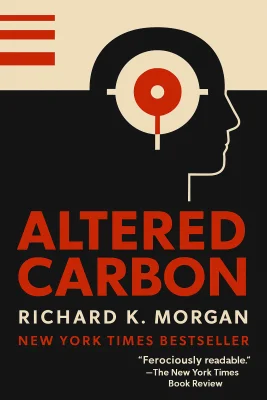
Altered Carbon
Categories
Fiction, Science Fiction, Audiobook, Mystery, Thriller, Fantasy, Science Fiction Fantasy, Crime, Cyberpunk, Noir
Content Type
Book
Binding
Kindle Edition
Year
2017
Publisher
Del Rey
Language
English
ASIN
B000FBFMZ2
File Download
PDF | EPUB
Altered Carbon Plot Summary
Introduction
# Altered Carbon: Death and Resurrection in Digital Flesh The needle slides into flesh with surgical precision, and Takeshi Kovacs dies screaming in a rain-soaked alley on Harlan's World. But death, in this age of digitized consciousness, is merely an inconvenience. One hundred and eighty light years away, on humanity's ancient homeworld of Earth, a new body waits in a resurrection tank. The cortical stack—that cigarette-sized repository of human memory and personality—has been transmitted across the void, carrying with it the compressed essence of a man who has killed for money, for principle, and sometimes for pleasure. Kovacs awakens in borrowed flesh to find himself conscripted by Laurens Bancroft, a Methuselah whose centuries of accumulated wealth and power have made him effectively immortal. Bancroft's problem is simple: someone murdered him. The police call it suicide, but Bancroft knows better. His remote storage backup ensures that death cannot hold him, but the missing forty-eight hours between his last memory update and his violent end represent a gap that someone desperately wants to keep closed. In the neon-drenched streets of Bay City, where human bodies are commodities and death is a temporary setback for those who can afford resurrection, Kovacs must navigate a labyrinth of corruption that reaches from the biocabin brothels of Licktown to the highest echelons of power.
Chapter 1: Resurrection in Borrowed Flesh: An Envoy's Commission
The resurrection tank splits open like a mechanical womb, spilling Takeshi Kovacs into a world that tastes of recycled air and institutional disinfectant. His new body—pale, scarred, unfamiliar—carries the muscle memory of violence and the neural architecture of a killer. The sleeve fits like an ill-tailored suit, but it will have to do. This flesh belongs to Elias Ryker, a disgraced Bay City police detective whose consciousness has been shelved to make room for an Envoy's borrowed existence. Lieutenant Kristin Ortega waits outside the re-sleeving facility, her hostility crackling like static electricity. To her, Kovacs is a ghost wearing her lover's face, an intruder in flesh she once knew intimately. Her anger runs deeper than professional disagreement—Ryker was framed for corruption, his stack locked away while his body serves as rental meat for off-world criminals. The irony isn't lost on either of them as they ride through Bay City's vertical sprawl in uncomfortable silence. Suntouch House rises from manicured lawns like a monument to accumulated centuries. Laurens Bancroft moves through his domain with the casual authority of a man who has outlived empires, his wife Miriam a stunning contradiction of ancient eyes in youthful flesh. The murder scene tells its story in scorched stucco and missing memories—a particle blast that vaporized Bancroft's head while leaving everything else untouched. Too clean for suicide, too impossible for murder. The contract Bancroft offers carries the weight of absolute necessity. Success means freedom and a fortune in UN credits. Failure means a return to storage and the completion of a century-long sentence. As Kovacs signs his name in handwriting that belongs to a dead man, he understands that he has become a piece in a game whose rules he has yet to comprehend. But the first attempt on his life comes before he even leaves the hotel, and Dimitri Kadmin's synthetic assassins paint the Hendrix lobby with their own blood, courtesy of the building's ancient defense systems.
Chapter 2: The Methuselah's Murder: Investigating Impossible Death
The investigation begins in the sterile corridors of PsychaSec, where Bancroft's backup consciousness waits in digital suspension. Director Nyman guides them through climate-controlled vaults lined with the stored essence of the wealthy, each disc containing a human lifetime compressed into quantum storage. The clone banks hang like obscene fruit, translucent sacs nurturing perfect copies of flesh that money can endlessly renew. Here, death is just another service industry. Bancroft's story fractures under scrutiny. The missing forty-eight hours before his death represent a gap that someone has carefully orchestrated. His last memory—going to bed on a Tuesday night—offers no clue to the violence that followed. The physical evidence speaks of impossibility: no forced entry, no struggle, no trace of an intruder in a house protected by military-grade security systems. Yet someone had walked into his study and blown his head off with his own antique revolver. Lieutenant Ortega's investigation reveals deeper currents of resentment. The Methuselahs—those who have lived for centuries—exist beyond the normal constraints of human justice. Their wealth insulates them from consequence, their longevity from accountability. When Bancroft speaks of perspective, comparing himself to an ancient tree that lesser mortals would casually destroy, Kovacs glimpses the vast gulf that separates the immortal from the merely long-lived. The name Elizabeth Elliott surfaces like a corpse in the bay. A young Catholic prostitute who had tried to blackmail the wrong client, found floating with her throat cut. Her faith made her doubly valuable—Catholics refuse cortical stacks on religious grounds, making their deaths permanent and their silence guaranteed. Ortega's fury at the girl's murder carries personal weight, and Kovacs begins to understand that this case runs deeper than a simple Methuselah's paranoia. Someone is killing the poor to protect the rich, and they're willing to murder anyone who gets too close to the truth.
Chapter 3: Shadows of the Underworld: Following Elizabeth Elliott's Trail
The investigation leads to Ember, a coastal town built around the rusting hulk of an ancient warship. Victor Elliott, broken by loss and consumed by rage, tells the story of his daughter Elizabeth—a young woman who sought stardom and found only degradation and death in the biocabins of Bay City. His wife Irene, caught in the digital nets of illegal data piracy, serves her sentence in storage while corporate executives wear her body like a designer suit. Elliott's fury burns with the intensity of a man who has lost everything to the casual cruelty of the powerful. His daughter's death was no random violence but a calculated silencing, orchestrated by forces that move in the shadows between legitimate business and criminal enterprise. The name Bancroft surfaces in whispered accusations, but the truth remains elusive, buried beneath layers of wealth and influence. Jerry's Closed Quarters squats beneath the elevated highway like a pustule on the city's skin, its neon promises flickering against rain-slicked concrete. The biocabins offer intimacy without connection, flesh without soul, while proprietor Jerry Sedaka orchestrates the degradation with casual efficiency. Louise, who calls herself Anenome in the professional vernacular, remembers Elizabeth Elliott with the careful neutrality of a survivor. She speaks of a young woman desperate enough to try blackmailing a Methuselah client, foolish enough to believe her Catholic faith would protect her from retaliation. The trap springs with professional precision. Jerry's associates take Kovacs with overwhelming force and deliver him to a clinic where human consciousness becomes raw material for interrogation. But they've underestimated their prisoner—Envoy conditioning runs deeper than mere physical endurance, and Kovacs has survived worse hells than anything their machines can conjure. The escape comes through calculated violence and desperate improvisation, leaving Jerry's establishment painted with the consequences of crossing an Envoy. In the back of a luxury transport, Kovacs transforms from prisoner to predator, and the message echoes through Bay City's criminal networks: the investigation will continue, and those who stand in its way will face consequences that transcend mere death.
Chapter 4: Virtual Torture and Corporate Conspiracy: The Wei Clinic
The Wei Clinic rises from the industrial district like a medical cathedral, its white walls hiding horrors that would make medieval torturers weep with envy. Dr. Bancroft's enemies have lured Kovacs into their web, using his investigation as bait for a trap decades in the making. The clinic's virtual interrogation chambers can stretch minutes into subjective years, breaking minds with the patience of geological time. Kovacs awakens strapped to a surgical table, his borrowed flesh opened like a textbook while the interrogators work. The clinic specializes in extracting information through carefully calibrated suffering, their virtual environments designed to shatter psychological defenses without damaging the valuable cortical stack. Pain becomes a language that transcends the boundaries between real and simulated flesh, and they speak it fluently. But they've underestimated their prisoner. In the spaces between agony, Kovacs constructs mental barriers, compartmentalizing trauma while gathering intelligence. The name Ryker surfaces repeatedly—a corrupt cop whose identity Kovacs has apparently inherited along with his sleeve. The interrogators seek information about connections that exist only in their paranoid imaginings, torturing a man for crimes he has never committed. The escape leaves bodies in its wake, the clinic's sterile corridors painted with the consequences of corporate greed. Kovacs carries evidence of the conspiracy in his damaged flesh—neural patterns that reveal the true scope of the operation. This isn't just about Bancroft's murder or Elliott's death. Someone is using Bay City's underworld to eliminate threats to a much larger scheme, one that reaches into the highest levels of government and corporate power. The virtual torture was meant to break him, but instead it has revealed the true enemy: Reileen Kawahara, a name from his past that carries the weight of old betrayals and unfinished business.
Chapter 5: Head in the Clouds: Confronting the Aerial Brothel
Head in the Clouds drifts through the stratosphere like a technological leviathan, its hull bristling with sensors and weapons. The airborne brothel caters to the elite's darkest appetites, offering experiences that would be impossible on the ground. Here, in international airspace beyond the reach of law, the wealthy can indulge fantasies that would destroy lesser mortals. The establishment's reputation for discretion is built on a foundation of corpses and silence. Kovacs infiltrates the airship using stolen credentials and chemical camouflage, his body temperature lowered to evade thermal sensors. The Reaper drug courses through his veins, slowing his metabolism to near-death levels while stimulants keep his mind sharp. He moves through the ship's corridors like a ghost, invisible to the security systems that would normally detect intruders. The irony is perfect—he must become temporarily dead to expose the truth about permanent death. Mary Lou Hinchley had fallen from these heights, her body shattering on the ocean's surface like a broken promise. The young Catholic woman had been selected for a snuff scenario, her permanent death part of the entertainment package. When she discovered her fate and tried to escape, gravity became her executioner. Her corpse washing ashore triggered the investigation that would eventually destroy everyone involved. The ship's records reveal the true scope of the conspiracy. Head in the Clouds isn't just a brothel—it's a recruitment center for a network that supplies victims to the wealthy elite. Young people, often from desperate circumstances, are lured aboard with promises of easy money and then trapped in contracts that make them property. Many are Catholics who have taken vows preventing their revival after death, making them perfect victims for clients who want to indulge in real murder. At the center of it all is Kawahara, using her influence to protect the network and eliminate anyone who threatens it. But Bancroft's murder was something different—the Meth had discovered the truth and threatened to expose the entire operation.
Chapter 6: Kawahara's Web: Double-Sleeving and Deadly Gambles
The revelation hits like a physical blow—Kovacs exists in two bodies simultaneously, a violation of both law and nature that could earn him centuries in storage. One version infiltrates Head in the Clouds while another maintains his cover in Bay City, the dual existence a desperate gambit to outmaneuver Kawahara's surveillance network. The psychological strain of divided consciousness threatens to tear his identity apart, but the mission demands this ultimate sacrifice. Reileen Kawahara emerges from the shadows like a spider sensing vibrations in her web. The centuries-old Meth controls vast networks of influence, her power built on the bones of the weak and the silence of the dead. She and Kovacs share history—former lovers turned enemies, their relationship poisoned by ideological differences and personal betrayals. Her offer comes wrapped in threats: abandon the investigation or watch everyone he cares about suffer in virtual purgatory. The confrontation unfolds in the basilica of a Spanish monastery, surrounded by the monuments of dead tyrants and the gray-wrapped forms of Kawahara's clone bodies hanging like cocoons in the shadows. She confesses with the casual arrogance of someone who believes herself untouchable, her words recorded by microscopic devices hidden in Kovacs' skull. The truth spills out like poison from a broken vial—Bancroft was drugged and manipulated, his enhanced aggression channeled toward a victim chosen for maximum psychological impact. Trepp's betrayal comes at the worst possible moment, her stunner dropping Kovacs as he confronts Kawahara with the evidence of her crimes. The mercenary's loyalty has shifted, perhaps influenced by conscience or simply better payment terms. But her change of heart comes too late—Kawahara's rage at being outmaneuvered transforms her from elegant predator to feral killer. The mask of civilization falls away, revealing the water carrier from Fission City's radioactive slums. The fight spills across the ancient stones with desperate fury, two enhanced humans locked in combat while history watches in stone silence.
Chapter 7: The Final Truth: Bancroft's Real Killer Revealed
The aftermath unfolds in sterile conference rooms and legal chambers, where truth is dissected by lawyers and bureaucrats who never risked their lives for justice. Kovacs awakens in Ryker's body once more, his other self's memories integrated like a fever dream. The double-sleeving violation is overlooked in light of his service, but the psychological cost lingers like radiation sickness. He carries the weight of two sets of experiences, two versions of the same crucial days. But the real revelation comes not from Kawahara's conspiracy but from a more intimate betrayal. The evidence points inexorably toward Suntouch House and the woman who had access to Bancroft's study, his weapons, his trust. Miriam Bancroft had killed her husband in a moment of rage, then manipulated the investigation to hide her crime behind a web of conspiracy and corruption that reached from the orbital brothels to the halls of government. The confrontation in Bancroft's conservatory carries the weight of accumulated violence and revelation. The Methuselah's composure cracks under the pressure of Kovacs' relentless investigation, revealing the appetites that drive a man who has outlived normal human constraints. But it's Miriam's true nature that emerges in fragments of memory and deduction—her resemblance to both victims and her careful selection of young women who mirror her own features before orchestrating their destruction. Bancroft learns the truth about his wife's betrayal with the stoic acceptance of someone who has survived three centuries of disappointment. The missing forty-eight hours reconstruct themselves through forensic deduction and psychological insight—a visit to the biocabins, a confrontation with Elizabeth Elliott, and a moment of conscience that threatened to expose decades of carefully concealed atrocity. Miriam's response was swift and decisive, a particle blast that erased her husband's inconvenient memories along with his head. The case closes not with legal resolution but with the quiet satisfaction of personal accounts finally balanced, leaving Kovacs to contemplate the price of resurrection in a universe where even death has become negotiable.
Summary
In the end, Takeshi Kovacs discovers that immortality does not elevate humanity but merely amplifies its capacity for both creation and destruction. The Methuselahs, freed from the constraints of mortality, have not transcended human nature but have instead refined its darkest impulses to an art form. Bancroft's murder was not the work of external enemies but the inevitable consequence of appetites that centuries of indulgence had transformed into monstrous compulsions. The investigation reveals a world where human consciousness has become just another commodity, where bodies are disposable and memories can be edited to serve the powerful. The case concludes with the understanding that justice, in a world where death has lost its sting, must be redefined to match the new realities of human existence. The cortical stack technology that promises immortality also creates new forms of vulnerability, new ways to suffer and die. In the digital realm where consciousness can be copied, edited, and destroyed, the ancient human drives for power, pleasure, and revenge find new expressions that transcend the boundaries of flesh and time. Kovacs walks away from Bay City carrying the weight of revelation—that in humanity's quest to conquer death, they have instead created new forms of hell, and the only true escape lies not in technology but in the choices that define what it means to be human.
Best Quote
“The personal, as everyone’s so fucking fond of saying, is political. So if some idiot politician, some power player, tries to execute policies that harm you or those you care about, take it personally. Get angry. The Machinery of Justice will not serve you here – it is slow and cold, and it is theirs, hardware and soft-. Only the little people suffer at the hands of Justice; the creatures of power slide from under it with a wink and a grin. If you want justice, you will have to claw it from them. Make it personal. Do as much damage as you can. Get your message across. That way, you stand a better chance of being taken seriously next time. Of being considered dangerous. And make no mistake about this: being taken seriously, being considered dangerous marks the difference - the only difference in their eyes - between players and little people. Players they will make deals with. Little people they liquidate. And time and again they cream your liquidation, your displacement, your torture and brutal execution with the ultimate insult that it’s just business, it’s politics, it’s the way of the world, it’s a tough life and that it’s nothing personal. Well, fuck them. Make it personal.” ― Richard K. Morgan, Altered Carbon
Review Summary
Strengths: The review acknowledges the interesting concept of resleeving, where consciousness is transferred to new bodies, and appreciates the exploration of its implications, including religious opposition and the notion of "real" death. Weaknesses: The review criticizes the book for excessive and unnecessary sexual content, describing it as distracting and irrelevant to the plot. The narrative is considered overly long and convoluted, with wooden characters and an unsatisfying resolution. The book's portrayal of women and sexual scenes is described as cringeworthy and juvenile. Overall: The reader expresses a negative sentiment, feeling misled by the book's sci-fi premise, which was overshadowed by gratuitous sexual content. The reviewer does not recommend the book and is unlikely to continue with the series.
About Author

Richard K. Morgan
Morgan interrogates the complexities of identity and control within speculative fiction, crafting narratives that push boundaries while exploring the darker aspects of human nature. His work delves into the intersection of technology and power, often featuring morally ambiguous protagonists and intricate plots. Known for a gritty, hard-boiled style influenced by William Gibson and Raymond Chandler, Morgan’s books challenge genre conventions, offering readers a unique blend of cyberpunk and noir elements.\n\nFor readers seeking thought-provoking narratives, Morgan's storytelling offers profound insights into corporate and governmental influences on individual autonomy. His novel "Altered Carbon" exemplifies this approach, as it explores themes of consciousness transfer in a future dominated by technological advancements. Beyond this notable book, Morgan’s standalone novel "Thirteen", also known as "Black Man", further delves into societal divides and ethical quandaries in a speculative setting, while his graphic novels such as "Black Widow: Homecoming" expand his exploration into visual storytelling.\n\nMorgan’s impact on science fiction and fantasy has been recognized with awards like the Philip K. Dick Award for "Altered Carbon" and the Arthur C. Clarke Award for "Thirteen". By merging literary and genre influences, Morgan crafts stories that resonate with audiences who appreciate narratives rich in depth and complexity. This brief bio of the author underscores his significant contribution to contemporary speculative fiction, inviting readers to explore the philosophical questions embedded within his works.
Read moreDownload PDF & EPUB
To save this Black List summary for later, download the free PDF and EPUB. You can print it out, or read offline at your convenience.
Altered Carbon
by Richard K. Morgan
