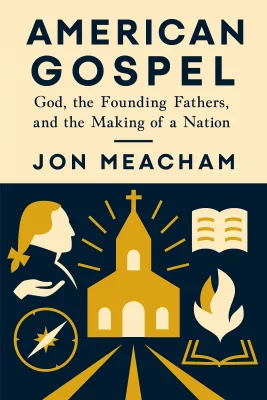
American Gospel
God, the Founding Fathers, and the Making of a Nation
Categories
Nonfiction, Philosophy, History, Religion, Politics, Christianity, American, Historical, American History, American Revolution
Content Type
Book
Binding
Hardcover
Year
2006
Publisher
Random House
Language
English
ISBN13
9781400065554
File Download
PDF | EPUB
American Gospel Plot Summary
Introduction
# Faith and Freedom: The American Religious Experiment On a September morning in 1774, as delegates to the first Continental Congress gathered in Philadelphia's Carpenters' Hall, their first debate was not about taxation or representation, but about prayer. Some objected that the colonies were "so divided in religious sentiments" that they could not join in common worship. Yet Samuel Adams rose to suggest they invite an Episcopal clergyman to lead them in prayer, and the motion passed. The next morning, as Reverend Duché read Psalm 35—"Plead my cause, O Lord, with them that strive with me"—John Adams wrote to his wife that he had "never saw a greater effect upon an audience." It seemed, he said, "as if Heaven had ordained that Psalm to be read on that morning." This moment captures the essential tension that would define America's relationship with religion for centuries to come. The Founders were creating something unprecedented: a nation that would neither establish an official church nor banish faith from public life. They understood that religion could be both a source of tyranny and a wellspring of liberty, both a divider of peoples and a unifier around shared moral principles. From the Mayflower's arrival to the civil rights movement, from Jefferson's "wall of separation" to Reagan's "city upon a hill," Americans have wrestled with fundamental questions about the proper role of faith in democratic society. This ongoing dialogue between belief and governance, between the sacred and the secular, reveals not a nation at war with itself, but one engaged in the delicate work of balancing freedom with responsibility, individual conscience with common purpose.
Chapter 1: Colonial Foundations: From Theocracy to Religious Pluralism
The first permanent English settlements in America were driven by two powerful forces that would shape the continent's destiny: the pursuit of gold and the quest for God. When the Virginia Company received its charter in 1606, King James I devoted only ninety-eight words out of nearly four thousand to religious purposes, while pages detailed the rights to "dig, mine, and search for all Manner of Mines of Gold, Silver, and Copper." Captain John Smith observed that faith was merely "their color, when all their aim was nothing but present profit." Yet within a generation, a different vision took root in New England. John Winthrop's Puritans aboard the Arbella in 1630 carried with them a covenant theology that would profoundly influence American political thought. In his famous sermon "A Model of Christian Charity," Winthrop declared that they would be "as a city upon a hill, the eyes of all people are upon us." This was no mere metaphor but a binding contract with the Almighty, one that promised divine favor for righteousness and divine judgment for transgression. The early colonial experience revealed both the promise and the peril of mixing religious conviction with political power. Massachusetts Bay Colony, founded on principles of religious freedom, quickly became intolerant of dissent. Anne Hutchinson was banished for her theological views, and the colony's legal code prescribed death for those who worshipped "any God but the Lord God." Meanwhile, Roger Williams, exiled from Massachusetts, founded Rhode Island on the radical principle that there should be "a hedge or wall of separation between the Garden of the church and the wilderness of the world." These competing visions—religious establishment versus religious liberty—created a laboratory of faith across the American colonies. Pennsylvania's Quaker experiment in tolerance, Maryland's brief protection of Catholics, and the gradual arrival of Jewish settlers in New Amsterdam all contributed to an unprecedented religious diversity. By the time of the Revolution, this pluralism had become both a practical necessity and a philosophical conviction. As James Madison would observe, the "variety of sects dispersed over the entire face" of the country would "secure the national councils against any danger" from religious faction.
Chapter 2: Revolutionary Vision: Creating Public Religion in a New Nation
The American Revolution was fought not just for political independence but for a new understanding of the relationship between divine authority and human government. When Thomas Jefferson penned the Declaration of Independence in his rented rooms on Market Street, he carefully chose religious language that would unite rather than divide. His "Nature's God" and "Creator" were deliberately non-sectarian, drawing on Enlightenment philosophy rather than biblical revelation. Yet these were not merely deistic abstractions—Jefferson's God was actively engaged in human affairs, endowing all people with "certain unalienable rights." The Constitutional Convention of 1787 faced the delicate task of creating a government that could accommodate the nation's religious diversity without either establishing or destroying faith. When Benjamin Franklin called for daily prayers during the difficult summer debates, he was rebuffed by delegates who thought such appeals "unnecessary." Yet the final document, while containing no explicit mention of God, prohibited religious tests for federal office and implicitly recognized the divine source of human rights through its protection of religious liberty. The ratification debates revealed deep anxieties about the Constitution's religious implications. Some, like William Williams of Connecticut, wanted explicit acknowledgment of Jesus Christ as "Ruler among the nations." Others worried that any religious establishment would inevitably favor one sect over another. The solution came through the Bill of Rights, whose First Amendment created what Jefferson would later call "a wall of separation between Church & State"—not to protect government from religion, but to protect religion from government interference. This revolutionary settlement created what Benjamin Franklin called "public religion"—a shared civic faith that acknowledged divine providence while respecting individual conscience. George Washington's Farewell Address captured this balance perfectly, arguing that "religion and morality" were "indispensable supports" of political prosperity while insisting that "every man has the same right to attend or not attend the church of his choice." The Founders had achieved something remarkable: a nation that was neither officially Christian nor militantly secular, but genuinely free.
Chapter 3: Constitutional Framework: Balancing Church and State
The Constitution of 1787 represented a masterpiece of religious statecraft, creating a framework that could accommodate both the nation's Christian heritage and its growing religious diversity. The document's most radical feature was not what it included but what it omitted: any reference to Jesus Christ, the Trinity, or Christian doctrine. Instead, the Founders crafted what historian Isaac Kramnick called "the godless Constitution"—not because they were atheists, but because they refused to privilege any particular faith. James Madison emerged as the chief architect of this new approach to church-state relations. His Virginia Statute for Religious Freedom, passed in 1786, had already demonstrated that disestablishment strengthened rather than weakened religion by freeing it from political corruption. Madison argued that religious liberty was not just a practical necessity but a natural right that preceded government and therefore could not be granted or revoked by political authority. His "Memorial and Remonstrance Against Religious Assessments" made the case that even non-preferential aid to religion violated conscience by forcing citizens to support religious teachings they might reject. The First Amendment's religion clauses, ratified in 1791, reflected this hard-won wisdom about the relationship between faith and freedom. The Establishment Clause prevented Congress from creating a national church or preferring one denomination over others, while the Free Exercise Clause protected individual religious practice from government interference. Together, these provisions created what Jefferson called "a wall of separation between church and state"—not to banish religion from public life but to protect both religious liberty and democratic governance from the corrupting influence of political establishment. This constitutional settlement faced immediate challenges as the young nation grappled with practical questions about religion's public role. Could government chaplains offer prayers at legislative sessions? Should religious oaths be required for state offices? Could public funds support religious schools? The answers emerged not from abstract constitutional theory but from the ongoing negotiation between competing claims of conscience in a pluralistic democracy. The genius of the American system lay not in resolving these tensions once and for all but in creating a framework within which they could be debated peacefully and resolved democratically.
Chapter 4: Civil War Crisis: Divine Providence and National Reckoning
Abraham Lincoln arrived in Washington as perhaps the least conventionally religious president in American history. He had never joined a church, rarely quoted scripture in his early political career, and once wrote a pamphlet questioning the divinity of Christ. Yet the crucible of civil war transformed Lincoln into America's greatest theologian-president, a man who would redefine the nation's relationship with the divine in the face of unprecedented suffering and moral reckoning. The war began with both sides claiming God's blessing. Confederate President Jefferson Davis called for a day of "fasting, humiliation, and prayer" before firing on Fort Sumter, while Northern ministers proclaimed the conflict a holy war against the sin of slavery. Lincoln initially avoided such certainty, telling a delegation of ministers that his concern was not whether God was on the Union's side, but whether the Union was on God's side. As the carnage mounted—600,000 dead by war's end—Lincoln developed a more complex theology that saw divine judgment falling on both North and South. This theological evolution reached its pinnacle in Lincoln's Second Inaugural Address, delivered just weeks before his assassination. Standing before the Capitol on a muddy March day in 1865, Lincoln offered not triumphant vindication but humble submission to divine mystery. "Both read the same Bible and pray to the same God," he observed of North and South, "and each invokes His aid against the other." The war's length and ferocity suggested that God had purposes beyond human understanding—perhaps to ensure that "every drop of blood drawn with the lash shall be paid by another drawn with the sword." Lincoln's vision of America as an "almost chosen people"—blessed but not beyond judgment—became the template for how the nation would understand its role in history. The Civil War had tested whether a nation "conceived in liberty and dedicated to the proposition that all men are created equal" could survive. Lincoln's answer was that it could, but only through the painful process of national repentance and renewal. His assassination on Good Friday 1865 sealed this interpretation, making Lincoln himself a Christ-like figure who died to redeem the nation's sins.
Chapter 5: Modern Challenges: Culture Wars and Presidential Faith
The twentieth century brought unprecedented challenges that tested America's religious foundations in new ways. Franklin Roosevelt, facing the Great Depression and global war, drew naturally on biblical imagery to rally a dispirited nation. His inaugural promise that "the only thing we have to fear is fear itself" was followed by references to the "money changers" in the temple and the biblical warning that "where there is no vision the people perish." Roosevelt understood that Americans needed not just economic recovery but spiritual renewal. World War II presented the starkest possible contrast between religious freedom and totalitarian oppression. Roosevelt's D-Day prayer, delivered to an estimated one hundred million Americans, cast the invasion of Nazi-occupied Europe in explicitly religious terms: "Lead them straight and true; give strength to their arms, stoutness to their hearts, steadfastness in their faith." The war was fought not merely for national interest but for the principle that human rights came from God, not from the state, and therefore could not be revoked by earthly powers. The postwar era saw both the flowering of American civil religion and growing tensions over its proper boundaries. President Eisenhower added "under God" to the Pledge of Allegiance and made "In God We Trust" the national motto, while the Supreme Court began erecting higher walls between church and state. The 1962 decision banning official prayer in public schools sparked fierce controversy, with critics charging that the Court had "driven God out" of American education. The cultural upheavals of the 1960s and 1970s created new fault lines in American religious life. The Supreme Court's decisions on school prayer and abortion rights, combined with rapid social changes around sexuality and family structure, mobilized conservative Christians who had previously remained largely outside of politics. Jerry Falwell, who in 1965 had declared that "preachers are not called to be politicians but to be soul winners," founded the Moral Majority in 1979 and helped elect Ronald Reagan to the presidency. Reagan masterfully employed the language of public religion while respecting the boundaries between church and state, demonstrating how religious rhetoric could serve legitimate political purposes without crossing into theocracy.
Chapter 6: Contemporary Balance: Religion in Twenty-First Century Democracy
As America enters the twenty-first century, the founders' experiment in balancing faith and freedom faces new challenges but remains fundamentally sound. The nation's increasing religious diversity, including growing numbers of Muslims, Hindus, Buddhists, and non-believers, tests the capacity of American civil religion to embrace citizens of all faiths and none. Yet the constitutional framework established in the 1780s has proven remarkably adaptable to changing circumstances. Contemporary debates over issues like abortion, same-sex marriage, and religious liberty in the workplace reflect the ongoing challenge of balancing competing claims of conscience in a pluralistic society. The American solution has never been to eliminate religion from public discourse but to ensure that no single religious voice drowns out all others. This requires both religious believers willing to translate their convictions into broadly accessible moral language and secular citizens willing to acknowledge the legitimate role of faith-based arguments in democratic deliberation. The rise of the "nones"—Americans who claim no religious affiliation—has created new dynamics in American religious politics. Yet even as traditional religious observance declines, Americans continue to wrestle with ultimate questions about meaning, morality, and transcendence. The challenge for contemporary democracy is to maintain space for these conversations while preventing any single worldview from dominating public life through political power. The key insight of the American founding remains as relevant today as it was in 1787: religious liberty and democratic governance strengthen rather than threaten each other when properly balanced. Religious faith provides the moral foundation that democracy requires, while democratic institutions protect the freedom of conscience that authentic faith demands. This symbiotic relationship has allowed both religion and democracy to flourish in America as nowhere else in the world. The path forward requires neither the triumph of secularism nor the victory of any particular faith but the continued commitment to constitutional principles that protect both believers and non-believers. Americans must approach contemporary debates with humility about ultimate questions while maintaining clarity about democratic values. Most importantly, they must remember that their greatest strength lies not in religious uniformity but in the ability to maintain both deep faith and genuine freedom within a single democratic framework.
Summary
The central tension running through American history has been the ongoing struggle to balance religious faith with religious freedom in a diverse democracy. From the Puritan settlements to the present day, Americans have grappled with fundamental questions about how a deeply religious people can create a government that serves citizens of all faiths and none. The founders' answer was neither to banish religion from public life nor to establish a particular faith, but to create space for what they called "public religion"—a broad acknowledgment of divine authority that could unite Americans across denominational lines while protecting individual conscience. This delicate balance has been tested repeatedly throughout American history, from the Civil War's challenge to the nation's moral foundations to the twentieth century's confrontation with totalitarian ideologies that rejected religious faith entirely. Each generation has had to rediscover the founders' insight that religious liberty is not the enemy of religious faith but its greatest protector. When government stays out of the business of defining religious truth, all faiths are free to flourish and contribute to the common good. The lesson for contemporary Americans is clear: neither rigid secularism nor sectarian dominance serves the nation well. Instead, the country needs what the founders called "charity toward all"—a generous spirit that can acknowledge differences while celebrating shared commitment to human dignity and freedom. The ongoing negotiation between faith and freedom is not a flaw in the American system but its greatest strength, addressing permanent features of human nature while creating space for both transcendent meaning and political liberty to flourish together.
Best Quote
“Democracy is easy; republicanism is hard. Democracy is fueled by passion; republicanism is founded on moderation. Democracy is loud, raucous, disorderly; republicanism is quiet, cool, judicious – and that we still live in its light is the Founders' most wondrous deed.” ― Jon Meacham, American Gospel: God, the Founding Fathers, and the Making of a Nation
Review Summary
Strengths: The book offers a moderate and well-researched exploration of America's religious history, supported by numerous quotes and sources. It provides interesting takeaways and lesser-known facts, making it suitable for discussion. The inclusion of illustrations and appendices enhances the reading experience. Weaknesses: The book is heavily influenced by the author's interpretations of historical figures' religious beliefs. It lacks groundbreaking insights and is relatively brief, with a significant portion dedicated to sources and bibliography. Overall: The review suggests that "American Gospel" is a quick and simple read, suitable for those interested in political or religious discussions. While not groundbreaking, it effectively highlights the diversity of American religious history.
About Author

Jon Meacham
Meacham probes the intricate tapestry of American history, focusing on the dynamic interplay between leadership, morality, and national identity. Through his work, he seeks to explore how historical figures and moments shape the ongoing American narrative. His narrative-driven style, characterized by rigorous scholarship, allows readers to engage with pivotal events as both historical accounts and contemporary reflections. This approach is evident in his Pulitzer Prize-winning book, "American Lion: Andrew Jackson in the White House," where he delves into the complexities of Jackson's presidency, revealing both its transformative and controversial aspects.\n\nIn addressing themes such as democracy, faith, and the struggle for ideals, Meacham's books often provide insights into the moral dimensions of public life. His exploration in "The Soul of America: The Battle for Our Better Angels" situates historical challenges within the context of modern struggles, offering readers a lens through which to view current societal issues. Meanwhile, "And There Was Light: Abraham Lincoln and the American Struggle" further cements his reputation as a chronicler of presidential history, emphasizing the ongoing dialogue between past and present leadership.\n\nThe author’s work is particularly valuable for those interested in the intersection of history, politics, and culture, as his accessible prose and compelling narratives make complex historical themes relatable. Beyond enriching the reader's understanding of American history, his writings serve as a guide for contemplating the moral complexities of leadership. Through his acclaimed works and contributions to scholarly and public discourse, Meacham’s bio exemplifies the power of history to inform and inspire, making him a significant figure in American historiography.
Read moreDownload PDF & EPUB
To save this Black List summary for later, download the free PDF and EPUB. You can print it out, or read offline at your convenience.
American Gospel
by Jon Meacham
