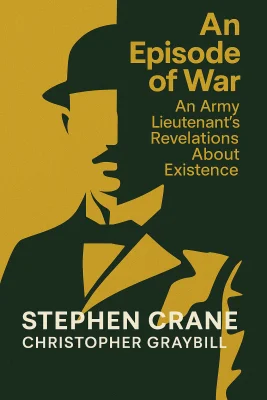
An Episode of War
An Army Lieutenant's Revelations About Existance
Categories
Short Stories, School
Content Type
Book
Binding
Audiobook
Year
0
Publisher
Listen & Live
Language
English
ASIN
B0DN1RDKM1
File Download
PDF | EPUB
An Episode of War Plot Summary
Introduction
The morning mist clings to the hills like a shroud over an army awakening from winter's grip. In the distance, enemy campfires glimmer red as malevolent eyes, while rumors of movement ripple through the ranks like fever. Henry Fleming lies in his crude hut, heart hammering against his ribs as he contemplates the terrible question that gnaws at every untested soldier: will he run when the bullets begin to sing? This is the American Civil War, where boys become men in the crucible of battle, and where courage is not born but forged in blood and terror. Henry, barely more than a farm boy from New York, has enlisted against his mother's wishes, drawn by romantic visions of glory and heroic deeds. But as dawn breaks over the battlefield, those dreams begin to crumble under the weight of approaching reality. What follows is a brutal education in the true nature of war, cowardice, and the complex alchemy by which fear transforms into something resembling valor.
Chapter 1: Romantic Illusions: The Youth's Untested Dreams of Glory
Henry Fleming had dreamed of battles all his life, visions painted in brilliant colors of charging cavalry and waving banners. In his mother's farmhouse, he had devoured tales of ancient warriors and modern heroes, imagining himself striding through smoke and fire, eagle-eyed and magnificent. The war seemed like a grand theater where he might finally prove his worth. But his mother had other plans. When Henry announced his intention to enlist, she merely covered her face with her quilt and said nothing. The next morning, she was milking the brindle cow when he returned from town wearing Union blue. "The Lord's will be done, Henry," she said simply, never looking up from her work. Her parting words were not of glory or honor, but of keeping warm socks and avoiding bad company. The journey to Washington had been intoxicating. At every station, girls smiled and old men patted shoulders, feeding the recruits bread and cheese while speaking of their noble cause. Henry felt himself growing into the hero he had always imagined, basking in the warmth of public adoration. But then came the reality of camp life, months of drilling and waiting that slowly tarnished his golden expectations. Now, as rumors of battle circulate through the ranks, Henry finds himself tormented by a question he had never seriously considered. What if, when the moment came, his legs simply carried him away from danger? What if the romantic hero crumbling inside his chest revealed himself to be nothing more than a frightened boy? The thought gnaws at him like a physical pain, and he searches the faces of his comrades for any sign that they share his terrible doubt. Jim Conklin, the tall soldier who spreads news like gospel, seems confident enough. Wilson, the loud young private, boasts endlessly about what he'll do to the rebels. But Henry can find no comfort in their bravado. As night falls over the camp, he lies awake listening to the distant sound of enemy drums, wondering if tomorrow will reveal him as the coward he fears himself to be.
Chapter 2: The Specter of Fear: Confronting the Unknown Within
Dawn brings the harsh reality Henry has been dreading. The regiment is roused before sunrise, formed into columns that snake through misty fields toward an appointment with destiny. Henry's stomach churns as he marches, his mind racing through calculations of courage and cowardice. Around him, other soldiers joke nervously or march in grim silence, but none seem to share the paralyzing terror that grips his heart. The landscape they traverse feels ominous, every shadow potentially harboring death. Henry studies the faces of veterans from other regiments, searching for clues about what awaits him. Some speak of gray-clad hordes advancing with relentless fury, others describe ragged, desperate men who fight with the ferocity of cornered animals. The contradictory tales only deepen his uncertainty. As they near the front lines, the sound of distant gunfire begins to filter through the trees. Henry's mouth goes dry, and his hands shake as he grips his rifle. The weapon feels foreign and unwieldy, nothing like the tool of heroism he had imagined. When the regiment finally halts and takes position behind hastily constructed earthworks, Henry feels the weight of approaching doom settling on his shoulders like a lead blanket. The waiting becomes unbearable. Through gaps in the trees, he can see flashes of movement, the glint of sunlight on bayonets. The artillery begins to roar, and shells whistle overhead with sounds like banshees wailing. Henry watches his comrades nervously checking their weapons and adjusting their gear, but their faces reveal nothing of their inner thoughts. Then Wilson approaches with a small packet wrapped in yellow paper. His usually boisterous demeanor has vanished, replaced by a pale solemnity that chills Henry to the bone. "It's my first and last battle, old boy," Wilson says, pressing the packet into Henry's hands. "Something tells me I won't make it through. Take these things to my folks." The confession of fear from his previously confident friend only amplifies Henry's own terror, confirming his worst suspicions about what awaits them in the approaching storm.
Chapter 3: Flight and Shame: The Desertion and Its Haunting Shadow
The battle erupts with volcanic fury, transforming the peaceful countryside into a hellscape of smoke and screaming metal. Henry finds himself caught in a maelstrom of noise and confusion, his rifle firing almost of its own accord while his mind struggles to process the chaos around him. For a few miraculous moments, he becomes part of something larger than himself, swept along by the collective will of the regiment as they repel the first Confederate assault. Victory tastes sweet, but the celebration is short-lived. The enemy regroups and attacks again, this time with greater ferocity. Henry watches in horror as men around him begin to break and run, their nerve shattered by the relentless pressure. When a soldier beside him throws down his rifle and flees with a scream of terror, something inside Henry's chest snaps like a taut wire. Without conscious thought, his legs begin to move. One moment he is standing in the firing line, the next he is crashing through underbrush in full retreat, his equipment bouncing wildly as branches tear at his uniform. Behind him, the sound of battle continues, but Henry can only think of escape, of putting as much distance as possible between himself and the murderous chaos he has abandoned. The forest becomes his refuge and his prison. As he stumbles deeper into the wilderness, Henry's mind churns with justifications for his flight. He tells himself that retreat was the only rational choice, that staying would have been suicide, that he was preserving himself for future battles. But even as he constructs these defenses, shame burns in his chest like acid. The sounds of renewed fighting reach him through the trees, and to his horror, Henry realizes that his regiment has not collapsed as he expected. The battle continues without him, his comrades standing firm while he cowers in the woods like a whipped dog. The knowledge transforms his fear into something far worse, a toxic mixture of shame and self-loathing that will haunt him for the rest of his journey. He has failed the ultimate test, and there seems no way back from this moral abyss.
Chapter 4: The Counterfeit Badge: Wounds of Deception and Identity
Wandering through the forest like a lost soul, Henry encounters a column of wounded men streaming away from the battle. Among them staggers a soldier so grievously hurt that blood soaks through his makeshift bandages, yet he continues to question Henry about his own supposed wound. The man's innocent curiosity becomes a knife twisting in Henry's conscience, forcing him to mumble vague responses while burning with shame at his deception. As if summoned by fate's cruel hand, Henry recognizes the spectral figure of Jim Conklin among the walking wounded. His tall friend has been shot through the side, and his face bears the gray pallor of approaching death. "Where yeh been, Henry?" Jim asks with heartbreaking simplicity, still concerned about his friend's welfare even as his own life ebbs away. The question cuts deeper than any blade. Henry watches in helpless anguish as Jim staggers away from the road, driven by some animal instinct to find a private place to die. Following at a distance, Henry and the tattered soldier witness Jim's final moments, a grotesque dance of death that ends with his body falling like a toppled tree. The sight sears itself into Henry's memory, a testament to the courage he lacks and the loyalty he has betrayed. In the gathering dusk, Henry finds himself alone with the persistent tattered man, whose gentle probing about wounds becomes unbearable. Unable to maintain his deception any longer, Henry abandons the injured soldier in a field, leaving him to wander helplessly in the darkness. This second act of betrayal completes his moral collapse, transforming him into something less than human in his own eyes. But fate offers him an unexpected reprieve. Caught up in a panicked retreat, Henry is struck on the head by a fleeing soldier's rifle butt when he tries to ask questions about the battle's progress. The blow opens his scalp, providing him with the genuine wound he needs to explain his absence. As he staggers through the night, blood trickling down his face, Henry realizes that fortune has granted him the red badge of courage he could not earn through valor. Yet the knowledge that his wound comes from cowardice rather than heroism makes it feel like a mark of shame rather than honor.
Chapter 5: Return to the Ranks: Redemption Through Fire
A mysterious soldier appears out of the darkness like an angel of mercy, guiding the wounded and disoriented Henry back to his regiment. The man's cheerful voice and sure knowledge of the terrain seem almost supernatural, and he vanishes as suddenly as he appeared, leaving Henry to wonder if he was real or merely a fever dream brought on by his injury. Wilson greets Henry's return with genuine relief and concern, his earlier bravado replaced by a newfound maturity born of battle. The loud young soldier tends to Henry's wound with surprising gentleness, never questioning the story of his absence or the circumstances of his injury. In Wilson's transformation, Henry glimpses the possibility of his own redemption, though the path remains unclear. The night passes in fitful rest, but dawn brings fresh challenges. The regiment prepares for another day of fighting, and Henry must confront the reality of returning to battle. His head throbs from the wound, but his greater pain comes from the weight of his previous failure. As he checks his rifle and adjusts his gear, he wonders if he will find courage or simply repeat his earlier disgrace. The men around him show signs of wear from the previous day's fighting, but their resolve remains firm. Henry listens to their casual discussions of tactics and casualties, marveling at how they treat such momentous events with workmanlike practicality. Their acceptance of him back into the ranks offers a form of absolution, though he knows he has yet to truly earn it. When Wilson casually asks for the return of the packet he had entrusted to Henry before the first battle, the request carries unexpected weight. The yellow envelope represents Wilson's moment of weakness, his confession of fear that now embarrasses him. As Henry returns the unopened packet, he realizes that his friend has moved beyond his earlier doubts, achieving the kind of genuine courage that still eludes Henry himself. The transaction becomes a symbol of the growth possible through trial by fire, offering Henry hope that his own transformation might yet be possible.
Chapter 6: The Flag Bearer: Courage Found in Desperate Hours
The regiment advances into another furnace of battle, but this time Henry moves with grim determination rather than paralyzing fear. The previous day's shame burns in his chest like fuel, driving him forward when others might falter. As bullets sing through the air and shells burst around them, Henry discovers that his terror has transformed into something harder and more useful, a cold fury that focuses his mind on survival and duty. When the attack stalls under withering Confederate fire, Henry watches the color bearer fall with the regimental flag clutched in his dying hands. Without conscious thought, Henry lunges forward to grasp the fallen standard, wrestling it free from the corpse's grip even as Wilson reaches for it from the other side. The flag becomes more than cloth and wood in Henry's hands; it transforms into a symbol of everything he has failed to be, everything he might yet become. Carrying the colors, Henry finds himself at the front of every charge, waving the flag like a battle standard while his voice rises in encouragement to his wavering comrades. The boy who once fled in terror now stands firm under fire, his earlier cowardice forgotten in the desperate fury of combat. But this newfound courage comes not from noble inspiration, but from a darker source, the need to prove himself worthy of the uniform he wears. The battle becomes a blur of smoke and flame, charge and countercharge, with Henry at the center of it all. He fights with the desperation of a man seeking redemption, as if each bullet fired and each step forward might wash away the stain of his earlier flight. The flag in his hands becomes his anchor, keeping him rooted to the earth when terror might otherwise send him skyward like smoke. As the day wears on, Henry realizes that courage is not the absence of fear, but the mastery of it. His hands still shake and his heart still races, but he no longer allows these natural reactions to control his actions. The transformation is not complete, but it has begun, forged in the crucible of battle and tempered by the weight of his own expectations. The flag he carries has become both his burden and his salvation, a reminder of the price of honor in a world gone mad with violence.
Chapter 7: Rebirth in Blood: The Soul's Reckoning with Truth
The final battle erupts with apocalyptic intensity, as if the very earth has opened to release its fury. Henry, now seasoned by fire and hardened by experience, moves through the chaos with lethal efficiency. The flag still waves in his hands, but he no longer needs its symbolism to maintain his courage. That virtue has been earned through repetition, built up like muscle through constant use in the face of mortal danger. When the regiment launches its climactic assault on Confederate positions, Henry leads the charge with Wilson at his side. The two friends, both transformed by their ordeal, surge forward into a storm of bullets that claims men to their left and right. But Henry no longer calculates odds or considers retreat. He has become what he once only dreamed of being, a soldier who faces death without flinching. The enemy flag becomes his obsession, a prize that represents final validation of his worthiness. As Confederate defenders waver under the assault, Henry sees the rival color bearer struggling to escape with his precious burden. In a moment of savage triumph, Henry and Wilson capture both the flag and several prisoners, their victory complete and undeniable. But even in triumph, shadows of the past linger. Henry remembers the tattered soldier he abandoned in his moment of weakness, a specter of shame that no amount of battlefield glory can entirely erase. The memory serves as a reminder that courage is not a permanent state but a choice that must be made again and again, in small moments as well as great ones. As the fighting finally ends and the regiment withdraws from the field, Henry feels the weight of his transformation settling over him like new skin. The boy who fled in terror has died somewhere in the smoke and blood of battle, replaced by a man who understands both his own capacity for cowardice and his ability to transcend it. The red badge he wears is no longer counterfeit but genuine, earned through suffering and sealed with the blood of enemies and friends alike.
Summary
Henry Fleming's journey from farm boy to soldier traces the brutal alchemy by which boys become men in the crucible of war. His initial flight from battle and the shame that follows serve not as permanent condemnation but as necessary prelude to genuine transformation. Through fire and blood, through the deaths of friends and the weight of his own moral failures, Henry learns that courage is not the absence of fear but the decision to act rightly despite it. The red badge he finally earns becomes more than a symbol of physical bravery; it represents the painful growth that comes from confronting one's deepest weaknesses and choosing to transcend them. In the end, Henry emerges not as the romantic hero he once imagined himself to be, but as something far more valuable: a man who has looked into the abyss of his own soul and found there the strength to stand firm when everything around him dissolves into chaos. The golden ray of sunlight that breaks through the clouds as his regiment marches away from the battlefield illuminates not just the end of battle, but the dawn of authentic manhood forged in the furnace of war.
Best Quote
Review Summary
Strengths: The review highlights the story's intriguing nature and its effective portrayal of the repercussions of war. The narrative's focus on the lieutenant and his personal reflections adds depth, making it a compelling read. The writing is described as beautifully crafted and succinct, capturing the timeless toll of war. The story's context and its connection to Stephen Crane's "The Red Badge of Courage" are also appreciated. Overall: The review conveys a positive sentiment, recommending the short story for its engaging depiction of war's impact on individuals. It is praised for its insightful narrative and emotional depth, making it a worthwhile read for those interested in war literature.
About Author

Stephen Crane
Crane interrogates the complexities of human nature and societal struggles through his pioneering work in American literary naturalism and impressionism. His writing explores themes of war, realism, and psychological turmoil, often reflecting the brutal realities faced by the marginalized. With his early departure from Syracuse University, Crane immersed himself in freelance reporting and the vivid experiences of New York’s Bowery district, which deeply influenced his distinctive style. Through gritty realism paired with subjective insight, Crane offers readers an intense exploration of both individual and collective human experiences.\n\nReaders encounter Crane's ability to capture the essence of war and social issues in novels like "Maggie: A Girl of the Streets", which offers a naturalistic view of slum life, and "The Red Badge of Courage", which delves into the inner conflict of a soldier during the American Civil War. His method of combining narrative experimentation with diverse themes allows for a rich reading experience, encouraging an understanding of the underlying psychological and societal dynamics. For those interested in literature that probes the depths of human and social conditions, Crane's works offer an enduring exploration of late 19th-century America.\n\nThough Crane did not receive major literary awards in his lifetime, his contributions as an author and journalist continue to influence modern American literature. His short stories, including "The Open Boat" and "The Blue Hotel," expand on themes of survival and frontier life, emphasizing his narrative range and innovative style. This bio underscores Crane’s impact on American realism and naturalism, providing a foundation for readers and writers interested in the evolution of literary themes and techniques.
Read moreDownload PDF & EPUB
To save this Black List summary for later, download the free PDF and EPUB. You can print it out, or read offline at your convenience.
An Episode of War
by Stephen Crane
