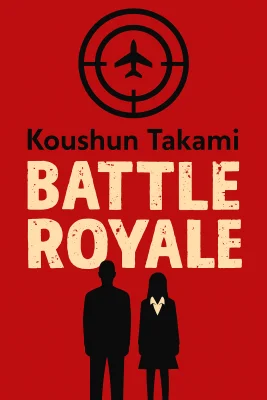
Battle Royale
Categories
Fiction, Science Fiction, Horror, Young Adult, Thriller, Fantasy, Japan, Novels, Japanese Literature, Dystopia
Content Type
Book
Binding
Paperback
Year
2003
Publisher
VIZ, LLC
Language
English
ASIN
156931778X
ISBN
156931778X
ISBN13
9781569317785
File Download
PDF | EPUB
Battle Royale Plot Summary
Introduction
# Collared Innocence: A Battle for Humanity's Soul The metal collar clicked shut around Shuya Nanahara's neck with the finality of a coffin lid. Forty-two students from Shiroiwa Junior High School had boarded what they believed was their class trip bus, only to wake in a nightmare dressed as education. Their teacher, Kinpatsu Sakamochi, stood before them with a smile that belonged in a morgue, explaining the rules of the Program with the casual efficiency of someone announcing lunch menus. Each student would receive a weapon—some useful, others laughably inadequate. The island around them would shrink through expanding forbidden zones. Only one could leave alive. When Yoshitoki Kuninobu, Shuya's best friend since childhood, stood to protest the rape of their caretaker, three soldiers fired in perfect synchronization. His body crumpled between the desks as blood pooled beneath twitching limbs. The lesson was immediate: in this game, friendship was a luxury that could kill you. As students filed out into the pre-dawn darkness, each carrying their death sentence in a black bag, the island waited to transform innocent children into desperate killers.
Chapter 1: The Game Begins: Innocence Shattered by Steel Collars
The gymnasium fell silent as Sakamochi's words carved reality into something unrecognizable. Shuya watched his classmates' faces drain of color, their eyes reflecting the fluorescent lights like trapped animals. The metal collars around their necks hummed with electronic menace, each one a bomb waiting for disobedience or the simple passage of time without sufficient bloodshed. Noriko Nakagawa sat frozen in her chair, her gentle features twisted by incomprehension. She had been the girl every boy secretly loved, too pure for their adolescent fantasies. Now she clutched a survival pack containing tools for murder, her hands trembling like autumn leaves. When she tried to help the dying Yoshitoki, a soldier's bullet tore through her leg, painting her sailor uniform crimson. The weapons distribution revealed the Program's cruel randomness. Some students received machine guns and grenades, others got pot lids and paper fans. Shuya's knife felt pathetic in his sweating palm, barely adequate for cutting rope, let alone human flesh. But the message was clear: adapt or die, kill or be killed, and pray that madness doesn't claim you first. As they stumbled into the island's darkness, the school building behind them blazed with artificial light. Inside, Sakamochi settled into his chair to watch the show, surrounded by monitors displaying their vital signs like a twisted video game. The Program had begun, and childhood died in that moment, replaced by something harder and infinitely more desperate.
Chapter 2: Alliances of Desperation: When Friends Become Lifelines
Dawn brought no mercy to the scattered survivors. Shuya found Noriko limping through the forest, her wounded leg leaving a trail of blood that any predator could follow. Despite the danger of traveling together, he couldn't abandon the girl his best friend had loved. They moved like wounded animals, every shadow potentially hiding a former classmate turned killer. Their fragile partnership was tested when Tatsumichi Oki emerged from the underbrush, his face twisted by paranoia and desperation. The handball team captain who'd once shared lunch money now swung a hatchet with murderous intent, convinced that killing was the only path home. The weapon caught morning sunlight as he advanced, his eyes reflecting the madness that had consumed so many others. The fight was brutal and brief. Shuya's knife found its mark in Tatsumichi's skull, splitting his face in a grotesque parody of symmetry. Blood sprayed across the forest floor as his former friend collapsed, twitching once before going still. Shuya stared at his crimson hands, understanding that he had crossed a line from which there could be no return. Salvation came in an unexpected form: Shogo Kawada, the mysterious transfer student with scars mapping violence across his body. His calm demeanor and tactical knowledge seemed impossible for a fifteen-year-old, until he revealed his terrible secret. He was the previous year's winner, the sole survivor of another class thrown into this nightmare. His presence offered hope, but in this game, even salvation came with a price that might prove too high to pay.
Chapter 3: Predators Among Peers: The Birth of Student Killers
The island's true horror revealed itself as some students embraced the Program's logic with terrifying ease. Kazuo Kiriyama moved through the landscape like death incarnate, his machine gun cutting down anyone in his path. The handsome, popular student showed no emotion as he systematically eliminated former friends, his kills efficient and calculated, devoid of the panic that marked other students' desperate acts. On the mountain peak, Yumiko Kusaka and Yukiko Kitano made their final stand for humanity. Using a megaphone, they called out to their scattered classmates, begging for unity against the Program's designers. Their voices echoed across the island like a prayer, offering hope in the growing darkness. But hope made them targets, and Kazuo's response was swift and merciless. The machine gun's chatter silenced their pleas forever, leaving their bodies sprawled among mountain flowers. Blood pooled beneath their still forms as their message of peace died with them, carried away on the wind like smoke from a funeral pyre. The lesson was clear to anyone who witnessed the execution: resistance was futile, mercy was weakness, and trust would only lead to death. Meanwhile, Mitsuko Soma played a different game entirely. Beautiful and damaged, she had learned long ago that survival meant being the predator rather than the prey. Her angelic appearance lured victims close before she struck with deadly precision, each kill coming easier than the last. The island had become a hunting ground where childhood friendships curdled into mortal enemies, and innocence was just another word for prey.
Chapter 4: Trust Betrayed: Sanctuary Becomes Slaughterhouse
The lighthouse that had sheltered six girls became a tomb of broken friendships. Yukie Utsumi, their class representative, had gathered them together believing safety lay in numbers. They shared meals and memories, trying to maintain some semblance of normal life while death stalked the island around them. But the Program's poison worked its way into even the strongest bonds, planting seeds of suspicion that bloomed into betrayal. It started with poisoned soup. Yuka Nakagawa, always eager to help, tasted the meal before serving it to the others. The poison worked quickly, turning her face purple as blood frothed from her mouth. She convulsed and died while her friends watched in horror, her bronzed skin turning pale as death claimed her. Trust shattered like glass in an instant. Panic replaced friendship as accusations flew like bullets. Satomi Noda grabbed a submachine gun and pointed it at the others, her usually calm demeanor cracking under pressure. The confrontation escalated beyond reason as paranoia consumed rational thought. Chisato Matsui reached for another weapon, prompting Satomi to open fire. The quiet girl who had cried over morning death announcements now lay bleeding on the lighthouse floor. In the end, only Yuko Sakaki remained alive among the girls, traumatized and alone. But her survival was brief. The real poisoner had been among them all along—Yuko herself, driven mad by fear and misunderstanding. Her guilt led her to the lighthouse's highest point, where she fell to her death rather than face the consequences of her paranoid act. The sanctuary meant to guide ships safely to shore had become a beacon of the Program's true nature.
Chapter 5: The Final Hunt: Confronting the Emotionless Hunter
Kazuo Kiriyama had become the island's apex predator, moving through the landscape with mechanical precision. His arsenal grew with each kill, his efficiency terrifying in its cold calculation. When he finally tracked down Shuya, Noriko, and Shogo, the confrontation felt inevitable—a collision between humanity and its complete absence. The chase began in the mountains and spilled onto the island's main road. Shogo commandeered a truck while Kazuo pursued in another vehicle, both machines becoming weapons in a deadly game of cat and mouse. Bullets shattered windshields and punctured metal as the vehicles careened through abandoned farmland, their engines screaming like wounded beasts. Shogo's driving skills kept them alive through the initial pursuit, but Kazuo's relentless assault gradually wore down their defenses. The truck's improvised armor absorbed countless rounds, but even scrap metal had its limits. When Kazuo's shots found their mark, Noriko cried out as shrapnel sliced across her face, leaving a permanent scar that would mark her as a survivor. The final battle took place in an open field where symmetry demanded this conclusion. Shogo used every trick he had learned from his previous Program experience, but Kazuo's body armor absorbed shots that should have been fatal. In the end, it was Noriko who made the difference. While the others engaged Kazuo directly, she flanked him with steady hands and a revolver, proving that survival sometimes depended on the quiet courage of those who seemed least likely to kill.
Chapter 6: Sacrifice and Escape: The Price of Freedom
Victory over Kazuo should have meant freedom, but Shogo carried a secret that would cost him everything. The bullet wound in his back, dismissed as minor, was slowly killing him. He had hidden his condition to ensure Shuya and Noriko could escape, knowing his own time was running short. On the boat carrying them away from the island, he finally revealed the truth about the collars and his elaborate plan for their freedom. Sakamochi, the Program's administrator, confronted them in the boat's cabin with evidence of Shogo's deception. The cheerful teacher who had explained the rules like a game show host now revealed his true nature—a bureaucrat who justified atrocities with casual efficiency. His threats to kill the survivors with poison gas represented everything evil about the system that had created this nightmare. The confrontation ended with Sakamochi's death, a pencil driven through his throat by Shogo's desperate final act. But victory came at a price that would haunt the survivors forever. As Shuya and Noriko took control of the boat, Shogo's strength finally failed him. The wound that had been slowly bleeding throughout their escape claimed its due. His final words were not of revenge or anger, but of hope. He urged them to live, to trust each other, to find happiness despite the trauma they had endured. In his hand, Shuya placed the red bird whistle that had been Shogo's most treasured possession—a gift from the girl he had loved and lost in his own Program experience. The boat continued toward the mainland, carrying two survivors and one more casualty of a system that consumed its children with methodical efficiency.
Chapter 7: Fugitives of Truth: Running from a System's Lies
Three months later, Shuya and Noriko moved through Osaka's crowded train station as wanted fugitives. Their faces stared back at them from television screens, identified as suspects in the deaths of Sakamochi and his soldiers. The government's version of events painted them as terrorists rather than survivors, twisting their escape into evidence of guilt. The underground network that Shogo had arranged helped them navigate their new reality. False identities, safe houses, and contacts who asked no questions became their lifeline in a nation that hunted them. But freedom remained elusive when an entire system was determined to silence witnesses to its crimes. The police officer who spotted them in the station represented everything they were running from—the system's long reach, its determination to erase inconvenient truths. As they fled through the crowded terminal, Shuya felt the weight of the gun hidden beneath his jacket. The Program had taught him to kill, but he hoped never to use that knowledge again. Their escape route led toward a fishing boat and eventual passage to America, where they might find the normal life that had been stolen from them. But normalcy felt like a foreign concept after everything they had endured. As they ran through the streets of Osaka, they carried with them the memory of forty classmates who would never run anywhere again, and the responsibility to bear witness to atrocities committed in the name of order.
Summary
The Program succeeded in its true purpose—not to select a winner, but to demonstrate how quickly civilization's veneer could be stripped away when survival became the only imperative. Forty-two students had entered the game as friends and classmates; only two emerged as scarred survivors, their bonds forged in blood and tempered by impossible choices. Some had discovered reserves of courage they never knew they possessed, while others had surrendered to the darkness that lurks within every human heart. Yet within this landscape of manufactured horror, moments of genuine connection blazed like stars in the darkness. Shogo's sacrifice, the bond between Shuya and Noriko, and the desperate attempts at unity all demonstrated that even in the face of systematic dehumanization, the human spirit could endure. Their survival was not just a victory over the Program's immediate threats, but a rejection of the philosophy that created it. As they disappeared into the crowd, hunted but not broken, they carried with them proof that some forms of resistance cannot be eliminated, no matter how efficiently the machinery of oppression operates.
Best Quote
“Loving someone always requires you to not love others.” ― Koushun Takami, Battle Royale
Review Summary
Strengths: The review highlights the book's complex narrative, which follows multiple characters, offering a broader perspective than "The Hunger Games." It is praised for its exploration of human psychology under extreme conditions, showcasing both brutality and moments of love and kindness. Weaknesses: The review notes challenges with the similarity of Japanese names, making it difficult to track characters initially. Additionally, the quality of translation is criticized, suggesting that some nuances may be lost. Overall: The reader expresses a strong positive sentiment, recommending the book for those who appreciate intense and gory narratives, despite its minor flaws. The book is considered a compelling and insightful read.
About Author

Koushun Takami
Takami explores the darker facets of society through his writing, especially focusing on themes of authoritarian control and the resilience of youth. His acclaimed book, "Battle Royale," presents a dystopian landscape where teenagers are coerced into a deadly game by a repressive government, thereby challenging the reader to reflect on themes of survival and morality. While Takami's narrative blends social critique with psychological tension, it also raises questions about the nature of violence and individual agency. This complex interplay of elements marks his contribution to modern literature and continues to engage audiences with its provocative content.\n\nIn terms of his method, Takami utilizes a stark narrative style that combines intense action with deep social commentary, creating a compelling juxtaposition that captivates readers. This approach allows him to dissect societal issues while maintaining an engaging storyline, appealing to those interested in both literary depth and thrilling plots. Despite the book's initial rejection due to its controversial nature, "Battle Royale" achieved international acclaim, being adapted into films and manga, which further expanded its reach and impact. Readers are drawn to Takami’s work for its bold examination of the human condition under extreme circumstances, providing insights into the struggles of youth in the face of societal oppression.\n\nTakami's background as a journalist for Shikoku Shimbun informs his attention to detail and thematic depth, although he has not published any other major works beyond "Battle Royale." This singular focus has only intensified the book's cult status, allowing it to remain a seminal piece in the genre of dystopian fiction. His bio reveals a meticulous thinker committed to exploring profound societal issues through fiction, offering valuable perspectives for readers interested in the intersection of narrative and social critique.
Read moreDownload PDF & EPUB
To save this Black List summary for later, download the free PDF and EPUB. You can print it out, or read offline at your convenience.
Battle Royale
by Koushun Takami
