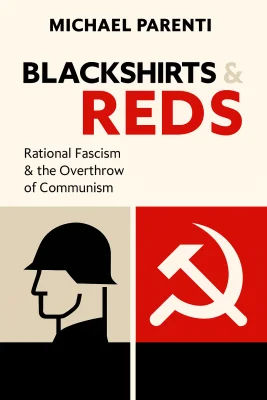
Blackshirts and Reds
Rational Fascism and the Overthrow of Communism
Categories
Nonfiction, Philosophy, History, Economics, Politics, Audiobook, Sociology, Political Science, Historical, Theory
Content Type
Book
Binding
Paperback
Year
1997
Publisher
City Lights Books
Language
English
ASIN
0872863298
ISBN
0872863298
ISBN13
9780872863293
File Download
PDF | EPUB
Blackshirts and Reds Plot Summary
Introduction
Why do societies seemingly embrace authoritarianism while simultaneously yearning for freedom? How can we understand the apparent contradictions between popular movements that claim to serve the people while ultimately benefiting the powerful few? These questions strike at the heart of modern political analysis, challenging our conventional understanding of both historical fascism and contemporary revolutionary movements. This book presents a comprehensive theoretical framework for analyzing the relationship between class power and political transformation. The author develops a materialist analysis that cuts through ideological mystifications to reveal the underlying economic forces that shape political outcomes. This approach provides readers with analytical tools to understand how ruling elites manipulate popular sentiments, how genuine revolutionary movements differ from pseudo-revolutionary fascism, and why class analysis remains essential for comprehending modern politics. The framework offered here promises to illuminate patterns of power and resistance that conventional political discourse often obscures or misrepresents.
Chapter 1: Rational Fascism: Class Interests Behind Totalitarianism
Fascism presents itself as an irrational, chaotic force driven by mass hysteria and extremist ideology. Yet beneath this surface appearance lies a rational system designed to serve specific class interests. The theory of rational fascism reveals how apparently irrational political movements actually function as calculated instruments of economic preservation and expansion for threatened capitalist elites. The rational fascism framework identifies three core components that define fascist movements. First, fascism serves as a tool of capital preservation, emerging when traditional democratic processes threaten to redistribute wealth or power away from established elites. Second, it employs pseudo-revolutionary rhetoric and mass mobilization to channel popular discontent away from genuine systemic change toward scapegoating and nationalist fervor. Third, it maintains the fundamental structure of capitalist property relations while destroying independent labor organizations and democratic institutions that might challenge elite control. Historical analysis demonstrates this pattern clearly in both Mussolini's Italy and Hitler's Germany. In each case, major industrialists and financial interests funded fascist movements precisely when democratic governments began implementing policies favorable to working people. The fascists promised to crush labor unions, eliminate social spending, and restore profitable conditions for business operation. Once in power, fascist regimes privatized public assets, cut wages, extended working hours, and transferred wealth upward to their corporate sponsors. This systematic class collaboration reveals fascism not as madness, but as ruthless rationality in service of elite interests. Understanding this dynamic helps explain why fascist movements continue to emerge during periods of economic crisis and democratic challenge to established power.
Chapter 2: Revolutionary Movements and Democratic Development
Authentic revolutionary movements represent the opposite pole from fascist pseudo-revolution, constituting genuine expressions of popular democratic aspirations against oppressive systems. The theoretical framework for understanding revolution rejects both romantic idealization and reflexive condemnation, instead analyzing revolutionary processes as rational responses to intolerable conditions and systematic exploitation. Revolutionary theory identifies several key characteristics that distinguish authentic from pseudo-revolutionary movements. Genuine revolutions emerge from broad-based popular coalitions seeking fundamental redistribution of economic and political power. They challenge existing property relations and seek to establish more egalitarian social structures. Most importantly, they face violent opposition from established elites and their international allies, who understand that successful revolutions threaten the global system of wealth concentration and imperial domination. The developmental impact of revolutionary movements provides crucial evidence for their democratic character. Socialist revolutions in countries like Cuba, Vietnam, and Nicaragua dramatically expanded literacy, healthcare, and economic security for previously marginalized populations. These achievements occurred despite sustained military and economic warfare directed by hostile capitalist powers. Revolutionary governments consistently prioritized human development over profit maximization, creating social systems that served popular needs rather than elite accumulation. This pattern demonstrates that revolutionary movements, whatever their limitations, represent authentic democratic advances for the masses of people they mobilize. The fierce opposition they face from established powers confirms their genuinely transformative character rather than their supposedly authoritarian nature.
Chapter 3: Left Anticommunism and Socialist Critique
A peculiar feature of intellectual discourse involves the phenomenon of left anticommunism, whereby progressive thinkers adopt the analytical frameworks and emotional hostility traditionally associated with conservative attacks on socialist movements. This theoretical analysis reveals how left anticommunism functions to constrain critical thinking and reinforce dominant ideological boundaries even among supposedly oppositional intellectuals. Left anticommunism manifests through several distinct patterns of thought and expression. Progressive critics routinely employ the same vocabulary and conceptual frameworks as right-wing propagandists when discussing socialist experiments, treating capitalism and socialism as equally flawed systems rather than analyzing their fundamentally different class orientations. They demand impossibly pure revolutionary outcomes while accepting massive violence and exploitation as normal features of capitalist societies. Most significantly, they refuse to acknowledge the achievements of socialist movements or to consider how external pressure and encirclement affected their development. The political function of left anticommunism becomes clear when examining its practical effects on progressive movements. By reinforcing anticommunist orthodoxy, left intellectuals help marginalize analyses that challenge capitalist class relations. They participate in the ideological policing that prevents serious consideration of socialist alternatives to existing arrangements. This pattern weakened labor movements during the Cold War period, as unions purged communist organizers and adopted narrowly economistic rather than broadly political orientations. Contemporary left anticommunism continues to fragment progressive coalitions and limit the scope of permissible criticism. Understanding this dynamic helps explain why even oppositional intellectuals often find themselves reinforcing rather than challenging dominant power structures, despite their apparent critical intentions.
Chapter 4: Communist Economic Structures and Systemic Challenges
Socialist economic systems created unprecedented achievements in human development while also generating significant internal contradictions and inefficiencies. A systematic analysis of these economies reveals both their historic accomplishments and the structural problems that ultimately contributed to their transformation or collapse. Communist economic structures operated according to fundamentally different principles than capitalist markets. Central planning replaced profit-driven production, aiming to meet social needs rather than generate private wealth. Full employment became a constitutional guarantee rather than a market outcome. Public ownership eliminated the extraction of surplus value by private capital owners. These structural changes produced remarkable results in previously underdeveloped societies, transforming peasant economies into modern industrial systems within decades while providing universal healthcare, education, and housing. However, centralized command economies also generated persistent problems that proved difficult to resolve within their existing institutional frameworks. Rigid bureaucratic planning stifled innovation and responsiveness to consumer needs. The absence of market signals made efficient resource allocation extremely difficult, leading to chronic shortages of some goods and overproduction of others. Workers lacked meaningful incentives for productivity improvements, while managers faced pressures to meet quantitative targets regardless of quality considerations. These systemic inefficiencies created growing popular dissatisfaction, particularly among younger generations who had not experienced pre-revolutionary poverty and took social achievements for granted. Understanding both the achievements and limitations of socialist economies provides essential context for evaluating their historical trajectory and the forces that ultimately led to their transformation.
Chapter 5: Capitalist Restoration and Neoliberal Transformation
The transformation of former communist societies provides a natural experiment in the transition from socialist to capitalist economic systems, revealing the actual rather than theoretical consequences of market-oriented reforms. This analysis demonstrates how capitalist restoration created unprecedented levels of inequality, social devastation, and economic chaos rather than the prosperity promised by free-market advocates. Capitalist restoration followed similar patterns across different societies, regardless of their specific cultural or historical contexts. State assets were transferred to private owners at dramatically below-market prices, concentrating wealth in the hands of politically connected elites. Social services that had been universal rights became expensive commodities accessible only to those who could afford market prices. Employment security disappeared as profit-maximizing enterprises eliminated jobs and reduced wages to increase returns for new owners. The human costs of this transformation proved catastrophic for ordinary populations. Life expectancy declined sharply in most post-communist societies, with millions experiencing unemployment, homelessness, and poverty for the first time in their lives. Industrial production collapsed as enterprises were shut down to eliminate competition with Western companies. Agricultural output fell as collective farms were dismantled and small private farmers lacked access to machinery, credit, or markets. Crime and corruption exploded as legal institutions designed for socialist societies proved inadequate for regulating capitalist markets. These outcomes demonstrate that the transition to capitalism created social devastation on a scale comparable to major wars, revealing the mythical character of claims about free-market prosperity. The systematic nature of these results across different societies confirms that they reflect inherent features of capitalist restoration rather than temporary adjustment difficulties.
Chapter 6: Class Analysis in Modern Political Discourse
Contemporary political analysis systematically avoids class-based explanations of social phenomena, treating class as an outdated concept irrelevant to modern society. This theoretical framework demonstrates how class denial functions as an ideological strategy that obscures the fundamental power relationships that structure contemporary life. Class analysis reveals persistent patterns of wealth concentration and political domination that conventional discourse systematically ignores or misrepresents. Rather than the fluid, meritocratic society portrayed in mainstream media, empirical investigation shows increasing inequality and declining social mobility. Corporate elites exercise dominant influence over political institutions, media organizations, and cultural production through their control of investment capital and employment. Working people face intensifying exploitation as unions are weakened, wages stagnate, and employment becomes increasingly precarious. The denial of class realities serves crucial ideological functions for maintaining existing power relationships. By treating social problems as individual failures or cultural conflicts rather than systematic exploitation, class denial prevents the formation of broad coalitions challenging elite domination. Identity politics, while addressing real forms of oppression, often fragments potential opposition by emphasizing divisions within the exploited population rather than their common interests against shared oppressors. Academic theory contributes to this fragmentation by developing increasingly abstract analytical frameworks that obscure rather than illuminate the material conditions shaping social life. Recovering class analysis provides essential tools for understanding how contemporary capitalism operates and why conventional reform efforts consistently fail to address fundamental problems. Only by acknowledging class power can progressive movements develop effective strategies for challenging entrenched interests and creating genuine democratic alternatives.
Chapter 7: Environmental Crisis as Class Struggle
The ecological crisis facing humanity represents not a technical problem requiring technological solutions, but a fundamental conflict between capitalist accumulation imperatives and planetary survival. This analysis reveals how environmental destruction emerges from the same class dynamics that generate other forms of social oppression and exploitation. Capitalist production necessarily treats natural systems as sources of raw materials and repositories for waste products, without regard for ecological limits or long-term sustainability. The competitive drive for profit maximization prevents individual capitalists from voluntarily adopting environmentally responsible practices, since such measures increase costs and reduce competitiveness. Corporate owners and their political representatives therefore systematically oppose environmental regulations and promote technological optimism as an alternative to fundamental economic restructuring. The class character of environmental politics becomes clear when examining who benefits from ecological destruction and who bears its costs. Wealthy elites can purchase relatively clean living environments, organic food, and healthcare to mitigate pollution effects on their own families. Meanwhile, poor and working-class communities face disproportionate exposure to toxic waste, industrial pollution, and climate change impacts. Environmental racism ensures that the most dangerous facilities are located in communities with minimal political power to resist them. This pattern reveals that environmental destruction, like other forms of oppression, reflects class power rather than technical inadequacy or individual consumer choices. Addressing the ecological crisis therefore requires challenging the capitalist system that generates environmental destruction as a necessary byproduct of its normal operation. Environmental movements that fail to adopt class analysis will remain ineffective against corporate power and may even serve elite interests by channeling opposition away from systematic change toward individual lifestyle modifications or technological fixes.
Summary
The fundamental insight of this theoretical framework can be captured in a single principle: apparent political irrationality often conceals rational class calculation, while genuine democratic movements face systematic suppression precisely because they threaten established patterns of wealth and power concentration. This analytical approach reveals that fascism and capitalism operate as complementary systems for maintaining elite domination, while socialist movements represent authentic challenges to class privilege despite their inevitable limitations and contradictions. The long-term significance of this analysis extends far beyond academic understanding to encompass the urgent practical challenges facing humanity in an era of ecological crisis and increasing inequality. By providing tools for understanding how class power operates through seemingly non-economic institutions and conflicts, this framework enables more effective resistance to elite domination and more realistic assessment of possibilities for democratic transformation. For readers seeking to understand contemporary politics and contribute to progressive change, these insights offer essential preparation for the struggles ahead in an increasingly polarized and environmentally threatened world.
Best Quote
“The very concept of "revolutionary violence" is somewhat falsely cast, since most of the violence comes from those who attempt to prevent reform, not from those struggling for reform. By focusing on the violent rebellions of the downtrodden, we overlook the much greater repressive force and violence utilized by the ruling oligarchs to maintain the status quo, including armed attacks against peaceful demonstrations, mass arrests, torture, destruction of opposition organizations, suppression of dissident publications, death squad assassinations, the extermination of whole villages, and the like.” ― Michael Parenti, Blackshirts and Reds: Rational Fascism and the Overthrow of Communism
Review Summary
Strengths: The review highlights the book's ability to debunk anti-communist myths using simple and clear language. It also appreciates Parenti's acknowledgment of the flaws within the USSR's authoritarian and bureaucratic system under Stalin, and his critique of regimes mischaracterized as socialist. Weaknesses: The review criticizes the book for its weak proposal of "Siege Socialism" as a viable alternative to capitalism, suggesting it oversimplifies the challenges faced by socialist states. It also notes the book's poor defense of existing socialist states, particularly the USSR, describing them as ill-planned police states. Overall: The review presents a mixed sentiment, appreciating the book's critique of capitalism but criticizing its solutions and defense of socialist states. The recommendation level is cautious, suggesting it is worth reading for its arguments but with significant reservations.
About Author

Michael Parenti
Parenti delves into the power structures inherent in capitalism and U.S. foreign policy, revealing how these systems often perpetuate inequality and injustice. His works, such as "Democracy for the Few" and "Against Empire", blend academic rigor with a polemical tone to critique imperialism and media manipulation. Parenti's method involves deconstructing historical narratives and presenting alternative perspectives that highlight the experiences of marginalized groups. By doing so, he challenges readers to reconsider mainstream political ideologies and understand the deeper economic forces at play.\n\nThe themes Parenti addresses resonate particularly with those interested in progressive political analysis, offering insights into the hidden dynamics of power that shape societal norms. His books, translated into approximately twenty languages, serve both academic settings and general readers, ensuring a wide impact. As a prominent intellectual on the American Left, Parenti's bio showcases a career dedicated to questioning the status quo and advocating for a more equitable society. Therefore, his work not only informs but also empowers readers to engage critically with contemporary issues.\n\nMichael Parenti's contributions extend beyond writing; his active engagement through lectures and media appearances broadens the reach of his ideas. Recognized by institutions like the Ford Foundation and awarded by Project Censored, his accolades underscore the influence and relevance of his scholarship. Meanwhile, his personal journey, from an Italian-American working-class background to a celebrated political scientist residing in Berkeley, California, enriches his perspective and underscores the authenticity of his critique. Thus, Parenti's work remains a vital resource for anyone seeking to understand and challenge entrenched power structures.
Read moreDownload PDF & EPUB
To save this Black List summary for later, download the free PDF and EPUB. You can print it out, or read offline at your convenience.
Blackshirts and Reds
by Michael Parenti
