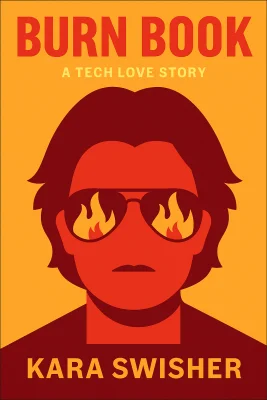
Burn Book
A Tech Love Story
Categories
Business, Nonfiction, Science, Biography, History, Memoir, Technology, Audiobook, Biography Memoir, Journalism
Content Type
Book
Binding
Hardcover
Year
2024
Publisher
Simon & Schuster
Language
English
ISBN13
9781982163891
File Download
PDF | EPUB
Burn Book Plot Summary
Introduction
In the sun-drenched corridors of Silicon Valley, where billion-dollar dreams are born over coffee and casual conversations can reshape entire industries, Kara Swisher has spent three decades watching nerds become titans and idealists transform into power brokers. Her journey began in the 1990s when the internet was still a curiosity, when Marc Andreessen sat barefoot on magazine covers and Steve Jobs was staging one of the greatest comebacks in business history. She witnessed the birth of Google in a garage, watched Mark Zuckerberg sweat through his first major interview, and chronicled Elon Musk's evolution from quirky entrepreneur to the world's most influential Twitter user. What started as a love story between a reporter and the revolutionary promise of technology has evolved into something far more complex. Through intimate conversations with the architects of our digital age, Swisher reveals how the utopian vision of connecting humanity through technology slowly gave way to platforms that amplify division, algorithms that harvest attention, and leaders who've lost sight of the human cost of their innovations. This is not just a chronicle of Silicon Valley's rise, but a deeply personal reckoning with the unintended consequences of the digital revolution we're all living through.
Chapter 1: Rise of the Tech Titans: From Nerds to Billionaires
When Kara Swisher first encountered the young founders who would reshape the world, they were barely recognizable as future billionaires. Marc Andreessen preferred breakfast at Hobee's, a forgettable chain restaurant, where he would methodically consume eggs while discussing his vision for web browsers that would make the internet accessible to everyone. Larry Page and Sergey Brin, the Google twins as she dubbed them, operated out of Susan Wojcicki's garage, charging her $1,700 a month for the privilege of building what would become the world's most powerful search engine. These weren't the polished executives of traditional corporate America; they were awkward, brilliant misfits who dressed like overgrown toddlers and filled their offices with toys and games. Jeff Bezos, even in Amazon's early days, moved through his warehouse like a "frenetic mongoose," already displaying the relentless focus that would make him one of the world's richest men. Unlike his peers who spoke in grandiose terms about changing the world, Bezos was refreshingly honest about his commercial ambitions. He understood that Amazon wasn't really a tech company at all, but a sophisticated logistics operation that happened to use technology. Mark Zuckerberg, barely twenty when Swisher first met him, opened their conversation with the confrontational line: "I heard you think I'm an asshole." Even then, his bottomless ambition was undisguised, complete with business cards that read "I'm CEO... bitch." Steve Jobs stood apart from this cohort of boy-kings, bringing an almost spiritual intensity to product creation that elevated Apple above its Silicon Valley peers. While others rushed to market with "move fast and break things" as their motto, Jobs obsessed over details that most consumers would never notice, insisting that the inside of a computer be as beautiful as its exterior. His vision of technology as a marriage of art and science would influence an entire generation of entrepreneurs, though few would match his combination of creative genius and operational excellence. The transformation from scrappy startups to global empires happened with breathtaking speed. Stock options turned software engineers into multimillionaires overnight. IPOs created paper billionaires before companies had proven they could generate sustainable profits. Suddenly, these former outcasts found themselves courted by presidents and prime ministers, their every utterance analyzed for its market implications. The same individuals who once struggled with basic social interactions were now setting global economic policy through their platforms and algorithms. The nerd had inherited the earth, but the question remained: what would they do with such unprecedented power?
Chapter 2: Disruption in Action: How Tech Changed Media and Society
The collision between Silicon Valley's disruptive force and traditional industries created seismic shifts that are still reverberating today. When AOL acquired Time Warner in 2001 for $182 billion, it marked the moment when the digital upstarts officially conquered the old guard. Steve Case, the AOL CEO who had once predicted his company would someday be bigger than Time Warner, watched his highly valued internet stock swallow one of media's most storied empires. The marriage was supposed to herald a new era of synergy between old and new media. Instead, it became what Swisher called "the heist of the century," as AOL's business model crumbled and the combined company lost three-quarters of its value within two years. Hollywood's encounter with the internet was equally traumatic and transformative. At a Sundance Film Festival panel, Swisher assembled Netflix's Reed Hastings, YouTube's Chad Hurley, and Hulu's Jason Kilar to explain the future of entertainment to an audience of filmmakers who clearly didn't want to hear it. The tech executives spoke of an "on-demand revolution" where linear broadcast schedules would disappear, theaters would shrink in importance, and algorithms would replace programmers. The film industry audience recoiled, clinging to romantic notions of the silver screen experience while the digital revolution swept away their distribution models. George Lucas, one of the few Hollywood figures who understood technology, warned that YouTube was "like throwing puppies on a freeway," but the damage was already done. The news industry faced perhaps the most existential threat from digital disruption. Newspapers had built their business models on classified advertising, but Craig Newmark's Craigslist systematically destroyed that revenue stream with a simple, free alternative. Publishers who had once controlled both content creation and distribution suddenly found themselves competing with platforms that could aggregate news from thousands of sources and serve it to readers without the overhead of newsrooms, printing presses, or distribution networks. The democratization of publishing meant anyone could become a content creator, but it also meant professional journalists were increasingly unable to make a living from their craft. What made these disruptions particularly brutal was the speed at which they occurred. Companies that had dominated their industries for decades found themselves obsolete within years. The internet didn't just compete with existing business models; it fundamentally changed consumer expectations about price, convenience, and control. Why pay for a newspaper when you could get news for free online? Why rent a movie from a video store when you could stream it instantly? Why buy a CD when you could download individual songs? The convenience was undeniable, but the hidden costs—lost jobs, closed businesses, decreased investment in original content—would only become apparent years later.
Chapter 3: When Founders Break Things: Ethics and Digital Responsibility
The "move fast and break things" mentality that Facebook emblazoned on posters throughout its headquarters wasn't just a software development philosophy; it became the operating principle for an entire generation of tech companies that prioritized growth over safety, engagement over truth, and profit over social responsibility. The human cost of this approach became devastatingly clear as platforms designed to connect humanity instead became vehicles for harassment, misinformation, and radicalization. When investigative journalist Maria Ressa brought Facebook data showing how her platform was being weaponized against critics of Philippine President Duterte's drug war, the company took two years to act, by which time the damage had metastasized across the globe. Mark Zuckerberg's evolution from awkward Harvard dropout to one of the world's most powerful men came with a troubling inability to anticipate the consequences of his creation. During a 2018 interview, he compared Holocaust deniers to people who might be "unintentionally getting it wrong," revealing a dangerous naivety about the forces his platform had unleashed. When pressed about who should be held accountable for Facebook's failures, his response was characteristically self-serving: if anyone should be fired, it should be him, but he wasn't going to fire himself because the company needed his leadership. This circular logic exemplified how tech leaders had constructed corporate structures that made them impossible to remove, creating digital kingdoms with kings who could never be dethroned. The culture of impunity extended throughout Silicon Valley, where being a "disruptor" became justification for breaking rules and ignoring consequences. Travis Kalanick at Uber embodied this attitude, openly celebrating the day when human drivers would become unnecessary and bragging about using people as "dudes" until machines could replace them. His company's internal culture reflected this dehumanizing approach, complete with documented sexual harassment, aggressive tactics against regulators, and a CEO memo that included instructions for proper sexual conduct between employees at company parties. When former Uber engineer Susan Fowler finally exposed the toxic culture in a devastating blog post, she described it as "a very, very strange year." The Ellen Pao discrimination lawsuit against venture capital firm Kleiner Perkins provided a rare glimpse into the systemic exclusion that kept Silicon Valley overwhelmingly male and white. Despite losing her case, Pao's legal challenge revealed a pattern of women being asked to take notes in meetings regardless of their seniority, being excluded from business discussions that happened on all-male ski trips, and facing retaliation when they complained about unequal treatment. The defense's strategy of painting Pao as a disgruntled employee seeking revenge worked in court, but the damage to Silicon Valley's self-image as a meritocracy was irreversible. As more women came forward with similar stories, it became clear that the industry's claims of being different from traditional power structures were largely fiction.
Chapter 4: The Social Media Revolution: Promise and Peril
Twitter began with a simple premise: answer the question "What are you doing?" in 140 characters or less. But this seemingly innocent microblogging platform would become the weapon of choice for the world's most dangerous demagogue. Donald Trump understood intuitively what many traditional politicians missed: that social media rewarded extreme statements over nuanced policy discussions, that controversy generated engagement, and that the rules governing presidential communication could be rewritten in real-time through tweets. His mastery of Twitter's engagement algorithms allowed him to dominate news cycles, frame political debates, and ultimately, as Swisher had predicted, use the platform to incite violence against democratic institutions. The January 6th attack on the Capitol represented the culmination of years of increasingly dangerous rhetoric amplified by social media platforms that prioritized engagement over truth. As Swisher watched the violence unfold from her home less than a mile away, she frantically tweeted at Twitter executives, warning that Trump's continued access to the platform posed a direct threat to public safety. The company's delayed response—waiting until after the attack to permanently suspend Trump's account—revealed the dangerous power that private companies now wielded over public discourse. A handful of Silicon Valley executives had effectively become the arbiters of global political speech, making decisions that governments around the world struggled to implement through democratic processes. Facebook's role in spreading misinformation proved even more pernicious than Twitter's tolerance for Trump's provocations. The platform's algorithm rewarded content that generated strong emotional responses, which inevitably meant that false, misleading, or inflammatory information traveled faster and farther than carefully reported news. When Russian operatives sought to interfere in the 2016 election, they found Facebook and Instagram to be perfect vehicles for their disinformation campaigns. Mark Zuckerberg's initial dismissal of this influence as "crazy" demonstrated a willful blindness to his platform's power to shape political outcomes. The company's business model, built on harvesting user data to sell targeted advertising, created perfect conditions for malicious actors to manipulate public opinion. The global consequences of social media's unchecked growth extended far beyond American politics. In Myanmar, Facebook posts helped incite genocide against the Rohingya minority. In Sri Lanka, false information spread through the platform triggered violent attacks against Muslim communities. In India, WhatsApp messages led to lynchings based on completely fabricated stories. Each of these tragedies followed the same pattern: inflammatory content would go viral on Facebook's platforms, traditional media would be too slow to fact-check the claims, and violence would erupt before anyone could intervene. The company's response was always the same—expressions of concern, promises to do better, and minor policy adjustments that failed to address the fundamental problem of prioritizing engagement over accuracy.
Chapter 5: AI's Dawn: New Hopes and Familiar Warning Signs
When Elon Musk first began warning about artificial intelligence in his interviews with Swisher, his concerns seemed like science fiction paranoia from someone who spent too much time reading dystopian novels. He spoke of humans as "meat" that would eventually be rendered obsolete by digital intelligence, comparing our situation to ants facing a highway construction project—we might be destroyed not out of malice, but simply because we were in the way of something more important. His solution, a brain-computer interface company called Neuralink, seemed like the kind of moonshot project that Silicon Valley loved to fund but never quite delivered. Yet as machine learning capabilities advanced exponentially, his warnings began to sound less like paranoia and more like prophecy. The release of ChatGPT in late 2022 marked a turning point in public awareness of AI's potential. Suddenly, millions of people could interact with artificial intelligence that could write essays, solve complex problems, and engage in sophisticated conversations that were often indistinguishable from human communication. OpenAI CEO Sam Altman, whom Swisher had known since he was a nineteen-year-old entrepreneur, embodied both the promise and the peril of this new technology. His optimistic vision of AI elevating humanity coexisted uneasily with his admission that "we are messing around with something we don't truly understand." The same pattern that had characterized earlier tech revolutions—rushing to market with inadequate safety measures—was being repeated with technology that could potentially surpass human intelligence. The sudden firing and reinstatement of Altman from OpenAI in November 2023 revealed the tensions brewing within the AI community. The company's nonprofit board, dominated by AI safety advocates, attempted to slow the breakneck pace of development by removing the CEO who had become the public face of the AI revolution. Their failure—Altman was reinstated within days after pressure from Microsoft and OpenAI employees—demonstrated that commercial interests would likely triumph over safety concerns, just as they had in previous tech cycles. The brief power struggle offered a glimpse of the forces that would shape AI development: venture capital demanding rapid growth, tech giants seeking competitive advantage, and researchers increasingly sidelined in discussions about deploying their own creations. Tristan Harris, the former Google design ethicist turned tech critic, captured the challenge facing society as AI capabilities exploded: most people remained "pre-tragic," believing that human ingenuity would somehow solve any problems that emerged from artificial intelligence. Others became stuck in "tragic" thinking, overwhelmed by the potential for catastrophic outcomes. What was needed, Harris argued, was a "post-tragic" mindset that acknowledged genuine risks while maintaining the capacity for constructive action. This required honest conversations about AI's implications, robust safety research, and regulatory frameworks that could evolve as quickly as the technology itself. The window for shaping AI's development was closing rapidly, and the decisions made in the next few years would determine whether artificial intelligence became humanity's greatest achievement or its final invention.
Chapter 6: Personal Journeys: The Human Side of Tech Reporting
Behind the scenes of Silicon Valley's greatest dramas, Kara Swisher was navigating her own complex relationship with an industry that had consumed her professional life for three decades. The work that had once felt like covering the future began to feel more like documenting a slow-motion disaster. The idealistic young entrepreneurs she had championed in the 1990s had morphed into defensive billionaires who viewed legitimate criticism as persecution. Her role had evolved from chronicler to conscience, from observer to adversary, and the personal cost of speaking truth to power was becoming increasingly apparent in her interactions with the tech elite. The pivot point came during her stroke in Hong Kong, when she found herself hospitalized while covering a conference she couldn't attend. The irony wasn't lost on her—a technology reporter sidelined by a medical emergency caused partly by the demands of global travel and constant deadline pressure. Jerry Yang's visit to her hospital room with a single perfect plum revealed the humanity that still existed beneath Silicon Valley's corporate machinery, but such moments had become increasingly rare. The industry's growing wealth and power had insulated its leaders from the kind of genuine human connection that Swisher valued most, replacing authentic relationships with transactional networking and strategic communication. Dave Goldberg's sudden death from an undiagnosed heart condition struck Swisher particularly hard, not just as a professional loss but as the disappearance of one of Silicon Valley's few authentic voices. Goldberg had served as both a successful entrepreneur and a moral compass for the industry, demonstrating that it was possible to build successful companies without sacrificing human decency. His absence left a void that seemed to grow larger as other ethical leaders either left the industry or were overwhelmed by its increasingly toxic dynamics. The ecosystem had lost one of its few reliable truth-tellers, someone who could bridge the gap between the industry's soaring ambitions and its human impact. The contrast between Silicon Valley's public image and private reality became increasingly stark as Swisher gained insider access to the tech elite's personal lives. She witnessed the isolation that accompanied extreme wealth, the paranoia that came with unprecedented power, and the sad spectacle of brilliant people surrounding themselves with enablers who would never tell them hard truths. Tony Hsieh's tragic death in a fire, following years of drug abuse and erratic behavior enabled by a cadre of paid sycophants, embodied the dark side of Silicon Valley success. Even those who achieved everything they had dreamed of often found themselves profoundly unhappy, trapped in golden cages of their own making, cut off from the authentic human connections that might have grounded them in reality.
Summary
Through three decades of covering Silicon Valley's transformation from scrappy startup culture to global dominance, Kara Swisher has witnessed both the breathtaking potential and devastating consequences of the digital revolution. Her journey from tech enthusiast to industry conscience reveals how the utopian vision of connecting humanity through technology gradually gave way to platforms that amplify division, algorithms that harvest human attention, and leaders who have lost sight of their responsibility to society. The same innovations that promised to democratize information and empower individuals have instead concentrated unprecedented power in the hands of a small group of mostly white, mostly male entrepreneurs who seem increasingly disconnected from the real-world impact of their creations. Yet Swisher's story is ultimately one of hope rather than despair, a reminder that technology itself is not the enemy—it's the choices we make about how to develop and deploy it. The internet that enabled misinformation campaigns also connected isolated individuals and democratized access to knowledge. The algorithms that reward inflammatory content could just as easily promote constructive dialogue and accurate information. The artificial intelligence that threatens to displace human workers could also solve humanity's greatest challenges, from climate change to disease. The path forward requires what Swisher calls a "post-tragic" mindset: acknowledging the genuine risks while maintaining the capacity for constructive action. The future remains unwritten, and there is still time to steer technology toward its highest potential rather than its darkest possibilities.
Best Quote
“French philosopher Paul Virilio has a quote I think about a lot: “When you invent the ship, you also invent the shipwreck; when you invent the plane, you also invent the plane crash; and when you invent electricity, you invent electrocution…. Every technology carries its own negativity, which is invented at the same time as technical progress.” ― Kara Swisher, Burn Book: A Tech Love Story
About Author

Kara Swisher
Swisher investigates the evolving landscape of technology journalism, illustrating her commitment to incisive reporting and critical analysis. Her career trajectory highlights her ability to adapt and innovate, from her early days at "The Washington Post" to co-founding Recode, a significant milestone that underscores her influence in tech media. Swisher's work, including the memoir "Burn Book: A Tech Love Story", blends investigative depth with narrative storytelling, offering readers a unique lens on the power dynamics within Silicon Valley. Her approach ensures that complex industry developments are accessible and engaging to a broad audience.\n\nThe themes Swisher explores often revolve around the intersection of technology, media, and politics, where she emphasizes accountability and transparency. Her probing style, evident in her articles and podcasts like "Pivot" and "Sway", caters to those seeking a nuanced understanding of digital progress's societal impacts. This commitment to thorough analysis and storytelling extends to her co-hosting of the "D: All Things Digital" conference series, a platform that attracted tech and media leaders. By consistently challenging tech narratives, Swisher’s work benefits both industry insiders and casual readers, enriching public discourse on technology’s role in modern society.\n\nRecognition of Swisher's contributions includes accolades such as being named a Pritzker Fellow at the University of Chicago’s Institute of Politics. Her impact on the field of tech journalism is profound, evidenced by her dynamic career and the lasting influence of her critical commentary. This short bio captures how Swisher's efforts shape how audiences comprehend the intricacies of the tech world, cementing her status as a pivotal figure in the industry.
Read moreDownload PDF & EPUB
To save this Black List summary for later, download the free PDF and EPUB. You can print it out, or read offline at your convenience.

Burn Book
by Kara Swisher
