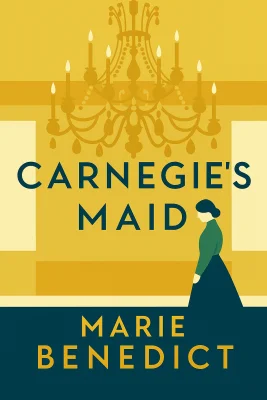
Carnegie's Maid
Categories
Fiction, Audiobook, Historical Fiction, Romance, Adult, Book Club, 19th Century, Historical, Novels, Adult Fiction
Content Type
Book
Binding
Hardcover
Year
2018
Publisher
Sourcebooks Landmark
Language
English
ASIN
149264661X
ISBN
149264661X
ISBN13
9781492646617
File Download
PDF | EPUB
Carnegie's Maid Plot Summary
Introduction
The ship's bell clanged through the fetid air of steerage, signaling the end of a forty-two day nightmare across the Atlantic. Clara Kelley—though that wasn't her real name—stepped onto American soil in 1863 with nothing but a worn dress and a dangerous secret. When she heard her stolen identity called out at the Philadelphia docks, she made a choice that would alter the course of American philanthropy forever. In the soot-blackened streets of Pittsburgh, where steel barons built empires on the backs of immigrants, Clara would transform from a desperate Irish farm girl into the confidante of Andrew Carnegie himself. But every lie has its price, and in the glittering parlors of Gilded Age society, the truth has a way of clawing its way to the surface. This is the story of how one woman's deception helped shape a man who would give away the world's greatest fortune—and why love sometimes demands the cruelest sacrifices.
Chapter 1: The Crossing: Identity Claimed on American Shores
The real Clara Kelley died somewhere in the North Atlantic, her body committed to the dark waters during a storm that flooded the steerage deck. But our Clara—the farm girl from Galway whose father's Fenian sympathies had cost the family their land—watched the burial with calculating eyes. When the Envoy finally limped into Philadelphia's harbor, she had memorized every detail of the dead woman's story. The voice cut through the chaos of the docks like a blade. "Clara Kelley?" A well-dressed man with a houndstooth coat stood beside a polished black carriage, scanning the bedraggled passengers streaming from steerage. Clara's heart hammered against her ribs. This was her moment—step forward and claim a life that wasn't hers, or fade into the anonymous mass of immigrants flooding America's shores. "Yes, sir," she said, curtsying with practiced grace. The man's eyes narrowed as he studied her ragged appearance, her single battered rucksack, her hollow cheeks from weeks of ship's rations. She held her breath, waiting for him to call her bluff. "You're not what I expected," he muttered, "but Mrs. Seeley knows her business." He gestured toward the carriage where two other girls in fine dresses waited—traveling companions who stared at Clara with barely concealed disdain. They had seen her board as a steerage passenger, dressed in clothes that reeked of poverty and desperation. As the carriage rolled toward Pittsburgh, Clara spun her first lie. Her trunk had been lost in a squall, she explained, forcing her to buy replacement clothes from fellow passengers. The other girls exchanged glances but said nothing. Perhaps they sensed something in Clara's steady gaze, some hint of the steel that would let her survive in a world built on deception. The industrial city rose before them like Dante's vision of hell—black smoke choking the sky, rivers running red with iron ore, the very air thick with the taste of ambition and ash. Clara pressed her face to the carriage window and smiled. She had found her battleground.
Chapter 2: Fairfield Façade: Becoming Mrs. Carnegie's Indispensable Maid
Mrs. Seeley's establishment reeked of carbolic soap and desperation. The proprietor of Pittsburgh's premier servants' registry took one look at Clara's soot-stained dress and wrinkled her nose in disgust. "We'll have to clean you up," she declared, gesturing toward a list on the wall where failed maids' names were scrawled beside their sins—lazy, slovenly, insubordinate. Clara burned the farm girl's dress in Mrs. Seeley's fireplace and emerged transformed, wrapped in the gray wool uniform of respectability. But it was at Fairfield, the Carnegie mansion in Homewood, where the real performance began. Mrs. Margaret Carnegie sat like a spider in her web of red damask and gold brocade, her Scottish accent thick as Highland fog, her eyes sharp enough to cut glass. "She looks the part, but can she play it?" Mrs. Carnegie asked, examining Clara as if she were livestock at market. The old woman's suspicion was palpable—she had been burned by servants before, girls who promised much and delivered little. Clara understood the test immediately. This wasn't about pressing dresses or brushing hair. This was about survival. The first night nearly broke her. Clara had never been a lady's maid, had never touched the intimate layers of another woman's undergarments or learned the mysterious rituals of corsets and crinolines. As she fumbled with the tiny hooks on Mrs. Carnegie's dress, her hands shaking with exhaustion and fear, she waited for the explosion of rage that would send her back to the streets. Instead, she found something unexpected in her mistress's eyes—uncertainty. Mrs. Carnegie, for all her imperious demands, was as new to this game as Clara. The Scottish immigrant family had money now, but not breeding, not the unconscious grace that came with generations of wealth. They needed each other, these two women pretending to be something they weren't. Clara began to study her mistress like a scholar studies ancient texts, learning every preference, every fear, every small vanity. When Mrs. Carnegie hesitated over which fork to use at dinner, Clara would quietly rearrange the place setting. When the older woman struggled with the complex social hierarchies of Pittsburgh society, Clara offered suggestions cloaked as humble observations about her fictional European mistresses. By the end of her first month, Clara had made herself indispensable—not just as a servant, but as a co-conspirator in the elaborate deception they were all performing. The Carnegies needed to belong to American high society, and Clara would help them build that bridge, one carefully chosen word at a time.
Chapter 3: Business and Betrayal: Secret Conversations with Andrew
The library became their sanctuary, though it took months before Clara understood why Andrew Carnegie sought her out there. At first, she thought it was kindness—a master taking pity on an isolated servant. But as their conversations deepened from poetry to politics to the intricate machinery of American commerce, she realized he saw something in her that no one else had bothered to notice. Andrew was building an empire, weaving together railroad contracts and iron foundries, telegraph companies and sleeping car patents. He spoke of these ventures with the passion other men reserved for love affairs, his eyes lighting up as he described the synergies and efficiencies that would reshape American industry. Clara found herself drawn into his vision, asking sharp questions that cut to the heart of his strategies. "You see what I see," he told her one afternoon as autumn light slanted through the library windows. "The connections between industries, the opportunities hidden in plain sight. Most businessmen think too narrowly." He pulled out charts and documents, showing her the web of partnerships that linked him to Pennsylvania Railroad executives Thomas Scott and Edgar Thomson. It was a dance of mutual benefit and carefully concealed conflicts of interest, all perfectly legal but ethically murky. Clara absorbed it all, creating her own secret charts in the margins of books and the backs of sewing patterns. She mapped the relationships between Carnegie's companies, traced the flow of insider information that helped him stay ahead of competitors, watched as he orchestrated mergers and consolidations that crushed smaller firms while enriching his inner circle. It was brilliant and ruthless in equal measure. The true test came when Clara suggested stringing public telegraph wires along railroad tracks. Andrew seized on the idea immediately, forming Keystone Telegraph and selling it to Pacific and Atlantic Telegraph before they had laid a single wire. Clara's insight had earned her shares worth more than she could make in a lifetime of service—if Andrew kept his word. But Clara was beginning to understand that Andrew Carnegie kept his word only when it served his interests. She watched him deceive his younger brother Tom about business dealings, manipulate investors with carefully crafted half-truths, and crush competitors with patent lawsuits based on technicalities. The charming man who quoted Robert Burns and spoke of democratic ideals was also capable of breathtaking callousness when money was at stake. The contradiction fascinated and troubled her. Which was the real Andrew Carnegie—the idealist or the predator?
Chapter 4: Hearts Entangled: The Impossible Promise of Love
The moment arrived on a storm-soaked afternoon when lightning split the sky above their picnic grounds. As guests fled to carriages and servants scrambled to save the china, Clara and Andrew found themselves alone beneath a canopy of oak trees, rain drumming on the leaves above like nature's own percussion. He spread his jacket on the damp ground for her to sit on, and in that simple gesture, Clara saw past the ruthless industrialist to the Scottish weaver's son who still remembered what it meant to be poor. They talked with a honesty that would have been impossible in the formal constraints of Fairfield, sharing their fears and ambitions like co-conspirators against the world. "You are a lady," he told her, his voice thick with conviction. "No other woman of my acquaintance is as graceful in her demeanor or as elegant in her thinking." The words hung between them, dangerous and thrilling. Clara felt the ground shifting beneath her feet, not from the storm but from the recognition that she was falling in love with a man who could never be hers. Their affair—if it could be called that—was conducted in stolen moments and meaningful glances. A brush of fingers when he handed her a book. Conversations about poetry that felt like confessions. The electric tension when they found themselves alone in darkened hallways, both acutely aware of the gulf between their official roles and their growing intimacy. Andrew began writing her letters he never sent, pouring his feelings onto paper only to crumple them up and throw them away. He bought her a first edition of Aurora Leigh, Elizabeth Barrett Browning's epic poem about a woman writer fighting for independence in a man's world. The gift was wildly inappropriate for a master to give his servant, but Clara treasured it like a love token. The danger made it sweeter and more terrible. Clara knew that discovery would mean her immediate dismissal, the destruction of her carefully constructed identity, and the loss of her ability to support her desperate family back in Ireland. She tried to maintain professional distance, but Andrew's intelligence and ambition were intoxicating. He saw her not as a servant but as an equal, a partner worthy of his respect and affection. When he finally left for his European grand tour, fleeing the impossibility of their situation, Clara felt the loss like a physical wound. She had found love and purpose in Andrew Carnegie's world, but both came with a price she wasn't sure she could pay.
Chapter 5: Duty's Price: Family Need Against Personal Desire
The letter arrived on a gray Pittsburgh morning, bearing news that shattered Clara's carefully maintained composure. Her youngest sister Cecelia was dead, claimed by a cough that might have been cured if the family had money for proper medicine. They were living in a single damp room in Galway City, her father's Fenian activities having cost them not just their farm but any hope of decent employment. Clara pressed her hand to her mouth to muffle her sobs, but nothing could silence the guilt that roared through her chest. While she lived in luxury at Fairfield, wearing fine dresses and dining on delicacies, her family was dying in poverty. Every moment she spent mooning over Andrew Carnegie was time stolen from their survival. The money Andrew had promised her from the telegraph company shares remained frustratingly out of reach. He spoke of investments and stock certificates with casual confidence, but Clara had seen nothing tangible, no actual cash she could send home. She began to understand the cruel arithmetic of servitude—servants were always promised more than they received, their futures mortgaged against their masters' goodwill. When Andrew returned from Europe, bronzed by Mediterranean sun and full of stories about opera houses and art galleries, Clara felt the distance between their worlds more keenly than ever. He had been expanding his mind while she had been emptying chamber pots. He spoke of architecture and fine dining while she worried about her family's next meal. Their reunion was electric but painful. Andrew pressed her for private meetings, his eyes bright with renewed passion, but Clara could barely focus on his words. How could she explain that every minute spent with him felt like a betrayal of her family's desperate needs? How could she tell him that his promises of fortune felt like mockery when she couldn't even afford to send medicine to Ireland? The weight of duty pressed down on her shoulders like a stone. Clara had been raised to believe that family came first, always, and that personal happiness was a luxury the poor could not afford. Andrew represented everything she longed for—intellectual companionship, genuine affection, a partnership of equals. But love was a privilege, and privileges had to be earned with other people's security. She began to pull away, constructing walls of formality where there had been intimacy. Andrew pushed back with increasing desperation, but Clara held firm. She had made her choice the day she stepped off that ship in Philadelphia. Everything else—including her heart—was secondary to her family's survival.
Chapter 6: Unmasked: The Truth Behind Clara Kelley
Mrs. Carnegie's triumph was absolute and terrible. She sat behind her mahogany desk like an avenging angel, her thin lips curved in a smile that held no warmth. The investigation she had commissioned through Mrs. Seeley had uncovered everything—the real Clara Kelley's death at sea, the desperate Irish farm girl who had stolen her identity, the web of lies that had sustained the deception for three long years. "When I think of all the trust I placed in you," Mrs. Carnegie hissed, her Scottish accent thickening with rage. Clara stood frozen before her, every carefully constructed persona crumbling like sand. The elegant lady's maid, the educated companion, the woman worthy of her son's affection—all of it revealed as elaborate fiction. But Mrs. Carnegie's fury contained a cold calculation that was far more frightening than mere anger. She had discovered Clara's secret just as Andrew was preparing to propose marriage, just as their impossible love story seemed ready to find its happy ending. The timing was too perfect to be coincidence. "You will leave this house immediately," Mrs. Carnegie continued, rising from her chair like a judge pronouncing sentence. "You will never contact my son again, never breathe a word of your pathetic charade. If you disappear quietly, I will tell Andrew that your lovers' quarrel drove you away. He can remember you fondly rather than with the disgust you deserve." Clara felt the trap closing around her. Mrs. Carnegie understood exactly how to apply pressure—through Andrew's ignorance rather than his knowledge. If he learned the truth about Clara's deception, he would hate her for the lies. If he never knew, he might spend his life wondering what had driven her away. Either path led to separation, but one preserved his illusions while the other destroyed them. The cruelty of the choice was breathtaking. Clara could confess everything and face Andrew's righteous anger, or she could disappear and let him believe she had chosen duty over love. Mrs. Carnegie watched her struggle with the satisfaction of a cat playing with a mouse. In the end, there was no choice at all. Clara's family still needed the money Andrew had promised her, and his mother could easily prevent her from accessing it if she chose to fight. More importantly, Clara had built her entire American life on a foundation of deception. How could she ask Andrew to love a woman who had lied to him from their first meeting? "Goodbye, Mrs. Carnegie," Clara whispered, and walked out of Fairfield forever, carrying nothing but her few possessions and the weight of a love that could never be claimed.
Chapter 7: Legacy Written: Seeds of Philanthropy Planted
Thirty-three years later, Clara Kelley stood on the steps of the Carnegie Library of Pittsburgh, her hand clasped by her great-niece Maeve, watching the bronze doors gleam in the afternoon sun. The words carved above the entrance—"Free to the People"—seemed to mock and comfort her in equal measure. She had become a nurse in Boston, using the money Andrew had given her to save her family and forge an independent life. The Lambs had thrived, their children educated in schools Clara's wages had made possible. Her own family had eventually joined her in America, building the modest but stable life that had eluded them in Ireland. She had never married, never had children of her own, but she had saved the people she loved most. And Andrew—Andrew had become exactly what she had hoped and feared he might. The richest man in the world, builder of a steel empire that reshaped American industry. But also the author of "The Gospel of Wealth," the philosopher of philanthropy who preached that great fortunes were held in trust for humanity. He had built thousands of libraries, funded schools and universities, created institutions that would outlive his steel mills by centuries. Clara opened the letter she had carried for decades, reading Andrew's words again through eyes blurred with tears. "You found me just before I was beyond all hope of recovery. Your morals, your convictions, and your honesty brought me back from the brink, away from the idolatry of money and self." He had searched for her for years, hiring detectives and bounty hunters, never knowing that the woman who had changed his life was living quietly in Boston, healing the sick and raising her rescued family. The irony was perfect and painful. Clara had deceived Andrew about everything except the things that mattered most—her intelligence, her compassion, her belief that wealth without purpose was meaningless. She had lied about her name and her background, but she had been entirely truthful about her values. And those values, planted like seeds in the fertile ground of his ambition, had grown into a legacy that would benefit millions. Little Maeve tugged on her hand, eager to explore the wonders of the free library that Andrew's fortune had created. Clara smiled and led her great-niece up the steps, past the bronze doors and into the cathedral of books beyond. She had paid a terrible price for love, but perhaps some sacrifices were worth making. Perhaps the greatest gift she could have given Andrew was not her heart, but her conscience.
Summary
In the end, Clara Kelley's greatest deception became America's greatest truth. The Irish farm girl who stole a dead woman's identity to escape poverty had helped transform the most ruthless industrialist of the Gilded Age into history's first modern philanthropist. Her lies had been small and personal; his legacy was vast and eternal. The libraries that bore Carnegie's name would educate generations of immigrants like herself, breaking the cycles of ignorance and want that had trapped her own family in Ireland's unforgiving soil. Clara had learned that love sometimes demands the cruelest mathematics—that saving her family required sacrificing her heart, that Andrew's greatness could only flourish in her absence. She had planted seeds of conscience in the mind of a titan and then disappeared, letting her influence work like yeast in bread, invisible but essential. Standing in the library that her sacrifice had helped create, watching her great-niece discover the magic of free books and boundless learning, Clara finally understood that some victories could only be claimed by walking away. She had lost Andrew Carnegie the man but helped create Andrew Carnegie the legend—and perhaps that was worth a lifetime of solitude after all.
Best Quote
“I have searched for you for well over a year. I have hired detectives and bounty hunters and I have employed my own security men as well. They have looked in Pittsburgh, Philadelphia, New York, Boston and pretty much everywhere in between. Even the staunchest of private detectives found not a trace of you after you left the bank in Pittsburgh. It was as if you never existed. But you did exist, Clara. You stamped your mark upon me, and I will stamp your mark upon the world to prove your existence and remind myself to stay your course. As you would have desired, any fortune I amass will be dedicated for the betterment of mankind, particularly the education and improvement of the poorer and immigrant classes by the establishment of free libraries.” ― Marie Benedict, Carnegie's Maid
Review Summary
Strengths: The book provides a vivid depiction of the trials faced by Irish immigrants and effectively contrasts the wealth of the Carnegies with the poverty in Ireland and Pittsburgh. The historical details, such as social mores and the role of a chatelaine, are well-executed. The portrayal of Mrs. Carnegie as a shrewd yet socially insecure businesswoman is particularly well done. Weaknesses: The main character, Clara Kelly, is perceived as unconvincing and more of a narrative device than a believable figure. The premise of her influencing Carnegie's business decisions is seen as implausible. The story's focus on Clara detracts from a potentially more engaging narrative centered on Andrew Carnegie. Overall: The book is likely to appeal to fans of historical romance, though it may not satisfy those seeking a more compelling protagonist or a deeper exploration of Andrew Carnegie's life.
About Author

Marie Benedict
Benedict investigates the hidden narratives of women who have shaped history, channeling her legal background into meticulously researched stories. Her books often spotlight influential yet overlooked female figures, blending historical fact with narrative flair to create engaging reads. This approach is evident in works like "The Other Einstein," which illuminates the life of Mileva Marić, and "The Only Woman in the Room," about Hedy Lamarr. Benedict’s commitment to women's empowerment and historical advocacy comes through in her narratives, challenging readers to reconsider familiar historical accounts.\n\nWhile focusing on complex female characters, Benedict employs a method that intertwines detailed research with creative storytelling, crafting stories that are both educational and suspenseful. Readers find themselves immersed in reimagined pasts where women's voices are amplified, offering a fresh perspective on historical events. This technique benefits audiences interested in exploring the often-unseen contributions of women throughout history, making her books a staple for those who value both literary quality and historical insight.\n\nBenedict's recognition extends beyond book sales, with translations into numerous languages and selections by prestigious book clubs, attesting to her global impact. Her bio reflects not just the titles she's penned but a broader mission to champion women’s roles in history. By elevating stories like that of Belle da Costa Greene in "The Personal Librarian," co-authored with Victoria Christopher Murray, she enriches our understanding of the past while inspiring future narratives. Through these efforts, Benedict cements her place as a significant contemporary author, offering readers compelling insights into the fabric of history.
Read moreDownload PDF & EPUB
To save this Black List summary for later, download the free PDF and EPUB. You can print it out, or read offline at your convenience.

Carnegie's Maid
by Marie Benedict
