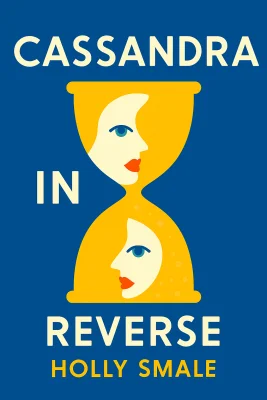
Cassandra in Reverse
Categories
Fiction, Science Fiction, Audiobook, Romance, Fantasy, Book Club, Contemporary, Magical Realism, Time Travel, Chick Lit
Content Type
Book
Binding
Hardcover
Year
2023
Publisher
MIRA
Language
English
File Download
PDF | EPUB
Cassandra in Reverse Plot Summary
Introduction
# Rewinding the Heart: A Journey Through Time and Self Cassandra Dankworth discovers her power on the worst day of her life. Standing in a London doorway, drenched in fake blood from an animal rights protest, freshly fired and freshly dumped, she closes her eyes and wishes desperately to undo it all. When she opens them, it's Wednesday morning again, and her boyfriend Will is breaking up with her for the second time. The thirty-one-year-old PR executive has stumbled into something impossible: the ability to rewind time itself. What begins as a frantic attempt to salvage her crumbling life becomes a journey through the labyrinth of her own heart. Armed with foreknowledge and infinite second chances, Cassandra sets out to craft the perfect relationship, only to discover that some patterns run deeper than time itself. When her estranged sister Artemis appears at the worst possible moment, Cassandra must confront the truth that the most important relationship she needs to repair might not be romantic at all.
Chapter 1: The Fracture: When Time Becomes Malleable
The fluorescent lights buzz overhead as Cassandra stares at Will's text message, each word a small blade twisting in her chest. Four months of careful dating reduced to casual dismissal about needing space and different life goals. Her Brixton flat feels too small, too bright, too much. She closes her eyes against the overwhelming sensation of failure. When she opens them, she's back in the Cambridge café where they first met. Will approaches her table with that easy smile, asking if the seat is taken. The conversation unfolds exactly as before, but this time she knows what comes next. His laugh at her joke about The Iliad. His hesitation before asking for her number. The way his eyes crinkle when he's genuinely amused. The realization hits like lightning. She's traveled backward through time, not far, just enough to matter. Cassandra, who has spent her entire life feeling out of step with the world, suddenly possesses the ultimate advantage. She can undo mistakes, replay conversations, perfect every interaction until it goes exactly as she wants. The mechanics prove frustratingly simple. Close her eyes, focus on when she wants to be, and reality bends to her will. But her powers come with limitations that feel almost personal. She can only travel backward four months, to this moment in the café, as if the universe has drawn a line and declared: this far, no further. Standing in the doorway, watching Will disappear into the Cambridge crowd, Cassandra feels something she hasn't experienced in years: hope.
Chapter 2: Loops of Longing: Rewriting Love's Algorithm
Armed with intimate knowledge of Will's preferences, fears, and future reactions, Cassandra begins crafting the perfect relationship. She knows he'll spill coffee on his laptop in three weeks, so she reminds him to back up his files. She remembers his favorite restaurants, his family dramas, the exact words that make him laugh. Every date becomes a performance where she holds all the scripts. But perfection proves exhausting. She catches herself becoming a curator of their romance, editing out spontaneity in favor of guaranteed success. When Will suggests something unplanned, her first instinct is to rewind and prepare, to research and rehearse until the surprise becomes another choreographed moment. Their first night together feels like cheating. She knows exactly what he likes, but he doesn't know her at all. The cracks begin to show during a dinner at his favorite restaurant. Cassandra's responses are too perfect, too precisely calibrated to his needs. She anticipates his stories, laughs at jokes before he delivers the punchlines. Will's confusion is palpable, a growing awareness that something isn't quite right. The intimacy is one-sided, a performance where only one actor knows they're in a play. The revelation terrifies her more than the time loops ever did. She's not building a relationship; she's constructing an elaborate manipulation. Every rewound conversation, every perfectly timed gesture, every moment of manufactured chemistry is another brick in the wall between who she really is and who she thinks he wants her to be. The woman Will is falling in love with doesn't actually exist.
Chapter 3: Sisters and Shadows: Confronting the Irreparable Past
The past refuses to stay buried. At an art exhibition, Cassandra encounters Artemis, the sister she hasn't spoken to in ten years. The reunion is explosive, filled with accusations and old wounds that time travel cannot heal. Artemis is everything Cassandra is not: impulsive, chaotic, emotionally unguarded. She's also the one person who can see through Cassandra's carefully constructed facades. Their confrontation in front of Will is devastating. Artemis strips away Cassandra's pretenses with surgical precision, revealing her as someone who compartmentalizes everything and everyone, who treats relationships like problems to be solved rather than connections to be nurtured. The words cut deep because they're true, and Will's horrified expression confirms what Cassandra has always feared. But the real blow comes later, when Cassandra discovers that Artemis and Will have met in a timeline she erased. Her sister, with her natural warmth and spontaneity, has effortlessly achieved the connection that Cassandra has been desperately trying to manufacture. They're falling in love, and it's genuine in a way that Cassandra's manipulated romance never was. The irony is crushing. In trying to control time to get what she wanted, Cassandra has created the exact scenario she was trying to avoid. Her sister has taken her place in Will's affections, and there's no amount of temporal manipulation that can change the simple fact that some people are just better suited for each other. Standing in her empty flat, surrounded by the careful order she's imposed on her small world, Cassandra finally understands the true cost of her gift.
Chapter 4: The Mirror's Edge: Seeing Self Through Time's Lens
Each rewind strips away another layer of Cassandra's self-deception. She begins to see herself as others see her: rigid, controlling, emotionally distant. Her coworkers at the PR firm tolerate rather than embrace her. Her flatmates find her odd and difficult. Even her carefully curated life feels like a prison of her own making. The revelation comes through her mother's posthumous diagnosis: autism. The clinical report, discovered by Artemis among their parents' papers, explains so much about Cassandra's struggles with social interaction, her need for routine, her sensory sensitivities. She's not broken or defective, just wired differently. The world has been asking her to be someone she's not, and she's been exhausting herself trying to comply. Understanding her neurodiversity doesn't excuse her behavior, but it provides context. Her time travel abilities become a metaphor for her lifelong struggle to fit in, to say the right thing, to be the person others want her to be. She's been rewinding and replaying social interactions her entire life, just without the supernatural assistance. The knowledge is liberating and terrifying in equal measure. If she's not fundamentally flawed, then her isolation is partly self-imposed. She's been so focused on hiding her differences that she's forgotten to look for people who might accept them. The tragedy isn't that she's autistic; it's that she's spent thirty-one years believing she needed to be someone else. Standing in her childhood bedroom in Cambridge, surrounded by her mother's books on Greek mythology, Cassandra finally begins to understand who she really is.
Chapter 5: Patterns Persist: The Limits of Temporal Control
Despite all her careful orchestration, the same problems begin to surface. Will starts arriving late to dates, just as he did before. She finds herself snapping at strangers who break minor rules. The fundamental patterns of their personalities reassert themselves like water finding its level. Her flatmate situation deteriorates along familiar lines, and Cassandra finds herself responding with the same defensive anger. The most devastating realization comes when she recognizes that she's still the same person who drove Will away in the first place. More self-aware, perhaps, but not fundamentally different. She still struggles with intimacy, still retreats into herself when overwhelmed, still finds human connection exhausting and confusing. The time loops have given her knowledge, but they haven't given her transformation. At a work gala, everything comes to a head. Her boss Derek makes another inappropriate comment, her colleague Sal shoots her another resentful look, and Cassandra finally snaps. She quits her job with characteristic bluntness, refusing to continue pretending to be someone she's not. The moment is both terrifying and exhilarating. For the first time in years, she's acting authentically, consequences be damned. Walking away from the venue, Cassandra feels something shift inside her. The time loops that initially seemed like a gift reveal themselves to be a mirror, reflecting back all the ways she's been hiding from genuine connection. She can change the words, alter the timing, but the underlying dynamics remain stubbornly consistent. It's as if the universe has a preferred shape, and her interventions are merely temporary distortions.
Chapter 6: The Ethics of Hearts: Manipulation Versus Growth
The final confrontation comes when Will discovers the truth about both sisters. The revelation that he's been dating siblings, one of whom can manipulate time, is too much for anyone to process. He flees, leaving both women devastated but for different reasons. Artemis has lost her first genuine love; Cassandra has lost her last chance at controlling the narrative. Success breeds its own complications. As their relationship deepened, Cassandra found herself trapped between two versions of the truth. There's the Will who's falling in love with her authentic self, and the Will from the original timeline who chose to leave. The knowledge haunts her, a constant reminder that without her intervention, he would have walked away. She begins to see the moral complexity of her situation with uncomfortable clarity. Every moment of happiness feels stolen, every declaration of love sounds hollow when she knows it required cosmic intervention to achieve. She's not just rewriting their relationship; she's rewriting his free will, using foreknowledge to manipulate his choices in ways he can't even perceive. But then she remembers the woman she was in the original timeline. Isolated, defensive, so afraid of rejection that she rejected others first. The time loops haven't just given her Will; they've given her the chance to become someone capable of love. Maybe the manipulation isn't in the rewriting. Maybe it was in the original version, where she was so busy protecting herself that she forgot to let anyone in.
Chapter 7: Authentic Choice: Love's Ultimate Sacrifice
Faced with the wreckage of her manipulations, Cassandra makes her ultimate choice. She could rewind one final time, prevent Will and Artemis from ever meeting, keep him for herself through temporal trickery. The power is literally in her hands, the familiar sensation of time bending to her will just a thought away. Instead, she chooses to let events unfold naturally, to give her sister the chance at happiness that Cassandra herself could never authentically achieve. The decision represents her final evolution. She's learned that love isn't about possession or control, but about wanting the best for someone even when it doesn't include you. Her relationship with Artemis, damaged by years of silence and misunderstanding, begins to heal through honest conversation and mutual forgiveness. They sit in their parents' old house in Cambridge, surrounded by books and memories, finally talking about the grief that drove them apart. Cassandra returns to the family home she fled ten years ago, to study the Greek mythology that has always been her refuge. She's choosing a life that fits her nature rather than fighting against it. The time travel abilities remain, but she no longer needs them. She's finally learned to live in the present tense, to accept uncertainty as the price of authentic connection. Her friendship with Sophie develops naturally without manipulation. Her understanding of herself deepens through honest self-reflection rather than temporal experimentation. These connections feel different because they're built on truth rather than performance, and Cassandra begins to understand what authentic relationships actually look like. The hourglass she's been rewinding so frantically finally runs out of sand, and she's left with the most terrifying and liberating realization of all: the only moment that truly matters is the one she's living right now.
Summary
In the end, Cassandra's greatest power wasn't her ability to manipulate time, but her capacity to finally stop running from herself. Her journey through temporal loops becomes a metaphor for the endless cycles of self-doubt and social performance that define so many lives. She discovers that authenticity isn't about being perfect, but about being genuinely, unapologetically yourself, autism and all. The relationship between the sisters, fractured by grief and misunderstanding, heals not through magical intervention but through the simple act of choosing love over pride. Artemis and Will's romance flourishes because it's built on truth rather than manipulation, while Cassandra finds peace in solitude and study. Sometimes the greatest act of love is knowing when to let go, and the most profound magic is learning to accept yourself exactly as you are. Time, Cassandra realizes, isn't meant to be controlled but experienced, one imperfect, irreversible moment at a time.
Best Quote
“Memories are time travel, and so are regrets, hopes and day-dreams.” ― Holly Smale, Cassandra in Reverse
Review Summary
Strengths: The book features a unique, neurodivergent heroine, Cassandra, who is both original and relatable. The narrative combines elements of time travel with themes of self-growth and second chances. The protagonist's passion for Greek mythology adds depth and philosophical layers to the story. The character development and humor are highlighted as engaging aspects. Weaknesses: The inclusion of numerous Greek mythology references is noted to slow the pace, and the repetitive nature of the time-loop theme can become tedious. These elements may detract from the overall enjoyment for some readers. Overall: The reviewer expresses a generally positive sentiment, appreciating the book's concept and character despite some pacing issues. The book is recommended, with a rating rounded up to 4 stars for its intriguing premise and likable protagonist.
About Author

Holly Smale
Smale interrogates the complexities of identity and self-discovery through her vibrant storytelling, particularly in narratives featuring socially awkward or neurodivergent female protagonists. Her acclaimed "Geek Girl" series illustrates this approach, with its protagonist Harriet Manners navigating the world of modeling while embodying traits now understood to align with autism and developmental coordination disorder. This focus is deeply personal for Smale, who received her own diagnoses later in life, and it drives her commitment to authentically portraying neurodiversity in her work.\n\nIn addition to her young adult novels, Smale extends her narrative reach into adult fiction with "The Cassandra Complex" (UK title) / "Cassandra in Reverse" (US title), marking a new chapter in her literary journey. Her writing method combines humor, empowerment, and a sense of adventure, resonating with readers who appreciate stories of personal growth and empowerment. The author’s background, including her academic studies in English literature and her varied career experiences—from modeling to teaching—fuels her rich character development and engaging plotlines.\n\nReaders benefit from Smale's ability to craft relatable and empowering tales that not only entertain but also provide insight into the challenges and triumphs of those who are often underrepresented in fiction. Her books have gained significant recognition, with the "Geek Girl" series winning the Waterstones Teen Prize of the Year and the Leeds Book Award. As her works continue to reach a global audience, notably with a Netflix adaptation on the horizon, Smale's impact as an author remains both significant and far-reaching.
Read moreDownload PDF & EPUB
To save this Black List summary for later, download the free PDF and EPUB. You can print it out, or read offline at your convenience.
Cassandra in Reverse
by Holly Smale
