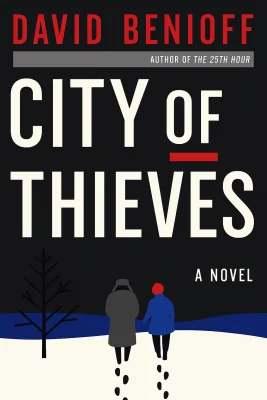
City of Thieves
Categories
Fiction, Audiobook, Historical Fiction, Adult, Book Club, Historical, Russia, World War II, Adventure, War
Content Type
Book
Binding
Hardcover
Year
2008
Publisher
Viking / Penguin
Language
English
ASIN
0670018708
ISBN
0670018708
ISBN13
9780670018703
File Download
PDF | EPUB
City of Thieves Plot Summary
Introduction
The winter of 1941 settled over Leningrad like a burial shroud. In the frozen streets, seventeen-year-old Lev Beniov crept through the darkness, watching a dead German paratrooper drift down from the black sky. The pilot's parachute caught the moonlight as it settled onto Voinova Street, carrying with it the promise of food, warmth, and survival. But when Lev and his friends descended from their rooftop fire watch to loot the corpse, they triggered a chain of events that would drag them far beyond the city's starving walls. What began as a desperate scramble for a scrap of sausage became something far more perilous. Arrested by Soviet authorities and thrown into the notorious Crosses prison, Lev found himself paired with Nikolai Vlasov—a deserter with the swagger of a Cossack prince and stories that might or might not be true. Their punishment: find a dozen eggs in a city where children had forgotten the taste of bread. The quest would lead them through cannibal lairs, across frozen battlefields, and into the heart of Nazi-occupied Russia, where death wore a dozen different faces and courage emerged in the most unlikely forms.
Chapter 1: The Arrest: Caught in the Act of Survival
The antiaircraft blimps drifted like fat gray whales above Leningrad's rooftops as Lev Beniov kept his fire watch in the frozen night. Four hundred residents once lived in the Kirov apartment building; by New Year's Eve 1942, barely a hundred remained. The rest had fled, starved, or simply vanished into the city's endless appetite for the dead. When the German paratrooper appeared in the searchlight's glare, his silk canopy white against the darkness, Lev and his friends saw salvation. The pilot was already dead, frozen solid during his descent, but his body promised treasures unimaginable: a leather jacket, boots, perhaps even food. They scrambled down from the roof, abandoning their sand buckets and fire tools for this rare windfall from the sky. The dead man lay spread-eagle in the snow, his face colorless as candle wax. Grisha Antokolsky claimed the pilot's pistol while his twin brother Oleg stripped off the leather gloves. Vera Osipovna, the cellist, took the aviator goggles. Lev found himself holding a pilot's knife, its blade etched with German words he couldn't read in the moonlight. The steel felt substantial in his grip, more real than anything he'd held in months. They passed around the pilot's flask, savoring liquor that might have been cognac or brandy—none of them knew the difference anymore. The alcohol burned warmth into their bellies as they crouched in the snow, giddy with their good fortune. Then headlights swept across Voinova Street, and everything changed. The NKVD patrol car's engine cut through the winter silence like a blade. Vera stumbled on a patch of ice as they ran for the courtyard gates. The others scaled the iron bars and disappeared into the Kirov's shadows, but Lev looked back and saw her panicked brown eyes pleading for rescue. He jumped down, hauled her to safety, and felt the soldiers' hands close around his ankles just as she vanished into the darkness. In that moment, watching his friends flee without a backward glance, Lev learned the first bitter lesson of survival: heroism was often indistinguishable from stupidity.
Chapter 2: An Impossible Quest: Twelve Eggs in a Starving City
The Crosses prison squatted beside the Neva like a brick cancer, its walls thick enough to swallow screams. In the darkness of his cell, Lev met his cellmate—a tall, golden-haired deserter named Nikolai Vlasov who claimed to be writing his thesis on a nonexistent novel called "The Courtyard Hound." Kolya, as he insisted on being called, possessed the kind of casual confidence that suggested he'd never doubted his own survival, not even here in death's waiting room. They should have faced a firing squad at dawn. Instead, they found themselves in the mansion of Colonel Grechko, an NKVD officer whose face bore the scars of his own imprisonment and rehabilitation. The colonel's daughter skated on the frozen Neva beyond the windows, her fox fur coat flashing in the sunlight, her movements graceful and strong. She would marry in six days, the colonel explained. His wife demanded a proper wedding cake. They had everything needed except eggs. The bargain was simple and impossible: find a dozen eggs in a city where pigeons had been eaten months ago, where ration bread contained sawdust and ground bone, where survival measured itself in grams and days. Return by Thursday sunrise with the eggs, and they would live. Fail, and their ration cards would be canceled—a death sentence by starvation, slower but just as certain as a bullet. Kolya accepted the challenge with a shrug, as if such impossible tasks were merely Tuesday's entertainment. Lev stared at the skating girl and realized that his life now hung on the whims of a seventeen-year-old with pretty legs and a sweet tooth. The colonel handed them a letter of safe passage and four hundred rubles—enough to buy a mansion before the war, barely sufficient for a loaf of bread now. As they stepped back into the frigid air, Kolya grinned and slapped Lev's shoulder. The hunt for eggs had begun, and with it, a journey that would lead them far from the starving city and into the heart of occupied Russia.
Chapter 3: Beyond the Lines: Venturing into Enemy Territory
The Haymarket thrived in the siege like a poisonous flower, its stalls offering ration bread made from sawdust and "Badayev Mud"—earth scraped from beneath the bombed grain warehouses, sweetened with melted sugar. Vendors sold German weapons stripped from corpses, leather boots still bloody from their previous owners' feet, and glasses of wood alcohol that could blind a man if filtered improperly. No one had seen eggs since September. A massive, black-bearded trader promised them what they sought, leading them to a bombed-out building where human meat hung from ceiling hooks like sides of beef. The cannibal's wife emerged from the shadows with a cleaver while her husband raised a steel pipe to crush their skulls. Kolya knocked the woman unconscious with a single punch before they fled into the night, leaving behind any illusions about the depths to which their city had fallen. By dawn they had abandoned hope of finding eggs in Leningrad. Following the railway tracks east, they walked into German-occupied territory, past the burned remnants of Berezovka where bodies lay frozen in the ruins. The countryside stretched before them in white silence, broken only by the distant thunder of artillery and the occasional scream of diving Stukas heading for the city. Near a prosperous farmhouse, they discovered a boy named Vadim huddled with the last of his grandfather's chickens. The old man sat dead in the corner, his shotgun across his knees, having starved rather than eat his birds. The boy offered them his final rooster—a pathetic creature named Darling, too weak to lay eggs even if she'd been female. They learned this bitter truth only after reaching safety: their great prize was worthless, a dying bird that would feed them for one night and leave them empty-handed when Thursday came. The rooster's sacrifice became a feast of sorts, shared with a group of doctors and nurses in an abandoned apartment. But as Lev fell asleep beside the fire, he understood that they had ventured beyond safety for nothing. The eggs remained a dream, and time was running short.
Chapter 4: Among Wolves: The Partisan Fighters
The partisan attack erupted from the forest like thunder, muzzle flashes strobing in the darkness as bullets whined through the winter air. Korsakov's fighters had been tracking a German convoy when Lev and Kolya stumbled into their ambush zone. Among the partisans moved a small figure in winter camouflage—Vika, barely eighteen, with cropped red hair and ice-blue eyes that held no mercy for enemies. She claimed to be a former astronomy student from Archangel, but her Karelian sniper rifle spoke a more violent language. From four hundred meters, she could thread a bullet through a German officer's skull while he sat in a moving staff car. Her knife was Finnish steel, its blade rippled like disturbed water, and she wore it strapped against her ribs where no casual search would find it. Korsakov's band had been hunting Major Abendroth, an Einsatzgruppen officer whose specialty was the systematic murder of civilians. They knew his habits, his routes, his taste for torturing children before ending their lives. The story they told—of a fourteen-year-old girl named Zoya, whose feet Abendroth had sawed off for the crime of trying to escape—painted pictures that would haunt Lev's dreams for years to come. When German mountain troops surrounded their hideout at dawn, the partisans scattered like wolves before hounds. Korsakov died with half his jaw blown away, still trying to return fire. Lev ran through the forest until his lungs burned and his legs gave out, following a stream downhill while bullets clipped branches overhead. He found Kolya and Vika and another partisan named Markov waiting in the shadow of an ancient larch, three survivors from a band of twelve. The Germans were closing in, their white anoraks moving through the trees like hunting ghosts. Vika studied the approaching column through her rifle scope and made a decision that would change everything: they would not run. They would hide among the enemy's prisoners and wait for the perfect moment to strike. It was madness disguised as tactics, but madness was all they had left.
Chapter 5: The German's Game: Chess with Death
The prisoners shuffled through the snow in ragged columns, Russian soldiers and civilians herded like cattle toward an uncertain fate. Hidden among them, Lev and Kolya watched German officers separate the literate from the illiterate with a simple test: read aloud from captured Soviet newspapers. Those who could read would work as translators in heated offices. The illiterate would labor in Estonian steel mills. The deception worked until the moment of execution. Machine guns opened fire on the translators, cutting them down against a brick wall while their families' hopes died with them. The Germans kept their promises exactly: they had never said the literate would live, only that they would work. Death was the only employment they offered. Among the Einsatzgruppen officers supervising the slaughter stood Abendroth himself—massive, intelligent, with prematurely white hair and a Knight's Cross at his throat. He spoke perfect Russian and carried himself with the confidence of a man who had made murder into an art form. When Kolya proposed a chess match, claiming Lev was one of Leningrad's finest players, Abendroth's eyes lit with genuine interest. The game took place that evening in a commandeered Party headquarters, the board set between them while armed guards watched from the corners. Abendroth played the Queen's Gambit with classical precision, but Lev had learned chess from his father, who had been city champion before his arrest. As the pieces danced across the board, Lev saw the trap he could set: a passed pawn in the center that would queen one move before Abendroth's own promotion. The German realized his position was hopeless just as Lev reached for the knife hidden in his boot. They grappled on the floor, Abendroth's massive hands trying to wrestle away his pistol while Lev clung to the barrel with desperate strength. When the Sturmbannführer finally broke free and raised his weapon, Lev drove the blade deep into his chest, just below the cluster of medals, feeling it slide between ribs until it found his heart.
Chapter 6: Blood and Honor: The Price of Courage
The conference room erupted in violence as Kolya fought one guard for his submachine gun while Vika's knife opened the throat of another. Blood splattered the peeling walls as bodies fell, mixing with the decades of terror that had soaked into this place. Lev found himself stabbing again and again, his blade rising and falling like a butcher's cleaver, until Vika pulled him off the corpse and bound his mangled finger with strips torn from the dead. They escaped through a second-story window, dropping into snow drifts while shouts echoed from inside the building. Kolya clutched a wooden crate filled with straw—their prize, twelve perfect eggs liberated from Abendroth's personal stores. The irony was not lost on any of them: they had crossed enemy lines, infiltrated a death squad, and killed one of the Reich's most decorated officers for the ingredients of a wedding cake. The forest welcomed them back with its familiar darkness, pine branches heavy with snow that sparkled in the moonlight like scattered diamonds. They ran until their lungs burned and their legs trembled, following streams and deer paths deeper into the wilderness. Behind them, searchlights swept the sky and engines roared as the Germans mounted their pursuit, but the woods were vast and the night was their ally. On a hilltop overlooking the valley, they paused to catch their breath and saw in the distance the pillar of light that marked Leningrad's heart—an antiaircraft searchlight cutting through the darkness like a beacon calling them home. Vika would not return with them. Her war lay elsewhere, with other partisans who needed her rifle and her cold expertise in killing. She kissed Lev goodbye on that frozen hill, her lips rough from the wind, her eyes holding promises neither of them believed. As she walked away into the forest, Lev understood that he had loved her completely and would probably never see her again. This was the arithmetic of war: everything you treasured was measured against everything you could lose, and the ledger never balanced. He and Kolya began the long journey home, carrying their fragile cargo through the winter night while the stars wheeled overhead in their ancient, indifferent dance.
Chapter 7: Return to Leningrad: Victory and Loss
The Soviet sentries at the city's edge nearly killed them for carrying German weapons, their bullets whining through the air before recognition dawned. Kolya took a rifle round in his hip, the slug punching through muscle and lodging near the bone. He bled into the snow as they loaded him into a military car, his face gray with shock but his humor intact: shot in the ass by his own side after surviving German machine guns and Einsatzgruppen executioners. At the Kirov Works hospital, Lev held pressure on the wound while Kolya's life leaked away one drop at a time. They spoke of the wedding they would attend, the colonel's daughter they would dance with, the feast of eggs they had earned through blood and courage. But Kolya's lips were turning blue, his breathing shallow and rapid, and they both knew these were lies told to ease the dying. "It's not the way I pictured it," Kolya whispered with his last breath, that beautiful smile fading from his face like sunset from water. Lev sat beside the body in the backseat of the idling car, listening to the foundry hammers and the welding torches that never stopped their vital work. The siege continued, the city endured, and one more defender had paid the price of survival. Colonel Grechko received the eggs in his wine cellar, surrounded by crates of delicacies airlifted in for his daughter's celebration. He already possessed four dozen eggs, making Lev's sacrifice meaningless except for the ration cards pressed into his palm—Grade One rations, an officer's portions, enough to keep him alive through the remaining months of winter. When Lev suggested the irony of their quest, the colonel's scarred face hardened: "Those words you want to say right now? Don't say them. That is the secret to living a long life." Three years later, when the siege guns fell silent and rockets lit the sky in celebration, Lev stood on a Leningrad rooftop and remembered his friend. Kolya had been writing a novel about a man who never left his apartment until love for a dying dog finally drew him into the world. The courtyard hound of the title died as all things die, but its death had meaning because someone grieved for it, someone acted despite fear to honor its memory. This, Lev understood, was what separated humans from the grinding machinery of war: the choice to love what could be lost, to act when action seemed pointless, to remember the names of the dead.
Summary
In the summer of 1945, as Leningrad rebuilt itself from the ashes of siege, a knock came at Lev's door. Vika stood in the hallway, her red hair long and lustrous now, carrying a cardboard carton—a dozen eggs arranged in neat compartments, a small miracle of engineering that made their wartime quest seem like something from another century. She had tracked him down as promised, following the thread of his name through a continent still counting its dead. The city that had nearly consumed them both now bustled with returning life. Water ran clean in the taps, bread filled the bakery shelves, and children played in streets where corpses once lay frozen. The siege had ended not with surrender but with artillery barrages that drove the Wehrmacht back across the same forests where Lev and Kolya had searched for sustenance and found instead the terrible arithmetic of survival. In that accounting, some debts could never be settled, some hungers never fully satisfied, but the living owed their breath to those who had fallen in the snow, their stories intact, their courage witnessed, their names carried forward like embers through the long Russian night.
Best Quote
“I've always envied people who sleep easily. Their brains must be cleaner, the floorboards of the skull well swept, all the little monsters closed up in a steamer trunk at the foot of the bed.” ― David Benioff, City of Thieves
Review Summary
Strengths: The review highlights the novel's unique approach to historical fiction, using a modern perspective to make the past relatable and engaging. The relationship between the main characters, a shy Jewish boy and his worldly older friend, is praised for its authenticity and depth, effectively capturing the coming-of-age experience. The narrative is noted for its fast pace and strong focus on relationships and internal observations, while still providing a realistic depiction of historical events, specifically the German invasion of Leningrad. Overall: The reviewer expresses a highly positive sentiment, comparing the book favorably to classics like "Catcher in the Rye" and "The Kite Runner." The novel is recommended for its compelling character dynamics and innovative historical storytelling.
About Author

David Benioff
Benioff delves into the intertwining of identity and history through his multifaceted career in literature and television. With novels like "The 25th Hour" and "City of Thieves", his work delves into themes of loss and redemption while blending realism with mythological elements. His writing style is known for its emotional depth and strong character development, ensuring readers are both entertained and challenged. As the screenwriter for the film adaptations of "The Kite Runner" and "Troy", Benioff demonstrates his ability to adapt complex narratives, a skill further showcased in the globally acclaimed HBO series "Game of Thrones", where he served as co-creator and executive producer.\n\nIncorporating a background in teaching and various other professions, Benioff’s narratives are enriched by diverse experiences, which help create a nuanced exploration of human experiences. This depth appeals to audiences who appreciate character-driven stories that reflect on personal and historical impacts. Readers and viewers alike find value in his ability to craft compelling tales that transcend the boundaries of traditional storytelling. Moreover, his significant achievements in both literature and television have established Benioff as a vital figure in contemporary American culture, influencing aspiring writers and filmmakers worldwide.\n\nBy effectively connecting personal narratives with broader historical contexts, Benioff’s work not only captivates but also resonates on a deeper level with audiences seeking more than just entertainment. His unique approach to storytelling makes his contributions to both the literary and visual arts essential reading and viewing for those interested in complex, well-developed stories.
Read moreDownload PDF & EPUB
To save this Black List summary for later, download the free PDF and EPUB. You can print it out, or read offline at your convenience.
City of Thieves
by David Benioff
