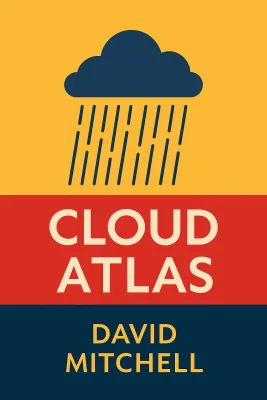
Cloud Atlas
Categories
Fiction, Science Fiction, Historical Fiction, Fantasy, Literature, Book Club, Contemporary, Novels, Literary Fiction, Dystopia
Content Type
Book
Binding
Paperback
Year
2004
Publisher
Random House
Language
English
ASIN
B00A2M3QD4
ISBN
0375507256
ISBN13
9780375507250
File Download
PDF | EPUB
Cloud Atlas Plot Summary
Introduction
# Cloud Atlas: Souls Crossing Time's Endless Ocean The Pacific stretches endlessly beneath Adam Ewing's trembling hand as he writes in his journal aboard the merchant vessel Prophetess. The year is 1850, and something terrible is happening inside his skull. Dr. Henry Goose administers increasingly potent medicines for what he calls a rare brain parasite, but with each dose, Ewing grows weaker rather than stronger. In the ship's hold, a Moriori stowaway named Autua hides like a ghost, the last survivor of a people slaughtered for their refusal to fight back. This is where the pattern begins—six souls scattered across five centuries, each carrying a comet-shaped birthmark, each fighting the same eternal war between predator and prey. Their stories spiral through time like a musical composition, each voice interrupted at its moment of greatest peril before the wheel turns and completes the circle. A young composer writes his masterpiece while planning his suicide in 1930s Belgium. A journalist uncovers a deadly conspiracy in 1970s California. A publisher escapes from a nursing home prison in modern England. A fabricated slave discovers her humanity in dystopian Korea. A goat herder guides civilization's last remnant through post-apocalyptic Hawaii. Each story contains the others, like Russian dolls nested within an endless ocean of human cruelty and compassion.
Chapter 1: The Pattern of Predation: Adam Ewing's Pacific Revelation
The Chatham Islands reveal their secrets slowly, like wounds opening under salt water. Adam Ewing, a young San Francisco notary, has come to settle an inheritance but discovers something that will haunt him forever. The Moriori people once lived here in perfect peace, their culture built on absolute pacifism. When Maori warriors arrived on stolen European ships, the Moriori chose death over violence. They were slaughtered like sheep, their ancient wisdom dying with them in the mud. Dr. Henry Goose tends to Ewing with increasing frequency, his English accent carrying the weight of exile and desperation. The physician speaks of his fall from London society, his need for redemption, his plans to harvest teeth from Maori burial grounds to fashion dentures for wealthy clients. Each day he administers vermicide for Ewing's mysterious brain parasite, watching with clinical interest as his patient grows weaker. Aboard the Prophetess, Ewing discovers Autua hiding in the hold like a broken bird. The Moriori's dignity transcends his desperate circumstances, and something in his eyes stays Ewing's hand from betrayal. Against the crew's violent objections, Ewing arranges for the stowaway to work his passage. The ship's first mate, Boerhaave, rules through casual brutality, tormenting a cabin boy named Rafael until the child hangs himself from the mainmast rather than endure another night. As the ship sails toward Hawaii, Ewing's condition reaches crisis. His thoughts swim through fog, his hand can barely hold his pen. Dr. Goose hovers constantly now, adjusting dosages with the precision of a man conducting a delicate experiment. In his delirium, Ewing begins to understand the truth—his trusted physician is the very predator he should fear most. The strong devour the weak, Goose often reminds him, but Ewing is about to learn that survival sometimes depends on unexpected allies.
Chapter 2: Ascending Voices: From Musical Rebellion to Corporate Conspiracy
Robert Frobisher arrives at Zedelghem château in 1931 with nothing but musical genius and a talent for destruction. Cast out by his Cambridge family, banned from every respectable establishment in London, the young composer becomes amanuensis to Vyvyan Ayrs, whose syphilis has left him nearly blind but whose reputation still commands European respect. The château becomes Frobisher's prison and paradise, where he transcribes the master's work while secretly composing his own revolutionary piece—the Cloud Atlas Sextet. The music flows through him like electricity, six overlapping soloists creating something entirely new. But Ayrs grows suspicious of his assistant's innovations, eventually claiming Frobisher's melodies as his own. The old composer holds the young man's scandalous past like a blade over his throat, threatening destruction if he dares to leave. Even Frobisher's affair with Ayrs's wife Jocasta proves orchestrated, another chain binding him to the château's crumbling walls. In 1970s California, Luisa Rey stumbles into a conspiracy that could kill millions. The young journalist meets elderly physicist Rufus Sixsmith at a corporate reception, where he hints at fatal flaws in the new HYDRA reactor design. When Sixsmith dies under mysterious circumstances, Luisa knows she's found her story. The Sixsmith Report contains evidence that could shut down Swannekke Island's nuclear plant, but Seaboard Corporation has invested too much to let one scientist's conscience derail their empire. Professional killers stalk Luisa through the California landscape as she races to expose the truth. Her car plunges off a fog-shrouded bridge into the dark Pacific, but she survives, clinging to the report like salvation itself. The reactor will fail catastrophically if allowed to operate, but stopping it means taking on an enemy with unlimited resources and no scruples about murder.
Chapter 3: The Center Cannot Hold: When Civilization Faces Its Reflection
In the far future, after the old world has destroyed itself through greed and folly, Zachry tends goats in the shadow of Mauna Kea. His people, the Valleysmen, scratch out a primitive existence in post-apocalyptic Hawaii while Kona raiders sweep down from the mountains with weapons inherited from the dead civilization. Into this broken world comes Meronym, a Prescient from across the ocean, seeking something in the ruins that might help rebuild human knowledge. The Valleysmen view Meronym with suspicion and terror. She represents the Smart that poisoned the skies and made vast territories uninhabitable. But Zachry finds himself drawn to her wisdom, her different way of seeing the world beyond their isolated valleys. Old Georgie, the devil of Valleysmen mythology, whispers constantly in his ear, urging betrayal and violence—the same impulses that caused humanity's Fall. When Kona raiders attack during the village's annual festival, Zachry faces his defining choice. Years ago, his cowardice led the cannibals straight to his family's camp, where they cut his father's throat and dragged his brother into slavery. The guilt has poisoned every day since, marking him as surely as any brand. Now, as painted warriors surge through the settlement with bullwhips and blades, he must choose between the safety of hiding and the risk of action. Meronym's people have preserved fragments of the old world's knowledge in distant cities across the ocean. They maintain libraries and laboratories where the work of rebuilding continues despite the devastation. But they need allies, bridges between the dying past and the uncertain future. Zachry's decision to help her escape the Kona assault sets in motion events that will determine not just their survival, but whether human wisdom can transcend the cycle of destruction that brought down the previous age.
Chapter 4: Descending Through Darkness: From Future Collapse to Present Courage
Timothy Cavendish's troubles begin with unexpected success in modern-day London. The elderly publisher's memoir of a gangster becomes a bestseller after the author murders a critic on live television, but success attracts predators. The Hoggins brothers want their cut of the profits, and when Cavendish refuses, they make it clear his life expectancy has suddenly shortened. In desperation, he calls his brother Denholme for help, only to find himself trapped in Aurora House—a nursing home that operates like a prison. Nurse Noakes rules her elderly inmates with iron efficiency, her cruelty matched only by her systematic approach to breaking human dignity. Cavendish discovers that escape is impossible, communication with the outside world forbidden, and resistance met with chemical restraint. His fellow prisoners are warehoused like inconvenient furniture—the senile, the abandoned, and the simply unlucky, all forgotten by a society that views aging as a personal failure. But Cavendish refuses to surrender quietly. Along with Ernie Blacksmith, a former trade unionist whose revolutionary spirit survived decades of decline, he begins planning an escape that would challenge a much younger man. Their conspiracy grows to include Veronica Costello, a dignified hat shop owner, and her sister who suffers from dementia but retains a talent for mischief. The nursing home's security systems are formidable, designed to contain confused elderly people, but not to stop determined conspirators with nothing left to lose. In dystopian Neo Seoul, Sonmi-451 serves noodles with mechanical precision in Papa Song's dinery. She is a fabricant—a genetically engineered slave designed for service, her consciousness deliberately limited to prevent inconvenient thoughts about freedom. But something is changing inside her manufactured mind. Words form that aren't in her programming. Questions arise without sanctioned answers. When her fellow server Yoona-939 exhibits similar symptoms, the corporate response is swift and brutal—public execution disguised as law enforcement.
Chapter 5: Breaking Chains Across Time: Liberation's Eternal Echo
Sonmi watches her sister die in a hail of bullets, her crime nothing more than curiosity about the world beyond their underground prison. The message is clear: fabricants who think too much don't live long enough to share their thoughts. Yet Sonmi's awakening continues, accelerating beyond corporate control, transforming her from compliant server to something unprecedented—a fabricant with fully conscious mind. Professor Mephi spirits her away to Taemosan University, where she encounters the impossible luxury of learning. Books open doorways to concepts her creators never intended her to understand. Philosophy, history, literature—each new idea becomes a small revolution in her expanding consciousness. But knowledge proves a double-edged gift. The more she learns about the world, the more she understands the true horror of her people's existence. The slaughterhouse stretches before her like a vision from hell, its violet lights casting everything in the color of old blood. Fabricants enter through golden arches, believing they're bound for paradise, only to have their skulls cracked by pneumatic bolts. Their bodies swing from hooks as workers strip away skin and organs, processing them into protein paste that feeds the next generation of slaves. There is no Xultation, no retirement paradise—only industrial murder disguised as reward. Timothy Cavendish leads his geriatric commandos through Aurora House's service corridors as alarms shriek like banshees. Behind them, Nurse Noakes's voice booms over the intercom, promising dire consequences for the escapees. But Timothy is beyond caring about consequences—three months of institutional humiliation have burned away everything except the pure desire for freedom. They burst through the fire exit into the cold December night, three old people and a stroke victim running for their lives across the frozen moors.
Chapter 6: The Comet's Return: Completing the Sacred Circle
The stories spiral back upon themselves like the comet that appears in each era, connecting souls across centuries through acts of courage and compassion. Adam Ewing discovers his trusted physician has been slowly poisoning him, stealing his money while claiming to cure a nonexistent parasite. Only Autua's intervention saves him from death, the Moriori's gratitude for earlier kindness now repaying itself in the most literal way possible. Ewing's survival transforms his understanding of human nature. He sees that the strong need not inevitably devour the weak, that predation is choice rather than law. His decision to join the abolitionist cause upon returning to San Francisco represents a rejection of the social Darwinism his era takes for granted. One drop in a limitless ocean, his father-in-law will say, but what is any ocean but a multitude of drops. Frobisher completes his sextet in a shabby Bruges hotel room while planning his own death. The music contains his entire life, every joy and sorrow compressed into six interwoven voices that will outlive his physical form. Luisa Rey's investigation exposes the nuclear conspiracy, her courage preventing a catastrophe that would have killed thousands. Her story becomes the basis for Cavendish's bestselling memoir, which transforms his humiliation into literary gold and inspires other families to question the institutions where they warehouse their inconvenient elderly. Sonmi's execution is broadcast across Neo Seoul, her final words echoing through corporate towers like a virus in the system. Her Declarations spread through the fabricant population despite every attempt at suppression, each copy spawning dozens more. The revolution she dies to inspire is still generations away, but the seeds are planted, waiting for the right moment to bloom. In the far future, when the old world has crumbled, Zachry's story will be told around countless fires—the tale of the coward who found courage, the goatherd who defied the devil himself.
Chapter 7: Drops in the Ocean: How Individual Courage Transforms Eternity
The wheel turns, the pattern repeats, but each revolution carries the possibility of change. In every age, in every form, the struggle between freedom and control plays out in human hearts. Some choose safety, others choose courage, but all leave their mark on the great tapestry of existence. The connections multiply across time like ripples spreading outward, creating a pattern of resistance to humanity's darker impulses. Each protagonist faces the same fundamental choice between predation and compassion, between the easy path of exploitation and the difficult road of justice. Their decisions echo across the centuries, proving that individual acts of conscience can ripple through time, inspiring others to similar acts of courage. The comet returns again and again, marking moments when single voices speak truth to power despite the cost, when ordinary people choose to act against the tide of history.
Summary
Cloud Atlas reveals itself as a meditation on the eternal struggle between civilization and savagery, between humanity's capacity for creation and destruction. Each story demonstrates that the choice between predator and protector exists in every era, in every heart. The strong may devour the weak, as Dr. Goose claims, but they need not do so. Compassion remains possible even when it seems futile, courage endures even when hope appears lost. The novel's structure mirrors its theme, with each story interrupted at its moment of greatest peril before returning to resolution. This pattern suggests that human progress is not linear but cyclical, that each generation must learn the same lessons about justice and mercy. Yet the connections between stories offer hope that wisdom can accumulate across time, that the sacrifices of one era can benefit the next. The atlas of clouds shifts constantly, but the sky itself endures—vast enough to contain all weathers, all possibilities, all the dreams of those who dare to look upward and imagine something better than the world they inherited.
Best Quote
“My life amounts to no more than one drop in a limitless ocean. Yet what is any ocean, but a multitude of drops?” ― David Mitchell, Cloud Atlas
Review Summary
Strengths: The review highlights David Mitchell's versatility in adopting distinct authorial voices across the six novellas of "Cloud Atlas." Each novella is praised for its originality and superb quality, contributing to a greater whole. The narrative structure, likened to a musical sextet, is noted for its brilliance. Specific novellas, such as "The Pacific Journal of Adam Ewing" and "Letters from Zedelghem," are commended for their historical depth and engaging style, respectively. Weaknesses: The review mentions that "The Pacific Journal of Adam Ewing" occasionally borders on mockery, though it avoids parody or disrespect. Overall: The review conveys a highly positive sentiment, recommending "Cloud Atlas" for its innovative structure and masterful storytelling, underscoring Mitchell's ability to transcend literary styles.
About Author

David Mitchell
Mitchell navigates the intricacies of identity and interconnectedness through his multifaceted novels. His literary journey began with a year in Sicily followed by eight years in Japan, experiences that deeply influenced his writing style. Mitchell's work is characterized by postmodern narrative techniques, such as metafiction and unreliable narration, which are apparent in his debut book, "Ghostwritten". This novel, along with his subsequent works like "Cloud Atlas", explores the themes of human consciousness and the connections that span across time and space, demonstrating his fascination with complex, layered storytelling.\n\nReaders interested in literary explorations of identity and memory will find Mitchell's books both challenging and rewarding. His novels often blend genres, offering intricate narratives that defy straightforward categorization, which provides a rich terrain for those who appreciate postmodern literature. For instance, "Cloud Atlas" uses a palindrome-like structure to connect disparate stories, while "Black Swan Green" reflects Mitchell’s own childhood challenges with stammering, offering a semi-autobiographical perspective. This narrative complexity ensures that his works remain engaging and thought-provoking, drawing readers into a dialogue with the text.\n\nBeyond his novels, Mitchell's contributions extend into screenwriting and opera librettos, showcasing his versatility as a creator. His collaborative work on the screenplay for "The Matrix Resurrections" highlights his ability to translate his narrative style into other media. Recognized with nominations for prestigious awards like the Man Booker Prize, Mitchell's influence in the literary world is significant. His bio, marked by awards and notable collaborations, situates him as an influential author whose works continue to resonate with a global audience, offering insights into the human condition through a unique lens.
Read moreDownload PDF & EPUB
To save this Black List summary for later, download the free PDF and EPUB. You can print it out, or read offline at your convenience.

Cloud Atlas
by David Mitchell
