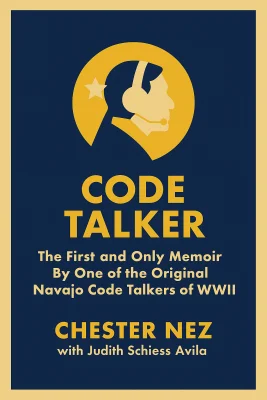
Code Talker
The First and Only Memoir By One of the Original Navajo Code Talkers of WWII
Categories
Nonfiction, Biography, History, Memoir, Audiobook, Military Fiction, Book Club, World War II, War, Native American
Content Type
Book
Binding
Hardcover
Year
2011
Publisher
Dutton Caliber
Language
English
ASIN
0425244237
ISBN
0425244237
ISBN13
9780425244234
File Download
PDF | EPUB
Code Talker Plot Summary
Introduction
In the heat of World War II's Pacific theater, while bullets whistled overhead and artillery shells exploded around him, a young Navajo Marine spoke quietly into a radio. His words, flowing in an ancient tongue that had echoed across the American Southwest for centuries, carried vital military intelligence that would help turn the tide of war. The enemy, for all their code-breaking expertise, could not decipher what they heard. This was the moment when Chester Nez and his fellow Navajo code talkers proved that their native language—once forbidden in government boarding schools—had become America's most unbreakable weapon. Chester Nez's extraordinary life spans nearly nine decades of American history, from his childhood herding sheep in the remote Checkerboard region of New Mexico to receiving the Congressional Gold Medal from President George W. Bush. His story reveals the profound transformation of a people and a nation, showing how traditional Navajo wisdom and warrior traditions ultimately served the cause of freedom. Through his journey, readers will discover the resilience required to bridge two worlds, the courage demanded by combat, and the quiet dignity that sustained him through both triumph and loss. His memoir stands as testament to how individual determination and cultural identity can shape history itself.
Chapter 1: Navajo Childhood: Life on the Checkerboard
Chester Nez was born in winter 1921 into a world where time moved with the seasons rather than clocks, and where survival depended on understanding the rhythms of nature. His home in Chichiltah—"Among the Oak Trees"—sat in New Mexico's Checkerboard region, a patchwork of land where Navajo, Anglo, and Hispanic families lived side by side, each struggling to make a living from the high desert terrain. The landscape was both beautiful and harsh, painted in countless shades of red rock and purple shadow, where turquoise skies arched over endless miles of sagebrush, piñon, and juniper. The death of his mother when Chester was very young left him in the care of his paternal grandmother, a strong woman whose weathered hands could gentle a frightened lamb or weave intricate patterns into wool rugs that would feed the family through trading post exchanges. Life revolved around the sheep and goats whose bells created a constant, comforting soundtrack to daily existence. These animals were more than livestock—they were wealth, security, and companions to a boy who learned to read the land as easily as city children learned to read books. Chester spent countless hours following the herds across unfenced rangeland, learning to spot the approach of coyotes, to find the sweet water springs, and to navigate by landmarks visible for dozens of miles. The Diné way of life demanded that everyone contribute according to their abilities, and Chester found purpose in the daily responsibilities of herding. He learned to use a sling with deadly accuracy, to milk goats and ewes, and to move livestock to fresh grazing areas with the practiced eye of someone three times his age. His grandmother and aunts taught him the prayers and blessings that maintained harmony between humans and the natural world, showing him how to offer corn pollen to the four directions each morning and how to walk in beauty through both joy and hardship. This childhood on the Checkerboard instilled in Chester a deep connection to the land and an understanding of his place within the larger web of creation. The isolation that might have seemed limiting to outsiders actually provided him with an education in self-reliance, observation, and respect for all living things. These lessons, learned while following sheep across ancient pathways, would later serve him well in environments he could never have imagined—from the regulated halls of boarding school to the chaos of Pacific island battlefields. The traditional Navajo emphasis on community cooperation and individual responsibility shaped Chester's character in ways that would prove crucial throughout his life. He learned that everyone had a role to play in the survival of the group, whether that meant protecting sheep from predators or sharing food during lean times. This understanding of interdependence, coupled with the warrior traditions of his people, prepared him to serve not just his immediate family and clan, but eventually his entire nation.
Chapter 2: Boarding School Years: Identity and Cultural Challenges
At age eight, Chester faced the first great upheaval of his life when he was sent to government boarding school at Fort Defiance, Arizona. The transition from the freedom of the Checkerboard to the rigid structure of institutional life represented more than a change of location—it was an assault on everything that defined him as a Navajo child. The school's mission was explicit: to "kill the Indian and save the man" by systematically erasing native culture and replacing it with white American values and customs. The physical transformation began immediately with the mandatory cutting of his shoulder-length hair, an act that violated fundamental Navajo beliefs about personal safety and spiritual protection. Stripped of his traditional clothing and dressed in military-style uniforms, given an English name to replace his Navajo identity, Chester found himself in an alien world where his native language was forbidden and its use brought swift punishment. Teachers and matrons enforced these rules with brutal efficiency, washing children's mouths with lye soap for speaking Navajo or striking them with rulers for failing to respond correctly in English. Despite the harsh conditions and constant hunger that characterized life at Fort Defiance, Chester discovered within himself a determination to master this new environment without losing his essential identity. He excelled in his studies, learning to read and write English while secretly maintaining his fluency in Navajo during whispered conversations with other students. The very language skills that the school sought to destroy would later prove invaluable to his country's war effort, though Chester could not have foreseen such an ironic twist of fate. The boarding school experience, traumatic as it was, taught Chester lessons in endurance and adaptation that would serve him throughout his life. He learned to navigate between two cultures without fully surrendering to either, maintaining his Navajo worldview while acquiring the tools necessary to function in white society. The discipline required to survive emotionally in such an environment—to remain true to himself while appearing to conform—developed the inner strength that would later enable him to excel as a Marine. Perhaps most importantly, the boarding school years revealed to Chester the power of education and communication. Despite the cultural violence inflicted upon him and his fellow students, he recognized that knowledge of English opened doors to opportunities beyond the reservation. This hard-won understanding of the value of linguistic skills would prove prophetic when military recruiters sought young Navajo men who were fluent in both languages. The very boarding school system designed to eliminate his cultural identity had inadvertently prepared him to serve that identity in ways no one could have imagined.
Chapter 3: The Creation of an Unbreakable Code
When Marine recruiters arrived at Chester's boarding school in April 1942, seeking Navajo men fluent in both English and their native language, they were responding to an innovative proposal by Philip Johnston, a civil engineer who had grown up on the Navajo Reservation. Johnston recognized what linguists and military strategists had overlooked: the Navajo language possessed unique characteristics that made it virtually impossible for outsiders to learn or decode. The complex tonal structure, intricate verb conjugations, and sounds that existed nowhere else in human speech created a natural encryption system that no enemy could crack. Chester and twenty-eight other carefully selected Navajo Marines were taken to a locked room at Camp Elliott, California, and given an unprecedented assignment: create a military code based entirely on their native language. The responsibility was staggering—the lives of thousands of American servicemen would depend on their ability to develop a communication system that was both unbreakable and practical for battlefield use. Working with the urgency that only wartime demands, they created a dual-layer encryption system where English letters were first represented by Navajo words, then transmitted in the Navajo language itself. The creative process revealed the deep poetry embedded within Navajo thinking. A battleship became a whale, fighter planes were hummingbirds, and bombs transformed into eggs. Each metaphor reflected traditional Navajo understanding of the natural world, connecting ancient wisdom to modern warfare in ways that honored both military necessity and cultural identity. The men worked with single-minded focus, understanding that any weakness in their code could result in American deaths and potentially alter the course of the war. The development phase demanded not only linguistic creativity but also the phenomenal memorization skills that Navajo oral tradition had cultivated for centuries. Chester and his fellow code talkers had to internalize hundreds of code words so thoroughly that translation became automatic, requiring no conscious thought that might slow communication in combat. They practiced relentlessly, testing each other until the artificial vocabulary became as natural as their childhood language. This process demonstrated how traditional Navajo educational methods—learning through repetition, story, and community involvement—could serve modern military needs. The psychological pressure of creating an unbreakable code weighed heavily on all the participants. They understood that they were being asked to weaponize their most sacred possession—their language—in service of a country that had historically oppressed their people. Yet they embraced this responsibility with the same dedication their ancestors had shown in protecting Navajo lands and traditions. The successful creation of the code represented more than military innovation; it was proof that Native American cultures possessed sophisticated knowledge systems that could contribute to the broader defense of freedom and democracy.
Chapter 4: Combat in the Pacific: Guadalcanal to Peleliu
Chester's first taste of combat came during the chaotic landing on Guadalcanal in November 1942, where he waded through chest-deep water littered with the bodies of American and Japanese soldiers while enemy artillery exploded around him. The theoretical had become brutally real as he and his partner Roy Begay established their first battlefield communication post, crouching in a water-filled foxhole while transmitting vital coordinates that directed American artillery against Japanese positions. Within hours of their first coded transmission, enemy machine gun nests were destroyed with pinpoint accuracy, proving that the Navajo code could function effectively under the most extreme combat conditions. The Pacific island battles that followed—Bougainville, Guam, and Peleliu—each presented unique challenges that tested both Chester's military training and his personal resolve. On Bougainville, the treacherous swampland made movement difficult and defensive positions nearly impossible to maintain, while Japanese snipers hidden in the dense jungle picked off American troops with deadly precision. The constant threat of Banzai suicide attacks meant that no moment offered true safety, as enemy soldiers would emerge from the darkness screaming their battle cry and seeking to die while killing as many Americans as possible. Chester's role as a code talker placed him in the nerve center of military operations, where split-second decisions could mean the difference between victory and catastrophe. He and his radio operator partner worked in constant motion, transmitting messages and immediately relocating to avoid Japanese artillery that targeted their position based on radio signals. The physical demands were enormous—carrying thirty-pound radio equipment while navigating coral reefs, jungle terrain, and enemy fire—but the psychological pressure was even greater. Every word had to be perfect, every transmission clear and accurate, because American lives depended on the precision of their communications. The horror of combat left lasting scars on Chester's psyche, as it did for all the men who fought in the Pacific theater. The stench of decomposing bodies in tropical heat, the screams of wounded comrades, and the constant presence of death created a psychological landscape unlike anything he had experienced growing up on the Checkerboard. Yet he found strength in his cultural training and his bond with fellow Marines, both Navajo and non-Navajo, who depended on each other for survival. The traditional Navajo emphasis on harmony and balance helped him maintain his sanity amid the chaos of war. Perhaps most significantly, Chester witnessed firsthand how his native language had become America's secret weapon against a formidable enemy. Japanese code-breakers, who had successfully cracked every other American communication system, remained completely baffled by Navajo transmissions. The speed and accuracy of code talker communications gave American forces a decisive advantage in coordinating attacks, calling for supplies, and requesting medical evacuation. Chester could take pride in knowing that his childhood language, once forbidden in government schools, was now helping to ensure American victory in the Pacific.
Chapter 5: Silenced Heroes: Post-War Struggles and Recognition
When Chester returned from the Pacific in 1945, he carried with him not only the physical wounds of combat but also the burden of absolute secrecy about his most significant wartime contribution. The Navajo code remained classified, meaning that Chester could not tell his family, friends, or community about his role in developing and using the communication system that had helped win the war. This enforced silence denied him the psychological relief that other veterans found in sharing their experiences, leaving him to wrestle alone with memories of combat and the persistent nightmares that plagued his sleep. The transition to civilian life proved particularly difficult for Chester and many other code talkers, who found themselves caught between the trauma of war and the inability to discuss their most meaningful service. While other veterans could find healing through talking with family members or fellow servicemen about their experiences, the code talkers remained bound by their oath of secrecy. Chester's family noticed his changed demeanor and persistent anxiety, but without understanding the source of his distress, they could offer only limited comfort and support. Traditional Navajo healing ceremonies provided some relief when Chester's family arranged an Enemy Way sing to address his war trauma. The four-day ceremony, designed to cleanse him of the evil influences acquired through contact with enemy dead, represented his community's efforts to restore him to spiritual balance and psychological health. The ritual use of items taken from Japanese soldiers, the complex sand paintings, and the participation of extended family and friends demonstrated how Navajo traditional medicine could address the psychological wounds that conventional treatment could not reach. Chester's determination to build a successful post-war life led him to pursue education and employment opportunities that had been largely unavailable to previous generations of Native Americans. He completed high school at Haskell Institute in Kansas, attended the University of Kansas as a fine arts major, and served again during the Korean War before settling into civilian employment at the Veterans Administration Hospital in Albuquerque. His success in navigating the white world while maintaining his Navajo identity reflected the bicultural competence that his boarding school experience and military service had developed. The twenty-three-year period of enforced secrecy about the code talker program represented both personal sacrifice and national security necessity. Chester and his fellow code talkers understood that their silence protected military intelligence that might be needed in future conflicts, but the psychological cost was enormous. Many code talkers struggled with alcohol, unemployment, and depression during these years, unable to claim recognition for their most significant contribution to American history. When the code was finally declassified in 1968, it provided validation and healing that had been denied for more than two decades.
Chapter 6: Legacy of the Navajo Code Talkers
The declassification of the Navajo code in 1968 marked the beginning of long-overdue recognition for Chester and his fellow code talkers, transforming them from invisible veterans into celebrated heroes whose story captured the American imagination. The revelation that a Native American language had served as an unbreakable military code challenged prevailing assumptions about indigenous cultures and their potential contributions to national defense. Chester found himself in demand as a speaker and interview subject, sharing his story with audiences who were amazed to learn how traditional Navajo linguistic skills had helped secure Allied victory in the Pacific. The formal recognition culminated in 2001 when President George W. Bush awarded Congressional Gold Medals to the original twenty-nine code talkers and Congressional Silver Medals to the hundreds who followed them into service. For Chester, receiving the nation's highest civilian honor represented not just personal validation but vindication of Navajo culture itself. The same language that government boarding schools had tried to eliminate was now celebrated as a crucial element in American military history, demonstrating the value of cultural diversity and the dangers of cultural suppression. Chester's later years were marked by his dedication to education and historical preservation, as he traveled extensively to share his story with school children, military audiences, and historical societies. His message consistently emphasized themes of service, perseverance, and the importance of maintaining cultural identity while contributing to the broader American community. He understood that his story represented something larger than individual achievement—it was proof that traditional Native American cultures possessed sophisticated knowledge systems that could serve modern needs. The code talker story also revealed the complex relationship between indigenous peoples and the American government, highlighting both historical injustices and moments of mutual respect. Chester's willingness to serve a country that had oppressed his people reflected the Navajo warrior tradition and their deep connection to the land, but it also demonstrated a mature understanding of the difference between America's founding ideals and its historical treatment of Native Americans. His service suggested that true patriotism sometimes required working to make one's country live up to its highest aspirations. The enduring fascination with the code talker story reflects its powerful demonstration that America's strength lies in its diversity rather than its uniformity. Chester's life proved that cultural differences, rather than representing obstacles to be overcome, could become sources of unique strength and capability. The Navajo code talkers' story continues to inspire discussions about the value of linguistic diversity, the importance of cultural preservation, and the ways that marginalized communities can contribute to national defense and security.
Summary
Chester Nez's remarkable journey from a sheep-herding boy on the Checkerboard to a Congressional Gold Medal recipient illustrates how individual determination, cultural pride, and service to others can transform both personal destiny and national history. His life demonstrates that the greatest strength often emerges from embracing rather than abandoning one's cultural identity, even when that identity has been devalued or suppressed by dominant society. The Navajo language that boarding schools tried to eliminate became America's most effective secret weapon, proving that diversity represents strength rather than division. The code talker story offers profound lessons about resilience, service, and the unexpected ways that traditional knowledge can serve modern needs. Chester's willingness to serve a country that had historically oppressed his people, while never abandoning his Navajo identity and values, provides a model for how marginalized communities can contribute to the common good while maintaining their unique cultural perspectives. His legacy reminds us that true patriotism sometimes requires challenging our nation to live up to its highest ideals rather than accepting its current limitations.
Best Quote
“We Navajos believe in witchcraft. Cut hair and fingernail clippings should be gathered and hidden or burned. Such things could be used to invoke bad medicine against their owner. People should not leave parts of themselves scattered around to be picked up by someone else. Even the smallest children knew that.” ― Chester Nez, Code Talker: The First and Only Memoir By One of the Original Navajo Code Talkers of WWII
Review Summary
Strengths: The book is praised for its unique subject matter, focusing on the Navajo "code talkers" during WWII, which is described as a marvelous tale. The audiobook is recommended for its inclusion of the Navajo language, adding an authentic auditory experience. Weaknesses: The review criticizes the author, Ms. Avila, for not fully capitalizing on the potential of the subject matter, suggesting that the book could have been a better read. Additionally, there is a noted lack of focus on the code itself, with more emphasis placed on battles. The post-war treatment of Navajos is also highlighted as a negative aspect. Overall: The book receives a mixed review, with a final rating of 4 stars, acknowledging the author's effort but suggesting that the story might benefit from a more skilled writer in the future. The memoir is considered a must-read for its unique perspective, despite its shortcomings.
About Author

Chester Nez
Nez interrogates the complexities of identity and cultural preservation through his profound contributions as a Navajo code talker during World War II and his literary endeavors. His commitment to using the Navajo language as an unbreakable code for the U.S. Marine Corps exemplifies the intersection of military strategy and cultural heritage. Nez's service in pivotal battles such as Guadalcanal and Peleliu highlights his strategic importance, whereas his later career as a painter at a Veterans Administration hospital in Albuquerque reflects a transition from combat to healing.\n\nThe author’s memoir, "Code Talker: The First and Only Memoir by One of the Original Navajo Code Talkers of WWII", provides a compelling narrative that blends historical testimony with personal reflection. Through this book, Nez extends an understanding of Navajo identity, emphasizing the dual role of language as both a tool of warfare and a vessel of cultural legacy. His literary style is marked by a deep introspection into his family's history and the broader implications of his wartime service, offering readers insights into the resilience and adaptability inherent in cultural preservation.\n\nFor readers interested in military history and cultural studies, Nez's bio and work offer a unique lens through which to view the impact of indigenous contributions to global events. His legacy, cemented by the Congressional Gold Medal awarded to the Navajo Code Talkers in 2001, underlines the lasting significance of his role in shaping both historical and cultural narratives. By receiving an honorary Bachelor of Fine Arts degree from the University of Kansas, Nez's dual legacy as a war hero and cultural icon is further acknowledged, making his life and work a significant point of reference for those exploring the intertwining of cultural identity and historical events.
Read moreDownload PDF & EPUB
To save this Black List summary for later, download the free PDF and EPUB. You can print it out, or read offline at your convenience.
Code Talker
by Chester Nez
