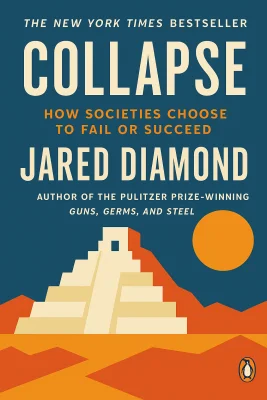
Collapse
How Societies Choose to Fail or Succeed
Categories
Nonfiction, Science, History, Economics, Politics, Anthropology, Sociology, Social Science, Society, Environment
Content Type
Book
Binding
Paperback
Year
2005
Publisher
Penguin Books Ltd. (London)
Language
English
ASIN
0143036556
ISBN
0143036556
ISBN13
9780143036555
File Download
PDF | EPUB
Collapse Plot Summary
Introduction
# Collapse: How Civilizations Choose to Fail or Succeed Standing among the nearly thousand stone statues scattered across Easter Island's windswept landscape, you can almost hear the whispers of a vanished civilization. These massive monuments, some weighing up to 80 tons, gaze silently across barren grasslands where lush palm forests once thrived. The haunting mystery of what happened here—how a sophisticated society capable of such monumental achievements could simply disappear—has captivated explorers and scientists for centuries. Yet Easter Island's story is not unique; it echoes across time and continents, from the abandoned cliff dwellings of the American Southwest to the jungle-covered temples of the Maya. These archaeological puzzles are far more than ancient curiosities. They are urgent messages from the past, written in stone and soil, offering profound lessons about the delicate relationship between human societies and their environments. Through careful detective work combining archaeology, climate science, and environmental analysis, we can now piece together the dramatic stories behind these collapses and survivals. More importantly, we can discover the timeless patterns that determine whether civilizations flourish or fade, providing essential wisdom for navigating our own environmental challenges and building a more sustainable future.
Chapter 1: Easter Island's Warning: Paradise Lost to Environmental Collapse
When Polynesian voyagers first arrived at Easter Island around 900 AD, they discovered a subtropical paradise unlike anywhere else in the Pacific. Towering palm trees, some reaching 80 feet in height, covered the island in dense forests. Millions of seabirds nested in the canopy, while rich volcanic soils promised abundant harvests. The island's isolation, which would later prove fatal, initially seemed like a blessing—a pristine world where a small group of settlers could build their own civilization without interference from outside forces. For centuries, the Easter Islanders thrived in this island Eden. Their population grew from the original settlers to perhaps 15,000 people at their peak. They developed a sophisticated society with complex rituals, astronomical knowledge, and remarkable artistic achievements. Most famously, they channeled their energy into creating the massive stone statues called moai that would make their island legendary. These weren't merely artistic expressions but sacred monuments to ancestors, symbols of clan prestige, and focal points for elaborate ceremonies that bound the community together. Yet success contained the seeds of destruction. As the population expanded and clans competed for status, the demand for resources intensified dramatically. Trees were cut not just for practical needs like houses and canoes, but to transport the ever-larger statues across the island using wooden rollers and rope made from palm fiber. The competition between clans drove them to build bigger and more elaborate monuments, creating an escalating cycle of resource consumption. Gradually, imperceptibly at first, the great palm forests began to shrink. By 1400 AD, the last palm tree on Easter Island had been cut down. The environmental collapse that followed was swift and catastrophic. Without trees, the islanders could no longer build the large canoes needed for deep-sea fishing, cutting off their primary source of protein. Soil erosion increased dramatically without forest cover, reducing agricultural productivity just as the population reached its maximum size. The bird populations crashed as their nesting sites disappeared, eliminating another crucial food source. Society itself began to unravel as clans fought desperately over dwindling resources. The elaborate statue-building culture collapsed, replaced by warfare, cannibalism, and a desperate struggle for survival. When European explorers first arrived in 1722, they found fewer than 3,000 people living in poverty among the silent monuments of their ancestors' former glory. Easter Island's tragedy reveals how even the most isolated paradise can become a prison when a society consumes its resources faster than nature can replenish them, offering a chilling preview of what awaits any civilization that ignores environmental limits.
Chapter 2: Maya Grandeur and Downfall: When Complexity Meets Crisis
In the dense rainforests of Central America, the ancient Maya created what was arguably the most sophisticated civilization in the pre-Columbian Americas. At their peak around 800 AD, magnificent cities like Tikal and Copán supported hundreds of thousands of people through intensive agriculture and complex trade networks. Towering pyramids rose above the forest canopy, their temples serving as both religious centers and astronomical observatories where Maya priests tracked planetary movements with stunning accuracy. The Maya developed the most advanced writing system in the Americas, created mathematical concepts including zero, and built elaborate water management systems that could store millions of gallons of rainwater. The city of Copán exemplified Maya achievement at its zenith. Nestled in a fertile valley in present-day Honduras, it housed perhaps 25,000 people in an urban landscape of stone palaces, ball courts, and ceremonial plazas. The city's rulers commissioned intricate sculptures celebrating their divine authority and supernatural power to bring prosperity to their subjects. Elaborate hieroglyphic texts recorded royal genealogies stretching back centuries, confident that these dynasties would endure forever. The surrounding valley had been transformed into a managed landscape of terraced hillsides, irrigation canals, and intensive agricultural plots that maximized food production from every available acre. Yet beneath this cultural flowering lay growing environmental stress that would ultimately doom Maya civilization. Copán's success had come at enormous ecological cost—the surrounding hills had been almost completely deforested to provide fuel for cooking fires, lime production for construction, and timber for building projects. Without forest cover, tropical rains washed away precious topsoil, reducing agricultural productivity just as the population reached its peak. Skeletal remains from this period show increasing malnutrition and disease, while pollen analysis reveals that even the royal elite were forced to supplement their diets with wild plants as food shortages intensified. The environmental crisis intersected with political instability as Maya kingdoms engaged in increasingly destructive warfare. Kings had built their legitimacy on promises to deliver prosperity through supernatural intervention, but prolonged droughts made these promises impossible to fulfill. When Copán's King 18 Rabbit was captured and beheaded by a rival ruler in 738 AD, it marked the beginning of the city's decline. Across the Maya lowlands, similar patterns played out as environmental degradation, climate change, and political competition created a perfect storm of collapse. Within a century, cities that had thrived for over 600 years were abandoned to the jungle, their populations scattered, their monuments left to crumble in the tropical heat. The Maya story demonstrates how even the most sophisticated civilizations can fall victim to the interaction between environmental limits and social complexity, reminding us that technical brilliance means nothing without the wisdom to live within nature's constraints.
Chapter 3: Norse Greenland: Cultural Identity Versus Environmental Adaptation
In 985 AD, Erik the Red led a fleet of 25 ships carrying nearly 500 Norse colonists to establish what would become medieval Europe's most remote outpost on the shores of Greenland. For over four centuries, these hardy settlers maintained a distinctly European way of life in one of the world's most challenging environments. They built stone churches that rivaled those of Norway, raised cattle and sheep in pastures carved from the Arctic wilderness, and traded walrus ivory and polar bear hides back to Europe. At their peak, the Greenland Norse numbered around 5,000 people living in two main settlements along the island's southwestern coast, proud of their ability to maintain Christian civilization at the edge of the known world. The Norse brought with them not just livestock and tools, but a complete cultural identity rooted in European Christianity and Scandinavian pastoral traditions. Their large farms, modeled on Norwegian estates, featured impressive stone buildings designed to house both families and their prized cattle through the long Arctic winters. The wealthiest farmers owned herds of hundreds of animals, and the community's status was measured by its ability to maintain European customs in this harsh frontier. They imported luxury goods from Europe, built elaborate churches, and even established their own bishop, maintaining their connection to European civilization through faith and commerce. Yet this very commitment to their European identity would prove their undoing as Greenland's climate grew colder during the Little Ice Age beginning around 1300. Sea ice increasingly blocked the shipping routes to Europe, cutting off vital trade and communication links. Hay production declined as summers grew shorter and cooler, making it increasingly difficult to feed their cattle through the winter. Meanwhile, the Inuit had migrated south into Norse territory, bringing with them sophisticated technologies perfectly adapted to Arctic conditions: kayaks for hunting seals, toggle harpoons for catching marine mammals, and warm clothing made from animal skins. The Norse had numerous opportunities to learn from their Inuit neighbors, who were thriving in the same environment where European farming was becoming impossible. Inuit hunting techniques could have provided reliable protein sources, their clothing was far superior for Arctic conditions, and their mobility allowed them to exploit resources across the entire landscape. Archaeological evidence shows that the Norse did begin eating more seals and less beef as their situation deteriorated, but they never fully embraced the lifestyle changes that might have saved them. Bound by their Christian European identity and their massive investment in a pastoral lifestyle, the Norse refused to adapt completely. They continued trying to maintain their cattle even as the animals starved, and they persisted in their European ways even as their society slowly died. The last written record from Norse Greenland dates to 1408, and by the time Europeans returned in the 18th century, only Inuit remained. The Norse Greenland tragedy illustrates how cultural identity, while providing the strength to survive in harsh conditions, can also become a prison that prevents the flexibility needed for long-term survival when environmental conditions change.
Chapter 4: Modern Parallels: Rwanda's Tragedy and Environmental Limits
In the rolling green hills of Rwanda, one of Africa's most densely populated countries, environmental pressure and social tensions converged in 1994 to produce one of history's most horrific genocides. While international media portrayed the killing primarily as ethnic hatred between Hutu and Tutsi populations, this explanation overlooked a crucial underlying factor: Rwanda had become a Malthusian nightmare where population growth had outstripped the land's ability to support its people. By the 1990s, this tiny nation supported over seven million people in an area smaller than Maryland, with the average farm shrunk to less than one acre per family. In Kanama commune, studied intensively by researchers, the signs of impending crisis were unmistakable years before the genocide began. Young men could no longer find land to marry and start families, remaining dependent on their parents well into their twenties and thirties. Disputes over land inheritance tore families apart, with fathers suing sons and brothers fighting over tiny plots barely large enough to grow subsistence crops. The poorest families, those with less than half an acre, were forced to sell their land during emergencies, while wealthier farmers used off-farm income to buy up these distressed properties, creating a growing divide between haves and have-nots. When the genocide erupted in April 1994, the killing in Kanama followed these lines of economic desperation as much as ethnic division. The victims included not only Tutsis but also large landowners, people involved in land disputes, and especially the malnourished poor who lacked the resources to buy their survival or flee to safety. Neighbors who had lived peacefully for generations turned on each other with machetes and clubs, but the underlying motivation was often competition for scarce land and resources rather than pure ethnic hatred. The environmental roots of Rwanda's tragedy became clear in the aftermath, as survivors struggled to rebuild their lives on the same overcrowded, degraded landscape that had contributed to the violence. International aid focused on reconciliation and governance, but the fundamental problem of too many people trying to survive on too little land remained largely unaddressed. Rwanda's genocide reveals how environmental stress and resource scarcity can interact with social tensions to produce unimaginable violence, transforming economic competition into a struggle for survival that tears apart the very fabric of society. The tragedy serves as a stark warning that environmental problems rarely remain purely environmental—when populations exceed their environment's carrying capacity, the resulting stress manifests in political instability, social conflict, and human suffering that can destroy entire communities.
Chapter 5: Corporate Responsibility: Business Responses to Ecological Challenges
In the remote highlands of Papua New Guinea, an unlikely environmental success story unfolds at the Kutubu oil fields, where Chevron operates one of the world's most environmentally careful extraction projects. This region, characterized by some of the planet's highest rainfall and most challenging terrain, might seem an improbable place for environmental stewardship. Yet visitors today encounter something remarkable: a thriving ecosystem where birds of paradise perch on communication towers, tree kangaroos move freely through the forest canopy, and rare species flourish in greater abundance than in most of the country's supposedly protected areas. This transformation didn't happen by accident or corporate altruism. When Chevron began operations in the 1990s, the company made a calculated business decision that environmental protection would be central to their strategy. Every employee undergoes rigorous environmental training, hunting and fishing are absolutely prohibited within the project area, and access roads are designed as narrow corridors that allow wildlife to cross freely. The company's environmental protocols are so strict that visitors must wear hard hats even while birdwatching, and any environmental incident, no matter how minor, triggers immediate investigation and comprehensive review. The contrast with other resource extraction projects in Papua New Guinea is stark and instructive. The Bougainville copper mine, once the country's largest industrial project, was shut down by violent local rebellion partly due to environmental devastation that poisoned rivers and destroyed traditional fishing grounds. The Ok Tedi mine continues to discharge massive amounts of waste into river systems, destroying fisheries and flooding agricultural land with contaminated sediment. These projects followed the traditional extractive industry model of externalizing environmental costs onto local communities and ecosystems while maximizing short-term profits. Chevron's different approach reflects a hard-headed business calculation rather than environmental idealism. The company recognized that in Papua New Guinea's decentralized democracy, local communities possess the political power to shut down projects that harm their environment and livelihoods. The memory of Bougainville's violent closure served as a powerful reminder that environmental damage could destroy billions of dollars in investment overnight. Moreover, operating in a pristine environment helps attract and retain the highly skilled international workforce that modern oil operations require. This case illuminates a crucial principle about corporate environmental responsibility: businesses respond to incentives, not moral appeals. When companies face real consequences for environmental damage and genuine rewards for environmental stewardship, they often discover that prevention is far cheaper than cleanup, and that sustainable practices can provide competitive advantages in attracting customers, employees, and investment capital. The key to corporate environmental responsibility lies not in changing corporate nature, but in designing institutions and market conditions that align private incentives with public environmental goals.
Chapter 6: Success Stories: Societies That Found Sustainable Balance
Not all stories of human societies facing environmental challenges end in collapse and tragedy. Scattered across the globe are remarkable examples of communities that confronted severe environmental limitations and not only survived but created sustainable ways of life that persisted for thousands of years. These success stories offer hope and practical wisdom, demonstrating that human ingenuity and social cooperation can indeed find ways to live within environmental limits while maintaining rich, fulfilling cultures that provide models for our own environmental challenges. In the highlands of New Guinea, millions of people have practiced sustainable agriculture for over 7,000 years in one of the world's most challenging environments. When European explorers first flew over the interior in the 1930s, they were astonished to discover a landscape as intensively cultivated as Holland, with terraced hillsides, elaborate drainage systems, and managed forests stretching as far as the eye could see. The highlanders had solved the fundamental problem of tropical agriculture—maintaining soil fertility under heavy rainfall—through a sophisticated system of crop rotation, composting, and agroforestry that actually improved the land over time. Perhaps even more remarkable is the story of Tikopia, a tiny Pacific island of less than two square miles that has supported a stable population of about 1,200 people for 3,000 years. The Tikopians transformed their entire island into a carefully managed food production system that mimics a natural forest but consists entirely of useful species. Their "orchard" has multiple layers—tall coconut and breadfruit trees forming a canopy, smaller fruit trees in the middle story, and root crops like taro and yams growing in the understory. Every plant on the island serves a purpose, and the Tikopians developed elaborate social mechanisms to prevent overpopulation and overexploitation of their limited resources. Japan's experience during the Tokugawa period (1603-1867) offers a large-scale example of successful environmental recovery and management. Faced with severe deforestation and resource depletion in the early 1600s that threatened the country's survival, Japanese society could have collapsed like so many others. Instead, the government implemented comprehensive forest management policies that included detailed regulations on tree cutting, massive reforestation programs, and the development of sustainable forestry practices. Within a century, Japan had not only halted deforestation but had begun to increase its forest cover while supporting a population of over 25 million people. These success stories share common elements that offer guidance for modern societies facing environmental challenges. They all developed strong social institutions for managing common resources, found ways to align individual incentives with long-term sustainability, and maintained the cultural flexibility to adapt their practices when conditions changed. Most importantly, they recognized that human prosperity and environmental health are not opposing forces but complementary aspects of a single system, showing us that with wisdom, cooperation, and the courage to change unsustainable practices, human societies can indeed find ways to thrive within the Earth's limits.
Summary
The haunting silence of Easter Island's stone statues and the abandoned pyramids of the Maya speak to us across the centuries, carrying urgent messages about the consequences of environmental destruction and social collapse. Yet these stories of failure are balanced by equally powerful tales of success—from the sustainable gardens of Tikopia to the recovered forests of Japan, from the ingenious agriculture of New Guinea to the environmental stewardship of modern corporations when properly incentivized. Together, these examples reveal that collapse is not inevitable destiny but the result of choices that societies make about how to respond to environmental challenges. The path forward requires embracing the wisdom that successful societies throughout history have discovered: we must think beyond immediate gains to consider long-term consequences, develop institutions that can manage shared resources for collective benefit, and maintain the courage to adapt our values and practices when they conflict with environmental realities. The choice between the fate of Easter Island and the success of sustainable societies lies before us, and the decisions we make today will determine not only our own future but the legacy we leave for generations yet to come. In this choice lies both our greatest challenge and our most profound opportunity to create a world where human civilization and the natural world can flourish together.
Best Quote
“[T]he values to which people cling most stubbornly under inappropriate conditions are those values that were previously the source of their greatest triumphs.” ― Jared Diamond, Collapse: How Societies Choose to Fail or Succeed
Review Summary
Strengths: The review highlights Jared Diamond's detailed examination of historical societies, particularly the in-depth analysis of medieval Greenland. The narrative effectively illustrates the consequences of resource mismanagement and the intriguing refusal of the Greenland settlers to adapt their diet, providing a compelling historical case study. Weaknesses: The review does not explicitly mention any weaknesses in Diamond's book. However, it implies a lack of direct comparison between historical and modern examples, suggesting a potential gap in connecting past lessons to present-day scenarios. Overall: The review conveys a positive sentiment towards Diamond's exploration of societal collapse due to environmental mismanagement. It suggests the book is thought-provoking, especially in its detailed historical accounts, and implicitly recommends it for readers interested in environmental history and societal behavior.
About Author

Jared Diamond
Diamond interrogates the interplay between environment and human societies, challenging conventional narratives of historical progress. By situating environmental and geographical factors as central to understanding societal development, he reframes debates traditionally dominated by notions of cultural superiority. In "Guns, Germs, and Steel: The Fates of Human Societies," Diamond demonstrates how natural endowments, rather than racial distinctions, have significantly influenced global power dynamics. Meanwhile, "Collapse: How Societies Choose to Fail or Succeed" probes why some civilizations thrive while others disintegrate, emphasizing the impact of ecological and societal choices.\n\nUsing an interdisciplinary methodology, Diamond connects biology, geography, and anthropology to analyze human evolution and societal trajectories. His book, "The Third Chimpanzee: The Evolution and Future of the Human Animal," delves into the evolutionary pathways that distinguish humans from other species, while "Why Is Sex Fun? The Evolution of Human Sexuality" offers a provocative exploration of reproductive behavior from an evolutionary perspective. These works demonstrate Diamond’s unique ability to synthesize scientific analysis with historical context, offering readers a comprehensive understanding of complex phenomena. Consequently, his contributions extend beyond academic circles, prompting a broader audience to reconsider entrenched beliefs about human history and evolution.\n\nReaders benefit from Diamond's incisive analysis and narrative clarity, gaining insights into the forces that shape human societies. His writing, while scholarly, remains accessible, making intricate subjects comprehensible to a diverse readership. The author’s work appeals not only to scholars in the fields of history, geography, and biology but also to anyone interested in the fundamental drivers of human development. The awards and accolades, including the Pulitzer Prize for "Guns, Germs, and Steel," underscore his impact and influence, solidifying Diamond's place as a pivotal figure in the exploration of human civilization.
Read moreDownload PDF & EPUB
To save this Black List summary for later, download the free PDF and EPUB. You can print it out, or read offline at your convenience.
Collapse
by Jared Diamond
