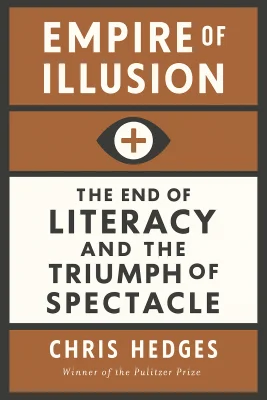
Empire of Illusion
The End of Literacy and the Triumph of Spectacle
Categories
Nonfiction, Psychology, Philosophy, History, Education, Politics, Sociology, Society, Cultural, American
Content Type
Book
Binding
Hardcover
Year
2009
Publisher
Nation Books
Language
English
ISBN13
9781568584379
File Download
PDF | EPUB
Empire of Illusion Plot Summary
Introduction
Modern American society operates within a carefully constructed web of illusions that obscure the harsh realities of corporate dominance, social decay, and democratic erosion. These illusions manifest across multiple domains—from entertainment and education to politics and personal relationships—creating a comprehensive system of distraction and control that prevents meaningful social change. The analysis presented here employs a "論证辨析" approach, systematically examining how various cultural phenomena serve not merely as entertainment or social institutions, but as mechanisms of social control. By tracing the logical connections between seemingly disparate cultural trends—professional wrestling, pornography, positive psychology, elite education, and political spectacle—this examination reveals the underlying architecture of a society that has substituted genuine democratic participation with passive consumption of manufactured experiences. This methodical deconstruction of cultural illusions provides essential insights for understanding how corporate power maintains its grip on American society while citizens remain largely oblivious to their own disempowerment.
Chapter 1: The Cultural Shift from Literacy to Spectacle
The transformation of American culture from a literacy-based society to one dominated by spectacle represents perhaps the most fundamental shift undermining democratic discourse. Professional wrestling serves as a particularly revealing case study of this transformation. Unlike the Cold War era when wrestling narratives centered on clear moral divisions between American heroes and foreign villains, contemporary wrestling reflects the fragmented, morally ambiguous landscape of post-industrial America. The evolution of wrestling storylines mirrors broader social changes. Where once audiences cheered for patriotic champions against communist threats, today's narratives focus on personal betrayal, family dysfunction, and economic desperation. The Heartbreak Kid's dilemma—forced to choose between dignity and financial survival—resonates with millions of Americans facing similar pressures in an economy that no longer provides stable employment or social safety nets. This shift from external threats to internal dysfunction reflects a society that has lost its capacity for collective action and shared meaning. Wrestling audiences now cheer for anti-establishment figures who openly defy corporate authority, yet this rebellion remains safely contained within the controlled environment of staged entertainment. The spectacle provides an outlet for genuine rage and frustration while simultaneously channeling those emotions away from real political action. The psychological appeal of wrestling lies in its promise of agency and revenge for those who feel powerless in their daily lives. The elaborate personal narratives and mythic storylines offer viewers a sense of participation in meaningful drama, even as they remain passive consumers. This dynamic reveals how spectacle culture operates more broadly—providing the illusion of engagement while actually reinforcing passivity and political disengagement. The decline of literacy parallels this rise of spectacle-based culture. When citizens lack the intellectual tools to analyze complex social and political structures, they become susceptible to emotional manipulation through visual imagery and simplified narratives. This vulnerability creates fertile ground for the various forms of illusion that characterize contemporary American society.
Chapter 2: Pornography as Dehumanization: Analyzing the Exploitation Industry
The pornography industry provides a stark illustration of how capitalist logic reduces human beings to commodities while masquerading as sexual liberation. The systematic degradation documented in contemporary pornographic content reflects broader patterns of dehumanization that characterize late-stage capitalism. The evolution from traditional pornography to "gonzo" productions reveals an escalating cycle of cruelty designed to generate profits from increasingly extreme content. This progression follows predictable market logic—as audiences become desensitized to existing content, producers must continually push boundaries to maintain consumer interest. The result is an industry built on the systematic abuse of vulnerable women, many of whom enter the business due to childhood trauma, economic desperation, or addiction. The health consequences faced by performers—including routine injuries, sexually transmitted diseases, and widespread drug addiction—demonstrate how the industry externalizes the true costs of production onto the bodies of its workers. Industry leaders acknowledge these harms while simultaneously portraying them as necessary components of the product being sold. This dynamic mirrors other industries that profit from environmental destruction or worker exploitation. The psychological impact on performers resembles trauma responses documented in war veterans, including dissociation, hypervigilance, and emotional numbing. Many performers describe using drugs and alcohol to cope with the physical and emotional demands of their work, creating cycles of dependency that further trap them within the industry. The mainstreaming of pornographic content through corporate media channels represents a cultural shift toward accepting commodified sexuality as normal and even progressive. This acceptance obscures the industry's exploitative labor practices while presenting extreme sexual behaviors as standard expressions of female desire. The corporate entities that profit from pornography distribution—including major telecommunications companies—rarely face scrutiny for their role in perpetuating these harms. The industry's treatment of women as interchangeable objects designed solely for male gratification provides a clear example of how capitalism reduces human relationships to market transactions. This reduction has implications far beyond the industry itself, influencing broader cultural attitudes toward sexuality, consent, and human dignity.
Chapter 3: Educational Institutions and the Erosion of Critical Thinking
Elite educational institutions have transformed from centers of intellectual inquiry into training grounds for corporate management, producing graduates who excel at systems maintenance but lack the critical thinking skills necessary for meaningful social analysis. This transformation represents a fundamental betrayal of education's democratic mission. The admissions process at elite universities systematically excludes working-class students while privileging those with access to expensive test preparation, private schools, and family connections. The resulting student bodies are predominantly drawn from affluent families, creating insular communities that reinforce existing class divisions rather than challenging them. Legacy preferences and donor influence ensure that wealth remains the primary determinant of access, despite rhetoric about meritocracy and diversity. The curriculum itself has been restructured to serve corporate interests rather than promote intellectual development. Humanities departments face continuous budget cuts and reduced enrollments as students gravitate toward business and pre-professional programs that promise immediate economic returns. This shift reflects broader cultural values that prioritize economic utility over intellectual growth or social responsibility. Faculty members increasingly operate within narrow specializations that prevent them from addressing broad social questions or challenging fundamental assumptions about economic and political structures. The use of specialized jargon creates barriers to public engagement while allowing academics to avoid taking positions on controversial issues that might threaten their funding or career prospects. The student experience emphasizes competition over collaboration and conformity over creativity. Students learn to provide expected responses rather than develop independent critical faculties. The focus on grades, test scores, and résumé building creates graduates who are skilled at meeting external expectations but lack the intellectual independence necessary for democratic citizenship. These institutional changes serve the interests of corporate power by producing compliant managers who will implement existing systems without questioning their legitimacy or exploring alternatives. The resulting graduates possess technical skills but lack the moral and intellectual foundation necessary to address the complex challenges facing society.
Chapter 4: The Psychology of False Positivity and Social Control
The positive psychology movement represents a sophisticated form of social control that channels individual discontent into self-blame while protecting existing power structures from criticism. By promoting the idea that happiness results from proper mental attitudes rather than material conditions, this movement serves corporate interests while claiming scientific legitimacy. The fundamental premise of positive psychology—that individuals can control their emotional states through cognitive techniques—ignores the social and economic factors that contribute to widespread unhappiness and anxiety. Workers facing job insecurity, medical bankruptcy, or housing instability are told that their problems result from insufficient optimism rather than systemic failures of economic organization. Corporate applications of positive psychology create workplace cultures that demand constant emotional performance from employees. Workers must display enthusiasm and gratitude regardless of their actual working conditions or compensation levels. This emotional labor represents an additional form of exploitation that extends corporate control into previously private realms of human experience. The therapeutic techniques promoted by positive psychology practitioners often mirror methods developed for interrogation and crowd control. Group exercises designed to break down individual resistance and promote conformity have historical precedents in coercive environments ranging from military training to cult indoctrination. Research supporting positive psychology claims often employs circular reasoning and methodological flaws that would be unacceptable in other scientific disciplines. The movement's proponents benefit financially from corporate consulting contracts and popular book sales, creating conflicts of interest that undermine their scientific credibility. The emphasis on individual responsibility for emotional states serves to deflect attention from collective problems that require political solutions. By teaching people to accept their circumstances and focus on personal attitude adjustments, positive psychology undermines the social solidarity necessary for democratic reform movements.
Chapter 5: Corporate Power and the Decline of American Democracy
The merger of corporate and governmental power has created a system that serves private interests while maintaining the formal structures of democratic governance. This corporate state operates through mechanisms that are largely invisible to most citizens, who continue to believe they live in a functioning democracy. Corporate influence over the electoral process ensures that viable candidates must secure massive financial backing from business interests before they can compete effectively. Campaign finance requirements create a filtering mechanism that eliminates candidates who might challenge fundamental assumptions about economic organization or corporate power. The revolving door between government agencies and private industry creates regulatory capture, where agencies tasked with overseeing corporate behavior instead serve corporate interests. Former government officials routinely join the companies they previously regulated, while corporate executives move into government positions that affect their former employers. Military spending represents a particularly clear example of corporate welfare disguised as national security. Defense contractors spread production facilities across multiple congressional districts to ensure political support for weapons systems that serve no genuine strategic purpose. The resulting military-industrial complex consumes resources that could address pressing social needs while creating international instability through arms sales and military interventions. Healthcare provides another illustration of how corporate power shapes policy against public interest. Insurance and pharmaceutical companies spend millions on lobbying to prevent implementation of single-payer systems that would reduce costs while improving health outcomes. The resulting system prioritizes corporate profits over human welfare, leading to preventable deaths and medical bankruptcies. The corporate media system ensures that public discourse remains within acceptable parameters by excluding voices that challenge fundamental assumptions about economic organization. Dissenting perspectives are marginalized or ignored entirely, creating the illusion of democratic debate while actually constraining the range of acceptable opinion.
Chapter 6: Media Manipulation and the Manufacture of Consent
Contemporary journalism has largely abandoned its democratic function in favor of serving as a conduit for corporate and governmental propaganda. The transformation of news into entertainment has created a media system that prioritizes ratings over truth and access over accountability. Television journalism exemplifies this decay through its reliance on celebrity anchors who earn millions while failing to perform basic journalistic functions. These media personalities develop cozy relationships with political and corporate elites, serving more as courtiers than as watchdogs. Their primary function becomes maintaining access to powerful sources rather than holding those sources accountable to the public. The techniques used to manipulate public opinion during the lead-up to the Iraq War demonstrate how corporate media serves power rather than truth. Government officials leaked false information to compliant journalists, who then reported these leaks as verified facts. The same officials could then cite these reports as independent confirmation of their claims, creating a circular system of manufactured credibility. The consolidation of media ownership has eliminated diversity of perspective while creating economies of scale that prioritize profit over public service. A handful of corporations now control most news sources, ensuring that alternative viewpoints struggle to reach mainstream audiences. Reality television and celebrity coverage serve as sophisticated forms of propaganda by directing public attention away from serious issues toward trivial entertainments. The obsessive focus on personal scandals and lifestyle choices prevents sustained attention to policy questions or structural problems that require collective action. Social media platforms, despite their potential for democratic communication, have largely been captured by corporate interests that profit from division and conflict. Algorithmic systems designed to maximize engagement promote sensational and divisive content while suppressing measured analysis and constructive dialogue.
Chapter 7: The Search for Authentic Human Connection
Beneath the various illusions that dominate American culture lies a deep human need for genuine connection and meaningful purpose that cannot be satisfied through consumer culture or technological solutions. The persistence of this need provides hope for eventual transformation despite the current system's apparent stability. The isolation and alienation that characterize modern life create psychological wounds that no amount of positive thinking or material consumption can heal. People instinctively recognize the hollowness of celebrity culture and corporate messaging, even as they participate in these systems due to lack of alternatives. Authentic human relationships based on mutual care and shared struggle represent the most fundamental threat to systems based on exploitation and control. Love, compassion, and solidarity cannot be commodified or controlled through market mechanisms, making them inherently subversive to corporate power. Historical examples from various totalitarian systems demonstrate that human dignity and connection persist even under the most oppressive conditions. The capacity for moral action and mutual aid survives attempts at systematic dehumanization, providing the foundation for resistance and eventual transformation. Small acts of kindness and solidarity, while seemingly insignificant in the face of massive structural problems, accumulate over time to create cultural changes that can undermine even the most powerful systems of control. These individual choices to prioritize human welfare over personal advantage represent the seeds of broader social transformation. The current crisis facing American society—combining economic collapse, environmental destruction, and political dysfunction—creates opportunities for genuine alternatives to emerge as the existing system's failures become undeniable.
Summary
The systematic analysis of these interconnected illusions reveals how corporate power maintains control through cultural manipulation rather than direct force. By understanding these mechanisms, citizens can begin to develop the critical consciousness necessary for democratic renewal and social transformation. The path forward requires both individual awakening and collective action to create institutions that serve human needs rather than corporate profits. While the challenges are enormous, the fundamental human capacity for love and justice provides an indestructible foundation for building a more humane society.
Best Quote
“We’ve bought into the idea that education is about training and “success”, defined monetarily, rather than learning to think critically and to challenge. We should not forget that the true purpose of education is to make minds, not careers. A culture that does not grasp the vital interplay between morality and power, which mistakes management techniques for wisdom, which fails to understand that the measure of a civilization is its compassion, not its speed or ability to consume, condemns itself to death.” ― Chris Hedges, Empire of Illusion: The End of Literacy and the Triumph of Spectacle
About Author

Chris Hedges
Hedges interrogates the deep moral and psychological consequences of war, empire, and neoliberalism, blending firsthand journalistic experiences with literary and moral analysis. As an acclaimed author and war correspondent, his work spans American and Middle Eastern politics, providing a critical lens on societal and cultural decline. His early book, "War Is a Force That Gives Us Meaning," not only became a best-seller but also a finalist for the National Book Critics Circle Award, setting the stage for his career-long exploration of the human cost of war and media manipulation.\n\nChris Hedges's method involves weaving together personal experiences with broader social critiques, challenging readers to confront uncomfortable truths about political corruption and democracy's erosion. His bio highlights his dedication to social justice, as evidenced by his role in teaching college courses in prisons and his ordination as a Presbyterian minister. This commitment is further reflected in his books like "Days of Destruction, Days of Revolt" and "Empire of Illusion," where he delves into the mechanisms of societal and cultural disenchantment.\n\nReaders gain valuable insights from Hedges's work, benefiting from his unique perspective as someone who has reported from conflict zones worldwide. His writing appeals to those interested in understanding the complexities of global and domestic political landscapes, while also emphasizing the moral imperative for change. Recognition for his impactful work includes contributing to The New York Times' Pulitzer Prize-winning coverage and receiving the Amnesty International Global Award for Human Rights Journalism.
Read moreDownload PDF & EPUB
To save this Black List summary for later, download the free PDF and EPUB. You can print it out, or read offline at your convenience.

Empire of Illusion
by Chris Hedges
