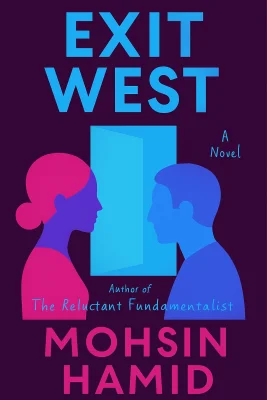
Exit West
Categories
Fiction, Audiobook, Romance, Fantasy, Adult, Book Club, Contemporary, Magical Realism, War, Literary Fiction
Content Type
Book
Binding
Hardcover
Year
2017
Publisher
Riverhead
Language
English
ASIN
0735212171
ISBN
0735212171
ISBN13
9780735212176
File Download
PDF | EPUB
Exit West Plot Summary
Introduction
In a city swollen with refugees but still mostly at peace, a young man named Saeed met a young woman named Nadia in an evening class on corporate branding. She wore flowing black robes from neck to toe, he maintained a studious stubble, and neither spoke to the other for many days. When he finally asked her for coffee, she surprised him by saying she didn't pray, despite her conservative dress. "So men don't fuck with me," she explained simply. This was how their love began, in a world where doors were still just doors, and migration meant dangerous overland routes through hostile territory. But rumors began to circulate of doors that could take you elsewhere, doors to places far away, well removed from this death trap of a country. Most people dismissed these as nonsense, the superstitions of the feeble-minded. Yet every morning, Saeed and Nadia found themselves gazing at their doors a little differently, each door now partially animate, whispering silently that dreams of escape were the dreams of fools. They had no idea that these whispers would soon become their salvation, carrying them through a series of magical passages from Mykonos to London to California, where love would be tested by the weight of displacement and the human need to belong somewhere, anywhere, in a world where everyone was migrating, even if they stayed in the same houses their whole lives.
Chapter 1: Meeting in a City on the Edge of War
The first time Saeed spoke to Nadia, car bombs were already punctuating the evening silence with subsonic vibrations that rattled windows like distant thunder. In the stairwell after class, he summoned his most endearing grin and asked her for coffee. She studied him with steady eyes, asked if he said his evening prayers, and when he stumbled through an explanation about personal faith, she cut him short. "I don't pray," she said, continuing to gaze at him. "Maybe another time." He watched her walk to the student parking area, expecting her to cover her head with a black cloth. Instead, she donned a motorcycle helmet, straddled a scuffed trail bike, and disappeared into the gathering dusk with a controlled rumble. The next day at his advertising agency, Saeed found himself unable to concentrate on a soap company pitch, distracted by a hawk building its nest in the tree outside his office window. The bird worked tirelessly, adjusting its flight with the tiniest movement of wing feathers, floating almost stationary in the wind. When they finally met for coffee the following week, Nadia chose a Chinese restaurant with flickering electronic candles and an opium-den ambiance. The family that had run it for three generations had recently fled to Canada, but the food remained good and the prices reasonable. She arrived first, watching Saeed enter with his bright, amused eyes, as though he saw humor in everything. They talked easily about travel dreams—she wanted to see Cuba for its music and beautiful buildings, he longed for Chile's Atacama Desert where you could lie on your back and watch the Milky Way splash across the sky like spilled milk. As night fell, they faced the problem that confronted all young couples in the city: where to go when darkness made the streets dangerous. Nadia surprised herself by inviting him home, making it clear that nothing would happen. She led him through refugee camps that had sprouted in every open space, past families living under plastic sheets and bodies that might have been sleeping or dead. At her small rooftop apartment, Saeed disguised himself in one of her black robes to slip past the landlady, and they shared their first joint together while listening to the voice of a long-dead American soul singer conjure a third presence in their candlelit room.
Chapter 2: Love Under Siege: Surviving the Militant Takeover
The city's descent into chaos began slowly, then accelerated with terrifying speed. What had been occasional shootings and car bombings escalated into full-scale urban warfare as militants poured in from the hills, taking territory building by building, neighborhood by neighborhood. The government responded with curfews, checkpoints, and eventually by cutting all mobile phone signals, severing the digital threads that had connected the city to itself and the world. For days, Saeed searched desperately for Nadia, calling insurance companies one by one from his office landline, while she stockpiled supplies and endured being groped in bank crowds. When they finally reunited, the joy was shadowed by loss. Nadia's cousin, a doctor who had successfully emigrated abroad, was blown to bits along with eighty-five others by a truck bomb. At his funeral, something solidified between Saeed and Nadia as they stood in the graveyard listening to a jetliner descend to the nearby airport. The sound of engines in the sky had become the sound of escape, of a world beyond reach. That night, Saeed asked Nadia to marry him, not in the romantic way he had imagined, but as a practical matter of survival and belonging. The militants' conquest transformed daily life into a series of deadly calculations. Windows became borders through which death was most likely to come. Doors took on new significance as rumors spread of magical passages to other countries, though using one was punishable by death. Saeed's neighborhood fell, then Nadia's, and when a stray heavy-caliber round passed through their family car's windshield and took away a quarter of his mother's head, something broke inside Saeed that would never fully heal. His father, now a widower, invited Nadia to live with them as family, and she accepted, moving into what had been Saeed's childhood room. The three of them created a makeshift family unit in their darkened apartment, rationing food and water, listening to the beautiful Igbo singing that drifted from other apartments, and learning to navigate around the bloodstain that had appeared on their ceiling after militants executed their upstairs neighbor. In this cocoon of shared grief and diminished hope, Saeed and Nadia became physically intimate for the first time, touching and tasting with desperate urgency, always stopping short of full consummation, their desire sharpened by the knowledge that unmarried lovers were now being executed in the streets as public examples.
Chapter 3: Passing Through Magical Doors: The Flight from Home
The agent they found in the burnt-out shopping center spoke in whispers like a poet or psychopath, demanding they stand still and not turn around as he examined them in the labyrinthine darkness. He took their money without guarantee, leaving them uncertain whether they had made a down payment or been robbed. For days they waited, hearing nothing, while artillery shells carved away pieces of their city and bodies swayed from streetlamps like seasonal decorations. When the handwritten note finally arrived, pushed under their door with precise instructions for time and place, Saeed's father delivered his devastating verdict: "You two must go, but I will not come." No argument could move the old man. "Your mother is here," he explained to his son, meaning not just her grave but the entire geography of their shared life together. What he did not say was that he understood the mathematics of survival, that an old man would only slow down these two young people who needed every advantage to escape alive. He walked away that morning rather than watch them leave, and Saeed and Nadia found themselves alone with their small backpacks and the terrible weight of permanent goodbye. The rendezvous point was a converted dentist's office where a crowd of frightened families waited in plastic chairs. The dental equipment looked like torture devices in the gloom. When their turn came, they faced a black door that seemed to absorb light rather than reflect it, a rectangle of complete darkness that felt equally like a beginning and an end. Nadia went first, squeezing Saeed's hands tight before releasing them and stepping through without a word. The passage felt like dying and being born simultaneously. Nadia experienced a kind of extinguishing as she entered the blackness, then a gasping struggle to exit, emerging cold and bruised and damp on a bathroom floor, trembling and too spent at first to stand. When Saeed followed, she crawled forward to give him space, both of them weak from the crossing. They rose on unsteady legs and made their way outside, finding themselves between low buildings with the sound of waves in their ears. Before them stretched sand and gray water rolling in endless succession. They had reached a beach on the Greek island of Mykonos, where hundreds of other migrants huddled around oil drum fires, speaking in a cacophony that was all the languages of the world.
Chapter 4: Strangers in Strange Lands: From Mykonos to London
Mykonos became a kind of trading post in an old-time gold rush, where everything was for sale or barter and decent people vastly outnumbered dangerous ones, but it was still best to stay near others after nightfall. Saeed and Nadia bought water, food, a tent, and power for their phones, setting up temporary home partway up a hill at the edge of the main camp. Days passed in waiting and false hopes as crowds would rush toward rumored doors to Germany or Sweden, only to find armed guards blocking their way. A former classmate of Saeed's swindled them out of half their remaining money with promises of passage to Sweden that never materialized. As their funds dwindled, they tried to fish with a broken rod, standing on rocks while four men approached along the beach in the gathering dusk. They dropped the rod and fled, finding safety near guards who protected a house containing a door to a desirable destination. The incident left them shaken but brought unexpected help: a teenage volunteer at a clinic, a partly shaved-haired local girl who cleaned the gash on Nadia's arm with gentle reverence, holding it as though it were something precious. The girl took to Nadia, and their friendship bloomed over coffee and conversation, until one dawn the girl smuggled them both through the empty streets to a house on a hill. The door they stepped through delivered them to a bedroom in London with a view of perfectly maintained white buildings and cherry trees in bud. The house was a palace of sorts, with room upon room of marvels, taps that gushed soft, bubbling water, and furnishings so expensive they seemed unreal. But they were not alone. Other migrants emerged from the same door throughout the night: Nigerians, Somalis, a family from the Myanmar-Thailand borderlands. What had once been a single residence now housed fifty people from around the world, an accidental community born of displacement and shared fear. Police surrounded the house within days, but something unprecedented happened: other migrants gathered in the street, banging cooking pots and chanting in various languages until the authorities withdrew. For a brief moment, it seemed they had won something more valuable than shelter—they had won the right to exist somewhere. Nadia felt the excitement of possibility, while Saeed struggled with guilt over occupying someone else's home. Their first argument in months erupted over her luxurious shower and his impatience, a crack in their unity that would only widen in the strange new world they had entered.
Chapter 5: Building and Breaking in Marin: The Dissolution of Love
London's brief respite ended in violence. Nativist mobs surged through their neighborhood with iron bars and knives, and while only three lives were lost that night, Nadia's eye swelled shut and Saeed's lip split and kept bleeding. They held tight to each other's hands to avoid separation, but the attack revealed something that had been growing between them—a distance that physical closeness could no longer bridge. As the government prepared to clear the migrant areas with overwhelming force, promising a night of shattered glass, they made their second great leap through magical doors. They emerged in Marin County, California, where the higher you climbed the hills, the better the view but the fewer the services. Their shanty looked across the Golden Gate Bridge to San Francisco when it was clear, or out over islands floating on seas of cloud when fog rolled in. Life was basic but not desperate: they had solar power, wireless data, and a roof that might fall in an earthquake but wouldn't kill them. Saeed found purpose working for a preacher whose late wife had come from their homeland, joining volunteers who fed and sheltered new arrivals. But among these volunteers was the preacher's daughter, a woman whose presence made Saeed's breath tighten and filled him with guilty thoughts. Nadia worked at a food cooperative in the hastily built commercial zones, making friends among coworkers who had initially found her black robes off-putting. The cooperative had spare rooms upstairs where workers could stay, and when a pale-skinned man placed a pistol on the counter one day and asked what she thought of that, her steady refusal to be intimidated earned their respect. She began to feel she belonged somewhere for the first time since leaving home, a sensation both liberating and terrifying in its implications for her relationship with Saeed. As warmth returned to their conversations over shared joints of California weed, the physical distance between them somehow grew wider. They slept without touching, spoke of grand plans for the future, but felt more like siblings than lovers. Saeed prayed more frequently, seeking connection to his dead parents and lost homeland, while Nadia found herself aroused by memories of others—the musician from home, the girl from Mykonos—but not by the man who lay beside her every night. Their love had survived war and displacement but was being eroded by something more subtle and perhaps more final: the simple fact that people change, and sometimes they change in different directions.
Chapter 6: Separate Paths: Finding New Connections
The conversation about separating came while they sat smoking under the endless Northern California evening, Nadia's words scenting the air like the marijuana smoke. Neither was surprised, yet both felt they were acting out roles in a play they had never auditioned for. Saeed offered to be the one to leave, feeling he owed some penance for his growing attraction to the preacher's daughter. But Nadia was already packing her things into a backpack, and their discussion became less about whether she would go than about navigating their shared terror of what came next. They stood facing each other at the threshold of their shanty, unable to embrace or even shake hands, any gesture seeming inadequate. In silence, Nadia walked away into the misty drizzle, her face raw and wet and alive. She moved into a storage room at the cooperative, sleeping on a cot that smelled slightly of other people among sacks of potatoes and bundles of thyme. The room reminded her of her first apartment, the one she had loved for its solitude and possibility, and while the first nights brought no sleep, gradually it began to feel like home. Saeed found solace in the preacher's daughter, whose mixed heritage—half American black, half from his homeland—created both exotic spark and familiar comfort. She was a leader in the movement to create a regional assembly for the Bay Area, elected on the principle of one person, one vote, regardless of origin. When she showed him a device like a thimble that could identify voters and prevent fraud, her joy was infectious, and he understood that she was building the kind of world he wanted to live in. Their conversations about faith intrigued her, his expansive view of the universe aroused her, and when they walked past his old shanty, she asked to see inside. Nadia discovered different pleasures with the head cook from the cooperative, a handsome woman with impossibly pale blue eyes and the bearing of a cowboy. The cook introduced her to old cuisines and new ones being born from the fusion of the world's foods in Marin, and rationing meant they were always slightly hungry, primed to savor every taste. The woman made love with a steady hand and sure eye, and Nadia felt her body come alive in ways it had not with Saeed for months. Both former lovers were finding their way toward futures they could not have imagined, but which felt increasingly natural as they moved into them.
Chapter 7: Full Circle: A Return to Where It All Began
Their weekly walks began as a way to ease the transition from couple to friends, but even these gradually diminished as other relationships strengthened and time worked its patient magic. When Saeed's father died of pneumonia back home, fighting a lingering infection without antibiotics, Saeed mourned by working extra shifts and redoubling his prayers. Nadia tried to comfort him but found herself relieved to be away from his grief, a feeling that filled her with guilt until she accepted it as natural. They drifted from weekly contact to monthly, then to silence broken only by the occasional message or glimpse of each other's life online. The Bay Area thrived in those years, experiencing what some called a new jazz age as migrants from everywhere created unprecedented forms of music and art. Both Saeed and Nadia found their places in this creative flowering—he in the interfaith community that formed around the preacher's message of inclusion, she in the collective spaces where women built new forms of economic cooperation. The fears of apocalypse that had driven them from London proved unfounded; life went on, adapted, and in many ways improved, even as the wealthy complained about the changes to their pristine communities. Time moved at its own pace, carrying them through seasons of joy and loss, success and failure, love found and love lost. Saeed married the preacher's daughter and raised children who spoke three languages and felt equally at home in mosque, church, or the open hillsides above the bay. Nadia never married but formed deep bonds with a series of partners, building the kind of chosen family she had always craved. Both stayed in California, becoming part of the landscape, their origins as refugees gradually forgotten by everyone except themselves.
Summary
Half a century later, when the fires of their youth had long burned out and their birth city had healed itself into something familiar yet strange, Nadia returned for the first time. Walking the streets where they had once fallen in love, she was informed of Saeed's proximity and, after a moment of stillness, reached out to him. They met at a café near her old building, sitting beside each other as they had once done, now with the comfortable sympathy of people who had shared something profound and unrepeatable. They watched young people pass who had no idea how bad things had once been, and they spoke of the paths their lives had taken, laughing about old jokes and might-have-beens. When Nadia asked if Saeed had ever made it to the Chilean desert to see the stars, he nodded and offered to take her if she had a free evening. She closed her eyes and said she would like that very much. Their story had become part of the great human migration of their era, when doors opened between worlds and millions of people discovered that home was not a place but a feeling you could carry with you and rebuild anywhere. In the end, they learned what migrants have always known: that love takes many forms, and the deepest connections can survive even the ending of romance. They rose and embraced and parted without knowing if they would meet again, but with the quiet satisfaction of having loved well, each in their own way, in a world where everyone was always moving toward some distant, unknowable shore.
Best Quote
“We are all migrants through time.” ― Mohsin Hamid, Exit West
Review Summary
Strengths: The initial scenes depicting Nadia and Saeed's life in a war-torn Middle-Eastern city are praised for their compelling portrayal of a couple's struggle to survive amidst adversity. The reviewer appreciates this aspect as a fascinating study of life during wartime. Weaknesses: The introduction of magical realism through the concept of magical doors is heavily criticized. The reviewer finds this narrative choice to be a significant misstep, likening it unfavorably to the plot of "Monsters Inc." and expressing frustration over the shift away from the original storyline. Overall: The reader expresses strong disappointment and frustration with the novel, particularly due to the inclusion of magical realism elements. The sentiment is negative, with a clear recommendation against the book due to perceived narrative sabotage.
About Author

Mohsin Hamid
Hamid interrogates the complex interplay between identity and globalization, weaving narratives that explore the effects of political and social upheaval on individuals. His works, such as "Exit West" and "The Reluctant Fundamentalist", combine realism with elements of magical realism and innovative narrative structures to depict migration and belonging. Hamid’s focus on the human consequences of economic and political change highlights themes of alienation and the search for meaning in a rapidly evolving world, drawing readers into a deeper understanding of these issues.\n\nReaders of Hamid’s books gain insight into the modern human condition through his compassionate and thought-provoking portrayals. His bio highlights his experiences in diverse global settings, enriching his narratives with authenticity and nuance. For those interested in the dynamics of migration and identity, Hamid’s work offers a reflective lens on these pivotal themes. With novels that have been adapted for cinema and translated into over thirty-five languages, Hamid’s impact on contemporary literature is profound and far-reaching. His recognition includes being shortlisted for the Man Booker Prize and receiving fellowships from esteemed foundations, underscoring his significance as an author whose work resonates worldwide.
Read moreDownload PDF & EPUB
To save this Black List summary for later, download the free PDF and EPUB. You can print it out, or read offline at your convenience.
Exit West
by Mohsin Hamid
