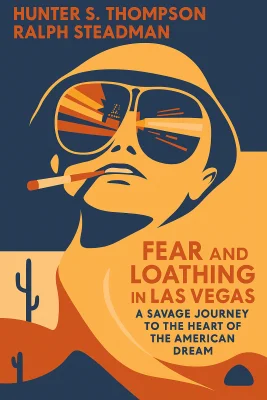
Fear and Loathing in Las Vegas
A Savage Journey to the Heart of the American Dream
Categories
Fiction, Classics, Travel, Literature, American, Journalism, Humor, Contemporary, Novels, Drugs
Content Type
Book
Binding
Paperback
Year
1998
Publisher
Vintage Books
Language
English
ASIN
B01BITNA5S
ISBN
0679785892
ISBN13
9780679785897
File Download
PDF | EPUB
Fear and Loathing in Las Vegas Plot Summary
Introduction
Somewhere around Barstow on the edge of the desert, the drugs began to take hold. The sky filled with what looked like huge bats, all swooping and screeching around a red convertible racing toward Las Vegas at a hundred miles an hour. Behind the wheel sat Raoul Duke, a gonzo journalist on assignment for a sports magazine, his trunk loaded with enough narcotics to stock a pharmacy. Beside him lounged his three-hundred-pound Samoan attorney, Dr. Gonzo, pouring beer on his chest while planning their assault on the American Dream. What began as a simple assignment to cover the Mint 400 motorcycle race quickly spiraled into something far more dangerous. When a second assignment arrived—infiltrating the National District Attorneys' Conference on Narcotics and Dangerous Drugs—Duke found himself trapped in the neon belly of America's most savage city, hunting for meaning in a landscape of hallucinations, paranoia, and brutal honesty. This is the story of two men's descent into the heart of the American nightmare, where the only way out was straight through the madness.
Chapter 1: Highway to Delirium: The Descent into Vegas
The Great Red Shark cut through the desert like a blade through fever dreams. Duke gripped the wheel as massive bats dive-bombed the windshield, their wings beating against his drug-addled consciousness. His attorney seemed oblivious to the aerial assault, focused instead on perfecting his tan with warm Budweiser. They had left Los Angeles in a chemical frenzy, their trunk transformed into a mobile narcotics laboratory. Two bags of grass, seventy-five pellets of mescaline, five sheets of high-powered blotter acid, a salt shaker half full of cocaine, and a galaxy of uppers, downers, screamers, and laughers. The sports magazine had given them three hundred dollars and a press pass to cover some desert motorcycle race, but the real assignment had become something else entirely: a savage journey to find whatever remained of the American Dream. The mescaline hit harder as they approached Vegas, turning the highway into a ribbon of molten silver. Duke's hands trembled on the steering wheel as he fought to maintain control, knowing that one wrong move would send them cartwheeling across the desert in a spectacular fireball of twisted metal and pharmaceutical evidence. When they stopped to pick up a young hitchhiker, Duke watched his attorney's mind slip further into chemical madness. The kid climbed into the back seat, grinning with innocent excitement about riding in his first convertible, unaware that he had just entered the mobile laboratory of two men who were quickly losing their grip on reality. Duke began explaining their mission with the fevered intensity of a true believer. They were searching for the American Dream, he told the terrified young man, and this red convertible was their vessel for penetrating the heart of that mystery. The kid's face shifted from excitement to horror as Duke's words became more unhinged, his attorney's behavior more threatening. By the time they reached the next gas station, their passenger was running across the desert, preferring the scorching wilderness to another moment in their company.
Chapter 2: Racing Through Dust and Delusion: The Mint 400 Assignment
The Mint Hotel rose from the Vegas desert like a concrete monument to American excess. Duke and his attorney stumbled through the lobby, their minds still reeling from the desert crossing, trying to blend in with the crowd of motorcycle enthusiasts and journalists gathering for the big race. The check-in process became a hallucinogenic nightmare. The desk clerk's face morphed into that of a moray eel, her features pulsing with deadly menace. Duke gripped the counter as reality shifted around him, his attorney stepping in to handle the transaction with the practiced ease of a man accustomed to functioning while completely twisted. Their suite on the fifteenth floor became base camp for deeper pharmaceutical exploration. Duke's attorney immediately attacked the room service phone, ordering enough food and alcohol to supply a small army. Four club sandwiches, four shrimp cocktails, a quart of rum, nine fresh grapefruits—vitamin C, he explained, would be essential for what lay ahead. The Mint 400 itself proved impossible to cover in any conventional sense. The race began at dawn with two hundred motorcycles disappearing into a dust cloud that hung over the desert like a brown shroud. Within hours, visibility dropped to fifty feet. Duke abandoned his press vehicle and retreated to the bar, where he found a gathering of the most authentically twisted individuals he had ever encountered. The press corps had devolved into a carnival of chemical casualties and weekend warriors. A beefy middle-aged man in a Harley-Davidson T-shirt regaled the crowd with stories of spousal abuse and spontaneous bus trips to Vegas. The correspondent from Life magazine collapsed behind the bar, his female companion clawing desperately at his belt while he proclaimed this the greatest sporting event in American history. Duke realized he was witnessing something far more significant than a motorcycle race. This was a perfect distillation of the American experience: violence, speed, drugs, and the desperate pursuit of something that remained forever just beyond reach.
Chapter 3: The Lucy Incident: Paranoia and Close Calls
Duke returned from the race to find his attorney had acquired a companion. Lucy was a massive, muscular young woman from Montana with the face of a pit bull and an obsession with painting portraits of Barbra Streisand. She stood in their hotel suite surrounded by dozens of charcoal sketches, all depicting the same demonically sensual face with glittering eyes and an oversized mouth. His attorney explained that he had met Lucy on the plane and, in a moment of pharmaceutical generosity, had shared some of his acid supply. Now she was completely twisted, babbling about meeting her idol backstage at the Americana Hotel while clutching a Bowie knife and staring at Duke with unconcealed hostility. The situation deteriorated rapidly. Lucy's mental state was clearly fragile, even before the LSD, and Duke realized they were harboring a potentially dangerous psychotic who could easily destroy them both. A religious freak running away from home for the fifth time, she represented everything wrong with their mission: innocent casualties caught in the crossfire of their chemical warfare against consensus reality. Duke watched his attorney struggle with guilt and pharmaceutical confusion as Lucy's condition worsened. Her eyes blazed with religious fervor and chemical madness, her massive frame coiled with the potential for sudden violence. The portraits of Streisand seemed to watch from every surface, their glittering eyes tracking his movement around the room. The solution came through deception. Duke's attorney crafted an elaborate story about Duke's death in a desert showdown, convincing Lucy that she should wait at the Americana for the survivor to contact her. They loaded her into the White Whale—the Cadillac convertible Duke had acquired to replace the Red Shark—and delivered her to the airport, where a cab driver was bribed to ensure she reached her destination. As they watched her disappear into the terminal, Duke felt the weight of their casual cruelty. They had used this damaged young woman as entertainment, fed her mind-altering chemicals, then abandoned her to navigate the Vegas labyrinth alone. It was a perfect microcosm of everything toxic about their generation's relationship with drugs and innocence.
Chapter 4: Infiltrating the Enemy: The Drug Conference Charade
A telegram arrived at the worst possible moment. Duke's attorney had arranged a second assignment: infiltrating the National District Attorneys' Conference on Narcotics and Dangerous Drugs at the Dunes Hotel. Rolling Stone wanted fifty thousand words, with total expenses paid and unlimited access to whatever samples might be required for research purposes. The assignment represented both opportunity and extreme danger. Here was a chance to penetrate the heart of the establishment's war on drugs while maintaining their chemical lifestyle, but the risks were astronomical. They would be surrounded by the most drug-obsessed law enforcement officials in America while carrying enough narcotics to supply a small city. Duke traded the Red Shark for a white Cadillac Coupe de Ville, reasoning that a more subtle approach might be necessary. The Flamingo Hotel became their new base of operations, its neon-soaked corridors providing perfect camouflage for their particular brand of madness. The conference registration process proved surprisingly simple. Duke presented himself as a private investigator from Los Angeles while his attorney claimed expertise in criminal drug analysis. Both descriptions were technically accurate, though not in any way the conference organizers might have expected. The opening session revealed the depth of the establishment's ignorance about the very culture they claimed to be fighting. Dr. Bloomquist, the keynote speaker, delivered a presentation that could have been written by someone whose only exposure to drug culture came from reading police reports from 1965. His explanation of cannabis terminology—"cool," "groovy," "hip," and "square"—drew knowing laughter from the audience of cops who had no idea how completely out of touch they had become. Duke realized he was watching the death throes of an old America, one that still believed in simple solutions to complex problems. These men had spent their careers fighting an enemy they had never bothered to understand, and now that enemy had evolved beyond their capacity to recognize or engage with it.
Chapter 5: Circus-Circus: The Heart of the American Dream
The Circus-Circus casino became Duke's laboratory for observing American excess in its purest form. The place was exactly what the entire world would become if the Nazis had won the war—a four-story circus tent filled with gambling tables on the ground floor while acrobats, wolverines, and half-naked teenagers performed death-defying stunts directly overhead. Duke and his attorney arrived in the grip of a powerful mescaline experience, their perception heightened to the point where every detail of the casino's madness became crystal clear. Trapeze artists swung through the air while desperate gamblers fed coins into slot machines below, the two levels of human activity creating a perfect metaphor for American civilization. The entertainment was relentless and bizarre. Korean acrobats battled silver-painted Polacks in mid-air while wolverines snapped at teenage performers. Customers could shoot pasties off the nipples of a ten-foot billboard for cotton candy prizes, or pay ninety-nine cents to have their image appear two hundred feet tall on a screen above downtown Vegas. Duke's attorney began experiencing what he called "the Fear"—that moment when the drug culture's pursuit of expanded consciousness collided with the brutal realities of American commerce. The sight of so much organized madness, all designed to separate tourists from their money, became overwhelming even for someone accustomed to chemical extremes. They retreated to the Merry-Go-Round Bar on the second balcony, spinning slowly around the bartender while trying to process what they were witnessing. Duke realized they had found something significant: this wasn't just another casino, but a perfect distillation of the American Dream itself. A place where childhood fantasies of running away to join the circus had been transformed into a license to steal from anyone naive enough to believe in magic. The casino represented everything America had become: a country that had abandoned the pursuit of genuine transcendence in favor of cheap thrills and financial exploitation. It was beautiful and terrifying and utterly honest about its intentions.
Chapter 6: Escape Velocity: Fleeing the Scene
Duke's attorney fled Las Vegas on the morning flight, leaving behind a hotel bill approaching four figures and enough evidence to convict them both on multiple felony charges. Duke found himself alone with a car full of drugs and a story that no magazine would ever dare to publish in its unedited form. The return journey became a meditation on survival and the price of pushing American tolerance to its absolute limits. Duke drove the white Cadillac through Death Valley, his mind still processing the chemical and psychological assault of the previous week. The desert landscape seemed different now, less threatening and more like a natural boundary between the fever dreams of Vegas and the comparative sanity of California. At a roadside diner in Baker, Duke encountered a California Highway Patrol officer who had clocked him at excessive speed. The confrontation should have ended in arrest, but the officer seemed more concerned with Duke's obvious exhaustion than his potential criminality. After a brief negotiation involving Duke's press credentials and a promise to rest before continuing, the officer let him proceed with nothing more than a warning. The encounter revealed something important about the American system: it still contained pockets of basic human decency, even in its law enforcement apparatus. Not everyone had been consumed by the paranoid authoritarianism that characterized the Vegas police establishment. Duke's final assessment of Vegas crystallized during the drive home. The city represented everything wrong with American capitalism: a place where human weakness was transformed into profit, where the house always won, and where the pursuit of the American Dream inevitably led to spiritual bankruptcy. It was honest in its corruption, which made it more bearable than the hypocritical moralizing of the drug conference attendees.
Chapter 7: Reflection in the Rearview: What Vegas Really Means
Duke's escape from Las Vegas marked the end of more than just a pharmaceutical adventure. As he drove through the desert, watching the city's glow fade in his rearview mirror, he understood that he had witnessed the death of the 1960s counterculture and the birth of something far more dangerous: a country where the distinction between legitimate authority and organized crime had become impossible to discern. The drug conference had revealed the establishment's complete disconnection from the realities of American drug culture. These men were fighting a war against an enemy that existed primarily in their own imaginations, using tactics that guaranteed their eventual defeat. Meanwhile, the real drug culture had evolved into something far more sophisticated and dangerous than anything they could comprehend. Vegas itself represented the logical endpoint of American capitalism: a place where every human desire could be commodified and every human weakness could be exploited for profit. The city's honest corruption made it almost admirable compared to the hypocritical moralizing of places that claimed to represent traditional American values. Duke realized that his generation's pursuit of consciousness expansion through chemicals had been fundamentally naive. They had believed that altered states of awareness would automatically lead to wisdom and social progress, but Vegas demonstrated that expanded consciousness was just another commodity to be bought and sold. The real American Dream had always been about money and power, not enlightenment.
Summary
Duke's savage journey through Las Vegas revealed a country in the final stages of cultural breakdown. The gap between the establishment's perception of reality and the actual state of American society had become so wide that meaningful communication was impossible. The drug war was being fought against phantoms while the real destruction came from legal forms of exploitation and corruption. The true horror of Vegas wasn't its criminality but its honesty about American values. Here was a place that admitted what the rest of the country preferred to disguise: that the pursuit of the American Dream inevitably led to spiritual emptiness and moral bankruptcy. The city's neon-soaked landscape served as a perfect metaphor for a civilization that had abandoned genuine transcendence in favor of cheap thrills and financial gain. Duke's chemical odyssey had taken him to the heart of American darkness, and what he found there was not enlightenment but a mirror reflecting the savage truth about a nation that had lost its way in the desert of its own making.
Best Quote
“No sympathy for the devil; keep that in mind. Buy the ticket, take the ride...and if it occasionally gets a little heavier than what you had in mind, well...maybe chalk it up to forced consciousness expansion: Tune in, freak out, get beaten.” ― Hunter S. Thompson, Fear and Loathing in Las Vegas: A Savage Journey to the Heart of the American Dream
Review Summary
Strengths: The review highlights Hunter S. Thompson's unique ability to capture the essence of American culture and politics with unmatched sharpness and wit. The reviewer appreciates Thompson's skill in chronicling American absurdities, drawing parallels to Mark Twain. The book's vivid portrayal of Las Vegas as a city of excess and superficiality is praised for its authenticity and humor. Overall: The reviewer expresses a deep admiration for Thompson's work, particularly after experiencing Las Vegas firsthand. The book is seen as a quintessential representation of the city's chaotic nature, making it a compelling read for those interested in a satirical exploration of American culture. The recommendation is strong, especially for readers who appreciate incisive social commentary.
About Author

Hunter S. Thompson
Thompson investigates the chaos and contradictions of American society through the lens of Gonzo Journalism, a style he pioneered where the author becomes a central figure in the narrative. This method, marked by immersive, first-person reporting, allowed him to challenge conventional journalism by blending personal experience with political and cultural critique. While his book "Fear and Loathing in Las Vegas" epitomizes this approach with its wild, psychedelic journey through the American Dream's wreckage, his other works, such as "Hell's Angels", reveal his commitment to exploring the fringes of society.\n\nHunter S. Thompson's unique style and perspective resonate with readers who seek an unfiltered look at reality, offering insights into the tumultuous times he chronicled. His writing appeals to those interested in counterculture, politics, and the human condition, as his work often intertwines these themes with a deep skepticism of authority. This short bio captures Thompson's impact, showing how his unconventional methods and vibrant storytelling continue to influence journalism and literature. The author's legacy endures, not only in his contributions to literary style but also in his fearless exploration of life's darker and more absurd aspects.
Read moreDownload PDF & EPUB
To save this Black List summary for later, download the free PDF and EPUB. You can print it out, or read offline at your convenience.
Fear and Loathing in Las Vegas
by Hunter S. Thompson
