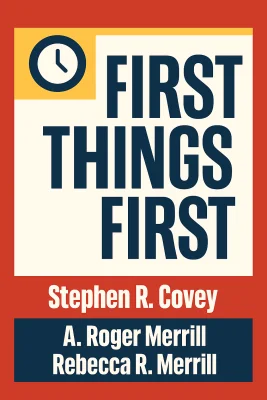
First Things First
Categories
Business, Nonfiction, Self Help, Psychology, Leadership, Productivity, Audiobook, Management, Personal Development, Buisness
Content Type
Book
Binding
Paperback
Year
1996
Publisher
Free Press
Language
English
ASIN
0684802031
ISBN
0684802031
ISBN13
9780684802039
File Download
PDF | EPUB
First Things First Plot Summary
Introduction
Do you ever feel that despite your best efforts to manage your time efficiently, you're still overwhelmed with tasks, deadlines, and responsibilities? Many of us struggle with the constant tension between what's urgent and what's truly important in our lives. We find ourselves caught in a cycle of reacting to pressing demands while neglecting activities that would bring us genuine fulfillment and meaningful results. The challenge isn't simply about managing time better—it's about fundamentally changing how we view time itself. This paradigm shift involves moving from urgency-driven reactions to importance-focused decisions that align with our deepest values and principles. When we center our lives around timeless principles rather than temporary pressures, we discover that effectiveness isn't just about doing more things faster, but about doing the right things at the right time for the right reasons.
Chapter 1: Transcend Urgency: Focus on What Truly Matters
At the heart of principle-centered time management is the ability to distinguish between what's urgent and what's important. Most of us instinctively respond to urgency—the ringing phone, the approaching deadline, the crisis that demands immediate attention. We've been conditioned to believe that responding quickly to these pressing matters makes us effective. But this urgency addiction often keeps us from addressing what truly matters in our lives. The Time Management Matrix helps us visualize this distinction by dividing our activities into four quadrants based on urgency and importance. Quadrant I contains activities that are both urgent and important—genuine crises and pressing problems that require immediate attention. Quadrant III includes urgent but unimportant activities—interruptions, some meetings, and many popular pressing matters. Quadrant IV encompasses activities that are neither urgent nor important—time wasters and escape activities. Most critically, Quadrant II holds activities that are important but not urgent—preparation, prevention, planning, relationship building, and personal development. Dr. Stephen Covey once worked with a division manager who complained of being constantly overwhelmed. "I'm running all day—meetings, phone calls, paperwork, interruptions. I push myself to the limit, fall into bed exhausted, and get up early the next morning to do it all again," she explained. Despite her tremendous output, she admitted feeling empty, wondering what she was really accomplishing that mattered. Through their discussions, she realized she was spending almost all her time in Quadrants I and III, responding to urgency rather than importance. As she began investing time in Quadrant II activities, something remarkable happened. She started having regular one-on-one meetings with key team members, clarifying expectations and building relationships. She dedicated time to strategic planning rather than just putting out fires. She even began having lunch with her husband weekly—something she hadn't done in years despite their close proximity. The transformation wasn't immediate, but within three weeks, she reported feeling more in control and productive. Within three months, she had established clear objectives for her division that aligned with the company's mission. Her subordinates were taking more initiative, and crisis management had decreased dramatically. Most importantly, she felt a renewed sense of purpose and balance. To transcend urgency in your own life, start by identifying activities in each quadrant of the Time Management Matrix. Then commit to gradually increasing your time in Quadrant II. Begin with just one important but non-urgent activity—perhaps exercising regularly, developing a relationship with a child or colleague, or planning strategically for a major project. As you invest more time in Quadrant II, you'll find yourself spending less time in crisis management and more time creating the results that truly matter to you. Remember that effectiveness is not just about getting more things done—it's about getting the right things done. True effectiveness comes from organizing and executing around your highest priorities, the "first things" in your life. As you focus on what truly matters rather than merely responding to what's pressing, you'll experience not just greater productivity but deeper fulfillment and peace of mind.
Chapter 2: Align Your Compass with True North Principles
Living by principles is fundamentally different than living by practices or values alone. Principles are like a compass that always points to "true north"—unchanging natural laws that govern human effectiveness regardless of our awareness or acceptance of them. When we align our internal compass with these timeless principles, we create a solid foundation for making decisions that lead to quality-of-life results. Many of us attempt to navigate life using the equivalent of a clock rather than a compass. We focus on efficiency, schedules, and to-do lists without first ensuring we're heading in the right direction. Think about driving down the California coast on Highway 101 making excellent time, getting great gas mileage in perfect weather. You're being extremely efficient—but if your destination is New York City, you're not being effective at all. Roger Merrill discovered this distinction through personal experience. He began his career as a time management consultant, helping clients become more efficient. "Typically, after observing and analyzing their activities for a day, I would make specific suggestions on things they could do to get more done in less time," he shared. But over time, he realized efficiency wasn't enough. "I began to wonder if I was just helping people fail faster. The problem wasn't how much they were getting done. It was where they were trying to go, and what they were trying to accomplish." This realization led Roger to question fundamental paradigms about time management. The answer wasn't in techniques but in principles—the natural laws that govern true effectiveness. One powerful illustration of this concept is what Covey calls "The Law of the Farm." In agriculture, we understand that we can't cram or cheat natural processes. We can't neglect a field all season and then suddenly work frantically before harvest and expect good results. Yet in our social and corporate cultures, we often attempt to ignore these natural processes. We cram for exams, neglect relationships until they're in crisis, or postpone health habits until we face a medical emergency. The Law of the Farm reminds us that lasting success follows natural cycles of planting, cultivating, and harvesting. There are no shortcuts. To align your compass with true north principles, start by identifying the core principles that matter most to you. These might include integrity, contribution, human dignity, service, or excellence. Next, evaluate your current priorities and activities against these principles. Are your daily choices aligned with what you value most? Then, begin making decisions based on principles rather than reacting to pressures and circumstances. This principle-centered approach empowers you to transcend the limitations of traditional time management. Instead of merely prioritizing your schedule, you learn to schedule your priorities. Rather than being driven by urgency, you're guided by importance. You move from managing things to leading your life with vision and purpose. The practical result is a life of greater balance and effectiveness. When you align with principles, you naturally invest in key relationships, personal renewal, and meaningful contribution. You experience less stress and greater peace because you're working with natural laws rather than against them. As you develop this principle-centered compass, you'll find yourself making better decisions in the moment, even when faced with competing priorities or unexpected challenges.
Chapter 3: Master the Quadrant II Organizing Process
The Quadrant II organizing process transforms how we approach our weekly planning. Rather than simply creating daily to-do lists or responding to whatever seems most urgent, this process empowers us to proactively focus on what's most important. At its core, this is a thirty-minute weekly process that subordinates the clock to the compass, shifting our focus from urgency to importance. Traditional daily planning can be like trying to walk down the street while looking through a telephoto lens—we see only what's directly in front of us. Weekly organizing provides a broader perspective that helps us put the big rocks in first before filling in with the gravel, sand, and water of less important activities. Roger Merrill shares a story that perfectly illustrates this concept: "I knew a man who was asked to be the new dean of the College of Business of a large university. When he first arrived, he studied the situation and felt that what the college needed most was money. He recognized he had a unique capacity to raise money, and he developed a vision about fund-raising as his primary function." This created immediate problems because previous deans had focused mainly on meeting faculty needs. The new dean was frequently absent, traveling to raise funds. Faculty became upset and sent a delegation to the university president demanding change. The president, understanding the dean's vision, told them to be patient. Within a short time, money began pouring in, and faculty recognized the value of his approach. They went from saying "We want to see you more" to "Get out of here! Go bring in more funds!" The dean had identified what was truly important—not just what was urgent or expected—and organized his time around that priority. To implement the Quadrant II organizing process in your own life, follow these six steps: First, connect with your vision and mission. Begin by reviewing your personal mission statement or reflecting on what's most important to you. This provides the foundation for all other decisions. Without this connection, you may efficiently climb a ladder that's leaning against the wrong wall. Second, identify your roles. We fulfill multiple roles in life—perhaps as a professional, parent, spouse, community member, or friend. Identifying these roles provides a framework for balanced living. One executive realized during this process that while he'd taken many business associates to lunch over seventeen years, he'd never taken his own wife to lunch—despite their relationship being one of the most important in his life. Third, select Quadrant II goals for each role. Ask yourself: "What is the most important thing I could do in each role this week that would have the greatest positive impact?" These goals should focus on important but not necessarily urgent activities that will make a significant difference. Fourth, create a decision-making framework for the week. Schedule your priorities rather than prioritizing your schedule. Put the big rocks in first, then work other activities around them. Create time blocks for important activities and protect them from interruption. Fifth, exercise integrity in the moment of choice. Throughout the week, you'll face unexpected opportunities and challenges. The framework you've created helps you make principle-centered choices in these moments, keeping first things first whether that means sticking to your plan or making conscience-directed changes. Finally, evaluate your week. Learn from your experiences to continuously improve your effectiveness. What worked well? What didn't? What adjustments would make next week even better? This process transforms planning from a mechanical exercise into a powerful opportunity for personal leadership. It creates a natural connection between your deepest values and your daily actions, empowering you to live with greater purpose, balance, and peace.
Chapter 4: Build Synergy Through Win-Win Relationships
At the heart of principle-centered time management is the understanding that our most significant achievements and deepest fulfillment come through relationships with others. Yet many traditional approaches to time management treat other people as either resources to be leveraged or interruptions to be managed. The fourth generation recognizes that true effectiveness comes through creating win-win relationships that unleash the full potential of everyone involved. Consider this simple experiment: Imagine being challenged to an arm-wrestling contest where the objective is to win as many times as possible in 60 seconds. Most people approach this competitively, straining to keep the other person's arm down once they've won. But what if instead, you immediately released after winning, allowing your partner to win, then they did the same for you? By cooperating rather than competing, you could each win dozens of times instead of just once. This principle applies to all our interactions. When we approach relationships with a win-win mindset, seeking mutual benefit rather than personal advantage, we create tremendous synergy and dramatically improve our results. This approach involves three key practices: thinking win-win, seeking first to understand, and synergizing to create third alternatives. A striking example of this approach comes from a corporation experiencing a bitter standoff between management and labor. During a leadership program, the union had walked out after management violated a previous agreement. Rather than postponing the meeting, Stephen Covey encouraged management to apologize and reconvene. When the session began, he asked the president of the company and the president of the union to come to the front of the auditorium. "How many here honestly believe with the present state of your culture, you could achieve those ambitious goals that have been established?" Covey asked the audience of 700-800 people. Not a single hand went up. "Now how many of you believe that if we literally practice the process we've been talking about—think win-win, seek first to understand, synergize—that we could accomplish those seemingly impossible goals?" Almost everyone raised their hand. Turning to the two leaders, Covey challenged them to commit to teaching this process throughout the organization. After a tense moment, they shook hands and embraced. The place exploded with applause. Today, that organization is one of the leading companies in America, largely because they applied this win-win process to transform their culture. To build synergy through win-win relationships in your own life, start by examining your basic mindset. Do you approach interactions with a scarcity mentality (believing there's only so much to go around) or an abundance mentality (believing there's plenty for everyone)? Practice thinking in terms of mutual benefit rather than competition. Next, develop the habit of seeking first to understand before trying to be understood. When someone sees things differently than you do, invest the time to truly understand their perspective. Listen empathically, without preparing your response. This creates the trust necessary for finding solutions that benefit everyone. Finally, look for opportunities to synergize—to find third alternatives that are better than what either party could have created alone. This isn't compromise where each gives up something; it's creative cooperation that produces new possibilities. The practical impact on your time management is profound. How much time do you currently spend dealing with the effects of misunderstanding, poor communication, or conflicting agendas? By investing in win-win relationships upfront, you dramatically reduce time wasted in Quadrant I crises and Quadrant III misunderstandings. More importantly, you tap into the tremendous creative potential that exists when people work together effectively toward shared goals.
Chapter 5: Transform Moments of Choice into Integrity
The true test of principle-centered time management comes in those critical moments of choice throughout our day. We may have excellent plans and clear priorities, but life rarely unfolds exactly as we anticipate. Unexpected opportunities arise, emergencies occur, and other people's agendas compete for our attention. How we respond in these moments ultimately determines the quality of our lives. Integrity in the moment of choice means making decisions that align with our deepest values and principles, even when it's difficult. It means pausing in that space between stimulus and response to consult our internal compass before deciding how to act. This isn't about rigidly sticking to schedules or robotically following rules—it's about making conscious, principle-centered choices. Consider this example from Rebecca Merrill's experience: "At one time I made the decision to attend a week-long seminar. I had clear expectations around what I was going to accomplish—particularly regarding some personal Quadrant II goals I planned to work on between and after seminar sessions." Her plans were immediately challenged when she was asked to coordinate activities for the other participants—a responsibility that would consume the time she had planned for her personal goals. Although frustrated, she recognized that contributing to others' success aligned with her deeper values, so she accepted the responsibility. "I found myself under a lot of pressure and anxiety, running from one thing to another, trying to meet everyone's needs, and feeling more than a little frustrated that I didn't have time to do the things I'd planned to do," she recalled. But then came a transformative moment: "I stopped and said, 'Wait a minute! I don't have to live with this frustration. I've made the choice to do what I really felt I ought to do, but that doesn't mean I have to suffer all this anxiety and tension. I can choose differently.'" In that moment, she took a deep breath and chose her response. "I chose to let go of all the anxiety, the concern about extrinsic pressure, the worry about what wasn't getting done. In my mind, I kept saying the words, 'I choose differently! I choose differently!'" The negative feelings left, replaced by determination to face challenges with courage. "This was not a one-time decision," she noted. "I had to revisit it several times during the week as I began to feel the pressures and anxiety creeping back. But the more I did it, the more empowered I felt." To transform your own moments of choice into integrity, practice these three essential steps: First, ask with intent. When faced with a decision, pause and ask yourself what's most important in this moment. Connect with your compass, not just your clock. Questions like "What's the best use of my time right now?" or "What would create the greatest good?" help you focus on principles rather than pressures. Second, listen without excuse. When you hear that first whisper of conscience, don't immediately rationalize or make excuses. Be honest with yourself about what you know is right, even if it's difficult or uncomfortable. Many of us spend tremendous energy justifying choices that don't align with our deeper values. Third, act with courage. Having the clarity to see what's right and the humility to acknowledge it isn't enough—you must have the courage to act accordingly. This often means swimming upstream against urgency, social pressure, or your own comfort. But with each courageous choice, your capacity for integrity grows stronger. The peace that comes from living with integrity far outweighs the temporary relief of taking the easy path. As you consistently transform moments of choice into integrity, you build what Covey calls your "Personal Integrity Account"—the reservoir of trust you have in yourself. A high balance in this account gives you the confidence and courage to make increasingly challenging principle-centered choices, creating an upward spiral of growth and effectiveness.
Chapter 6: Create Balance Across Your Life's Key Roles
One of the deepest pains many people express is the feeling of imbalance—being consumed by one area of life while neglecting others that matter deeply. We feel torn between work and family, personal development and community service, physical health and mental growth. Traditional time management approaches often suggest that balance means running faster between these competing demands, trying to touch all bases without truly succeeding at any. Principle-centered time management offers a completely different paradigm. Balance isn't about equal time in all areas—it's about appropriate attention to each according to your values, season of life, and unique mission. It's recognizing that all dimensions of your life are interconnected parts of a harmonious whole. In the movie The Karate Kid, the elderly Miyagi sends his young student Daniel out into the pounding surf, calling "Learn balance! Learn balance!" Time after time, as the boy struggles against the crashing waves, he's knocked off his feet. Finally, he turns to see his mentor in the distance, poised atop a single post, executing perfect movements with flawless balance. This scene captures how many of us feel—knocked off our feet by powerful forces while struggling to find our center. Rebecca Merrill shares a personal experience that illustrates a principle-centered approach to balance: "Years ago, I was thinking about my role as a father and envisioning how I wanted to be remembered by my kids. So when we planned our vacation that summer, I decided to apply that principle of vision to the family. We came up with a sort of family mission statement for the event. We called it 'the Smith Team.' It described for us the perspective we wanted to take when we went off together on our trip." Each family member took particular roles to help build the team. His six-year-old daughter chose to be the family cheerleader, creating chants to dispel any contention during travel. They even made matching T-shirts, which created a powerful sense of unity when others noticed them together. Three months after their vacation, their three-year-old son was diagnosed with leukemia, throwing the family into months of challenge. Throughout his treatments, the boy would always ask to wear his team shirt. "It was covered with stains of vomit, blood, and tears," the father recalled. When the boy finally recovered and came home, the entire family wore their shirts in his honor. "That vision of the Smith Team helped us through what was the greatest challenge our family had ever faced." To create better balance across your key roles, start by identifying these roles clearly. Rather than seeing them as separate compartments competing for your time, recognize them as complementary parts of your whole life. Think "and" rather than "either/or." Your role as a parent can enrich your professional life, not detract from it. Your personal development strengthens your capacity in community service. Next, look for synergy between roles. Could you exercise (physical dimension) while building a relationship with your spouse or child (social dimension)? Might community service provide opportunities for professional growth? When you see your roles as interconnected, creative possibilities emerge. Recognize that balance may look different in different seasons of life. A mother with a newborn appropriately focuses intensely on that role for a time. An entrepreneur launching a business may temporarily invest extraordinary hours. The key is making these choices consciously, based on your mission and principles, not defaulting to imbalance through urgency addiction. Finally, create regular renewal in all dimensions of life—physical, social, mental, and spiritual. This "sharpening the saw" activity is foundational to effectiveness in every role. Just as a lumberjack who never stops to sharpen his saw becomes increasingly ineffective, we need regular renewal to maintain our capacity to contribute in all areas of life. By approaching balance from this principle-centered perspective, you move from the stress of competing demands to the peace of an integrated, purposeful life. You gain the wisdom to make appropriate investments in each role and the confidence that comes from living true to your deepest values.
Chapter 7: Cultivate a Legacy-Driven Mindset
At the heart of principle-centered time management is a profound question: What legacy do you want to leave? This isn't just about what you'll leave behind after death—it's about the impact you're having today and every day through your choices, actions, and relationships. A legacy-driven mindset transforms how you view time, shifting your focus from immediate urgency to lasting importance. Viktor Frankl, an Austrian psychologist who survived Nazi death camps, made a remarkable discovery about human resilience. As he observed fellow prisoners, he found that the single most significant factor determining survival wasn't physical strength, age, or intelligence. It was having a compelling future vision—a sense of purpose, a mission yet to fulfill. This "will to meaning" provided the psychological and spiritual strength to endure unimaginable hardship. This power of vision extends far beyond extreme situations. Research shows that children with "future-focused role images" perform better academically and handle life challenges more effectively. Teams and organizations with a strong sense of mission significantly outperform those without vision. According to Dutch sociologist Fred Polak, the primary factor influencing the success of civilizations is the "collective vision" people have of their future. Stephen Covey shares a powerful story illustrating how vision can transform even deeply troubled individuals: "I was invited to a university to participate in a week-long forum dealing with many problems and issues of current interest. On the second night, I spoke at a fraternity-sorority exchange about principles and universal standards." During the discussion, two articulate students strongly advocated for situational ethics—the idea that right and wrong depend entirely on circumstances, not principles. After attempting to reason with them, Covey tried something different: "Each of us knows in our heart the truth of this matter. We all have a conscience. If you will take a few moments and just reflect and listen carefully to what your heart tells you, you will know the answer." Despite initial skepticism, the students agreed to sit quietly for one minute. Afterward, Covey asked the most vocal opponent what he had heard. "What I heard is not what I have been saying," the student admitted quietly. Another said, "I don't know—I just don't know. I'm not certain anymore." The atmosphere completely changed as students connected with their deeper values and principles. To cultivate your own legacy-driven mindset, begin by creating a personal mission statement that articulates your sense of purpose and the principles you want to live by. This isn't just a pleasant exercise—it's creating what Covey calls "the DNA of your life," the fundamental code that shapes all your choices and actions. Take time to envision your eightieth birthday or fiftieth wedding anniversary. Imagine people from different areas of your life speaking about your impact on them. What would you want them to say about your character, your contributions, your relationships? These reflections reveal what matters most to you and help define the legacy you want to create. Connect regularly with this vision through weekly review. Before planning your activities for the coming week, revisit your mission statement. This reconnection with purpose helps ensure your daily actions align with your long-term legacy. Without this regular compass check, urgent matters easily displace important ones. Share your vision with others, especially those in your key relationships. When families create shared mission statements, they establish guiding principles that help everyone navigate challenges together. When teams clarify their collective purpose, they tap into deeper motivation and commitment than tasks alone can inspire. Finally, measure your success by contribution, not acquisition. Legacy-driven people find their deepest satisfaction not in what they get but in what they give—the lives they touch, the problems they solve, the beauty they create. This shift from consumption to contribution naturally leads to more meaningful investments of time and energy. A legacy-driven mindset doesn't diminish effectiveness in daily tasks—it enhances it by providing context and meaning. When you see today's work as part of creating a worthwhile legacy, you naturally focus on what matters most. The discipline of principle-centered time management becomes not a burden but a joy, because it connects your moments to your mission, your days to your dreams, your time to your purpose.
Summary
Throughout this exploration of principle-centered time management, we've discovered that true effectiveness isn't simply about getting more things done faster. It's about aligning our lives with timeless principles that govern human effectiveness and fulfillment. As Stephen Covey reminds us, "The key to keeping first things first is principle-centered leadership—leadership first, management second; effectiveness first, efficiency second; purpose first, structure second; vision first, method second." The journey begins with a simple choice—the choice to pause in that space between stimulus and response and consult our internal compass rather than merely reacting to the urgency around us. When we make this choice consistently, we transform our relationship with time itself. We move from the stress of urgency addiction to the peace of principled living. We shift from merely managing our schedules to truly leading our lives. Today, take one step toward principle-centered living by identifying just one important but not urgent activity in your life, and schedule time for it this week. Remember that effectiveness is ultimately a matter of character, not technique—and character is built one choice at a time.
Best Quote
“We are free to choose our actions, . . . but we are not free to choose the consequences of these actions.” ― Stephen R. Covey, First Things First
Review Summary
Strengths: The book provides a practical tool in the form of a two-by-two matrix to help readers prioritize tasks effectively. It emphasizes priority management over time management, which the reviewer found transformative. The concept of focusing on important but not urgent tasks (Quadrant II) is highlighted as a key takeaway. Weaknesses: The book is criticized for excessive content that could be condensed. It is also noted that the emphasis on leaving a legacy may not resonate with all readers, particularly those focused on immediate concerns like career advancement and financial stability. Overall: The reader finds the book valuable, particularly for young adults, due to its focus on effective prioritization. However, the book's length and some content may not be relevant to all audiences.
About Author

Stephen R. Covey
Covey probes the intricate balance between timeless principles and practical guidance, integrating ethical leadership with personal development. His writing emphasizes personal responsibility and proactive behavior, positioning these concepts as cornerstones for effective personal and professional transformation. Covey’s method involves distilling complex ideas into actionable habits, therefore making his work accessible to a broad audience seeking personal change. By connecting universal values with concrete strategies, his books empower individuals to align their actions with core principles, thus fostering trust and balanced self-renewal.\n\nA hallmark of Covey's approach is his focus on the integration of personal growth with leadership excellence. In his seminal work, "The 7 Habits of Highly Effective People," Covey introduces a principle-centered paradigm that provides readers with a structured path towards enhanced effectiveness. This book, alongside "The 8th Habit: From Effectiveness to Greatness," illustrates how personal development extends beyond individual gains to influence organizational culture and performance. By addressing the evolving challenges in leadership and family dynamics, Covey’s work remains a critical resource for individuals and organizations aiming to cultivate trustworthiness and leadership strength.\n\nReaders of Covey's work benefit from his clear, motivational style, which synthesizes empirical research with narrative elements to inspire meaningful change. This approach not only aids in personal development but also offers frameworks that resonate within educational and professional contexts. Consequently, Covey's contributions have profoundly shaped leadership discourse, empowering both individuals and organizations to achieve their highest potential. His influence endures through his books and the global reach of FranklinCovey, a testament to his legacy as a transformational figure in leadership and personal development.
Read moreDownload PDF & EPUB
To save this Black List summary for later, download the free PDF and EPUB. You can print it out, or read offline at your convenience.
First Things First
by Stephen R. Covey
