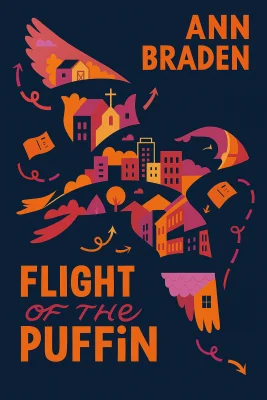
Flight of the Puffin
Categories
Fiction, Audiobook, Young Adult, Family, School, Contemporary, LGBT, Realistic Fiction, Middle Grade, Friendship
Content Type
Book
Binding
Hardcover
Year
2021
Publisher
Penguin/Paulsen
Language
English
ISBN13
9781984816061
File Download
PDF | EPUB
Flight of the Puffin Plot Summary
Introduction
In a small Vermont town, seventh-grader Libby Delmar stands before a blank school wall, paintbrush trembling in her hand. Orange paint drips onto her shoes as she creates something beautiful—a sunrise that burns with impossible colors, sparks flying upward like hope itself. When Principal Hecton's voice cuts through her moment of creation, demanding to know what she's done to that wall, Libby realizes she's crossed a line that can't be uncrossed. But this act of defiant artistry will set in motion a chain of kindness that stretches across the country, connecting four lonely souls who desperately need to know they're not alone. What begins as one girl's rebellion against a world that wants to paint her gray becomes something far more powerful. In Seattle, Vincent clutches a too-small puffin shirt like armor while bullies circle. On the streets, a teenager named T huddles with their dog, cast out by family who couldn't accept who they are. And in rural Vermont, Jack tries to save his beloved school while grappling with truths about acceptance he's never had to face. Each carries wounds that seem too deep to heal, secrets too heavy to bear alone. But when Libby's handmade cards begin appearing in unexpected places, they discover that sometimes the smallest gestures can crack open the hardest hearts.
Chapter 1: Seeds of Courage: Creating Messages of Hope
Libby's bedroom feels like a prison. Rex's dirty socks carpet the floor, his baseball marks scar the ceiling, and her parents' voices echo from the kitchen—another lecture about how she needs to be more like her successful older brother. The grounding stretches ahead like a life sentence, but the rock hidden under her pillow whispers impossible dreams: "Create the world of your dreams." She pulls out stolen index cards and colored pencils, her hands moving with desperate purpose. A dandelion pushes through concrete on the first card, mountains burning with sunrise colors behind it. "You are amazing," she writes in glitter glue that catches the lamplight. Each card becomes a small rebellion—flowers growing from impossible places, birds flying toward freedom, messages of hope written in the language of someone who knows what it means to feel invisible. When her parents finally leave her alone, Libby slips through her bedroom window like a secret agent. The town sleeps around her as she places cards in window boxes, bike racks, bulletin boards—anywhere a lonely person might find them. At the dentist's office, she tucks a card into the bush where she'd seen a terrified little boy clinging to a bench earlier, his mother calling him a crybaby. The card disappears by morning, and Libby allows herself to hope that somewhere, someone is reading the words: "You are amazing. And you are not alone." Standing in the art supply store, she meets a woman whose friend's son is being bullied for wearing a puffin shirt to school every day. The image burns in Libby's mind—a boy choosing to be himself despite the cost. Without hesitation, she copies the address onto her most beautiful card, the one with birds flying in formation across a sunset sky. "Fly free! We're right behind you. Because YOU are amazing." She chooses a puffin stamp with trembling fingers, whispering a prayer as she drops it in the mail slot. Across the country, Vincent will soon discover that someone believes he's worth saving.
Chapter 2: Walls of Resistance: Confronting Change and Tradition
Jack Galenos stands in his tiny school's parking lot, watching a woman in a business suit pick her way across the muddy ground in ridiculous heels. Ms. Duxbury from the state education department surveys their playground equipment like a judge pronouncing sentence, scribbling notes about missing wood chips and inadequate facilities. She doesn't see what Jack sees—the care Mr. Sasko puts into every lesson, the way Mrs. Lincoln makes each child feel special, the community that has thrived in this two-room schoolhouse for generations. "How many students are in this school right now?" she asks with barely concealed disdain. When Jack answers seventeen, her eyebrows rise like she's discovered a crime scene. Every question feels like an attack on everything he loves—their shared bathrooms, their playground, their very existence. This woman sees backwardness where Jack sees home. Desperation drives him to action. If the adults won't fight for their school, he will. The petition grows with each signature from neighbors who've watched their children flourish in those small classrooms. Mack and Deb sign without hesitation. Mrs. Caldimore pours them milk and shares her own stories of bureaucratic overreach. By Saturday, Jack and little Joey have filled two sheets with names, each signature a promise that this community won't go quietly. But the school board meeting becomes a nightmare Jack never anticipated. Surrounded by strangers in suits who speak a language of motions and procedures, he tries to explain why their school matters. Instead, his words twist into something ugly when a man in the crowd starts shouting about transgender children being "gross." Jack never meant to exclude anyone—he just wanted to preserve what he loved. But the damage is done, his photo splashed across newspapers with headlines that make him sound like a villain. Walking to his truck afterward, he realizes he's become the face of everything wrong with small-town ignorance, when all he wanted was to save the place that saved him after Alex died.
Chapter 3: Finding One's Flock: The Search for Belonging
Vincent's mother finds him curled under the kitchen table, having given up on school entirely. The button-down puffin shirt that was supposed to be his armor lies crumpled in the laundry, torn apart by bullies who couldn't understand why anyone would choose to be different. Cal Carpenter's laughter still echoes in his ears, along with the word they've started using as a weapon: "Girl." Not because he is one, but because in their minds, being different makes him weak. The loneliness feels infinite. At school, he's learned to navigate like a ghost, timing bathroom visits to avoid confrontation, eating lunch alone in empty classrooms. His mom's well-meaning attempts to help—offering homeschooling, suggesting he try to fit in better—only highlight how fundamentally she doesn't understand. He doesn't want to blend in. He wants to exist as himself without being shoved into lockers for the crime of loving puffins. Then the postcard arrives, hand-drawn and glittered with impossible kindness. "Fly free! We're right behind you. Because YOU are amazing." A stranger named Libby in Vermont has somehow reached across the country to tell him he matters. The puffin stamp feels like a miracle, chosen by someone who understood exactly what he needed to hear. For the first time in weeks, Vincent allows himself to imagine that maybe, just maybe, he's not as alone as he thought. The postcard gives him courage to venture beyond his apartment, to the streets where real loneliness lives. T huddles against a church wall with only a dog for company, cast out by family who couldn't accept their truth. Vincent's hands shake as he offers sandwiches and sees eyes that reflect his own pain—but deeper, rawer, without the safety net of a loving home. In T's desperate gratitude for simple kindness, Vincent glimpses what courage really looks like. Not the absence of fear, but the choice to keep being yourself when the whole world wants you to disappear.
Chapter 4: Crossing Paths: When Kindness Connects Strangers
Rain pounds the town hall steps as two figures seek shelter under the narrow overhang. Jack clutches an envelope containing his letter of apology to the school board, words that will cost him the approval of neighbors who saw him as their champion. The girl beside him drips with determination and polka-dot defiance, holding out a plastic-wrapped index card like an offering. "This is for you," Libby says, and Jack stares at the mushroom drawing that somehow captures both whimsy and wisdom. Her question cuts straight through his defenses: "Do you feel better after you bully someone?" The accusation should sting, but her voice carries curiosity rather than condemnation, as if she's trying to solve a puzzle rather than assign blame. They stand there in the downpour, two kids from different worlds discovering they're not so different after all. Libby talks about rooms full of stinky socks, her metaphor for living under someone else's rules, and Jack understands. He thinks about Alex's stomachaches, the dinner table silences, all the ways his little brother tried to disappear rather than face their father's disapproval. Maybe Jack had been looking at this all wrong. Maybe protecting tradition wasn't worth protecting pain. When Jack seals his apology letter in Libby's baggie—now sparkling with mushroom glitter—it feels like a baptism. The boy who stood on these same steps defending exclusion is gone, replaced by someone brave enough to admit he was wrong. As Libby races away through the rain, her yellow sweatshirt flapping like butterfly wings, Jack realizes she's given him more than artwork. She's given him permission to grow. The connections multiply like ripples in a pond. Vincent's postcard to Jack carries T's story across the country. Jack's letter acknowledges the harm of assumptions. Libby's random acts of beauty find their way to Joey, the little boy who needed to know someone cared. None of them planned this web of kindness, but each thread strengthens the others, creating something larger than any individual gesture.
Chapter 5: Standing Tall: The Power of Being Authentically Yourself
Vincent draws a new puffin on his replacement shirt with a Sharpie, the marker's broad tip turning his beloved bird into something resembling a UFO. But when he puts it on and tucks it in tight, he feels the familiar surge of defiance. Let them think he's from another planet—maybe he is. Maybe that's exactly what this world needs. Standing in the school parking lot with hands on hips, he faces Cal Carpenter's sneer with something new burning in his chest. T's defensive stance echoes in his memory, the way they'd stood tall despite everything the world had thrown at them. "I know you must like puffins as much as I do," Vincent says, his voice steady and clear, "but I'd like my shirt back." The bullies laugh, but something has shifted. Vincent's triangular power pose creates a force field they can't quite penetrate. When they mock his drawing, he doesn't flinch. When they try to reduce him to their crude categories, he holds his ground. The hands-on-hips stance becomes more than defiance—it becomes a declaration of selfhood that no locker can contain. The transformation spreads beyond Vincent. Jack finds the courage to hang Alex's glittery butterfly drawings on the family refrigerator, finally honoring the brother who tried so hard to fly. T calls their Uncle Eddie from the church phone, their voice shaking but determined, ready to take the risk of love again. Even Libby stands up to her parents' demands, choosing truth over peace when she explains why her art matters. Each act of authenticity creates space for others to breathe. Vincent's geometry club gives him a place to belong without apology. Jack's honest letter to the school board opens doors he didn't know existed. T's phone call home bridges a chasm that seemed impossible to cross. They learn that being yourself isn't selfish—it's the greatest gift you can give to others who need permission to do the same.
Chapter 6: Transformations: Hearts and Minds Opening
The postcards arrive at T's sidewalk address like messages from another universe. Three index cards with puffin stamps, each one a small miracle of someone caring enough to reach out. The pastor from the church stands quietly as T reads words that crack open something frozen inside: "You are loved." Not tolerated, not pitied, not conditionally accepted—loved, full stop. Uncle Eddie's voice breaks over the phone, thick with tears and cranberry sauce memories. The uncle who always stirred up trouble at Thanksgiving dinners, who never let T's mother get away with small-minded thinking, has been waiting for this call. "I was hoping you'd call," he sobs. "We miss you. Can I come get you?" The words wash over T like warm rain after months of drought. Jack's apology letter appears in the newspaper, each word a small earthquake in his mountain community. Some neighbors turn away in disgust, but others nod with understanding. Mr. Sasko and Mrs. Lincoln stand beside him as they change the bathroom signs to simply read "Bathroom"—a small change that signals something larger shifting. The grant comes through, the school survives, and Jack learns that sometimes growth requires breaking before healing. Libby's mother leaves new colored pencils on her pillow without a word, the silence more meaningful than any speech. The gesture acknowledges what they've both known but couldn't say—that love sometimes looks like letting someone be who they need to be, even when you don't understand it. The impossible becomes possible, one index card at a time. Vincent watches these transformations with wonder, finally understanding what the postcard meant about not being alone. His geometry club gives him mathematical friends who speak his language. T moves toward reunion with family who've learned to see love as bigger than their fears. Jack discovers that admitting mistakes takes more courage than defending them. Each person's journey toward self-acceptance creates room for others to breathe and grow and become who they were always meant to be.
Chapter 7: Coming Home: Building Communities of Acceptance
The Historic Mill Commemoration Day arrives with all its small-town pageantry, but something has changed in the air. Libby's index cards flutter like prayer flags along the walkways, tucked into every corner where someone might need to find them. The softball game plays out without her on the field, but she doesn't feel the loss anymore. She's found something better than being carried on shoulders—she's learned to stand on her own ground. Vincent returns to school with his power pose and his geometry club, his lunch box full of sandwiches for T, his heart full of purpose. The bullies still try their old games, but they're playing against someone who no longer believes their rules apply to him. When Cal Carpenter calls him "girl" now, Vincent just shrugs and says, "I'm me, and that's awesome." The words have lost their sting because Vincent has found his flock. T packs their sleeping bag for the last time, Peko dancing around their feet in anticipation. Uncle Eddie's car idles at the corner, exhaust visible in the morning air, while T says goodbye to the sidewalk that sheltered them through their darkest season. The reunion won't be perfect—families never are—but it will be real, built on the foundation of T's courage to be themselves and Eddie's determination to love without conditions. Jack stands in his school's playground, watching Joey sink another impossible basket with his help. The grant money has bought wood chips and fresh paint, but more importantly, it's bought time—time for hearts to change, minds to open, understanding to grow. The school that almost closed for lack of acceptance has become a place where every child can find their way to belonging. The web of connection spreads beyond what any of them could have imagined. Joey creates his own cards now, inspired by the one that saved his day. Vincent's geometry club grows to include kids who never knew they could find beauty in angles and equations. Jack's honesty about transgender rights reaches other small towns struggling with change. Libby's art appears in coffee shops and community centers, little bursts of color in gray places.
Summary
In the end, it was never about the big gestures or grand speeches. It was about index cards left in bushes, sandwiches shared with strangers, hands placed on hips in defiance of a world that demanded conformity. Four young people scattered across the country discovered that the antidote to loneliness isn't finding people exactly like yourself—it's finding the courage to be exactly yourself, knowing that somewhere, someone will recognize the truth in your authenticity and respond with their own. The ripples continue spreading, impossible to trace or contain. A puffin-obsessed boy learns that loving what you love isn't a weakness. A runaway teenager discovers that home can be rebuilt on foundations of acceptance. A small-town defender of tradition finds that the best way to preserve what matters is to make room for everyone at the table. And an artist trapped by other people's expectations learns that the world of your dreams isn't something you find—it's something you create, one brave stroke at a time. Their stories interweave like threads in a tapestry, each individual act of kindness strengthening the whole, proving that even the smallest voice can echo across the vastness of human need and find exactly the heart that needs to hear it.
Best Quote
“I eye that lady's shiny car through the window -- there's no way she knows what we need better than we do.” ― Ann Braden, Flight of the Puffin
Review Summary
Strengths: The book is praised for its lovely, poetic, and moving narrative, effectively conveying themes of self-discovery and positive change. The story's unique approach, using index card notes to spread positivity, is highlighted as enchanting. The writing is described as beautiful and strong, with a compelling message that resonates with readers. The cover is noted as stunning. Weaknesses: Characters are critiqued for lacking depth, making it difficult for readers to form attachments. The narrative is described as slightly didactic. Overall: The reviewer expresses a strong recommendation for the book, emphasizing its necessity and appeal, particularly for middle school readers. Despite some character depth issues, the book's positive messages and engaging storytelling make it highly recommended for libraries and personal collections.
About Author

Ann Braden
Braden investigates resilience and self-empowerment in her middle-grade novels, focusing on young characters who learn to stand up for themselves despite challenging circumstances. Drawing from her background as a middle school teacher, she crafts narratives that tackle difficult themes such as social marginalization and domestic adversity. This approach is evident in books like "The Benefits of Being an Octopus," which Edutopia hailed as a pivotal read for middle schoolers, and "Flight of the Puffin," which engaged students nationwide through read-aloud sessions.\n\nHer writing style emphasizes empathy and courage, encouraging readers to explore their voices and inner strength. Braden's work is marked by its commitment to inclusivity and kindness, promoting social awareness among young readers. Her most recent novel, "Opinions and Opossums," showcases these themes and was recognized as a School Library Journal Best Book of the Year.\n\nBeyond her books, Braden actively contributes to her community by advocating for social causes. She founded the Local Love Brigade, which sends supportive postcards to those facing hate, and GunSenseVT, a group that successfully pushed for gun safety legislation in Vermont. Through these initiatives and her novels, she connects literature with real-world impact, fostering a more compassionate and understanding society.
Read moreDownload PDF & EPUB
To save this Black List summary for later, download the free PDF and EPUB. You can print it out, or read offline at your convenience.
Flight of the Puffin
by Ann Braden
