
Fyodor Dostoyevsky
The Devils
Categories
Content Type
Book
Binding
Paperback
Year
0
Publisher
Penguin
Language
English
ASIN
B002A93E66
File Download
PDF | EPUB
Fyodor Dostoyevsky Plot Summary
Introduction
# Demons: The Possession of Provincial Souls The autumn mist clings to the provincial Russian town like a shroud, carrying whispers of scandal and revolution through its quiet streets. In the grand drawing rooms where the elite gather for tea and gossip, anonymous letters circulate like poison, spreading dark rumors about the beautiful and enigmatic Nikolai Stavrogin. His mother, the imperious Varvara Petrovna, has ruled local society for decades through sheer force of will, but now her carefully constructed world trembles on the edge of collapse. Into this atmosphere of growing tension steps Pyotr Stepanovich Verkhovensky, a young revolutionary whose charm masks a calculating intelligence. He moves through the town like a spider weaving an invisible web, identifying the discontented and the idealistic, slowly drawing them into his conspiracy. As winter deepens, these disparate threads will weave together into a tapestry of murder, madness, and betrayal that will shatter the foundations of their insular society. The demons of ideology are stirring, and soon they will possess the souls of ordinary people, transforming neighbors into enemies and turning a sleepy provincial town into a battlefield where civilization itself hangs in the balance.
Chapter 1: The Return of the Prodigal: Stavrogin's Magnetic Corruption
The cathedral bells had barely finished their Sunday morning call when Nikolai Stavrogin entered his mother's drawing room, his presence immediately electrifying the assembled guests. Four years abroad had transformed him into something both beautiful and terrible. His pale eyes seemed to see through every pretense, every carefully maintained facade, with an indifference that bordered on contempt. Varvara Petrovna felt her breath catch as she studied her son's face. The same aristocratic features, the same penetrating gaze, but something hollow lurked beneath the surface. Among the visitors sat Stepan Trofimovich, the aging liberal tutor who had raised Stavrogin and now trembled at the sight of his former pupil. The old man's romantic ideals seemed suddenly fragile in the presence of this transformed young aristocrat. The morning's careful social choreography shattered when Marya Timofeevna Lebyadkin, a lame and simple-minded woman, threw herself at Varvara Petrovna's feet outside the cathedral. The pathetic creature's eyes lit up with recognition and terror when she saw Stavrogin, her trembling lips whispering words that made the blood drain from his face. The crowd watched in fascination as the great lady wrapped her own shawl around the shivering woman's shoulders, not knowing she was harboring a living reminder of her son's darkest secrets. The confrontation reached its climax when Shatov, a brooding former serf turned radical intellectual, approached Stavrogin with deliberate steps. Without warning, his fist connected with devastating force against the aristocrat's cheek, the sound echoing through the stunned silence like a gunshot. Stavrogin stood motionless, his hands clasped behind his back, accepting the blow with an expression of terrible calm that was more frightening than any rage could have been. In that moment, everyone present understood they were witnessing something that would change everything.
Chapter 2: Weaving the Web: Pyotr Stepanovich's Revolutionary Conspiracy
The drawing room fell silent as Pyotr Stepanovich Verkhovensky burst through the doors, talking before he had even crossed the threshold. Ten years had transformed Stepan Trofimovich's son into something alien and dangerous. Where his father was all romantic idealism and ineffectual dreaming, the younger Verkhovensky was pure pragmatic energy, a revolutionary who cared nothing for noble causes but saw destruction as an end in itself. With surgical precision, he began dissecting the situation, revealing secrets and exposing lies with the skill of a master puppeteer. He spoke of Stavrogin with intimate knowledge, describing their friendship in Petersburg with something proprietary in his tone, as if he owned some part of the enigmatic aristocrat's soul. When he offered to explain the mystery of Marya Lebyadkin, Varvara Petrovna found herself agreeing despite her better judgment. In the dim light of secret meetings, Pyotr Stepanovich gathered his conspirators around simple tables, their faces illuminated by flickering candles as they discussed revolutionary plans. There was Virginsky, the mild-mannered civil servant who dreamed of social justice; Liputin, the cynical clerk who enjoyed the thrill of secret meetings; Shigalyov, the theorist whose radical ideas called for dividing humanity into rulers and slaves. Each brought their own grievances against the world. The most crucial figure was Kirillov, the engineer whose philosophical obsession with suicide had made him a perfect tool. The quiet man had agreed to take responsibility for the group's crimes when the time came, believing his self-destruction would be a final act of free will. His calm acceptance of this role chilled even the hardened conspirators. As each meeting dissolved into the night, the machinery of revolution had been set in motion, and there would be no stopping it now.
Chapter 3: The Gathering Storm: Secret Meetings and Hidden Agendas
The revolutionary ferment spread through the town like a fever, infecting even the most respectable drawing rooms. Governor von Lembke found himself jumping at shadows, seeing revolutionary plots in every gathering of workers and seditious meaning in every casual conversation. His wife Yulia Mikhailovna, ambitious and naive, dreamed of uncovering a grand conspiracy that would bring her fame in Petersburg, never realizing her eagerness made her the perfect tool for manipulation. Anonymous letters began appearing throughout the town, designed to sow suspicion and paranoia. They hinted at vast conspiracies while providing just enough specific detail to seem credible. The careful social order that had maintained peace for decades began to crack under the pressure of imagined threats. Workers at the Shpigulin factory, cheated of their wages and living in squalid conditions, began organizing protests that threatened to disrupt the town's fragile stability. Pyotr Stepanovich moved through these tensions like quicksilver, presenting himself as indispensable to everyone he encountered. To the governor, he offered himself as an informant who could uncover revolutionary conspiracies. To Yulia Mikhailovna, he became the charming young radical who could be reformed through proper influence. To the genuine revolutionaries, he appeared as a dedicated comrade ready to sacrifice everything for the cause. The most dangerous element was Fedka the Convict, an escaped prisoner who haunted the outskirts of town like a dark omen. Pyotr Stepanovich had made contact with this brutal man, seeing in him the perfect instrument for the violence that would soon be necessary. As autumn deepened into winter, all the pieces were falling into place for a catastrophe that would consume innocent and guilty alike.
Chapter 4: Spectacle of Chaos: The Literary Fête's Spectacular Collapse
The White Hall of the marshal's wife's mansion filled with the town's elite, their silk gowns and military decorations glittering under crystal chandeliers. Yulia Mikhailovna's literary fête was meant to showcase the town's cultural sophistication while raising funds for impoverished governesses, but from the moment the first speaker took the platform, it became clear that something had gone terribly wrong. Liputin appeared first, reading a crude satirical poem supposedly written by the drunken Captain Lebyadkin. The verses mocked the very governesses the fête was meant to benefit, reducing their plight to vulgar comedy. The audience shifted uncomfortably as the performance descended into deliberate tastelessness, while Yulia Mikhailovna watched in growing horror from her prominent seat. When the celebrated author Karmazinov took the stage, his pretentious farewell address proved even more disastrous. He droned on for nearly an hour about his artistic superiority and contempt for his homeland, while the restless crowd grew increasingly hostile. Shouts and jeers erupted from the back rows, where Pyotr Stepanovich had planted his supporters among the legitimate guests. The final catastrophe came when Stepan Trofimovich rose to defend art and beauty against the tide of nihilism. His passionate speech about Shakespeare and Raphael being higher than material progress struck the audience like a match to gunpowder. A seminarian in the crowd accused him of being responsible for creating monsters through his aristocratic negligence, reducing the old liberal to tears of shame and rage. As chaos erupted throughout the hall, the careful boundaries between civilization and barbarism dissolved, leaving Yulia Mikhailovna's dreams of cultural triumph in smoking ruins.
Chapter 5: Night of Blood and Fire: Murder in the Darkness
The cry of "Fire!" shattered the evening air just as the literary matinée collapsed into complete disorder. Across the river in Zarechye, the wooden houses of the poor quarter blazed against the night sky in three separate locations, making arson unmistakable. The panicked crowd surged toward the exits as the reality of their situation became clear. In a small house on the outskirts of the burning district, a more intimate horror was unfolding. Captain Lebyadkin sat dead on his bench, his throat cut while he was too drunk to resist. His sister Marya Timofeevna, Stavrogin's secret wife, lay stabbed repeatedly on the floor, having fought desperately against her killer. Their elderly housekeeper had been bludgeoned to death, her skull crushed by savage blows. Fedka the Convict had come for the money Lebyadkin had been flashing around town, but the murders served a deeper purpose in Pyotr Stepanovich's grand design. By eliminating Stavrogin's inconvenient wife, he had cleared the path for his leader to marry Liza Drozdova and claim her fortune. The fires provided perfect cover for the crime, as the authorities would assume the deaths were part of the general chaos. Meanwhile, in the chaos of the burning town, Pyotr Stepanovich saw his opportunity to bind his conspirators together through blood. Ivan Shatov, a former member who had grown disillusioned with revolutionary politics, was lured to a remote spot under the pretense of retrieving a hidden printing press. There, in the darkness beside a pond, the conspirators fell upon him. Pyotr Stepanovich put the revolver to Shatov's head and pulled the trigger without hesitation, while the others held the victim down. They weighted the corpse with stones and threw it into the pond, watching the ripples spread across the dark water before quickly dispersing.
Chapter 6: The Crumbling Network: Exposure and Disintegration
The revolutionary network that had seemed so formidable in the conspirators' imaginations proved to be built on foundations of sand. Within days of the murders, the entire structure began to collapse. Lyamshin, unable to bear the weight of his guilt, broke down completely and confessed everything to the authorities. His testimony revealed not a vast revolutionary conspiracy, but a small group of provincial misfits led by a cynical manipulator. One by one, the other conspirators were arrested. Virginsky, sick with fever and guilt, welcomed his capture as a relief. The gentle idealist who had dreamed of social justice found himself implicated in cold-blooded murder, his romantic notions shattered by the brutal reality of what revolution actually meant. Erkel, the young officer who had helped lure Shatov to his death, maintained his silence but could not hide his despair. The investigation revealed the pathetic reality behind the revolutionary rhetoric. There were no vast networks of conspirators, no international connections, no grand plan to overthrow the government. There was only Pyotr Stepanovich's ambition and the weakness of men who had allowed themselves to be used for purposes they barely understood. The town that had seemed on the verge of revolution settled back into its provincial routine, but the scars remained. Pyotr Stepanovich himself escaped, boarding a train for Petersburg with forged papers and a false identity. He had achieved his goal of creating chaos and destruction, but the revolution he had promised never materialized. He left behind only corpses and broken lives, the debris of his failed experiment in systematic destruction. The demon of ideology had possessed him completely, driving him to acts of violence that served no purpose beyond their own perpetuation.
Chapter 7: Final Confessions: Empty Souls and Ultimate Despair
In the aftermath of the conspiracy's collapse, Nikolai Stavrogin found himself more isolated than ever. The magnetic charm that had once drawn people to him now seemed like a curse, attracting only those who sought to use him for their own purposes. Liza Tushina, who had abandoned her fiancé to spend a single night with him, was killed by an angry mob who blamed her for the town's troubles. Her death was the final confirmation of Stavrogin's toxic influence on everyone around him. Among Stavrogin's disciples had been Alexei Kirillov, the engineer whose logical mind had led him to a terrible conclusion. If God did not exist, he reasoned, then man must become God, and the ultimate expression of divine will was the power to choose one's own death. On the night after Shatov's murder, Pyotr Stepanovich visited Kirillov to collect on their agreement. He found the engineer in a state of feverish excitement, alternating between moments of crystalline clarity and periods of near-madness. As dawn approached, Kirillov wrote out a confession taking responsibility for Shatov's death, claiming it was the result of a personal quarrel. Then, with Pyotr Stepanovich watching, he placed the revolver to his temple and pulled the trigger. His death was both a philosophical statement and a practical necessity, the final piece in Pyotr Stepanovich's plan to escape justice. Faced with the wreckage of so many lives, Stavrogin made a final attempt to find meaning in existence. He wrote to Darya Pavlovna, confessing his spiritual bankruptcy with brutal honesty, acknowledging that he was capable of neither genuine love nor genuine hatred. When Darya and his mother arrived at his estate to find him, they discovered his body hanging in the attic. The note he left behind was characteristically brief: "Blame no one; it was I." The preparations for his suicide showed the same methodical planning he had brought to everything else in his life, but in the end, even death could not fill the terrible emptiness that had consumed his soul.
Summary
The demons that possessed this provincial town were not supernatural beings but the ideological obsessions that transformed ordinary people into instruments of destruction. Stavrogin's hollow nihilism, Pyotr Stepanovich's manipulative radicalism, and the conspirators' romantic delusions combined to create a perfect storm of violence and chaos. The old order, represented by figures like Stepan Trofimovich and Varvara Petrovna, proved helpless against forces they could neither understand nor control. What makes this tale so chilling is not the presence of evil but its absence, the way decent people became complicit in atrocity through their own weaknesses and blind spots. The revolutionaries were not monsters but failed human beings whose resentments and fantasies led them to embrace destruction as a form of meaning. In the end, the greatest tragedy was not the violence itself but the spiritual emptiness that made such violence seem like the only authentic response to an unbearable world. The demons among us are not external threats but the corrupted ideals and poisoned dreams that turn neighbors into enemies and transform the promise of progress into an apocalypse of the soul.
Best Quote
About Author
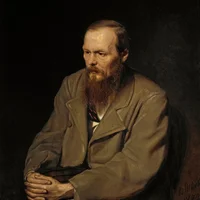
Fyodor Dostoevsky
Dostoevsky probes the human psyche and existential dilemmas with a penetrating depth that has left an enduring impact on literature. By situating his narratives within the tumultuous socio-political landscape of 19th-century Russia, Dostoevsky offers a critique of human nature and society. His philosophical exploration in works like "The Brothers Karamazov" delves into faith and morality, while "The Idiot" presents the complexity of innocence in a flawed world. His experiences, such as his exile to Siberia, profoundly shaped his narrative style and themes, leading to a profound exploration of sin, redemption, and the conflict between reason and passion.\n\nDostoevsky’s method combines intricate character development with an existential inquiry that interrogates the spiritual and moral questions of his time. This approach enables him to craft narratives that transcend simple storytelling, offering readers a deeper understanding of the human condition. For example, in "Crime and Punishment," the torment of Raskolnikov serves as a vehicle for examining guilt and redemption. Therefore, Dostoevsky’s works remain seminal in their psychological insight, influencing both contemporary literature and philosophy.\n\nFor readers, Dostoevsky's works provide a rich tapestry of thought-provoking themes that challenge the reader to reflect on their own beliefs and the nature of humanity. Those interested in the intersections of literature, philosophy, and psychology will find his novels invaluable, as they offer profound insights into existential and theological questions. This short bio encapsulates the author’s mastery in blending narrative with deep psychological and moral inquiry, making Dostoevsky’s books an essential part of the literary canon for anyone seeking a comprehensive exploration of the complexities of the human soul.
Read moreDownload PDF & EPUB
To save this Black List summary for later, download the free PDF and EPUB. You can print it out, or read offline at your convenience.

Fyodor Dostoyevsky
by Fyodor Dostoevsky
