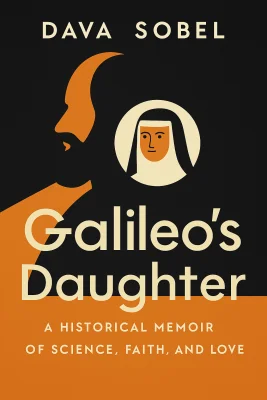
Galileo's Daughter
A Historical Memoir of Science, Faith and Love
Categories
Nonfiction, Science, Biography, History, Religion, Biography Memoir, Book Club, Historical, Italy, Astronomy
Content Type
Book
Binding
Paperback
Year
2000
Publisher
Penguin Books (NYC)
Language
English
ASIN
0140280553
ISBN
0140280553
ISBN13
9780140280555
File Download
PDF | EPUB
Galileo's Daughter Plot Summary
Introduction
# Galileo's Daughter: Faith, Science, and Unbreakable Bonds In the summer of 1633, as the great astronomer Galileo Galilei knelt before the Roman Inquisition to publicly renounce his belief that the Earth moves around the Sun, his greatest source of comfort came not from fellow scientists or powerful patrons, but from the loving letters of his eldest daughter, a cloistered nun who had chosen the name Suor Maria Celeste. Their extraordinary correspondence reveals a relationship that transcended the walls of her convent and the boundaries of his house arrest, illuminating both the human cost of scientific revolution and the enduring power of familial devotion in the face of institutional persecution. Through the intimate exchange between father and daughter, we witness not only Galileo's transformation of our understanding of the cosmos, but also the profound personal struggles that accompanied his public triumphs. Maria Celeste emerges as far more than a supportive daughter; she becomes his confidante, caretaker, and spiritual anchor during the most turbulent period of his life. Their story offers us timeless insights into the delicate balance between scientific inquiry and religious faith, the sacrifices demanded by intellectual courage, and the ways in which unconditional love can sustain us through our darkest hours of doubt and persecution.
Chapter 1: Early Years: The Making of a Revolutionary Mind
Galileo Galilei entered the world in Pisa on February 15, 1564, the same year that witnessed both Michelangelo's death and Shakespeare's birth, as if the cosmos itself were orchestrating a changing of the guard in human creativity. His father, Vincenzio Galilei, was an accomplished musician and music theorist whose own rebellious spirit against established authority would prove prophetic of his son's future battles. The elder Galilei challenged the rigid mathematical rules that governed Renaissance music composition, arguing instead for the primacy of the ear over abstract theory, a philosophy that would deeply influence young Galileo's approach to understanding the natural world through direct observation rather than ancient texts. Initially destined for the medical profession, Galileo enrolled at the University of Pisa in 1581, but his restless intellect soon wandered from anatomy texts to the geometric principles underlying all of creation. Legend holds that during a particularly tedious church service, he noticed a hanging lamp swaying in the cathedral's drafts and began timing its oscillations against his own pulse, discovering that regardless of the amplitude of the swing, each oscillation took precisely the same amount of time. This moment of insight into what would later be called the law of the pendulum marked his first step toward revolutionizing physics through careful observation and mathematical analysis. His academic career proved as unconventional as his discoveries. Abandoning his medical studies without a degree, Galileo spent several years in Florence tutoring mathematics while conducting private research into motion and mechanics. His early investigations into falling bodies led him to question Aristotle's assertion that heavier objects fall faster than lighter ones, though the famous story of dropping cannonballs from the Leaning Tower of Pisa may be more legend than fact. What remains undisputed is his growing reputation as a brilliant, if sometimes abrasive, challenger of accepted wisdom who preferred experimentation to philosophical speculation. In 1589, at the remarkably young age of twenty-five, Galileo secured a professorship in mathematics at his alma mater, the University of Pisa. His lectures drew crowds not only for their mathematical precision but for their theatrical flair and willingness to demolish cherished beliefs through logical demonstration. Students watched in fascination as their young professor used reason and experimentation to dismantle theories that had stood unchallenged for centuries. Yet his iconoclastic approach also earned him powerful enemies among the university's more traditional faculty, setting a pattern of intellectual courage coupled with political naivety that would define his entire career and ultimately lead to his confrontation with the Church.
Chapter 2: Celestial Revelations: Telescope and the New Cosmos
The year 1609 marked the great turning point in Galileo's life, when news reached him of a curious Dutch invention called a "spyglass" that could make distant objects appear closer. Rather than simply acquiring one of these devices, Galileo immediately set about improving its design, grinding his own lenses with obsessive precision and increasing the magnification from a mere three times to an unprecedented twenty times. But his true genius lay not in the technical refinement of the telescope, but in his revolutionary decision to point it skyward and systematically observe the heavens with an intensity and methodical approach no human being had ever before applied to the cosmos. What he saw through his improved telescope shattered the crystalline perfection that philosophers had attributed to the celestial realm for over a thousand years. The Moon's surface, far from being a smooth, polished sphere befitting its supposed divine nature, revealed itself to be scarred with mountains and valleys much like Earth itself. Venus displayed phases similar to the Moon's, proving conclusively that it orbited the Sun rather than Earth. Most dramatically of all, four previously unknown moons circled Jupiter in a celestial dance, their regular orbits around the giant planet providing a miniature model of the Copernican solar system that Galileo increasingly believed described our own cosmic neighborhood. His publication of these discoveries in "The Starry Messenger" in 1610 brought him instant fame across Europe and secured his appointment as Chief Mathematician and Philosopher to Cosimo II de' Medici, Grand Duke of Tuscany. The position freed him from tedious teaching duties and provided the financial security to pursue his research full-time, but it also placed him at the center of the intellectual and political storms that would eventually consume him. The four moons of Jupiter, which he diplomatically named the "Medicean Stars" after his patron's family, became his calling card to the powerful and his passport to the increasingly dangerous world of cosmological controversy. Galileo's telescopic observations of sunspots proved equally revolutionary, demonstrating that even the Sun itself was subject to change and imperfection. By carefully tracking these dark blemishes across the solar surface over many days, he could prove that the Sun rotated on its axis, adding yet another piece of compelling evidence to support the Copernican theory that Earth was not the stationary center of creation but merely one planet among many orbiting our local star. Each discovery seemed to diminish humanity's special place in the cosmic order, a theological implication that would not go unnoticed by Church authorities already suspicious of ideas that challenged traditional interpretations of Scripture.
Chapter 3: Sacred Tensions: Scripture, Science, and Authority
The collision between Galileo's scientific discoveries and religious doctrine was perhaps inevitable, but it was precipitated by his own inability to remain diplomatically silent about the theological implications of his work. In 1613, his former student Benedetto Castelli wrote to him about a breakfast conversation at the Medici court where the question had arisen of how Galileo's discoveries could be reconciled with biblical passages that seemed to describe a stationary Earth and a moving Sun. Galileo's response, later expanded into his famous "Letter to the Grand Duchess Christina," articulated a sophisticated theological argument that the Bible was intended to teach salvation rather than astronomy, and that when Scripture spoke of natural phenomena, it accommodated itself to common understanding rather than revealing literal scientific truth. This theological reasoning, while intellectually sound and supported by respected Church fathers like Augustine, proved politically disastrous in the charged atmosphere of Counter-Reformation Italy. Galileo had ventured into the dangerous territory of biblical interpretation, a realm that the Catholic Church, still reeling from the Protestant Reformation's challenge to its authority, guarded with particular jealousy. His argument that Scripture should not be used to settle questions of natural philosophy was seen not as a defense of both science and religion, but as an attack on the Church's right to determine truth in all spheres of human knowledge. The first formal confrontation came in 1616, when the Holy Office of the Inquisition declared the Copernican theory "foolish and absurd in philosophy, and formally heretical since it explicitly contradicts in many places the sense of Holy Scripture." Cardinal Robert Bellarmine, the Church's most respected theologian and the man who had overseen the trial of Giordano Bruno, summoned Galileo to Rome and instructed him not to "hold, teach, or defend" the heliocentric theory. Galileo agreed to this restriction, believing he had received permission to discuss Copernican ideas as mathematical hypotheses rather than physical realities. This misunderstanding, or perhaps willful misinterpretation, would prove crucial to his later trial and condemnation. For several years following the 1616 injunction, Galileo maintained a careful public silence on cosmological questions, turning his attention to seemingly safer topics like the behavior of floating bodies in water and the nature of comets. But the election of his friend and admirer Maffeo Barberini as Pope Urban VIII in 1623 seemed to offer new hope for a more liberal attitude toward scientific inquiry. Urban had opposed the 1616 condemnation of Copernicanism and had praised Galileo's work in laudatory verse. Emboldened by six audiences with the new pope and convinced that he had tacit permission to present both sides of the cosmological debate, Galileo began work on what would become both his masterpiece and his downfall.
Chapter 4: Maria Celeste: Letters from the Convent
While Galileo navigated the treacherous waters of ecclesiastical politics, his personal life was anchored by his relationship with his eldest daughter, Virginia, who had taken religious vows as Suor Maria Celeste at the Convent of San Matteo in Arcetri. Born in 1600 to Marina Gamba, a Venetian woman who would never become Galileo's wife, Virginia's illegitimate status had limited her marriage prospects and made the convent her most viable option for a respectable life. Yet what might have seemed like a constraint became the foundation for one of history's most remarkable father-daughter relationships, sustained entirely through their extraordinary correspondence that began in earnest around 1623 when she was twenty-three years old. Their letters reveal a relationship of extraordinary intimacy and mutual devotion that transcended the physical barriers separating them. Though Maria Celeste lived in strict religious enclosure just a short walk from his villa, they could meet only at the convent's grilled parlor during designated visiting hours, making their frequent letters the primary vehicle for their emotional connection and practical collaboration. Her correspondence displays a remarkable intellect that clearly inherited her father's analytical precision, though channeled toward domestic and spiritual rather than scientific concerns. She managed his household affairs with meticulous attention to detail, oversaw his health with homemade medicines and carefully prepared foods, and provided emotional support with a wisdom that often seemed to exceed her years. Maria Celeste's letters illuminate the complex relationship between science and faith in seventeenth-century Italy, revealing a woman who never questioned her father's scientific work or saw any contradiction between his discoveries and her religious devotion. Instead, she viewed his investigations of God's creation as a form of worship, writing that his telescopic observations brought him closer to understanding divine majesty rather than distancing him from it. Her perspective offers a compelling alternative to the simplistic narrative of science versus religion, suggesting instead a more nuanced relationship in which scientific discovery could deepen rather than threaten religious faith when approached with proper humility and reverence. Perhaps most poignantly, the correspondence reveals the personal cost of Galileo's commitment to scientific truth and his growing isolation as controversy swirled around his work. Maria Celeste's letters frequently express concern for his health, his reputation, and his safety, while offering practical advice on everything from legal strategies to dietary remedies. She became his emotional refuge and most trusted confidante, the one person who loved him unconditionally regardless of whether his theories proved correct or his battles with authority ended in victory or defeat. Her unwavering support provided him with the psychological strength to continue his research even as the institutional pressures against him mounted and his circle of supporters gradually diminished.
Chapter 5: Trial and Tribulation: The Inquisition's Judgment
The publication of Galileo's "Dialogue Concerning the Two Chief World Systems" in 1632 marked the beginning of the final, tragic act of his public career. Despite having received official approval from Church censors in both Rome and Florence, the book's transparent advocacy for the Copernican system through its eloquent spokesman Salviati enraged Pope Urban VIII, who felt personally betrayed by a man he had considered a friend and intellectual equal. The pope's anger was compounded by political pressures related to the devastating Thirty Years' War and accusations from Spanish cardinals that his policies were insufficiently Catholic, making him particularly sensitive to any challenge to Church authority that might be construed as weakness or doctrinal laxity. Summoned to Rome in February 1633 to face charges of heresy before the Holy Office of the Inquisition, the sixty-nine-year-old Galileo endured a trial that was as much about obedience to ecclesiastical authority as about scientific truth. The Inquisition's case rested not primarily on the astronomical content of his book, but on his alleged violation of the 1616 injunction against teaching Copernican theory as anything more than a mathematical hypothesis. Galileo's defense that he had been permitted to discuss heliocentrism hypothetically and had presented arguments on both sides fell on deaf ears, as the tribunal was more concerned with establishing the Church's absolute right to determine the boundaries of acceptable discourse than with evaluating the scientific merits of competing cosmological theories. The trial's outcome was predetermined by political necessity rather than theological reflection or scientific evidence. Galileo's former friend Pope Urban VIII, feeling betrayed and under pressure from conservative cardinals, had already decided that an example must be made to demonstrate that even the most celebrated intellectuals could not challenge Church authority with impunity. On June 22, 1633, after weeks of interrogation and the threat of torture, Galileo was forced to kneel before his judges and formally abjure the "false opinion" that the Sun stands still and the Earth moves, declaring it "abjured, cursed, and detested" in a humiliating public ceremony that broke his spirit even as it preserved his life. The personal toll of these events was devastating, not only for Galileo but for his beloved daughter, who had anxiously followed every development of the trial through letters from friends in Rome and reports from intermediaries. Maria Celeste's correspondence during this period reveals her deep anguish over her father's suffering, combined with her unwavering determination to provide whatever comfort and support she could manage from within her convent walls. She took upon herself the weekly recitation of penitential psalms that had been imposed as part of his penance, hoping to ease his spiritual burden even as she could do nothing to alleviate his public disgrace. Her letters during this dark period demonstrate remarkable emotional strength and spiritual maturity, as she sought to maintain her father's morale while helping him find meaning in his suffering through their shared Catholic faith.
Chapter 6: Final Years: Love, Loss, and Scientific Legacy
House arrest at his villa Il Gioiello in Arcetri proved to be both a prison and an unexpected sanctuary for Galileo's final years. Cut off from the intellectual community that had sustained him throughout his career, forbidden from receiving most visitors or publishing new work on astronomy, he might have been expected to sink into despair and bitter inactivity. Instead, with characteristic resilience and an undiminished passion for understanding the natural world, he turned his enforced isolation into an opportunity to complete his most important scientific work, the "Discourses and Mathematical Demonstrations Relating to Two New Sciences," which laid the mathematical foundations for the modern science of mechanics and established experimental methodology that would guide scientific inquiry for centuries to come. The daily presence of Maria Celeste just a short walk away provided crucial emotional support during these difficult years of exile from the broader scientific community. Her letters continued to manage his practical affairs with remarkable efficiency while offering spiritual comfort and intellectual companionship that helped sustain his mental health. She arranged for his meals to be prepared according to his dietary needs, supervised his household servants, procured his medicines from the convent's pharmacy, and served as his discreet liaison with the outside world when official channels were closed to him. More importantly, she provided the unconditional love and acceptance that sustained him through periods of depression and physical decline, reminding him that his worth as a human being transcended any judgment that earthly authorities might render on his scientific theories. Tragedy struck in April 1634 when Maria Celeste died suddenly of dysentery at the age of thirty-three, just ten months after her father's trial and condemnation. Galileo was utterly devastated by the loss of his closest companion and most devoted supporter, writing to a friend that he felt "immense sadness and melancholy, together with extreme inappetite" and that he constantly heard her voice calling to him from beyond the grave. Her death marked the beginning of his final decline, as failing health and increasing blindness gradually reduced his world to the confines of his villa and the company of a few faithful disciples who risked official displeasure by maintaining contact with the condemned heretic. Yet even in his final years, bereft of his beloved daughter and increasingly isolated from former colleagues, Galileo's scientific imagination remained remarkably active. He continued to make astronomical observations until blindness claimed his sight in 1637, discovering the Moon's libration and refining his theories of motion and mechanics. His last great work, the "Two New Sciences," was smuggled out of Italy and published in Protestant Holland in 1638, ensuring that his scientific legacy would survive the Church's attempts at suppression. When he died in January 1642, exactly one hundred years before Newton's birth, he left behind not only a revolution in human understanding of the cosmos, but also a model of intellectual courage that would inspire generations of scientists to follow evidence wherever it might lead, regardless of the personal cost or institutional opposition they might face.
Summary
The intertwined stories of Galileo Galilei and his daughter Maria Celeste illuminate the profound truth that the pursuit of knowledge requires not only intellectual brilliance but also moral courage, and that the greatest scientific discoveries often exact the highest personal price from those who make them. Galileo's willingness to defend observational truth in the face of institutional opposition transformed him from a mere astronomer into an enduring symbol of intellectual freedom, while his relationship with his devoted daughter revealed the tender human heart that beat beneath his revolutionary mind and sustained him through his darkest hours of persecution and doubt. Their extraordinary correspondence offers us timeless lessons about the importance of maintaining our commitment to truth while nurturing the relationships that give life its deepest meaning and purpose. For anyone struggling to balance principle with pragmatism, or seeking to understand how personal relationships can sustain us through professional challenges and public setbacks, their example provides both inspiration and practical wisdom about the sources of human resilience. Maria Celeste's unwavering support reminds us that behind every great achievement stands a network of love and encouragement, often provided by those whose names history may forget but whose contributions prove essential to human progress.
Best Quote
“with its graceful language and poetic conceit, and even more because it expressed his own philosophy of science. To wit: As earnestly as men may seek to understand the workings of the universe, they must remember that God is not hampered by their limited logic—that all observed effects may have been wrought by Him in any one of an infinite number of omnipotent ways, and these must ever evade mortal comprehension.” ― Dava Sobel, Galileo's Daughter: A Historical Memoir of Science, Faith and Love
Review Summary
Strengths: The book provides considerable detail about Galileo's challenges in explaining the world amidst the political dominance of the Catholic Church. It is described as entertaining and interesting, offering a dramatic recoloring of Galileo's personality and accomplishments. Weaknesses: The focus on Galileo's daughter is considered the weakest part of the book, with the letters from her being suggested as skippable. The daughter's role is seen more as a narrative hook rather than a substantial element of the memoir. Overall: The review conveys a generally positive sentiment, acknowledging the book as a worthwhile read for its detailed portrayal of Galileo's life and struggles, though it does not consider it a must-read. The reader is advised to approach the daughter's letters with less emphasis.
About Author

Dava Sobel
Sobel navigates the confluence of science and narrative to illuminate historical scientific achievements. Her works such as "Longitude" and "Galileo's Daughter" epitomize her ability to blend rigorous historical research with compelling storytelling, making complex scientific topics accessible and engaging. By exploring the lives of figures like John Harrison and Maria Celeste, she not only chronicles scientific progress but also highlights the human stories behind these advancements. Sobel’s books often delve into the intersections of science, culture, and history, providing readers with a deeper understanding of the societal impacts of scientific endeavors.\n\nThrough her meticulous research and narrative flair, Sobel's books serve as a bridge between the academic world and the general public. Readers benefit from her skill in translating complex scientific ideas into relatable narratives, making her works valuable for both science enthusiasts and those new to the subject. Her role as an author is further recognized through prestigious awards, with "Longitude" earning the Harold D. Vursell Memorial Award and "Galileo's Daughter" becoming a finalist for the Pulitzer Prize in Biography. This bio encapsulates her significant contributions to the literary and scientific fields, underscoring her impact on how science is perceived and appreciated by the wider audience.
Read moreDownload PDF & EPUB
To save this Black List summary for later, download the free PDF and EPUB. You can print it out, or read offline at your convenience.
Galileo's Daughter
by Dava Sobel
