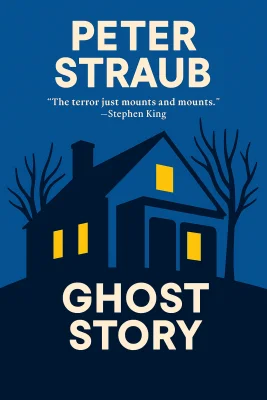
Ghost Story
Categories
Fiction, Horror, Mystery, Thriller, Fantasy, Book Club, Ghosts, Paranormal, Supernatural, Halloween
Content Type
Book
Binding
Mass Market Paperback
Year
1989
Publisher
Pocket Books / Simon & Schuster, Inc.
Language
English
ASIN
0671685635
ISBN
0671685635
ISBN13
9780671685638
File Download
PDF | EPUB
Ghost Story Plot Summary
Introduction
# Ghosts of Memory: The Chowder Society's Reckoning The snow fell wrong in Milburn that winter of 1974, too early and too deep, blanketing the small New York town in an unnatural silence that seemed to muffle even the screams. In the leather-appointed library of Sears James, four elderly gentlemen gathered as they had for decades, members of an exclusive club called the Chowder Society. They told ghost stories to pass the long evenings, but their tales had grown darker, more personal, as if something hungry was listening from the shadows. Dr. John Jaffrey's body was found floating face-down in the Milburn River that December morning, his face frozen in an expression of absolute terror. The official cause was suicide, but his three surviving friends knew better. They had been sharing the same nightmares for months, visions of a bare room where something monstrous climbed the stairs toward them. Now their circle was broken, and the thing they had tried to forget for fifty years was finally coming to collect what it was owed.
Chapter 1: The Chowder Society: Gentlemen Haunted by Shared Nightmares
The ritual never varied. Every two weeks, the four men gathered in evening dress, sharing tales of the supernatural over brandy and cigars. Sears James, massive and dignified, presided from his wing-backed chair like a judge pronouncing sentence. Ricky Hawthorne, precise in his bow tie, spoke with the careful diction of a college professor. Lewis Benedikt, still handsome at sixty-five, carried himself with the easy grace of old money. Dr. John Jaffrey looked the worst of them all, his skin waxy and stretched tight over sharp bones. Tonight it was Ricky's turn to tell a story, but the words came slowly, reluctantly. He spoke of shadows that moved independently of their owners, of voices calling from empty rooms, of dreams that felt more real than waking life. The fire crackled in the grate, but the room grew colder with each word. "We've been having the most remarkable dreams," Ricky whispered. "All of us. The same dreams." The nightmare was always identical: a bare room in an abandoned house, the sound of footsteps on creaking stairs, and at the climax, the appearance of their dead friends with empty eye sockets and knowing smiles. But for Sears, the visions had begun bleeding into daylight hours. Outside, the wind howled through Milburn's narrow streets, and somewhere in the darkness, something ancient stirred in response to their words. The Chowder Society had become a beacon in the night, drawing hungry shadows toward their small town like moths to a flame. Their stories were no longer entertainment but desperate incantations, trying to hold back forces they had awakened decades ago.
Chapter 2: Death Comes Calling: The Unraveling of Old Friendships
The call shattered Ricky Hawthorne's sleep at seven in the morning. Milly Sheehan's voice crackled through the phone line, broken and desperate. Dr. Jaffrey was dead, she sobbed. He had jumped from the bridge over the Milburn River, his body found floating in the icy water by the town drunk. Sheriff Walt Hardesty delivered the news with callous indifference, reducing their gentle friend to crude statistics. But when they saw the body in the county morgue, there could be no doubt. John Jaffrey's face was frozen in an expression of absolute terror, as if he had seen something that literally frightened him to death. The autopsy revealed secrets none of them had suspected. Jaffrey had been addicted to morphine for years, injecting himself daily with the precision of his medical practice. The revelation split the town's opinion, but Milly Sheehan had her own theory. Standing in Ricky's living room with tears streaming down her weathered face, she pointed an accusing finger at the three survivors. "You killed him," she declared, her voice breaking. "With your terrible stories and your obsession with death. You should call yourselves Murder Incorporated." The words hung in the air like a curse. That same night, the nightmares intensified. Each man found himself walking through the same bare room, hearing the same footsteps on the stairs. But now John Jaffrey waited at the top, his eye sockets empty and black, his mouth stretched in a grin that belonged on no human face. The Chowder Society's reckoning had begun, and death was climbing the stairs toward them one by one.
Chapter 3: Don Wanderley's Arrival: A Writer's Investigation into Terror
The letter had been sent in desperation, a plea for help addressed to Edward Wanderley's nephew in California. Don Wanderley was a writer, author of a supernatural thriller called The Nightwatcher, and the surviving members hoped he might understand what was happening to them. They needed someone from outside their circle, someone who could look at their situation with fresh eyes. Don arrived on the day of Jaffrey's funeral, a tall man in his thirties with intelligent eyes and the rumpled appearance of someone who lived more in imagination than reality. He had inherited his uncle's house on Montgomery Street, though he noticed none of the three old men suggested he stay there. Instead, Lewis Benedikt offered him a room at his converted farmhouse, and Don sensed an unspoken fear surrounding his uncle's property. At the funeral, he watched the three survivors stand like broken monuments in the wind, their faces etched with grief and something deeper. That evening, in Ricky's living room, the truth finally emerged. They told him about the dreams, the visions, the growing sense that something malevolent was stalking them through Milburn's streets. Don listened with growing unease, recognizing echoes of his own past in their story. In California, he had fallen in love with a woman named Alma Mobley, an aspiring actress whose beauty masked something fundamentally wrong. Their relationship had ended in tragedy when his brother David died under suspicious circumstances in Amsterdam. Don had written The Nightwatcher as an attempt to understand what had happened, to transform his guilt and grief into something comprehensible. Now, sitting in the warm glow of Ricky's fireplace while snow fell outside the windows, Don realized his past was catching up with him once again. The patterns were too similar, the coincidences too precise. Something had followed him to Milburn, something that had been waiting fifty years for the perfect moment to strike.
Chapter 4: The Shape-Shifter's Return: Eva Galli's Fifty-Year Vengeance
The past reached forward with bloody fingers, stretching back fifty years to a woman named Eva Galli. She had been beautiful and mysterious, arriving in Milburn in 1929 to court the five young men who would later form the Chowder Society. But Eva Galli was not human, had never been human. She was something far older that wore human form to hunt among the living. In Edward Wanderley's study, surrounded by the tools of a writer's trade, the surviving members finally told the story they had kept buried for half a century. Sears James's massive frame seemed to shrink with each word as he described Eva's arrival that autumn when the world was falling apart around them. "She enchanted us all," Sears began, his voice thick with shame. "Five young men on the threshold of our adult lives, each believing himself to be the sole object of her affections. She played us against each other with the skill of a master manipulator, feeding on our jealousy and desire." The truth about Eva emerged slowly, like a photograph developing in chemical baths. She was a shapeshifter, a being that could take any form and had lived for centuries by feeding on human life and suffering. The confrontation had come on a night in October 1929, when Eva had visited Edward's apartment in a state of wild rage, stripping away all pretense of humanity. "We killed her," Ricky whispered. "We drove a stake through her heart and watched her body crumble to dust. We thought it was over." But Eva Galli's death had been only the beginning. Her final words, spoken as the stake pierced her heart, had been a promise of return. She would come back when they were old and weak, and she would make them pay for what they had done. Now, fifty years later, that promise was being fulfilled. Anna Mostyn, the beautiful secretary who had recently arrived in Milburn, was Eva Galli returned, more powerful than before and hungry for the revenge death had denied her.
Chapter 5: Nightwatchers Unleashed: When the Dead Hunt the Living
The killing began in earnest as winter tightened its grip on Milburn. Lewis Benedikt was found torn apart in the woods behind his mansion, his body savaged by what authorities assumed was a wild animal. But the wounds were too precise, too deliberate, and those who found his corpse spoke in whispers of the unnatural cold that seemed to emanate from his remains. Young Peter Barnes became an unwitting witness to the creatures' true nature when his friend Jim Hardie was murdered before his eyes. They had broken into Anna Mostyn's house, driven by teenage curiosity and Jim's reckless need to prove himself. The attack came without warning—a tall, pale man appeared at the top of the stairs, wearing dark glasses despite the darkness. His companion was a child, barefoot and grinning with malevolent joy. "Hello, boys," the man said, his voice carrying an authority that froze Peter's blood. "She will be delighted to see you again." Jim's scream cut through the night as the pale man's hands found his throat. Peter watched in horror as his friend's head struck the wall with a sound like breaking pottery, leaving a bright smear of blood on the wallpaper. The thing that had been wearing a human face smiled, revealing teeth that gleamed like polished bone. Peter ran, crashing through windows and tumbling across rooftops in his desperate flight. Behind him, he could hear laughter that seemed to come from the house itself. He made it home, but the sanctuary of his bedroom felt fragile now. Through his window, he could see the lights of Milburn flickering like dying stars. The creatures called themselves Gregory and Fenny Bate, brothers who had died in 1929 but now walked again in service to Eva Galli. They were nightwatchers, beings that existed in the spaces between life and death, feeding on terror and blood while serving a master whose hunger was older than human memory.
Chapter 6: Milburn Under Siege: A Town Trapped in Supernatural Winter
The supernatural blizzard that engulfed Milburn was no natural phenomenon. Snow fell continuously, piling into drifts that reached second-story windows and sealing the town off from the outside world. Roads became impassable, power lines snapped under the weight of ice, and the few remaining authorities found themselves helpless against forces they could neither understand nor combat. Animals were found drained of blood, their bodies twisted in unnatural positions. The attacks followed a pattern that chilled those who bothered to notice—each victim lying peacefully, as if they had simply chosen to sleep forever. The wounds were precise, almost ritualistic, and the complete absence of blood suggested something that fed with an intelligence far beyond any earthly predator. Sheriff Walter Hardesty descended into alcoholic madness as his jail filled with the bodies of the nightwatchers' victims. The creatures seemed to take perverse pleasure in displaying their handiwork, leaving corpses arranged in ways that maximized the psychological impact on those who discovered them. Hardesty, a practical man who had never believed in anything he couldn't arrest or shoot, found his worldview crumbling. Sears James, the most formidable of the surviving friends, met his end when he attempted to rescue a local farmer. The old lawyer's body was found in his car, buried in a snowdrift, his face frozen in an expression of defiant rage. Even in death, he had refused to give his enemies the satisfaction of seeing him break. The nightwatchers were not random killers but soldiers in an army commanded by something that had been planning this invasion for decades. They moved with purpose, selecting their victims according to some grand design. Milburn was being systematically harvested, its population converted into fuel for something that existed beyond the normal boundaries of existence.
Chapter 7: The Final Hunt: Confronting Ancient Evil in Its Lair
With winter's grip tightening and their enemies closing in, the survivors realized they had only one chance to end the nightmare. Don Wanderley, Ricky Hawthorne, and young Peter Barnes formed an unlikely alliance, bound together by shared loss and desperate determination. They had learned that the nightwatchers, despite their supernatural nature, could be hurt and even destroyed by conventional weapons wielded with sufficient courage. Their investigation led them to the abandoned movie theater where the creatures had made their lair. The Rialto had become a temple to their twisted philosophy, where they screened horror films to empty seats and celebrated each new victory over human decency. Gregory and Fenny Bate waited for them there, confident in their superiority and eager to complete their revenge. The battle was brutal and desperate. Gregory revealed his true nature as a predator that had transcended human limitations through sheer malevolence, while Fenny displayed the mindless hunger of a creature that existed only to feed and destroy. But the three humans had advantages their enemies hadn't anticipated: Peter's youth and determination, Ricky's stubborn courage despite his age, and Don's intimate knowledge of how the creatures operated. Using axes and knives, weapons as old as humanity's struggle against darkness, they hacked the nightwatchers to pieces. The creatures' bodies dissolved into writhing masses of corruption before finally dissipating entirely, their unnatural existence ended. But even as they celebrated their victory, the survivors knew their work wasn't complete. The final confrontation took place in the ruins of Edward Wanderley's old apartment, where the original tragedy had unfolded fifty years earlier. Anna Mostyn waited for them there, no longer bothering to maintain her human disguise. She appeared as she truly was: a creature of pure malevolence that had worn countless faces over the centuries, feeding on human suffering and delighting in the corruption of innocence.
Chapter 8: Beyond the Grave: Breaking the Cycle of Revenge
Anna Mostyn assaulted her enemies with visions and illusions, trying to break their will by showing them distorted versions of their deepest fears and regrets. Don found himself transported to imaginary scenes where his brother David tried to convince him that surrender was the only rational choice. Ricky was tormented by false versions of his dead friends, while Peter was forced to confront manifestations of his murdered mother. But the three survivors had learned to see through such deceptions. When Anna Mostyn's illusions failed to break them, she revealed her true form: not human at all, but something that shifted and changed like an oil slick, beautiful and terrible and utterly alien. The battle was as much psychological as physical, a test of will against an entity that had perfected the art of corruption over centuries. Peter Barnes, the youngest and most innocent of the group, struck the killing blow. The ancient Bowie knife that had once pierced Eva Galli's heart found its mark again, driven deep into the creature's chest by hands that shook with righteous fury. Anna Mostyn's death was spectacular and final, her body collapsing in on itself, consumed by forces that had sustained her unnatural existence. The house around them shuddered and groaned as reality reasserted itself. Across town, the building where Eva Galli had once lived exploded into flames. The supernatural winter that had gripped Milburn began to break, and for the first time in months, the survivors could see clear sky through the falling snow. But even in victory, they knew that other creatures like Anna Mostyn existed in the world, patient and malevolent, ready to prey upon human weakness. The price of survival was eternal vigilance, and the knowledge that some evils were too ancient and too cunning to be defeated permanently. Yet they had proven that such creatures could be fought and beaten, that even in humanity's darkest hour, courage and love could triumph over forces that sought to drag the world into eternal night.
Summary
The aftermath brought both relief and profound sadness to the survivors. Milburn slowly began to heal from its supernatural siege, but the scars would remain forever. Too many good people had died, too many families had been shattered. The Chowder Society, that genteel institution that had bound five friends together for decades, was finished, its members dead or forever changed by their encounter with primordial evil. Don Wanderley found himself the inheritor of his uncle's legacy, keeper of knowledge that few would believe and fewer still would want to possess. He had learned that the world contained horrors beyond human comprehension, but also that ordinary people could find the courage to stand against such darkness when everything they loved was threatened. Peter Barnes, aged beyond his years by trauma and loss, would carry similar knowledge into his adult life, forever watchful for signs that such creatures had returned. Ricky Hawthorne, the last surviving member of the original Chowder Society, chose to leave Milburn behind entirely, seeking peace in places untouched by the memories of that terrible winter. But he knew, as they all knew, that their victory had been temporary, and that somewhere in the world, other shapeshifters waited in the shadows, ready to begin the hunt anew.
Best Quote
“... He was particularly disgruntled to see what he had taken for a bundle of old rags on the tracks outside was a human body. He did not say "Not again" (what he said was "Shit on this"), but "Not again" was what he meant.” ― Peter Straub, Ghost Story
Review Summary
Strengths: The novel is a literary homage to classic horror, with references to authors like Hawthorne and James. Straub's writing is praised for its quality, with some passages being particularly enjoyable. The book effectively incorporates themes from American supernatural fiction and features a story within a story structure. Weaknesses: The pacing is criticized as slow and cumbersome, making the book difficult to get through. The narrative switches between multiple viewpoints, which can disrupt the flow. Characters are passive and fail to take action against the looming threat, diminishing tension and engagement. Overall: The reviewer appreciates Straub's writing style and thematic homage but finds the execution lacking due to pacing and character passivity. The recommendation is lukewarm, suggesting interest for genre enthusiasts but cautioning about its slow progression.
About Author

Peter Straub
Straub interrogates the darker facets of human experience through his masterful blending of horror and literary sophistication. His work often weaves themes of trauma, memory, and identity into intricate narratives, which explore the blurred lines between reality and illusion. The author’s early book, "Julia," marked his initial foray into supernatural fiction, setting the stage for his acclaimed career in the genre. This innovative approach resonates in his later works like "Ghost Story" and the collaborative efforts with Stephen King, such as "The Talisman" and "Black House." Straub’s writing stands out for its psychological depth and lyrical prose, appealing to readers who appreciate complex storytelling that defies conventional genre boundaries.\n\nStraub's literary journey is characterized by a shift from initial literary novels to pioneering horror fiction, a move that brought him widespread recognition and success. His books often employ unreliable narrators and complex narrative structures, creating a unique reading experience that challenges and engages audiences. Moreover, his capacity to blend genres—melding elements of mystery, crime, and metafiction—enriches his storytelling. As a result, his contributions have been acknowledged with numerous accolades, including multiple Bram Stoker Awards. Straub’s bio exemplifies a trajectory that not only redefined horror literature but also captivated readers worldwide with its sophisticated narratives and profound thematic exploration.
Read moreDownload PDF & EPUB
To save this Black List summary for later, download the free PDF and EPUB. You can print it out, or read offline at your convenience.
Ghost Story
by Peter Straub
