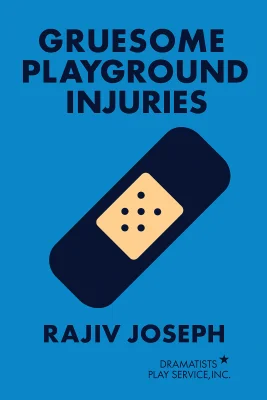
Gruesome Playground Injuries
Categories
Fiction, Plays, Adult, School, Contemporary, Read For School, Drama, Theatre
Content Type
Book
Binding
Paperback
Year
2012
Publisher
Dramatists Play Service Inc.
Language
English
ASIN
0822225298
ISBN
0822225298
ISBN13
9780822225294
File Download
PDF | EPUB
Gruesome Playground Injuries Plot Summary
Introduction
The roar never came. When the Bengal tiger bit off Marine Tom's hand that night at Baghdad Zoo, there was only the wet crunch of bone and the soldier's scream echoing through the bombed-out ruins. Kevin raised the gold-plated pistol and fired, watching the massive beast collapse into death. But death, it seemed, was just another kind of cage. What follows is a haunting tapestry of three interconnected stories, each exploring the wreckage left behind by violence, loss, and the desperate human need for connection. From the blood-stained corridors of war-torn Iraq to the pristine origami studios of New York, from the sterile hospital rooms where broken soldiers piece themselves back together to the elaborate topiary gardens where beauty masks unspeakable cruelty, these tales weave together the common thread of souls searching for redemption in a world that offers none. In this collection, the living and the dead walk side by side, haunted equally by what they've done and what's been done to them.
Chapter 1: The Tiger's Last Meal: A Violent Encounter at Baghdad Zoo
The Baghdad Zoo had become another casualty of war, its walls blown open, cages twisted into metal sculptures. Two American marines, Tom and Kevin, stood guard over the last remaining predator—a mangy Bengal tiger whose glory days were long behind him. The creature paced in his concrete prison, twelve years of captivity having dulled his magnificent stripes to faded memories. Kevin was young, eager, and tired of guarding animals while other soldiers saw real action. He pestered Tom to show him the gold-plated pistol they'd looted from Uday Hussein's mansion, a gaudy trophy that glinted even in the dim zoo lighting. Tom, older and more cautious, had also claimed a gold toilet seat from the same raid, buried somewhere safe for his return home. The tiger watched them with ancient eyes, understanding more than they realized. He remembered the escape of eight lions two days prior, how they'd called for him to join their desperate flight. But he was wiser than they were. Freedom in Baghdad meant death, and the lions had been mowed down within hours. Better to wait, to endure, to survive the concrete walls and the daily humiliation of captivity. But hunger makes fools of even the wisest predators. When Tom began taunting him with a Slim Jim, poking the processed meat through the cage bars, something primal snapped. The tiger's jaws closed around more than meat. Tom's screaming filled the night as his right hand disappeared down the beast's throat, blood spraying across the cage floor. Kevin didn't hesitate. The gold pistol bucked in his hands, bullets tearing into the tiger's massive frame. The great cat collapsed, his life bleeding out onto the concrete that had been his world for over a decade. As Tom writhed in agony, clutching his mangled stump, the tiger's last thought was of irony. He'd spent his entire captive life dreaming of one perfect hunt, one moment of being truly tiger again. Instead, he'd doomed himself with a single desperate bite.
Chapter 2: Wandering Spirits: The Afterlife of a Predator
Death should have been an ending, but for the tiger, it was merely a transformation. He found himself standing outside his cage, watching Kevin panic over Tom's injury, observing his own corpse with detached curiosity. The afterlife, it seemed, came with consciousness intact but purpose mysteriously absent. Baghdad's streets had become a supernatural highway, crowded with the recently deceased. The city burned both literally and metaphysically, a hellscape where the living stumbled through their daily horrors while ghosts wandered freely among the ruins. The tiger discovered he wasn't alone in his post-mortem confusion. Teenage monkeys blown apart by roadside bombs frolicked through the debris, too young to understand their condition. But the tiger was older, more contemplative, and increasingly disturbed by his persistence. As a lifelong atheist, the tiger had expected oblivion. Instead, he found himself capable of learning, of understanding concepts that had been foreign to his living mind. Literature, philosophy, mathematics—knowledge flowed into his consciousness like water into a drought-stricken riverbed. He could quote Dante, contemplate existence, even understand the mathematical principles behind the city's destruction. Yet with knowledge came torment. He began to remember not just his final violent act, but every kill from his wild days in the Sundarbans. Two children especially haunted him—a sister and brother who had wandered too close to his hunting ground sixteen years ago. Their deaths had been necessity then, survival, the natural order. But now, with his expanded consciousness, he wondered if his every meal had been an act of cruelty, if his very nature was fundamentally at odds with some cosmic moral code. The Muslim call to prayer echoed across the city five times daily, a constellation of voices calling out to God from minarets throughout Baghdad. For an atheist tiger suddenly confronted with his own continued existence, these prayers became both mockery and desperate hope. If there was no God, why was he still here? And if there was, what kind of twisted deity would punish a creature for being exactly what it was created to be?
Chapter 3: The Gardener's Gold: Musa's Dangerous Possession
In a cramped office where translators worked late into the night, Musa sat hunched over his laptop, struggling to understand American slang through dictionary definitions. The phrase "Operation Iraqi Freedom, bitch" had been nagging at him, its casual cruelty somehow emblematic of everything wrong with his situation. He was caught between worlds—too Iraqi for the Americans, too collaborative for his neighbors, earning survival through language while his homeland crumbled around him. When Kevin burst into the office, fully armed and seeking privacy to don his combat gear, their collision was inevitable. Kevin, still traumatized from the tiger attack and Tom's injury, was desperate to prove his worth through displays of American firepower. The gold pistol became his prop, his symbol of victory over Saddam's sons. But when he showed it to Musa, expecting admiration, he triggered something he couldn't understand. Musa recognized the weapon immediately. More than that, he recognized what it represented—the theft of his country, the desecration of everything he'd once served. Years earlier, he had worked for Uday Hussein as a gardener, creating elaborate topiary animals in the desert compound. The work had been beautiful, artistic, a way to bring life to barren sand. But it had also been a deal with the devil, and the price had been his sister Hadia. The memory crashed over him as he held the gold gun. Uday had demanded more than gardening services. He'd taken Hadia, torn her apart while Musa worked outside among his green creations, her screams mixing with the sound of irrigation systems watering his masterpieces. Now this American boy stood before him, boasting about killing Uday, completely oblivious to the web of trauma surrounding the weapon he treated as a trophy. Kevin left the gun behind after his psychological breakdown, another casualty of a war he'd been too young to understand. Musa stared at the golden barrel, feeling its weight in his hands. It was stolen twice over—first from Iraq by the Americans, then from the Americans by circumstance. But possession of it made him something he'd never wanted to be: a man with power in a powerless world, holding the means to either salvation or damnation.
Chapter 4: Haunted Minds: Kev's Descent into Madness
The hospital room had become Kevin's world, a sterile white box where reality bent and twisted like smoke. Since the night at the zoo, since pulling that trigger and watching the tiger die, something had broken inside his mind. The doctors called it Gulf War Syndrome, but Kevin knew better. The tiger wasn't gone. The massive predator stalked through his days and nights, visible only to him, a constant reminder of violence given flesh. Tom returned from America with a bionic hand, all business and bitter pragmatism. The reunion Kevin had hoped for turned toxic immediately. Tom wanted his gold gun back and had no patience for Kevin's deteriorating mental state. The friendship Kevin had treasured, the bond he thought they'd forged through shared combat, revealed itself as an illusion. Tom had never cared about him at all. But the tiger cared. The ghost spoke to Kevin in conversational tones, discussing philosophy and guilt with the casual air of an old friend. The beast had developed theories about their interconnected hauntings—Kevin haunted by the tiger, the tiger haunted by his victims, all of them trapped in cycles of violence that stretched back through generations. Death, the tiger explained, wasn't an ending but a refraction, splitting souls into fractured pieces that echoed endlessly. Kevin tried to explain the supernatural algebra of their situation to Tom, how the night at the zoo had broken something fundamental in the fabric of reality. But Tom saw only madness, another casualty to be catalogued and forgotten. Their final confrontation stripped away Kevin's last illusions about friendship, about brotherhood, about anything beyond the brutal mechanics of survival. Alone with his visions, Kevin made a decision that felt both desperate and logical. If he could remove his hand, just as the tiger had removed Tom's, perhaps the cycle would break. Perhaps the symmetry of self-inflicted violence would free them both. The metal he'd hidden beneath his mattress was sharp enough, and his determination absolute. The tiger watched him work, offering neither encouragement nor deterrence, simply bearing witness to another soul's dissolution into the void.
Chapter 5: Return of the Wounded: Tom's Quest for Golden Treasures
The bionic hand was supposed to be liberation, but Tom discovered that phantom limbs carry phantom needs. Years of muscle memory couldn't be rewired with titanium and servos. The simplest human pleasure had become an impossibility, leaving him feeling incomplete in ways that went far beyond the physical. His return to Iraq wasn't about patriotism or duty—it was about reclaiming the gold that represented his only hope for a livable future. Finding a translator who spoke both Arabic and desperation, Tom struck a deal with Musa. The Iraqi needed weapons, and Tom needed his gold gun back. Neither man trusted the other, but necessity makes strange partnerships. Their arrangement was purely transactional, each using the other to achieve goals that felt increasingly urgent as Baghdad burned around them. The gold toilet seat lay buried in a bombed-out leper colony deep in the desert, guarded by a woman whose disease had eaten away her hands, leaving only stumps. She had survived the destruction that killed her community, existing alone among ruins that had once sheltered society's most reviled outcasts. When Tom arrived seeking his treasure, he found her living proof that survival sometimes meant enduring far worse than death. But Tom's need went beyond golden toilets and phantom sensations. In a converted building where desperate women sold what little they had left, he found a teenage girl who reminded Musa painfully of his murdered sister. The encounter became a twisted transaction of mutual need—Tom seeking the physical connection his prosthetic hand couldn't provide, the girl earning money to survive another day in occupied Baghdad. Musa watched the degradation with growing rage, recognizing in the girl's face an echo of Hadia's innocence. The resemblance was too strong, the parallel too exact. Every moment in that room became an indictment of what war had reduced them all to—buyers and sellers of flesh, dignity stripped away by necessity, humanity bargained down to its basest components.
Chapter 6: Desert Confessions: A Fatal Journey for Redemption
The desert swallowed lies as efficiently as it consumed water. Tom's promise of weapons for the gold gun had been a deception from the start, but Musa played along, driven by curiosity about what desperation looked like when stripped of pretense. Their journey to the bombed leper colony became a pilgrimage of sorts, each man carrying secrets that the harsh landscape would force into the light. The leper woman greeted them with Arabic blessings, her stumped arms reaching toward visitors who represented the first human contact she'd experienced since the bombing. She offered water from ancient containers, hospitality that shamed Tom's growing agitation as his search for the buried toilet seat proved fruitless. The gold that had sustained his dreams of salvation had vanished into the same void that claimed everything else in this war. Musa understood then the full scope of Tom's delusion. A toilet seat. All this death and compromise and betrayal, and the American's great prize was a golden place to defecate. The absurdity broke something inside him, years of accumulated rage finally finding a target worthy of its intensity. The gold pistol materialized in his hands like destiny made manifest, its weight familiar and terrible. The bullet caught Tom in the stomach, dropping him onto sand already stained with the blood of countless others. Musa stood over his victim, the gun smoking in the desert heat, finally understanding what Uday Hussein had tried to teach him about power and its applications. But the satisfaction lasted only moments before horror flooded in, washing away anger and leaving only the terrible recognition of what he'd become. Tom died slowly, calling out for help that would never come, while the leper woman offered the only comfort available in her ruined world. Kevin's ghost appeared with a Band-Aid from an ancient first-aid kit, a gesture both pathetic and profound in its inadequacy. Death came with whispers of acceptance, the desert claiming another soul who'd traveled too far from home in search of meaning that had never existed.
Chapter 7: God's Abandoned Garden: Final Confrontations with Truth
The topiary garden had been Musa's masterpiece, a green miracle carved from desert hedges into the shapes of magnificent beasts. Lions, elephants, giraffes—an entire menagerie created by patient hands and sustained by precious water in a land where both were scarce. But war had burned away the green, leaving only blackened skeletons of wire and ash, monuments to beauty destroyed by indifferent violence. Uday Hussein's ghost held court among the ruins, his bullet-riddled form radiating the same sadistic joy that had defined his living years. He congratulated Musa on the murder in the desert, claiming credit for the gardener's transformation from artist to killer. The gold gun had always been Uday's, he insisted, just as Musa's hands had always been Uday's tools, just as Hadia's body had always been Uday's to destroy. But Musa's sister appeared too, walking among the burned topiary with wonder still shining in her dead eyes. She saw beauty where others saw only destruction, hope where others found only despair. Her presence reminded Musa that his hands had created life before they'd learned to take it, that he'd once been capable of miracles that made the desert bloom. The tiger found them there, still searching for the god he'd never believed in, still hoping for answers that refused to come. He mistook Musa for his creator, begging for explanations about existence and suffering from a gardener who possessed no more wisdom than any other broken soul wandering through the aftermath of human cruelty. The conversation became a meditation on responsibility—divine, human, and animal—in a universe that seemed designed to punish the innocent alongside the guilty. When Musa raised the gold gun to his own head, it wasn't despair that guided his hand but a kind of terrible clarity. He understood finally that some gardens couldn't be saved, some beauty was too damaged to restore. His creation lay in ruins not through neglect but through the inevitable progress of a world that devoured its artists along with their art. The trigger's weight felt like the last honest thing in a landscape built entirely from lies.
Summary
In the end, the ghosts outnumbered the living in Baghdad's burning streets, each spirit carrying its own catalog of regrets and might-have-beens. The tiger continued his eternal wandering, no closer to understanding his purpose in death than he'd been in life. Kevin's phantom hand reached across the void for connections that had never truly existed, while Tom's golden dreams crumbled into desert sand. Musa's topiary garden stood as testament to the fragility of beauty in a world designed for its destruction. What emerges from these interconnected tragedies isn't redemption or meaning, but something rawer and more honest—the recognition that in our most desperate moments, we become both predator and prey, artist and destroyer, haunted and haunting. The true horror isn't death itself but the persistence of consciousness beyond it, the terrible weight of memory in minds that can no longer act upon their knowledge. In Baghdad's ruins, among the ghosts of humans and animals alike, the only constant is the endless cycle of violence begetting violence, beauty created only to be destroyed, souls searching for gods who may themselves be lost in gardens that bloom briefly before returning to ash.
Best Quote
Review Summary
Strengths: The play is praised for its hauntingly beautiful and emotionally impactful narrative, with strong subtext and complex character relationships. It is noted for its engaging structure, which reflects the disjointed nature of memory, and contains some of the best two-person scenes in recent times. The play is described as wonderfully crafted and is recommended for its short, enjoyable, and thought-provoking nature. Weaknesses: Some readers found the play's non-linear timeline disjointed, which may detract from the overall coherence. There is also a mention of the play not being as impressive as other works the reviewer has read, resulting in a moderate rating. Overall: The general sentiment is positive, with readers appreciating the play's emotional depth and unique structure. It is recommended for those interested in contemporary plays, despite some concerns about its narrative flow.
About Author

Rajiv Joseph
Joseph interrogates the complexities of human identity and cultural heritage through his plays, blending surrealism with deep political and human themes. His works often tackle subjects like war, violence, and personal trauma, as seen in "Bengal Tiger at the Baghdad Zoo", which was a finalist for the Pulitzer Prize for Drama. This book creatively uses the unique perspective of a tiger to examine the Iraq War, showcasing Joseph's talent for mixing the imaginative with the harsh realities of life. Meanwhile, plays like "Gruesome Playground Injuries" delve into the enduring nature of friendship and pain, demonstrating his knack for intertwining humor with emotional intensity.\n\nJoseph’s methods emphasize the intersection of cultural heritage with American life, as exemplified by "Huck & Holden", which draws inspiration from his father's experiences as an Indian immigrant. His explorations extend to historical dramas, such as "Guards at the Taj", which dissects the human and architectural marvels surrounding the Taj Mahal, earning him an Obie Award. Such works invite readers to reflect on diverse cultural narratives, making his writing both thought-provoking and impactful for audiences interested in multifaceted themes.\n\nWith numerous accolades, including the Lortel Award for Best Play and recognition as a Steppenwolf Theatre ensemble member, Joseph continues to contribute to both theater and film. His ability to craft plays that are rich in thematic depth and cultural insight offers valuable perspectives to audiences, enriching their understanding of the intricate layers of human experience. This bio captures the essence of an author whose work challenges societal norms while embracing the complexity of identity and history.
Read moreDownload PDF & EPUB
To save this Black List summary for later, download the free PDF and EPUB. You can print it out, or read offline at your convenience.
Gruesome Playground Injuries
by Rajiv Joseph
