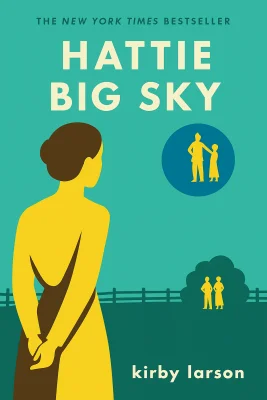
Hattie Big Sky
Categories
Fiction, Audiobook, Historical Fiction, Young Adult, Book Club, Historical, Coming Of Age, Childrens, Middle Grade, Teen
Content Type
Book
Binding
Hardcover
Year
2006
Publisher
Delacorte Books for Young Readers
Language
English
ASIN
0385733135
ISBN
0385733135
ISBN13
9780385733137
File Download
PDF | EPUB
Hattie Big Sky Plot Summary
Introduction
The train whistle pierced the frozen January air as sixteen-year-old Hattie Brooks stepped onto the platform at Wolf Point, Montana, clutching a wicker cat carrier and wearing every stitch of warm clothing she owned. Behind her lay Iowa and the suffocating certainty of Aunt Ivy's disapproval. Ahead stretched 320 acres of prairie that a mysterious uncle had left her—a man she'd never met who called himself a scoundrel yet offered her something no relative ever had: a chance to belong somewhere. The year was 1918, and America was deep in the Great War's grip. On Montana's unforgiving plains, where winter temperatures plunged to sixty below and summer heat could cook a man where he stood, Hattie would discover that proving up a homestead claim demanded more than surviving the elements. She would face wolves and wildfires, hailstorms and influenza, neighbors who became family and others who saw her German friends as enemies. Most challenging of all, she would confront the gap between dreams and reality, between the girl who arrived as Hattie Here-and-There and the woman she might become under that endless Montana sky.
Chapter 1: An Unexpected Inheritance: From Hattie Here-and-There to Homesteader
The letter arrived on a December day when Aunt Ivy was in one of her charitable moods, which meant she had found Hattie another position—this time as a servant in a boardinghouse. But the envelope from Montana changed everything. Inside, Hattie found words that would haunt and inspire her: a claim deed from Chester Wright, the uncle she'd never known, offering her 320 acres of prairie and a fresh start. Chester's letter was brutally honest. He called himself a scoundrel and warned that neither of them had ever known a proper home. But he trusted she had enough of her mother's backbone to meet the challenge. If she could prove up the claim within a year—building, fencing, and cultivating the required acreage—the land would be hers forever. Uncle Holt drove her to the station in his new Ford, his pipe smoke mixing with the winter air. He pressed her shoulder awkwardly before she boarded. "No piecrust promises about writing," he said, though his eyes suggested he understood why she had to go. Aunt Ivy had refused to come, furious that her ward would choose such foolishness over steady employment. The three-day train journey west gave Hattie time to dream and worry in equal measure. A fat man in her car laughed when she mentioned her destination. "Fool farmers think they can make a go of it out here," he bellowed, while a weathered cowboy spat tobacco juice and muttered about "honyockers"—his dismissive term for homesteaders. But when the train lurched and the fat man continued his tirade, Hattie's temper finally snapped. "If I were your daughter," she told him, "I would wait until this train started up again and throw myself in front of it." Wolf Point materialized through swirling snow like a frontier mirage. Perilee Mueller waited at the station with her husband Karl and their children, ready to transport Hattie to her new life. As they loaded her trunk and Mr. Whiskers into their wagon, Hattie caught her first glimpse of the vast prairie stretching endlessly toward tomorrow.
Chapter 2: Learning the Land: First Steps in a Harsh New World
Chester's cabin struck Hattie like a physical blow. Nine feet by twelve feet of tar paper and rough planks, it looked more like a tool shed than a home. Snow had blown through the keyhole, forming an icy line across the floor as if Nature herself was drawing boundaries. But eight-year-old Chase Mueller, wise beyond his years, helped her get the fire lit and the coffee brewing while his father unloaded her supplies. The first week nearly killed her. On her inaugural morning, Hattie stepped outside to pump water and discovered her bare hands had frozen to the metal handle. She would have stood there until spring if Chase hadn't arrived with warm water to free her. He showed her the mitten Perilee always tied to their pump handle and patiently explained a dozen other survival tricks that meant the difference between living and dying on the prairie. Every day brought new humiliations and small victories. Hattie learned to milk the cantankerous cow Violet, whose tail-whipping was an art form of bovine vengeance. She discovered that buffalo chips made excellent fuel once you got past the dignity of it. The chickens Rooster Jim gave her—Martha, Rose, and June, along with Albert the rooster—required elaborate strategies to convince them to set on their eggs rather than breaking them for sport. The isolation pressed against her like the winter cold. At night, she would read by lamplight in Uncle Chester's books, finding solace in stories while the wind howled outside. During the day, she wrote letters to Charlie Hawley, her friend from Iowa who had enlisted to fight in France. His responses came sporadically, full of bravado at first, though she noticed the censor's knife had carved holes in many of his descriptions. By spring, Hattie had survived her first Montana winter. She had learned to distinguish between the howl of wind and the howl of wolves, had mastered the art of keeping fires burning through subzero nights, and had discovered that loneliness could be both crushing and strangely liberating. As the prairie began to green with new growth, she prepared to face the real test: proving up the claim by building fence and planting crops.
Chapter 3: War Shadows on the Prairie: Loyalty, Prejudice, and Community
Spring brought warmth and wildflowers, but also the ugly shadow of war hysteria. Karl Mueller, born in Germany but now Hattie's closest neighbor and trusted friend, found himself required to register as an "alien enemy" at the Vida post office. The shame on Perilee's face as she explained it cut Hattie deeper than any Montana wind. The transformation was swift and vicious. Hanson's grocery store began refusing Perilee's German strudel, even though it had won blue ribbons at the county fair. German textbooks were burned in public bonfires. Reverend Schatz was forbidden to preach in German, leaving his immigrant congregation lost and confused. The County Council of Defense, led by the charismatic rancher Traft Martin, prowled the countryside hunting for signs of disloyalty with the fervor of predators. Hattie watched it all with growing unease. These were her neighbors, her friends. Karl had helped her build fence when her own efforts produced crooked lines that would have embarrassed a drunken spider. Perilee had nursed her through illness and taught her to quilt. Their children had become the siblings Hattie had never known. Yet suddenly, accident of birth made them suspect in their own community. The night she found the barn smoldering behind her house, Hattie knew the hatred had found her doorstep. Someone had left burning hay against the wooden walls—not enough to destroy the building, but sufficient to send a message about associating with the wrong sort of people. When Traft Martin appeared in her yard the next morning, she accused him directly. His response surprised her. "I didn't set the fire at Karl's," he said quietly. "By the time I heard about it, it was too late to stop them. I was able to drag the burning bundle away from your barn before it went too." Hattie glimpsed something wounded in his green eyes, something that spoke of a man trapped by circumstances beyond his control. His mother had maneuvered to keep him from enlisting, appointing him instead to the Council of Defense as his patriotic service. As spring turned to summer and her crops began to grow tall and strong, Hattie learned that war's casualties included more than soldiers. It claimed neighbors' trust, children's innocence, and the simple faith that decent people would act decently when tested. On the Montana prairie, the battle lines were drawn not between nations but between fear and compassion, between those who saw enemies everywhere and those who saw only neighbors in need of grace.
Chapter 4: Seeds of Hope and Heartbreak: The Struggle to Prove Up
Summer arrived with scorching heat that could fry eggs on fence posts. Hattie's wheat grew tall and golden while her flax fields bloomed blue as an inland sea. She had forty acres under cultivation now, thanks to Karl's help with his tractor, and nearly five miles of fence stretched across her claim. The proving-up requirements that had seemed impossible in January now appeared within reach. Then came the visitors she dreaded. Chase and Mattie appeared one day after school, bloody and crying. The Martin boy and his friends had attacked them, stolen Karl's German fairy tale book, and thrown it in the schoolhouse outhouse while calling the family "Hun-lovers." When Hattie confronted the bullies, she sent them running with well-aimed stones, but the damage went deeper than bruises. Chase refused to return to school, declaring he could learn more at home than from classmates who called his stepfather a traitor. The heat continued relentlessly. Day after day, temperatures soared past ninety-five degrees while not a drop of rain fell. Hattie's once-promising crops began to wither, their leaves curling like arthritic hands. She hauled bucket after bucket of precious well water to her kitchen garden, watching her neighbors' faces grow grim as their own fields turned brown under the pitiless sun. Traft Martin began visiting more frequently, always with the same offer: sell him the claim and walk away with enough money to start fresh somewhere else. His proposition was generous—four hundred dollars, enough to buy a house in town—but Hattie refused each time. This land had become more than property to her; it was proof that Hattie Here-and-There could create something permanent, something that belonged to her and her alone. As the weeks passed without rain, grasshoppers appeared on the horizon like a biblical plague. Farmers told stories of swarms so thick they blocked the sun, stripping entire sections to bare earth in minutes. Hattie checked the sky constantly, watching for the dark clouds that could mean either salvation or destruction. She had invested everything in this gamble—money, sweat, heart, and soul. By November, she would either be a landowner or a failure, and the margin between them grew thinner with each blazing day. The arithmetic was unforgiving: forty acres cultivated, 480 rods of fence completed, and thirty-seven dollars and seventy-five cents for the final filing fee. Three requirements that would determine whether she had found her place in the world or remained forever rootless, forever searching for home.
Chapter 5: Nature's Verdict: Facing Hailstorms and Influenza
August brought the harvest Hattie had dreamed of since planting. The wheat stood golden and heavy-headed while the flax fields rippled like blue silk in the summer wind. Karl arrived with his threshing crew, and for three days the prairie rang with the sounds of machinery and men's voices as they cut and bundled the grain into neat shocks to dry. Then the sky turned black as midnight in midafternoon. At first Hattie hoped for rain—her fields were parched despite their recent success—but the darkness carried something far more destructive. Hail began falling, first as pea-sized pellets, then as stones large as oranges. The sound was deafening, like gunfire from heaven. They huddled in the cabin—Hattie, Perilee, the children, Karl, and Wayne Robbins—listening to their dreams being battered to pieces. When the white reaper finally moved on, Hattie's fields looked like a battlefield. The flax was completely destroyed, beaten into the mud. Most of the wheat lay trampled and broken, worth nothing except as animal feed at a fraction of grain prices. Wayne tried to comfort her as they surveyed the wreckage. "You won't be the only one," he said, but his words felt hollow. Hattie did the arithmetic in her head: with feed prices instead of grain prices, she could not possibly earn enough to pay her debts, let alone the final filing fee. The claim that had seemed within reach now lay as broken as her crops. Worse was yet to come. The Spanish influenza arrived in October like a thief in the night. Mrs. Martin died despite her family's wealth. Mr. Ebgard lost his wife. The Nefzgers buried their daughter Leta. Then Hattie arrived at Perilee's cabin to find the family burning with fever. For three days and nights, she battled death for their lives, bathing their scorching bodies with cool water, forcing medicine down unwilling throats, praying over each labored breath. She saved three of them. Little Mattie, the family's chattering magpie with her rag doll Mulie, slipped away despite everything Hattie could do. On her seventeenth birthday, instead of celebrating, Hattie stood beside a small grave on the prairie, watching Karl shovel earth over the wooden coffin he had built for the child who had called him Papa. The influenza had taken many lives that autumn, but this one death shattered something inside Hattie that would never fully heal. As November approached and the proving-up deadline loomed, Hattie faced the bitter mathematics of failure. She owed more than her ruined crops could pay. The dream of owning her own piece of Montana had died along with too many friends, leaving her once again adrift in a world where she had no permanent place to call home.
Chapter 6: Beyond the Claim: Finding Home in One's Heart
November arrived with bitter winds and the finality of dreams deferred. Hattie sat in Mr. Ebgard's office in Wolf Point, watching him shuffle through papers that documented her failure. The filing fee might as well have been a thousand dollars; she could not scrape together thirty-seven seventy-five, let alone pay the debts that threatened to swallow her like prairie quicksand. There was no appeal, no second chance, no mercy in the homestead law. Three years was the limit, and Chester's claim had reached its deadline. By month's end, the county would reclaim the land. Traft Martin could buy it at auction for the cost of back taxes, adding another piece to his expanding ranch empire at a fraction of what he had offered Hattie when she still had choices. The cruelest irony came in the mail that final week. Charlie's letter arrived from France, full of plans for their future together. The war was ending, he wrote, and he was coming to Montana to see what she had been raving about in her letters. He wanted to marry her, to build something permanent together under that big sky she loved so much. But Hattie no longer owned any sky. She was returning to what she had always been: Hattie Here-and-There, the girl without a permanent address, without a place to call her own. Her great experiment in belonging had lasted exactly eleven months and left her deeper in debt than when she arrived. Perilee and Karl were leaving too, selling their farm and moving to Seattle where Karl's cousin had found him work in a machine shop. Too many memories haunted their prairie home—Mattie's laughter in every corner, her small handprints on every surface. They needed to start fresh somewhere that did not echo with loss. On the last night in the cabin, Hattie packed her few belongings into Uncle Chester's trunk. She had arrived with almost nothing and was leaving with even less, but something had changed in those eleven months that she could not quite name. She was still Hattie Here-and-There, still rootless and searching. But she was also the woman who had faced down wolves and bullies, who had delivered a baby and buried a child, who had stood up to hatred and learned that belonging was not always about the ground beneath your feet. The train to Great Falls would depart at dawn, carrying her toward another job as a chambermaid in another rooming house. But as she settled onto the worn seat and faced west toward whatever came next, Hattie carried with her something more valuable than land: the knowledge that she had the strength to try, to fail, and to try again. Under Montana's endless sky, she had learned that home was not just a place you owned, but a courage you carried within yourself wherever the journey might lead.
Summary
Hattie Big Sky is a story of resilience forged in the crucible of an unforgiving land, where a teenage girl's quest for belonging collides with the harsh realities of prairie life and wartime hysteria. Though Hattie loses her homestead claim, she gains something perhaps more precious: the understanding that true home exists not in the deed to property, but in the connections forged through struggle, sacrifice, and shared humanity. The friends who become family, the neighbors who show grace under pressure, the courage discovered in moments of crisis—these form the real inheritance Uncle Chester left her. Montana's vast sky witnesses both triumph and tragedy, teaching Hattie that some victories cannot be measured in acres or dollars. In learning to see Karl and Perilee as family rather than strangers, in standing against hatred with simple human decency, in finding the strength to begin again after devastating loss, she claims something more enduring than land. The girl who boarded a train as Hattie Here-and-There steps off as someone who knows her own worth, carrying within herself an unshakeable home that no drought, hailstorm, or prejudice can destroy. Under that endless prairie sky, she discovers that the deepest belonging comes not from owning a place, but from becoming the kind of person worthy of the love and loyalty of others.
Best Quote
“Hon, when someone's a true friend, there's no need to miss 'em." She patted her chest. "'Cause they're always right here.” ― Kirby Larson, Hattie Big Sky
Review Summary
Strengths: The review highlights the book's engaging storyline that inspires readers to consider homesteading, despite personal limitations. It appreciates the nuanced portrayal of patriotism and the treatment of German-Americans during WWI, adding depth to the narrative. The protagonist, Hattie, is praised for her relatable journey of self-discovery, and the supporting characters, particularly Traft Martin, are noted for their complexity. The setting provides a vivid historical context, enriching the reader's experience. Overall: The review conveys a strong positive sentiment, expressing regret for not reading the book sooner and eagerness to share it with others. The reader finds the novel emotionally engaging, with moments of joy, anger, and reflection, ultimately recommending it for its compelling characters and historical insights.
About Author

Kirby Larson
Larson traces a journey from initial reluctance to an enduring passion for historical fiction, which is vividly reflected in her celebrated books. Her entry into the genre was somewhat accidental, sparked by a desire to explore her great-grandmother's life, which led to the creation of her debut novel, "Hattie Big Sky". This book earned a Newbery Honor and became a "New York Times" bestseller, highlighting Larson's ability to transform personal history into compelling narratives. Her works often emphasize themes of courage and resilience, particularly in the context of historical events, which are depicted through her unique storytelling approach.\n\nHer method involves extensive research to create rich, historically accurate settings that serve as a backdrop for engaging plots and relatable characters. This meticulous approach is evident in her acclaimed "Dogs of World War II" series, which includes "Duke", "Dash", "Liberty", and "Code Word Courage". Meanwhile, Larson collaborates with other writers to broaden her creative scope. She partnered with Mary Nethery to produce narrative nonfiction picture books like "Two Bobbies", and her efforts have resulted in books that are not only informative but also touching and inspiring.\n\nReaders of Larson’s works benefit from her deep commitment to authenticity and her skillful weaving of fact and fiction. Her stories are particularly impactful for young audiences, who gain insights into different historical periods while finding inspiration in the characters' journeys. Larson's ability to engage and educate through her narratives has earned her numerous awards and nominations, underscoring her significant contribution to children's literature. This short bio captures the essence of an author who uses her platform to bridge past and present, fostering a love for history in her readers.
Read moreDownload PDF & EPUB
To save this Black List summary for later, download the free PDF and EPUB. You can print it out, or read offline at your convenience.
Hattie Big Sky
by Kirby Larson
