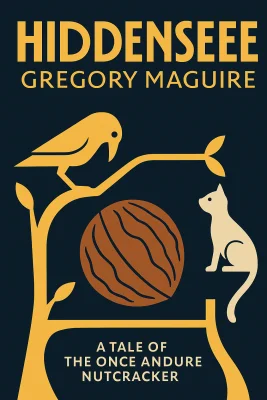
Hiddensee
A Tale of the Once and Future Nutcracker
Categories
Fiction, Audiobook, Historical Fiction, Fantasy, Adult, Book Club, Retellings, Christmas, Fairy Tales, Holiday
Content Type
Book
Binding
Kindle Edition
Year
2017
Publisher
William Morrow
Language
English
ASIN
B01N9ZRNBG
ISBN
006268440X
ISBN13
9780062684400
File Download
PDF | EPUB
Hiddensee Plot Summary
Introduction
In the deep Bavarian forests of 1808, an abandoned boy dies beneath a falling tree, only to find himself in a mystical grove where ancient spirits dwell. This boy, who will come to be known as Dirk Drosselmeier, carries within him a secret burden—he has glimpsed the Little Lost Forest, a sacred woodland severed from its ancient home and wandering the earth for millennia, seeking a place to root once more. What begins as a foundling's desperate flight from his guardians transforms into a lifelong odyssey across Europe and beyond. Drosselmeier becomes a master craftsman of toys, his wooden figures imbued with an otherworldly vitality that children sense instinctively. Yet beneath his carved creations lies a deeper purpose—to find a sanctuary for the displaced spirits of Pan and Pythia, the forest's eternal guardians who appear to him in visions, pleading for release from their endless exile.
Chapter 1: The Boy Who Died in the Forest
Deep in the Bavarian woods, where mist clung to ancient pines like spectral hands, a foundling boy named Dirk lived with two elderly caretakers in a crude waldhütte. The old man was a woodcutter, his beard the color of muddy ice, while the old woman spun tales by firelight—stories of enchanted forests and displaced spirits that seemed to whisper from the shadows beyond their door. The arrangement was fragile as morning frost. Dirk had been found in a basket, they claimed, though their eyes held secrets darker than the surrounding wilderness. The old woman's nervous glances at the boy, the hushed arguments that leaked through the floorboards at night—all pointed to a reckoning approaching like winter wolves. That reckoning came on a grey autumn day when the old man led Dirk deep into the forest, ostensibly to teach him the woodcutter's trade. The axe felt heavy in the boy's small hands as he approached the chosen tree, a young ash with branches that seemed to reach toward him in supplication. At its roots, a mother mouse cowered with her six blind infants, their pink bodies pulsing with new life. The boy's swing went wide, the axe spinning from his grip to bite deep into the old man's leg. As crimson darkened the forest floor, Dirk frantically carved a crutch from the wounded tree. But the ash, dying, spoke its final curse. The massive trunk groaned, twisted, and fell upon the child who had severed it from life. In that instant between breath and silence, between the world of flesh and something far stranger, Dirk Drosselmeier died his first death. Yet death was not his destination. The boy found himself in a grove that existed between heartbeats, where time pooled like honey and ancient spirits paced in endless circles. Here dwelt Pan, the goat-footed trickster with eyes like burning coals, and Pythia, the oracle-priestess whose beauty carried the weight of centuries. They were prisoners of this place, exiles from their sacred home at Delphi, condemned to wander with their severed forest until someone might grant them sanctuary. The boy had died, but in dying, he had gained something precious—the ability to see beyond the veil, to carry their desperate message back to the world of the living.
Chapter 2: Pfarrer's Apprentice and the Awakening Mind
Dirk returned to consciousness in the waldhütte, wrapped in bearskins like a corpse prepared for burial. The old man's leg was bound, his face grey with pain and confusion. The old woman wept over what she believed was their certain discovery—for who would believe the boy had simply awakened from death? But Dirk felt the weight of otherworldly knowledge settling into his bones like winter cold, and when he looked at his guardians, he saw them clearly for the first time: not ancient crones, but frightened peasants who had chosen murder over starvation. Under cover of darkness, he fled. The forest that had once seemed endless now revealed its boundaries, paths opening before his steps as if guided by invisible hands. He carried with him only a crude knife with a carved handle—a grotesque dwarf-figure that seemed to leer with secret knowledge—and the memory of spirits who had trusted him with their ancient burden. His wandering led him to the village of Achberg, where Pfarrer Johannes Albrecht took in the scarred, one-eyed boy without question. The Protestant minister was a gentle soul whose austere chapel stood like a fortress of faith against the surrounding Catholic countryside. For seven years, Dirk swept floors and tended candles, listening to sermons that spoke of salvation while his mind drifted to visions of a forest that walked the earth like a vast, slow creature seeking home. The minister tried to teach him letters and catechism, but Dirk's true education came from the knife-handle that whispered in languages older than Christ. He learned that the Little Lost Forest had been wandering for millennia, torn from its sacred grove at Delphi by an earthquake born of divine rage. Pan and Pythia were its guardians and its prisoners, carrying the spirits of every tree, every stone, every sacred spring that had been severed from the world's first temple. When traveling musicians desecrated the chapel and left a bear to rampage through the sanctuary, Dirk saw the writing on the wall. The world was changing, growing hostile to mystery and magic. The forest needed a new kind of sanctuary, and he—marked by death and vision—was chosen to find it.
Chapter 3: The Persian Rose and Her Forbidden Garden
Years of wandering brought Dirk to Meersburg, a lakeside town where paper-maker Gerwig Pfeiffer had taken a most unusual wife. Nastaran was her name—Persian for "wild rose"—and she moved through the German household like a displaced spirit herself, wrapped in gauze and memory, haunted by dreams of a walled garden in Bandar-e Bushehr where pomegranates hung heavy and walnuts held the keys to childhood's paradise. Dirk was hired to watch over her, for Nastaran walked in her sleep, seeking pathways back to the lost world of her girlhood. She was a woman severed from her roots as surely as the Little Lost Forest was severed from Delphi, and in her midnight wanderings, Dirk recognized a kindred exile. She painted sheets that hung in the attic—some depicting Meersburg with cartographer's precision, others blazing with impossible colors that seemed torn from Persian miniatures. The paper-maker's two young sons, Franz and Moritz, watched their exotic mother with the wariness children reserve for beautiful, dangerous things. Franz, the elder, tried to please her with careful obedience, while dark-eyed Moritz inherited her capacity for seeing beyond the veil of ordinary reality. In the garden, Nastaran hung golden walnuts from barren trees, trying to recreate the paradise she could never reclaim. When Gerwig Pfeiffer fell ill and delayed his return from a business journey, Dirk was pressed into service escorting the boys to visit their uncle. The trip should have taken a single day, but unseasonable snow trapped the party overnight in a farmer's barn. There, by lamplight, Dirk carved his first masterwork—a nutcracker with the face of a stern soldier, designed to crack the golden shells that held the keys to memory. But when he returned to Meersburg the next morning, it was too late. Nastaran had walked into the lake during the night, seeking a passage to her lost garden that existed only in death's dark waters. Her body was pulled from the shallows at dawn, the golden walnut Dirk had given her clutched tight in her lifeless hand—a key to a door that opened only into silence.
Chapter 4: Wanderer of Worlds, Seeker of Home
Grief drove Dirk across the known world like a fever. He wandered east through Austria and the Ottoman lands, seeking in distant bazaars and mountain passes the peace that eluded him in civilized Europe. In Samarkand, he learned to carve jade figurines that captured the essence of motion in stone. In the monasteries of Tibet, he discovered woods that held the whispers of ancient prayers. In the ports of Cathay, he encountered Wu Min, a woman whose perfect recall of family genealogies stretched back twelve generations. She loved him with the intensity of someone who had never met a man who couldn't remember his own childhood, and for a season he allowed himself to imagine a life anchored in her memories. But her gift was also a curse—she could recite every slight, every moment of pain, every disappointment as if they had happened yesterday. Living with her was like dwelling in a palace built entirely of the past, beautiful and terrible and utterly without escape. The Little Lost Forest followed him everywhere, appearing in the corner of his vision like a mirage that dissolved when observed directly. Sometimes Pan would materialize as a beggar on a market corner, his goat-eyes gleaming with mockery and desperation. Sometimes Pythia appeared as a merchant's wife, her oracle's wisdom trapped behind the veil of domesticity. They were fading, he realized—the spirits grew weaker the longer they remained homeless, like cut flowers slowly dying in a crystal vase. In London, he met collectors who filled their mansions with marble gods torn from Mediterranean temples, trying to capture antiquity in glass cases and drawing rooms. They were grave robbers, he understood, stealing the corpses of dead faiths. What the forest needed wasn't preservation but transformation—a new kind of sacred space for a world that no longer believed in sacred spaces. After fifteen years of exile, Dirk returned to Munich empty-handed but seasoned by sorrow. He established a toy shop in a forgotten square, carving wooden figures that children found mysteriously compelling. His toys possessed a quality that made them seem almost alive, as if tiny spirits dwelt within their painted eyes and jointed limbs. Parents called them playthings, but Dirk knew better—he was creating vessels for the displaced magic of a world rapidly losing its capacity for wonder.
Chapter 5: The Toymaker's Sanctuary in Munich
Munich in the middle of the nineteenth century was a city caught between worlds—still provincial enough for mystery, yet growing too sophisticated for outright magic. Drosselmeier's toy shop occupied a narrow building whose windows overlooked a square where vendors sold everything from blessed relics to mechanical automata. Here, in this liminal space between commerce and enchantment, he began his true work. The Nutcracker presided over the shop like a grizzled general surveying his domain. Battered by years of travel and carved from wood that remembered the sacred grove, he had evolved beyond mere tool into something approaching totemic power. His painted uniform had faded to the color of old blood, his wooden jaw worked loose by countless golden walnuts that had yielded their secrets to his mechanical bite. Children were drawn to the shop by forces they couldn't name. They pressed their noses against the mullioned windows, breath fogging the glass as they stared at the armies of carved figures within. Russian boyars in fur-trimmed coats stood beside Turkish janissaries, while Chinese mandarins shared shelf space with Alpine shepherds. Each figure carried within its wooden heart a fragment of the world's displaced spirits—not enough to grant true life, but sufficient to kindle that spark of recognition children possess before the world teaches them to stop believing. One snowy evening, as Drosselmeier was preparing to close shop, the bell above his door chimed with unusual resonance. A man entered, brushing snowflakes from a ginger beard, his walking stick tapping against the threshold with metallic authority. The stick's head was carved in the shape of a crouching dwarf—the very twin of Drosselmeier's old knife handle, transformed into gentleman's accessory. Felix Stahlbaum stood in the doorway like a ghost made flesh, older now but carrying still that musical vitality that had once made the walls of an abandoned chapel ring with beauty. He had married well, he explained—Ethelinda von Koenig, sister to his old university friend Kurt. They had two sons, Sebastian and Günther, who were in desperate need of the kind of toys that possessed more than mere mechanical virtue. The reunion was bittersweet as wine mixed with honey. Felix had abandoned music, claiming his fingers could never match his ear's ambitions, but his eyes still held that searching quality of one who sought the ineffable in the mundane. When he saw the Nutcracker, his face grew still with recognition. Some debts, Drosselmeier realized, could only be paid across generations.
Chapter 6: Felix's Friendship and the Baltic Shore
The Stahlbaum family estate of Meritor perched on the cliffs of Rügen Island like a stone ship anchored against the Baltic winds. Felix had inherited the property from his grandmother—three stories of grey granite that faced the narrow channel separating the main island from mysterious Hiddensee. It was here, in this place where sky met water in an endless dialogue of light and storm, that Drosselmeier found something approaching peace. Felix's sons were golden children who moved through the world with the unconscious grace of those born to privilege. Sebastian possessed his father's musical sensitivity, while Günther carried his mother's aristocratic reserve. They accepted their father's strange friend with the equanimity of children accustomed to adult mysteries, though Otto von Blotto, the family's King Charles spaniel, never ceased regarding Drosselmeier with suspicious hostility. During long Baltic summers, Drosselmeier carved toys on the cliff-top terraces while the boys built castles from driftwood and shells. The proximity to open water seemed to strengthen his connection to the wandering forest—sometimes, during the white nights of midsummer, he could see it clearly in the distance, a dark line on the horizon that pulsed with green life. Pan and Pythia appeared more frequently here, walking the shore at dawn like lovers quarreling over ancient grievances. But even paradise carries the seeds of its own destruction. Felix's heart, weakened by some hereditary flaw, finally surrendered during a Munich winter. Drosselmeier stood beside Ethelinda at the graveside, watching the earth claim the only true friend he had ever known. The music died with Felix, leaving behind only the echoes that haunted Meritor's empty rooms. Ethelinda managed her widowhood with Germanic efficiency, raising her sons to honor their father's memory while building new lives from the ruins of the old. Sebastian eventually married a French girl named Clothilde, producing two children who would carry the family name into an uncertain future. Günther emigrated to America, seeking fortunes in a land that still had room for individual dreams. The wheel of generations turned as it always had, but Drosselmeier felt time's weight more heavily now. He was becoming the last keeper of secrets that would die with him unless he could find a way to pass them on. The Little Lost Forest was growing fainter, its spirits worn thin by centuries of homelessness. Soon, he feared, they would fade entirely, leaving the world diminished by their absence.
Chapter 7: The Nutcracker's Creation and Klara's Fever
Sebastian Stahlbaum's daughter was born under a November sky the color of pewter, her first cry cutting through Munich's early winter silence like a blade through silk. They named her Marie-Claire, though she would be known as Klara—a name that meant "bright" in German, prophetic for a child who would illuminate the shadows between worlds. From her earliest years, Klara possessed that rare quality that made her godfather's toys come alive in her hands. Where other children saw carved wood and painted faces, she perceived personalities and histories, entire worlds waiting to unfold. Her conversations with Mother Ginger and the Ottoman Princess revealed depths of imagination that both delighted and disturbed the adults around her. For Klara lived simultaneously in the mundane world of Munich domesticity and in that parallel realm where toys harbored souls and stories spilled from wooden lips. But the gift came with a price. Klara was born with the same weakened heart that had claimed her grandfather Felix, a flaw that manifested in fevers and vivid dreams where the boundaries between waking and sleeping dissolved entirely. During these episodes, she spoke of armies of mice with seven-headed kings, of battles fought across nursery floors while responsible adults slept in ignorance. Her parents, Sebastian and Clothilde, watched their daughter with the helpless anxiety of those who love something too fragile for this world. The family physician spoke in euphemisms about "excitable hearts" and "overstimulated imaginations," but Drosselmeier recognized the signs. Klara was dying the way she lived—caught between worlds, her spirit too large for her delicate flesh to contain. As Christmas Eve approached in her seventh year, Drosselmeier worked through countless nights preparing what he sensed might be his final gift to the child who had become the center of his twilight world. In his workshop above the toy store, he carved a fairy-tale castle complete with drawbridge and turrets, its miniature chambers populated by clockwork figures that danced to a hidden music box. The key to wind the mechanism was concealed within a golden walnut, hinged and painted to hide its secret purpose. But it was the old Nutcracker that would prove most significant—that battle-scarred veteran of countless campaigns who had stood guard over Drosselmeier's shop for decades. Something in the approaching crisis demanded that the wooden soldier finally fulfill his long-deferred destiny, to serve not as mere ornament but as guardian and guide for a child whose fevered dreams might hold the key to salvation itself.
Chapter 8: Hiddensee: The Island Between Worlds
Christmas Eve in the Stahlbaum household blazed with the fierce joy of those who know such moments cannot last. The tree stood like a green altar in the yellow parlor, its branches heavy with candles and golden ornaments, while presents arranged beneath promised wonder and transformation. Fritz received his armies of tin soldiers with boyish delight, but it was Klara who truly understood the magic thrumming through the air like electricity before a storm. When she lifted the Nutcracker from his hiding place, Drosselmeier saw recognition flicker in her fever-bright eyes. She held the wooden soldier as if he were a real person shrunk by enchantment—which, in a sense, he was. The pink ribbon binding his damaged jaw became a badge of honor rather than infirmity, proof that he had suffered for noble causes and would suffer again if duty demanded. That night, as fever wracked her small body, Klara descended into dreams deeper than any she had experienced before. Her parents found her in the parlor at midnight, surrounded by scattered toys and speaking to invisible presences in a voice both her own and utterly foreign. The glass door of the curio cabinet lay shattered, the golden walnut cracked open to reveal its secret key. In her delirium, she spoke of battles between mice and toys, of the Nutcracker transformed into a prince, of journeys to lands where seasons never changed and stories never ended. Her fevered narrative poured forth like prophecy, describing a realm that existed in the spaces between heartbeats, between sleeping and waking, between the world as it was and the world as it might become. When the crisis passed three days later, Klara was changed. The fever had burned away some essential part of her mortality, leaving her translucent as porcelain and twice as fragile. She spoke less often of the ordinary world and more of that other place she had visited, where the Nutcracker ruled as king over a domain built from crystallized dreams and childhood's last illuminations. Years passed in this twilight existence. Klara grew into a young woman of ethereal beauty who seemed always to be listening to music only she could hear. She wrote stories and poems about her nocturnal journeys, tales that captured something essential about the intersection of wonder and loss. When she finally married, it was to a man who understood that he was sharing her with mysteries he could never fully comprehend. But it was in her final dream, on the last night of a long life dedicated to bridging worlds, that the true resolution came. In her vision, she stood again on the shores of Meritor, holding the Nutcracker like a child might hold a treasured doll. Without hesitation, she placed her sleeping godfather—somehow shrunk to toy size—within the wooden soldier's hollow chest and set him adrift on the Baltic tide. The Nutcracker did not sink but sailed toward the horizon, growing larger and more substantial with each wave until he became an island unto himself—a sanctuary of red coat and white beard that settled between Rügen and Hiddensee like a bridge built of stories themselves. There, in that place where geography surrendered to imagination, the Little Lost Forest finally found its home.
Summary
Drosselmeier's quest reaches its culmination not through his own actions but through the fevered dreams of a dying child whose heart proved large enough to encompass the homeless spirits of an ancient world. Klara Stahlbaum becomes the vessel through which the Little Lost Forest finally achieves its sanctuary—not in any physical location but in that eternal realm where stories live and toys retain the power to transform reality through the force of desperate belief. The tale suggests that salvation often comes from the most unexpected sources—not from heroes or saints but from those who exist at the margins of ordinary existence, marked by death or fever or the simple inability to accept the world's insistence that magic died with childhood. In sacrificing her mortal existence to fever dreams, Klara creates something far more lasting than flesh: a story that bridges the gap between the sacred groves of antiquity and the mechanized world of the modern age, ensuring that wonder survives even as the conditions that originally nurtured it disappear forever. In the end, the wandering forest finds its rest not in soil and stone but in the infinite country of human imagination, where it will bloom eternal in the hearts of children yet to be born.
Best Quote
“You might forget a story, but you can never unhear a story.” ― Gregory Maguire, Hiddensee: A Tale of the Once and Future Nutcracker
Review Summary
Strengths: The book offers a new perspective on the Nutcracker story by focusing on Drosselmeier, the toy maker, which the reviewer found intellectually compelling. Maguire's previous work, such as "Wicked," was praised for its originality and depth. Weaknesses: The reviewer found the book emotionally unsatisfying and lacking in holiday cheer. The narrative failed to provide the desired depth and richness, leaving the Nutcracker character lifeless. The book's length was criticized for being unsuitable for both a fairy tale and a deeper novel, resulting in an unstable middle ground. Overall: The reader was disappointed with the book, finding it neither engaging nor fulfilling. They do not recommend it for those seeking a revitalizing retelling of the Nutcracker.
About Author

Gregory Maguire
Maguire reframes classic tales through a revisionist lens, interrogating the boundaries between fantasy and reality. By transforming well-known children's stories into complex narratives aimed at adults, he creates a space where themes of good and evil, identity, and societal norms can be re-examined. His book "Wicked: The Life and Times of the Wicked Witch of the West" not only explores the nature of villainy but also examines the impact of loss and societal expectations, themes that resonate deeply due to Maguire's own experiences, such as the loss of his mother at birth.\n\nIn his approach, Maguire employs rich storytelling and complex character development to breathe new life into familiar tales. His early works, like "The Lightning Time", show an engagement with young adult literature that gradually evolved into adult fiction with titles like "Confessions of an Ugly Stepsister". While exploring such narratives, his method involves weaving fantastical elements with realistic human experiences, thereby offering readers a unique blend of escapism and introspection. This evolution in his writing mirrors a broader shift in literary culture towards more sophisticated retellings of classic narratives.\n\nReaders gain a profound sense of empathy and insight from Maguire's works, as he connects personal experiences with broader human themes. The transformation of "Wicked" into a Tony Award-winning Broadway musical further underscores the cultural impact of his stories. Maguire’s contributions to literature are not only in his books but also in his advocacy for the importance of reading, evidenced by his role in co-founding Children's Literature New England. This short bio highlights how Maguire's literary endeavors extend beyond mere storytelling to influence contemporary thought and discourse.
Read moreDownload PDF & EPUB
To save this Black List summary for later, download the free PDF and EPUB. You can print it out, or read offline at your convenience.
Hiddensee
by Gregory Maguire
