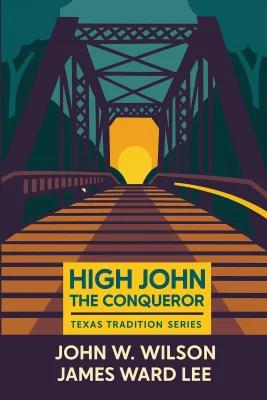
High John the Conqueror (Texas Tradition Series)
Categories
Content Type
Book
Binding
Paperback
Year
1998
Publisher
TCU Press
Language
English
ASIN
0875651860
ISBN
0875651860
ISBN13
9780875651866
File Download
PDF | EPUB
High John the Conqueror (Texas Tradition Series) Plot Summary
Introduction
The white dog's yelp pierced the sultry Texas night as Cleveland's boot found its mark. "I told you not to come at me," he growled into the darkness, his hand instinctively reaching for the long-bladed knife in his pocket. The dog whimpered and retreated under Joe Coby's house, tail between its legs, while Cleveland continued his restless walk down the turnrow road. It was 1940 in the Brazos River bottomlands, where the red earth promised abundance but delivered heartbreak with each flood season. Cleveland Webster had left his father Bully's struggling farm on the Navasota River to work the richer bottomlands for John Chaney, a white landowner whose green pickup truck ruled these fertile fields like a roving kingdom. With his new wife Ruby Lee, Cleveland had found a tenant house and forty acres to work on thirds and fourths—keeping three-fourths of what he raised, giving one-fourth to Chaney. It seemed like a step up from the family farm where the river had drowned their crops year after year. But in these bottomlands, different currents ran beneath the surface, and Cleveland was about to discover that some chains bind tighter than others.
Chapter 1: Red Earth and Divided Loyalties
The morning sun cast long shadows across the cotton field as Cleveland guided his mules, Pete and Blue, between the knee-high rows. The cultivator sweeps turned the red earth in clean furrows, burying the young grass and weeds that threatened his crop. This was work he understood—the weight of the handles in his calloused hands, the rhythm of the team, the satisfaction of leaving straight, clean rows behind him. But even here, in the familiar ritual of farming, trouble followed. "I seen you last night," Buddy Boy Taylor called from across the turnrow, his voice cutting through the morning air. "I seen who it was leave Lometa's house before I got there." Buddy Boy was a shade lighter than Cleveland, taller but leaner, and his words carried the sting of accusation. "I tell you she my woman, Cleveland. You better stay home with your wife." Cleveland felt his shoulders bunch, his head drawing down like a turtle retreating into its shell. "You watch how you talk, Buddy Boy. I come to the field to do my work. When my work done I walk the road to where I please." But even as he spoke, Cleveland knew the accusation held a grain of truth that burned in his chest like swallowed fire. The confrontation might have ended in blood—Cleveland's hand had found his knife, Buddy Boy's fists were already flying—but John Chaney's pickup truck appeared in a cloud of dust, and the white man's shrill voice cut through their anger like a whip crack. "What the hell are you black sons of bitches trying to do?" Within moments, the fight was over, the men separated, and Cleveland stood alone on the turnrow, watching Chaney's truck disappear toward town, wondering why a simple accusation about a woman had nearly cost him everything.
Chapter 2: The Rising Waters of Jealousy
Ruby Lee walked carefully down the turnrow carrying a pitcher of hot coffee, her movements deliberate in the afternoon heat. She wore Cleveland's old hat pushed back on her head, and despite the simple dress and field shoes, there was something about her that made men stop their work and watch. She was twenty, brown-skinned, and shaped like a woman should be shaped—full-breasted, narrow-waisted, with eyes that seemed to hold secrets. "I brought you some coffee," she said, offering the pitcher to Cleveland. "Something hot inside you will keep you from feeling the sun so much." The coffee was rich with cream and sugar, better than anything Cleveland had tasted in weeks. But when Ruby Lee mentioned that John Chaney had brought the cream, stopping by the house while Cleveland was in the field, the pitcher slipped from Cleveland's hands. He watched the coffee splash into the red dirt, each drop a small accusation. "If I got to wait for the man to bring me milk for my coffee, I don't want no milk," he said, his voice flat and dangerous. Ruby Lee's face crumpled, but Cleveland had already turned away, shouting at his mules to move faster down the row. That evening, when Ruby Lee came home late from the store, Cleveland's hand was already moving before she could speak. The slap sent her reeling against the kitchen wall, the dishpan rattling on its nail. "Where you been? Why does the man stop by here?" he demanded, but Ruby Lee's whispered explanations only fed his suspicions. She spoke of errands and helping at Chaney's house in town, but Cleveland heard something else—the careful way she chose her words, the fear in her eyes that seemed deeper than fear of him alone.
Chapter 3: When the White Man Comes Calling
John Chaney's voice carried the authority of a man accustomed to being obeyed. Tall, broad-shouldered, and perpetually red-faced from the Texas sun, he drove his green Studebaker pickup through the bottomlands like a general surveying his territory. The dust from his frequent visits had become as familiar as the morning mist rising from the river. "I may have another place for you in the fall," Chaney told Cleveland, mopping his face with a white handkerchief. "Your crop here is looking good, but it seems to me you'd do better on a different kind of place." Cleveland listened with growing unease as the white man outlined plans that would move him further from his family, deeper into Chaney's web of properties scattered across two counties. But Cleveland had his own plans. "I been wanting to talk to you about getting away from here for a couple days," he said, his words rushing together. "My folks need help with their place." Chaney's response was swift and final: "This ain't the time of year for you to move. I've never had anybody leave me in the middle of the summer." The conversation ended with Chaney driving away in a cloud of dust, leaving Cleveland standing in his cotton field with the bitter taste of powerlessness in his mouth. Around him, the crops he had nurtured with his sweat and skill suddenly felt like prison walls. The mules, the land, even his marriage—everything seemed to belong more to John Chaney than to him. That night, Cleveland sat on his porch smoking cigarettes until dawn, listening to the mockingbirds in the willows and wondering how a man could own so much and still feel like he owned nothing at all.
Chapter 4: A Baby Born of Doubt
The sheriff's voice was almost friendly as he approached Cleveland in the Bon Ton Café, where the Saturday night crowd had gathered to watch the drunk farmer wave his knife and preach salvation to anyone who would listen. "You done raised enough hell in town tonight, Cleveland. Time you come with us." The deputy's forty-five barrel caught Cleveland behind the ear, and the jail cell door clanged shut on another weekend of borrowed freedom. Monday morning brought John Chaney to the jailhouse, his face grim as he counted out five hundred dollars bond money. "You're going to have to raise a lot of cotton for me to pay off that bond," he told Cleveland as they drove back to the bottomlands. But the cotton meant nothing now, not with Ruby Lee gone and the house empty except for the echo of Cleveland's boots on the bare floors. When Cleveland finally tracked Ruby Lee to his family's place on the Navasota, she stood in the doorway of Bully's house wearing one of his mother Daly's dresses, looking small and lost. The lamplight behind her made her seem insubstantial, like a ghost of the woman he had married. "The baby yours, Cleveland," she said, her voice barely above a whisper. "I swear to God the baby yours." Cleveland felt the weight of her words, but heavier still was the weight of his own accusations. He had called her a whore, had struck her, had let his jealousy poison everything between them. Now, standing in the darkness of his childhood home, he saw Ruby Lee clearly for perhaps the first time—not as a prize to be protected from other men, but as a woman trying to survive in a world that gave her few choices. "Hit me now," she said, tears streaming down her face, "but I'm telling you the truth." Cleveland's hand hung at his side, the fight finally gone out of him.
Chapter 5: The Loss of Ancestral Ground
Bully Webster stood by the pasture gap, one foot propped on the rusty fence wire, watching floodwater creep across his cornfield. The Navasota had backed up from the big Brazos again, and what should have been waist-high corn was now a shallow lake dotted with the tops of drowned stalks. Behind him lay the farm that had been in his wife Daly's family since her grandfather received it at the end of slavery—forty acres of bottomland that could grow anything, when it wasn't underwater. "I think it's about to come to a standstill," Bully told his son Cleveland, who had appeared at his elbow like a man drawn by bad news. But they both knew it didn't matter whether the water rose higher or began to fall. The crop was lost, and with it, Bully's last chance to hold onto the land. The Beck mule had died in the winter, leaving them without power to work the fields. The bank had carried Bully as far as it was willing, and now the note payments loomed like storm clouds on a clear horizon. When Cleveland offered to buy his father's remaining mules and bring them back to work the family farm, Bully had to tell him the truth that tasted like ashes in his mouth: "We can't use them mules here. We don't own the place now. Mr. John done bought the place and made the papers on it." The words hit Cleveland like a physical blow. He had walked fifteen miles through the heat to reach home, only to discover that home no longer existed. Even here, on the land where his grandfather had been born free, John Chaney's shadow fell across everything. The white man appeared that very night, his truck lights cutting through the darkness as he came looking for his runaway tenant. Cleveland had reached for Bully's shotgun, but Ruby Lee's desperate grip on his arm held him back from a confrontation that would have ended only one way. "Don't cause no more trouble with the white man," she whispered, and Cleveland let his hand fall away from the gun.
Chapter 6: Confronting High John
The loading of Bully's truck was a funeral procession in reverse—instead of lowering something into the ground, they were lifting their entire life onto Walter Steptoe's flatbed. The bed railings, the cookstove, the chicken coop, the children's few toys—everything that had made the house a home was now stacked like cordwood for the journey to town. John Chaney stood by the yard fence, mopping his red face with a handkerchief and making conversation as if this were a social call. "I wish you would stay on, Bully," he said, his high voice almost pleading. "You're a good hand, and I'd like to keep you here. With a good team you could make a crop." But Bully's answer was as final as the dirt being thrown on a grave: "We done sold you the place, and I reckon we better move." Old Unca Dempse shuffled across the yard to speak with the white man, his cane tapping against the hard-packed earth. "My granddaddy had this place give to him when slavery times was over," he told Chaney, his voice carrying the weight of decades. "We been had this place ever since." The old man's words hung in the morning air like smoke from a dying fire, marking the end of something that could never be rekindled. As the truck pulled away from the house where four generations had lived and died, Little Suster cried for the tomcat she had to leave behind. "Let him go," Bully said gently, "he wild anyhow; that cat wouldn't do no good in town." But they all knew it wasn't really about the cat—it was about leaving pieces of themselves scattered across the bottomland like seeds that would never take root again. Behind them, John Chaney's pickup sat in front of the empty house, waiting to claim what he had always believed was rightfully his.
Chapter 7: Reconciliation in the Cotton Fields
Cleveland walked the dark road back to Book Turner's house, his arms cradling a sack of groceries and his heart carrying a weight heavier than anything his hands had ever held. The summer was ending, the cotton bolls beginning to open in the fields that stretched endlessly under the star-filled sky. Soon there would be picking, and after that, the reckoning of accounts that would determine whether he had earned his freedom or merely deeper debt. Behind him on the road, he heard the soft padding of feet in the dust. Joe Coby's white dog had appeared out of the darkness, no longer the snarling guardian of territory but a creature as displaced as Cleveland himself. The dog's owner had moved away to the Navasota bottomlands, leaving the animal to fend for itself among the cotton rows and creek bottoms. "Hey, dog," Cleveland said softly, and the animal crept forward on its belly, whining with hunger and loneliness. Cleveland reached down to touch the slick head, feeling the dog's desperate gratitude in the way it pressed against his hand. They were both refugees now, both casualties of John Chaney's expanding empire, both trying to find their way in a world that seemed to offer no permanent place for either of them. As they walked together through the darkness, Cleveland thought of Ruby Lee waiting at her father's house, heavy with the child that would tie them forever to this land of red dirt and rising water. He thought of Bully, preparing for his first day at the oil mill in Navasota, trading the independence of farming for the security of wages. And he thought of himself, bound to John Chaney by debts and circumstances and the simple fact that in East Texas in 1940, a black man's choices were as limited as the roads that led out of the bottomlands. But for the first time in months, Cleveland felt something approaching peace. The dog trotted beside him in companionable silence, and overhead, the stars wheeled in their ancient patterns, indifferent to the struggles of men and animals below.
Summary
By the novel's end, the cycles of flood and debt have claimed the Webster family's ancestral land, forcing them from the independence of farming into the dependency of wage labor. Bully takes work at the oil mill, Daly will likely become domestic help, and the children face an uncertain future in town. Cleveland, bound to John Chaney by a web of debt and circumstance, must find his way forward with Ruby Lee and their coming child. The sexual harassment that drove so much of the conflict remains unresolved—Chaney's power intact, the system that enabled his predation unchanged. Yet in the novel's final image, there is a quiet redemption. Cleveland's reconciliation with Joe Coby's abandoned dog mirrors his reconciliation with Ruby Lee and with his own capacity for tenderness. The "High John" of the title—both the root of folk magic that promised protection and the white landowner who seemed all-powerful—has conquered the land but not the human spirit. In a world where the powerful prey upon the powerless and the river claims what it will, small acts of kindness become profound acts of resistance. The dog follows Cleveland home through the darkness, two survivors finding solace in shared displacement, proving that even in the hardest ground, something like hope can take root and grow.
Best Quote
Review Summary
Strengths: The review highlights the book's ability to vividly capture the emotional and social struggles of black cotton farmers in southeast Texas during the Great Depression. It emphasizes the depth of the narrative in portraying complex issues such as racial, financial, and implied sexual tensions, which are depicted with a sense of realism and historical accuracy. Overall: The review conveys a positive sentiment, suggesting that the book effectively resonates with contemporary issues despite its historical setting. It implies a recommendation for readers interested in exploring the enduring themes of racial and economic struggles in rural America.
About Author

John W. Wilson
Wilson interrogates the intersection of corporate ambition and cultural storytelling, as evidenced in his notable work "High John the Conqueror". This book delves into the rich tapestry of Texas folk tradition, exploring themes of regional identity and folklore. Wilson's dual role as an executive at Texas Instruments and an author enriches his literary output, providing a unique vantage point that blends leadership insights with cultural narratives. \n\nHis method involves weaving folklore with contemporary themes, thereby offering readers a nuanced perspective on the interplay between traditional tales and modern societal shifts. Readers interested in the cultural dynamics of the mid-20th century will find Wilson's work particularly enlightening. His literary contributions invite an exploration of how regional stories can resonate on a broader scale, impacting both local and national cultural discourse. Although detailed personal and educational information remains scarce, Wilson's "High John the Conqueror" stands as a testament to his ability to craft compelling narratives that reflect his Texan roots and professional acumen.
Read moreDownload PDF & EPUB
To save this Black List summary for later, download the free PDF and EPUB. You can print it out, or read offline at your convenience.
High John the Conqueror (Texas Tradition Series)
by John W. Wilson
