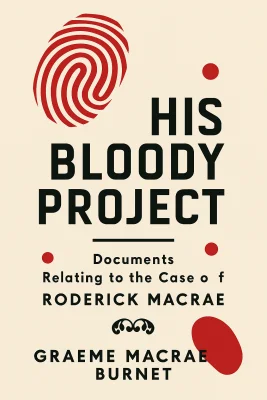
His Bloody Project
Documents Relating to the Case of Roderick Macrae
Categories
Fiction, Mystery, Historical Fiction, Thriller, Book Club, Historical, Scotland, Crime, Literary Fiction, Mystery Thriller
Content Type
Book
Binding
Paperback
Year
2015
Publisher
Contraband
Language
English
ISBN13
9781910192146
File Download
PDF | EPUB
His Bloody Project Plot Summary
Introduction
# The Croman's Edge: A Highland Tale of Justice and Madness In the grey stone cell of Inverness Castle, seventeen-year-old Roderick Macrae sets down his pen and stares at the blood beneath his fingernails. Three days have passed since he walked into his neighbor's house and methodically murdered three people with farming tools. The croman and flaughter lie heavy in his memory—simple implements transformed into instruments of calculated vengeance. Now, at his advocate's request, he writes his confession, not seeking absolution but repaying a kindness with brutal honesty. The year is 1869, and the remote Highland village of Culduie exists in the shadow of ancient feuds and modern injustices. Here, among nine struggling crofting families, systematic persecution has driven an intelligent boy to embrace the terrible mathematics of murder. What emerges from Roderick's memoir is not the ravings of a madman, but the methodical account of a young man who calculated killing as his only path to justice. In this forgotten corner of Scotland, where superstition walks hand-in-hand with scripture, the line between sanity and madness dissolves like morning mist before the sun.
Chapter 1: The Black Macraes: A Family Marked by Tragedy
The curse of the Black Macraes began with death, as Highland curses often do. Una Macrae died screaming in childbirth on a wild April night, leaving behind her husband John, seventeen-year-old Roderick, fifteen-year-old Jetta, and twin infants who would never know their mother's touch. The cottage that had once echoed with laughter now festered in grief and grinding poverty. John Macrae, bent and broken at forty-four, retreated into religious fanaticism and bitter silence. His weekly beatings of Roderick became ritual—the crack of his walking stick against the boy's back a percussion of despair. The man who had once owned a share in a fishing vessel now stammered apologies for imaginary crimes, his spirit crushed beneath the weight of accumulated sorrows. Jetta, once bright and capable, began seeing visions and speaking to spirits, her sanity fraying like the edges of her threadbare shawl. She dressed in perpetual mourning black, assuming the burden of motherhood while sleeping in the back chamber with her father like a replacement wife. The girl who had once danced at village gatherings now moved through their home like a ghost haunting her own life. But it was Roderick who drew the most suspicion from their neighbors. Tall for his age with dark, intelligent eyes beneath a heavy brow, he possessed a mind that devoured books and questioned everything. The village schoolmaster had begged John to let the boy continue his education, calling him the most gifted pupil he had ever taught. John's response was to beat Roderick harder and set him to work on their failing croft. The boy began talking to himself, conducting elaborate conversations with unseen companions as he worked the barren soil. Neighbors would pause in their own labors to watch him gesture and mutter, his lips moving in animated discussion with the empty air. When approached, he would fall silent, his eyes holding secrets that made grown men uncomfortable. In the village of Culduie, where nine families scratched survival from rocky soil, the Black Macraes had become marked for destruction.
Chapter 2: Under the Constable's Shadow: Systematic Persecution Begins
Lachlan Mackenzie—known as Lachlan Broad for his imposing six-foot frame—stood like a Norse god among the Highland crofters, his pale blue eyes and thick yellow hair marking him as different from his darker neighbors. When the position of village constable fell vacant, no one dared oppose him. The single challenger was Murdo Cock, a half-wit who lived on limpets and sowens in a hovel at Aird-Dubh. Broad's election marked the beginning of systematic oppression disguised as civic duty. Armed with a notebook and the factor's authority, he prowled the villages like a predator cataloguing weaknesses. Every regulation became a weapon, every tradition a potential transgression. The gathering of sea-ware—fertilizer that families had collected from the shore since time immemorial—suddenly required written permission that he granted or withheld at whim. The Macrae family found themselves particular targets of his attention. When Roderick accidentally killed one of Broad's sheep while practicing with his slingshot, the constable demanded compensation that would bankrupt the family. Thirty-five shillings—a fortune to the Macraes—to be paid through forced labor that bound Roderick to his tormentor like a medieval serf. The boy worked Broad's schemes with silent hatred, building walls and clearing ditches while the constable's mocking laughter followed him. Then came the land seizure. Broad declared that the Macrae croft was too large for their reduced household and awarded a portion to their neighbor, Duncan Gregor. John Macrae accepted this theft with the broken resignation of a man who had lost everything that mattered. But Roderick felt something darker stirring in his chest—a cold rage that whispered of justice and revenge. The village itself seemed to hold its breath under Broad's regime. The easy camaraderie of communal work disappeared, replaced by rigid hierarchies and fearful efficiency. Men who had once sung while cutting peat now labored in silence, their eyes fixed on the ground lest they be accused of idleness. The constable had succeeded in transforming a community into a collection of isolated, anxious individuals, each too frightened to trust their neighbors. In this atmosphere of fear and suspicion, the Macrae family's destruction became inevitable.
Chapter 3: The Gathering at Applecross: Humiliation and Broken Dreams
The summer Gathering at Applecross should have been a day of celebration, but for Roderick it became a descent into humiliation that would seal his fate. Dressed in his only good clothes, he accompanied his sister Jetta to sell her handiwork at the festival, trying to maintain the pretense of normalcy while their world crumbled around them. At the inn, he encountered Archibald Ross, a young man from his own village who had risen above his station to work for the laird's shooting parties. Ross, resplendent in tweeds and carrying himself like a gentleman, represented everything Roderick might have become with different luck. Their reunion began warmly, with Ross buying rounds of ale and treating Roderick as an equal, but alcohol loosened tongues and revealed dangerous truths. Emboldened by drink and desperation, Roderick confessed his hopeless love for Flora Broad, the constable's fifteen-year-old daughter. Ross, with the casual cruelty of youth, insisted they seek out the girl and force a confrontation. They found Flora walking with a friend in the grounds of the Big House, and Ross engineered a moment of privacy for his companion to declare his feelings. What happened in those woods by the burn would haunt Roderick forever. Desperate and drunk, he grabbed Flora and pressed his lips to her neck, his hands roaming where they had no right to go. She struck him hard across the face and fled, leaving him sprawled in the moss with tears streaming down his cheeks and the taste of rejection bitter on his tongue. The girl who had once brought him cups of milk when he labored on her father's projects now looked at him with disgust and fear. The humiliation was complete when Lachlan Broad found him in the inn later that evening. The constable's massive fists reduced Roderick to a bleeding, broken thing on the tavern floor while the crowd cheered. As consciousness faded, Broad's whispered threat burned itself into his memory: he would have the old man off his croft by year's end. The boy who had dreamed of escape from Culduie's poisoned ground now faced the certainty of exile and disgrace.
Chapter 4: The Eviction Notice: When Hope Dies and Vengeance is Born
The letter arrived on a Monday morning like a death sentence written in elegant script. John Macrae's hands shook as he read the formal language that condemned his family to exile: failure to maintain the croft, appropriation of the laird's property, agitation against the village constable, and debts that exceeded their ability to pay. They had until September 30th to quit the premises forever. The document enumerated their failures with bureaucratic precision, reducing thirty years of backbreaking labor to legal terminology and official seals. Reverend Galbraith came that evening to offer cold comfort, his Presbyterian certainty as sharp as winter wind. The tribulations of this life, he intoned, came as just payment for sin. Prayer was the only remedy he prescribed, as if words could rebuild what Broad's malice had destroyed. When Roderick arrived home to find the minister departing, the boy's dark eyes held a light that made the clergyman hurry his steps. That night, the Macrae cottage became a battlefield of accumulated rage and despair. John's fury, long suppressed beneath layers of pious resignation, finally erupted when he discovered Jetta's condition. His daughter was with child—another shame to heap upon their family's reputation. His accusations flew like blows, and when she refused to name the father, he seized her by the hair and beat her head against the wooden table until blood pooled on the scarred surface. Roderick threw himself at his father, wrestling the older man to the floor with desperate strength. John Macrae collapsed like a punctured bladder, all his fury spent in that moment of violence. The twins wailed in their corner while Jetta fled into the night, her scalp torn and her left eye swollen shut, seeking refuge in the barn where she had once discovered her brother's secret kindness. In that dim space, she sat on the milking stool with a length of rope in her lap, her ruined face serene in the lamplight. She spoke of endings and beginnings, of the mercy that awaited those who chose their own departure from this world. But she also shared a vision that would change everything—she had twice seen Lachlan Broad wrapped in a winding sheet, the traditional shroud of the dead. If providence had already decreed the constable's fate, she whispered, did it matter by whose hand death came calling?
Chapter 5: Blood on the Earthen Floor: The Triple Murder
August 10th, 1869. The morning mist hung low over Culduie as Roderick Macrae walked through the village with murder in his heart and farming tools in his hands. The croman and flaughter felt heavy with purpose, their familiar weight transformed into something terrible and final. He had told Carmina Smoke he was going to break ground behind Broad's house—a lie that came easily to his lips, though his true intention was to break something far more precious. The constable's cottage stood solid and prosperous at the village's heart, its slate roof and whitewashed walls a monument to ill-gotten authority. Little Donnie Broad played in the dirt outside, his three-year-old innocence soon to be extinguished by forces beyond his understanding. Inside, Flora worked at the kitchen table, scrubbing potatoes with the same hands that had struck Roderick's face in the woods at Applecross. When he stepped through the doorway, she looked up with startled recognition. His declaration came without preamble or emotion: he had come to kill her father. She laughed nervously, thinking it a poor jest, but something in his eyes killed her mirth. As she ran for the door, his flaughter caught her legs and sent her crashing to the earthen floor, her knee shattered beyond repair. The blade fell with surgical precision, splitting her skull like an eggshell. Flora's limbs twitched once and were still, her blood seeping into the packed dirt floor. When little Donnie toddled inside and slipped in his sister's brains, Roderick struck him down with casual efficiency—another obstacle removed from his path. The child's death was gentler, more of a tap than a blow, but sufficient to still his cries forever. Roderick arranged the bodies with practical precision, then settled into the shadows to wait for his true target, the man whose persecution had driven him to this moment of calculated vengeance. Lachlan Broad's arrival brought with it the full weight of the man's physical presence—six feet of muscle and bone that had intimidated the village for years. When he finally registered Roderick's presence in the gloom, his charge forward met the point of the flaughter, though his momentum carried them both to the ground in a tangle of limbs and fury. The fight that followed was brief but savage, ending when the croman found its mark and caved in the tyrant's skull, spilling his brains across the floor where his children lay. In that cottage where three lives ended, Roderick Macrae had finally balanced the scales of Highland justice.
Chapter 6: The Trial of Roderick Macrae: Sanity, Madness, and Highland Justice
The trial of Roderick Macrae became the sensation of 1869, drawing crowds to Inverness like pilgrims to a shrine of violence. In the dock sat not the monster they expected, but a pale, quiet boy who seemed disconnected from the proceedings swirling around him. His advocate, Andrew Sinclair, mounted a defense of insanity, calling witnesses to testify to Roderick's strange behavior and alienation from reality. The boy who had once talked to invisible companions and conducted elaborate conversations with empty air surely could not be held responsible for his actions. The prosecution painted a different picture entirely: a calculating killer who had planned his revenge with cold precision. They brought forth Archibald Ross, resplendent in yellow tweeds, who described Roderick's humiliation at the Gathering and his obsession with Flora Broad. The Crown suggested that sexual frustration, not family loyalty, had driven the boy to murder. The horrific injuries inflicted on the girl spoke not of noble vengeance but of base desire followed by desperate concealment. The star witness was James Bruce Thomson, the renowned alienist from Perth Prison, whose testimony should have saved Roderick's life but instead sealed his doom. Thomson argued that the boy's elaborate justifications proved his sanity—a truly insane person would not have fabricated such a noble motive to hide his base desires. The methodical nature of the killings, the careful arrangement of the bodies, the patient waiting for Lachlan Broad's return—all spoke of a mind in full control of its faculties. For three days, the legal minds of Scotland debated the contents of a seventeen-year-old boy's mind. Was he the avenging angel he claimed to be, driven mad by persecution and grief? Or was he a cunning predator who had used his family's suffering as cover for his own twisted desires? The memoir he had written at Sinclair's request became evidence against him, its articulate reasoning proof that madness had not clouded his judgment. The jury deliberated through the night, returning the next morning with faces grave as tombstones. Guilty on all three counts, by a majority of thirteen to two. The black cap descended like a raven's wing, and Lord Ardmillan pronounced the sentence that would send Roderick Macrae to the gallows on September 24th. The boy who had dreamed of education and escape would instead meet his end on the scaffold, another victim of the Highland tragedy that had claimed his mother, his sister, and now himself.
Chapter 7: The Gallows at Inverness: Death of the Last Black Macrae
In his final days, Roderick Macrae became a ghost haunting his own execution. The sensational pamphlets that flooded Scotland transformed him into a national bogeyman, their lurid illustrations bearing no resemblance to the hollow-eyed boy who sat in Inverness gaol. His memoir, meant to explain his actions, was butchered into penny dreadfuls that portrayed him as a ravening beast rather than a broken child seeking justice in a world that offered none. Andrew Sinclair's desperate petition for clemency fell on deaf ears. Lord Moncrieff's response was coldly formal: there being nothing amiss in evidence or trial conduct, the law must take its course. Whatever talents the condemned boy possessed could play no part in considerations of justice. The machinery of execution ground forward with inexorable precision, indifferent to questions of motive or circumstance. On the morning of September 22nd, a letter arrived from Culduie bearing news that completed the family's destruction. John Macrae had been found dead in his chair, his heart finally surrendering to the weight of accumulated sorrows. The twins were scattered to relatives, the cottage abandoned to wind and rain. The Black Macraes were extinct, their name erased from the Highland landscape like morning mist before the sun. Roderick's final request was simple: a walk in the prison yard beneath the open sky. He completed his circuits in silence, his eyes fixed on horizons only he could see. The boy who had once talked to invisible companions now faced his end alone, abandoned by the spirits that had once provided comfort in his isolation. When the time came, his legs failed him at the threshold of the execution chamber, and he had to be dragged to his fate by the warders. The hood descended over his tear-streaked face at twenty-four minutes past eight on September 24th, 1869. Roderick John Macrae, the last of the Black Macraes, paid the ultimate price for his bloody project. In death, he joined the long roll of Highland casualties—another young life crushed beneath the wheels of progress and persecution, his story reduced to cautionary tale and sensational entertainment for a public hungry for tales of violence and madness.
Summary
The story of Roderick Macrae ends not with his death on the gallows, but with the questions that haunted Scotland long after his body was cut down. Was he the calculating killer the Crown portrayed, or the broken boy his defender claimed? The truth, like Highland mist, shifts and changes depending on the observer's position, revealing different landscapes of guilt and innocence, madness and reason. In his final memoir, written in the grey stones of Inverness Castle, Roderick had tried to explain how systematic persecution could drive an intelligent mind to embrace the logic of murder. Perhaps it matters less whether Roderick was sane or mad than what drove him to that cottage on that August morning. The grinding poverty that made dignity impossible, the casual cruelties of those in power, the systematic persecution of his family—these were the real killers in Culduie. Roderick Macrae was both perpetrator and victim, a product of a Highland system that crushed the weak and rewarded the strong. His bloody project was the final, desperate act of a boy who saw no other way to balance the scales of justice. The three lives he took were the price of a reckoning centuries in the making, paid in full on the earthen floor where innocence died alongside its victims.
Best Quote
“One man can no more see into the mind of another than he can see inside a stone...” ― Graeme Macrae Burnet, His Bloody Project: Documents Relating to the Case of Roderick Macrae
Review Summary
Strengths: The review highlights the originality of the book's format, which includes a mix of memoirs, official documents, and trial minutes, creating an authentic and engaging narrative. The historical setting in the Scottish Highlands and the exploration of human suffering and mental soundness are praised. The writing is described as gritty and well-executed, maintaining the reader's interest with an unexpected twist at the end. Overall: The reader expresses a highly positive sentiment, finding the novel intriguing and recommending it enthusiastically. The unique storytelling approach and the depth of character and setting contribute to its appeal, making it a standout Booker Prize contender.
About Author

Graeme Macrae Burnet
Burnet interrogates the complexities of truth and fiction through his inventive narratives, focusing on psychological intricacy and unreliable narrators. His work often merges the psychological thriller and historical crime genres, creating stories that question the nature of reality and memory. This method is evident in his acclaimed book "His Bloody Project", which combines fictional storytelling with a true crime format, delving into a 19th-century triple murder in the Scottish Highlands. This innovative approach not only earned him multiple awards but also captivated a wide international audience, with the novel being translated into over twenty languages.\n\nThe author continues to explore crime-adjacent themes, as demonstrated in "Case Study". This book delves into the reliability of psychiatric evaluations through a narrative structure that blends notebooks and biographical accounts, reflecting Burnet's interest in the limits of narrative truth. His literary style, marked by metafiction and psychological depth, invites readers to engage with stories that challenge conventional narrative forms and explore the ambiguity of human experience. The careful construction of his novels offers an enriching experience for readers interested in complex, genre-blending narratives that probe the depths of subjectivity and truth.\n\nGraeme Macrae Burnet's contribution to contemporary literature is further recognized through various accolades, such as being longlisted for the Booker Prize for "Case Study" and winning the Saltire Society Fiction Book of the Year Award for "His Bloody Project". His approach to storytelling, with its emphasis on the unreliable nature of narratives and the blending of fact and fiction, provides readers with a thought-provoking exploration of the human psyche, making his books a compelling addition to any literary collection.
Read moreDownload PDF & EPUB
To save this Black List summary for later, download the free PDF and EPUB. You can print it out, or read offline at your convenience.
His Bloody Project
by Graeme Macrae Burnet
