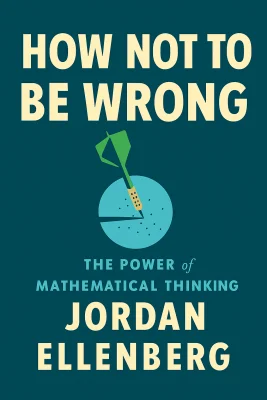
How Not to Be Wrong
The Power of Mathematical Thinking
Categories
Business, Nonfiction, Self Help, Psychology, Philosophy, Science, Education, Audiobook, Personal Development, Mathematics
Content Type
Book
Binding
Hardcover
Year
2014
Publisher
Penguin Press
Language
English
ISBN13
9781594205224
File Download
PDF | EPUB
How Not to Be Wrong Plot Summary
Introduction
# Mathematical Thinking: How Logic Beats Intuition in Everyday Decisions Every day, we make countless decisions based on incomplete information, from choosing which route to take to work to deciding whether a new medical treatment is worth trying. We live in an age drowning in data—statistics about everything from crime rates to climate change, polls predicting election outcomes, and studies claiming to reveal the secrets of health and happiness. Yet most of us lack the mathematical tools to separate genuine insights from statistical nonsense, leaving us vulnerable to manipulation and poor judgment. Mathematical thinking isn't about memorizing formulas or solving complex equations. It's about developing a powerful lens for seeing through the fog of everyday confusion and making better decisions. You'll discover why our intuitive understanding of probability often leads us astray, how simple statistical concepts can protect us from being misled by dubious research claims, and why the same mathematical principles that help scientists make discoveries can also lead them down dead ends. Most importantly, you'll learn to recognize the hidden mathematical structures beneath complex real-world problems, giving you the confidence to question suspicious claims and think more clearly about uncertainty, risk, and the patterns that shape our world.
Chapter 1: Linear Thinking Fails: Understanding Non-Linear Relationships in Real Life
One of the most seductive traps in human reasoning is assuming that relationships between things follow straight lines. If a little exercise is good for you, then more exercise must be better. If cutting taxes by a small amount helps the economy, then slashing them dramatically should create an economic boom. This linear thinking feels natural because it matches our everyday experience with simple cause-and-effect relationships, but it can lead us dramatically astray when dealing with complex systems. The reality is that most important relationships in the world are decidedly non-linear, meaning they don't follow the simple "more input equals more output" pattern. Consider the famous Laffer curve in economics, which describes the relationship between tax rates and government revenue. At a tax rate of zero percent, the government collects no money. At a tax rate of one hundred percent, people stop working entirely, so revenue again drops to zero. Somewhere between these extremes lies an optimal tax rate that maximizes revenue, creating a curved relationship where the best policy depends entirely on your starting point. This principle appears everywhere once you know to look for it. In medicine, the right dose of a drug can save your life, while too little does nothing and too much can kill you. During World War II, mathematician Abraham Wald solved a crucial military problem by recognizing non-linear thinking. When analyzing bullet holes in returning aircraft, officials wanted to add armor where they saw the most damage. Wald realized this was backwards—planes hit in those areas were surviving and making it home, while planes hit in other spots weren't returning at all. The areas without bullet holes were actually the most vulnerable. The failure to recognize non-linear relationships leads to countless mistakes in both personal decisions and public policy. Politicians argue that if some regulation helps, more regulation must be better, or conversely, that if deregulation works in one area, it must work everywhere. Individuals make similar errors, assuming that if moderate saving is wise, extreme frugality must be extremely wise, or that if some social media use keeps them connected, constant scrolling must be even better. Understanding non-linearity requires abandoning the comfortable simplicity of "more is always better" thinking. Instead, we must ask where we currently stand on the curve and which direction leads toward the optimum. This mathematical insight transforms how we approach everything from diet and exercise to business strategy and relationships. The goal isn't to find universal rules that always apply, but to develop the flexibility to recognize when we've reached a point where more of the same will actually make things worse.
Chapter 2: Statistical Significance Deception: What Research Numbers Actually Tell Us
The phrase "statistically significant" appears in countless news headlines and research papers, usually presented as scientific proof that settles all debate. Politicians cite statistically significant studies to support their policies, health websites use them to promote miracle cures, and businesses invoke them to justify their strategies. Yet this mathematical concept is widely misunderstood, even by many researchers who use it daily, leading to a crisis of false discoveries that undermines our ability to distinguish genuine insights from statistical noise. Statistical significance is essentially a measure of surprise. When scientists say a result is statistically significant, they're claiming that if their hypothesis were wrong, they would be very surprised to see data like what they observed. The conventional threshold requires less than a 5% chance that such extreme results could occur by random luck alone. This cutoff point is completely arbitrary—it was chosen by statistician Ronald Fisher nearly a century ago and has persisted through tradition rather than logic. The most dangerous misconception is treating statistical significance as proof of practical importance. A study might find a "statistically significant" effect that is so tiny as to be meaningless in real life. For example, a massive study involving millions of people might discover that a new supplement reduces heart attack risk from 2 in 10,000 to 1.9 in 10,000—a statistically significant but practically trivial difference. Conversely, a smaller study might fail to detect a genuinely important effect simply because it didn't include enough participants to reliably spot the pattern. This confusion has real-world consequences that can be literally life-and-death. In the 1990s, British health authorities warned that certain birth control pills doubled the risk of blood clots, causing widespread panic and leading thousands of women to stop taking the pill. While the relative risk increase was real and statistically significant, the absolute risk was tiny—rising from about 1 in 7,000 to 2 in 7,000. The resulting unplanned pregnancies, with their own health risks, far outnumbered the blood clots that would have been prevented. The problem becomes even worse when researchers engage in what's called "p-hacking"—consciously or unconsciously adjusting their analysis until they achieve statistical significance. They might exclude certain data points as outliers, try different statistical tests, or slice their data in various ways until they find a combination that produces the magic number. This isn't usually deliberate fraud but rather unconscious bias driven by intense pressure to publish positive results. Understanding statistical significance properly means recognizing it as one piece of evidence among many, not as a final verdict on truth. The most reliable knowledge comes from multiple studies that consistently point in the same direction, regardless of whether each individual study crosses the arbitrary significance threshold. When evaluating research claims, focus on the size of the effect, the quality of the study design, and whether the results have been replicated by independent researchers, rather than simply looking for those two magic words in the conclusion.
Chapter 3: Correlation vs Causation: Why Medical Studies Often Mislead
The warning that "correlation does not imply causation" has become so common it's almost a cliche, yet people continue to fall into this trap with remarkable regularity. When two things tend to occur together, our brains naturally assume one causes the other—an instinct that helped our ancestors survive but can mislead us in our complex modern world. This confusion between correlation and causation lies at the heart of many medical controversies and explains why promising treatments often fail when put to rigorous testing. Correlation simply means that two variables tend to move together in some predictable way. When ice cream sales increase, drowning deaths also increase—these phenomena are positively correlated. But ice cream doesn't cause drowning, nor do drownings boost ice cream sales. Both are caused by hot weather, which drives people to buy ice cream and also to spend more time swimming in potentially dangerous conditions. This example illustrates how correlations often arise from hidden common causes rather than direct causal relationships. The confusion becomes more serious in medical research, where correlations are often the best evidence available. Researchers can't randomly assign people to smoke cigarettes for decades to test whether smoking causes cancer—such experiments would be both unethical and impractical. Instead, they must rely on observational studies that reveal correlations between behaviors and health outcomes. The challenge lies in determining whether these correlations reflect genuine causal relationships or simply indicate that people who engage in certain behaviors differ in other important ways. Consider the long-standing correlation between hormone replacement therapy and reduced heart disease in postmenopausal women. For years, doctors observed that women taking hormones had fewer heart attacks, leading to widespread recommendations for hormone therapy. The correlation seemed strong and biologically plausible. However, when researchers finally conducted randomized controlled trials—the gold standard for establishing causation—they discovered that hormone therapy actually increased heart disease risk. The original correlation existed because women who chose hormone therapy were generally healthier, wealthier, and more health-conscious than those who didn't. Even when we're confident about causation, the direction isn't always obvious. The correlation between high levels of HDL cholesterol and reduced heart disease risk led researchers to assume that raising HDL would prevent heart attacks. This seemed logical—if high HDL is associated with healthy hearts, then artificially boosting HDL should provide protection. Yet clinical trials of HDL-raising drugs largely failed to prevent cardiovascular events, suggesting that HDL might be a marker of heart health rather than a direct cause of it. The mathematical reality is that correlation is not transitive. If A correlates with B, and B correlates with C, it doesn't follow that A correlates with C. This principle has profound implications for understanding complex systems like the human body, where multiple factors interact in unpredictable ways. A drug might successfully target a biomarker that correlates with disease yet fail to improve patient outcomes because the web of causation is more intricate than simple correlation suggests. Understanding this distinction helps us maintain appropriate skepticism about promising correlations while recognizing the rigorous evidence needed to establish genuine causal relationships.
Chapter 4: Bayesian Logic: How Smart People Update Beliefs with Evidence
Human beings are natural statisticians, constantly updating beliefs based on new evidence. When we see dark clouds gathering, we increase our estimate of rain probability. When a usually punctual friend is late for dinner, we gradually shift from assuming traffic delays to worrying about more serious problems. This intuitive process of belief revision can be formalized mathematically through Bayesian reasoning, named after 18th-century minister Thomas Bayes, providing a powerful framework for thinking clearly about uncertainty and evidence. Bayesian thinking requires starting with prior beliefs—our initial assessment of how likely different possibilities are before seeing new evidence. These priors matter enormously and often determine how we interpret new information. If you see a news report about a study showing that a common household product causes cancer, your reaction should depend heavily on your prior beliefs about that product's safety. Something with a long history of safe use and no obvious biological mechanism for harm deserves much more skepticism than a newly introduced chemical with unknown long-term effects. The power of Bayesian reasoning becomes clear when considering how it protects us from false alarms. Imagine a terrorist-detection system that correctly identifies 90% of actual terrorists and falsely flags only 1% of innocent people. This sounds impressively accurate, but if terrorism is extremely rare—affecting perhaps 1 in 100,000 people—then most people flagged by the system will actually be innocent. The mathematics is counterintuitive but inescapable: when searching for something very rare, even highly accurate tests produce mostly false positives. This same logic applies to medical screening, criminal investigations, and scientific research. A positive mammogram doesn't mean you probably have breast cancer—it means you need additional testing. A "statistically significant" research finding doesn't prove a hypothesis is true—it suggests the hypothesis deserves further investigation. The rarer the condition being tested or the more implausible the hypothesis being investigated, the more skeptical we should be of positive results, regardless of how impressive the initial evidence appears. Bayesian reasoning also explains why extraordinary claims require extraordinary evidence. If someone claims to have psychic powers, the evidence needed to convince a rational person should be much stronger than evidence needed to establish a new medical treatment. This isn't closed-mindedness but logical consequence of the fact that psychic powers contradict well-established understanding of how the world works, while new medical treatments operate through known biological mechanisms. The key insight is that evidence strength depends not just on what we observe, but on what we believed before seeing the data. This might seem to make reasoning hopelessly subjective, but it actually makes it more honest. We all bring prior beliefs to every situation, and pretending otherwise doesn't eliminate bias—it just makes bias invisible and therefore more dangerous. Bayesian thinking provides a mathematical framework for acknowledging our assumptions while updating them appropriately as new evidence arrives, helping us navigate an uncertain world with greater clarity and consistency.
Chapter 5: Probability Mistakes: When Human Intuition Goes Dangerously Wrong
Our brains evolved to make quick survival decisions in environments very different from the modern world of statistics, probabilities, and complex data analysis. As a result, our intuitive judgments about mathematical relationships are often spectacularly wrong, leading to systematic errors that can have serious consequences in everything from medical decisions to financial planning to evaluating scientific claims. Understanding these predictable mistakes helps us recognize when to trust our instincts and when to rely on mathematical reasoning instead. One of the most pervasive errors is our tendency to see patterns where none exist. Humans are pattern-recognition machines, so good at finding structure that we often detect it in purely random data. This leads to widespread belief in "hot streaks" in sports, even though careful analysis shows that basketball players who have just made several shots are no more likely to make the next shot than usual. We see faces in clouds, hear messages in static, and detect conspiracies in coincidences, all because our brains are wired to find meaning even in meaningless noise. Our probability intuition is particularly unreliable when dealing with sequences of events. Most people think that heads-tails-heads-tails-heads looks more random than heads-heads-heads-heads-heads, even though both sequences are equally likely when flipping a fair coin. This bias toward seeing alternating patterns as more "random" leads to poor decision-making in gambling, investing, and other situations involving chance. It explains why people often try to "balance" their lottery numbers or avoid betting on the same roulette number twice in a row. We also systematically misjudge the likelihood of rare events, with dramatic consequences for risk assessment. Vivid, memorable events like terrorist attacks or plane crashes loom much larger in our minds than mundane risks like heart disease or car accidents, even though the latter are far more likely to affect us personally. This availability bias, amplified by media coverage that focuses on unusual rather than typical events, leads to poor allocation of resources both individually and societally. Perhaps most dangerously, we tend to seek information that confirms existing beliefs while ignoring or dismissing contradictory evidence. This confirmation bias means that people can examine the same data and reach opposite conclusions, each convinced that the evidence supports their position. In an era of abundant information and sophisticated analysis tools, this bias becomes particularly pernicious because it's always possible to find some study or statistic that appears to support almost any viewpoint. The gambler's fallacy represents another common probability mistake, where people believe that past results affect future probabilities in independent events. After seeing several coin flips come up heads, many people expect tails to be "due," not understanding that each flip has exactly the same 50-50 probability regardless of previous results. This error appears in many contexts, from lottery playing to investment decisions, where people mistakenly believe that recent trends must reverse. The solution isn't to distrust all intuition—our gut feelings often contain valuable information that pure mathematical analysis might miss. Instead, we need to recognize situations where intuitive judgments are most likely to be wrong and develop thinking habits that compensate for our biases. This means actively seeking disconfirming evidence, being suspicious of patterns in small samples, and remembering that personal experiences aren't representative of broader reality. Most importantly, it means approaching claims that seem to confirm our existing beliefs with extra skepticism, since these are precisely the situations where our biases are most likely to lead us astray.
Chapter 6: Data Patterns: Distinguishing Real Signals from Random Noise
In our data-rich world, we're constantly bombarded with charts, graphs, and statistics that claim to reveal important trends and relationships. Stock market analysts point to technical patterns that supposedly predict future price movements. Health researchers identify correlations between lifestyle factors and disease outcomes. Social scientists discover relationships between education, income, and life satisfaction. Yet many of these apparent patterns are simply the inevitable result of randomness creating structure in large datasets, leading to false discoveries and misguided decisions. The fundamental challenge lies in understanding how many patterns exist in any sufficiently large collection of data. If you examine stock prices over many years, you'll find periods where certain investment strategies appear to work perfectly. If you analyze sports statistics across multiple seasons, you'll discover streaks and trends that seem to defy chance. If you study health data from thousands of people, you'll uncover correlations between seemingly unrelated factors. The question isn't whether patterns exist—they always do—but whether they represent genuine underlying phenomena or simply random variation creating apparent structure. This problem becomes particularly acute when researchers have the freedom to hunt through data until they find something interesting. Modern datasets often contain hundreds or thousands of variables, creating millions of possible relationships to explore. Even if no genuine effects exist, some correlations will appear statistically significant purely by chance. The studies that get published are often those lucky few that happened to find dramatic results, while investigations that discovered nothing interesting remain hidden in file drawers. The winner's curse compounds this problem by ensuring that published findings systematically overestimate effect sizes. When many researchers test similar hypotheses, the studies that achieve publication are typically those that found the most extreme results. This creates a scientific literature filled with exaggerated claims that often fail to replicate when other researchers attempt the same experiments. The bias isn't usually deliberate fraud but rather the natural consequence of a publication system that rewards dramatic discoveries over careful replication. Small sample sizes make the problem even worse by creating more variable results that can look impressive but aren't reliable. This explains why the states with the highest rates of rare diseases are often just states with small populations, where random fluctuations create dramatic-looking statistics. Similarly, the best-performing schools in many areas are disproportionately small schools, not because small schools are superior but because they're more likely to have extreme results in either direction. Distinguishing genuine signals from random noise requires understanding both the mathematical properties of randomness and the human factors that bias our interpretation of data. Real patterns typically persist across different datasets, remain stable over time, and make sense within broader theoretical frameworks. Random noise, by contrast, tends to be inconsistent, fails to replicate, and often lacks plausible explanations. The most reliable knowledge comes from multiple independent studies that consistently point in the same direction, combined with theoretical understanding of why the relationships might exist. This mathematical approach to pattern recognition doesn't eliminate uncertainty, but it helps us focus on relationships that are most likely to represent genuine features of the world rather than statistical mirages.
Summary
Mathematical thinking reveals that the world is far more complex and counterintuitive than our everyday experience suggests, but this complexity follows discoverable patterns that can guide better decision-making. By understanding concepts like non-linearity, statistical significance, correlation versus causation, Bayesian reasoning, and the distinction between signal and noise, we develop intellectual tools for seeing through misleading statistics, avoiding common logical traps, and making more rational choices when facing uncertainty. The goal isn't to turn every decision into a mathematical calculation, but to recognize when our intuitions are likely to mislead us and when rigorous analysis can provide clearer guidance. This mathematical perspective raises profound questions about how we should evaluate evidence, make decisions under uncertainty, and balance the insights of data analysis against human experience and intuition. How can we maintain appropriate skepticism about dramatic research findings while remaining open to genuine discoveries? What role should mathematical literacy play in education and public discourse? These questions become increasingly important as we navigate a world where data is abundant but wisdom remains scarce, and where the ability to think clearly about numbers, probabilities, and patterns becomes ever more crucial for both personal success and societal progress.
Best Quote
“I think we need more math majors who don't become mathematicians. More math major doctors, more math major high school teachers, more math major CEOs, more math major senators. But we won't get there unless we dump the stereotype that math is only worthwhile for kid geniuses.” ― Jordan Ellenberg, How Not to Be Wrong: The Power of Mathematical Thinking
Review Summary
Strengths: The book is praised for its exceptional prose quality, attributed to the author's dual expertise in writing and mathematics. It offers thoughtful and useful content, particularly valuable for those interested in applied math and statistics. The book effectively reveals the hidden mathematics in everyday life and provides reasonable arguments, such as the critique of voting systems and lottery exploitation. Weaknesses: The book is criticized for lacking direction and frequently delving into complex explanations, which may challenge some readers. It is noted for not maintaining focus on a single subject, which can disrupt the reading experience. Overall: The review conveys a positive sentiment, especially for math enthusiasts and professionals, though it acknowledges the book's complexity and organizational issues. It is recommended for those who appreciate well-written mathematical discourse, despite its occasional flaws.
About Author

Jordan Ellenberg
Ellenberg interrogates the role of mathematics in everyday life, linking abstract concepts to tangible human experiences. As an influential author, his mission is to demystify mathematics for general audiences through engaging narratives. His work, therefore, is not just about numbers but about the stories those numbers tell. In "How Not to Be Wrong: The Hidden Maths of Everyday Life," Ellenberg provides readers with a framework for understanding the unseen mathematical principles that govern their decisions and experiences. Meanwhile, his subsequent book, "Shape: The Hidden Geometry of Information, Biology, Strategy, Democracy, and Everything Else," expands this exploration by illustrating how geometry informs diverse aspects of modern existence. By connecting these themes, Ellenberg enhances public appreciation for the elegance of mathematical thought.\n\nEllenberg's bio reflects his commitment to education and public discourse, illustrating how mathematical reasoning pervades society. Beyond his written works, he actively engages with the public through contributions to major publications and his "Do the Math" column for "Slate". His ability to contextualize complex theories with clarity and wit makes his books not only educational but also accessible to a broad readership. Furthermore, his accolades, including a Guggenheim Fellowship and recognition as a Fellow of the American Mathematical Society, underscore his contributions to both mathematics and literature. Readers benefit from Ellenberg’s unique talent for turning intricate mathematical ideas into relatable stories, fostering a deeper understanding of how these concepts influence various facets of life.
Read moreDownload PDF & EPUB
To save this Black List summary for later, download the free PDF and EPUB. You can print it out, or read offline at your convenience.
How Not to Be Wrong
by Jordan Ellenberg
