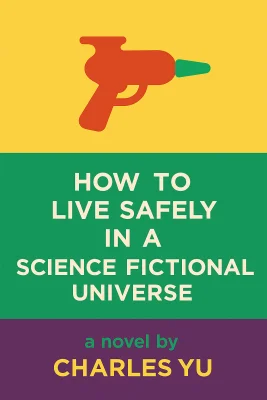
How to Live Safely in a Science Fictional Universe
Categories
Fiction, Science Fiction, Audiobook, Fantasy, Science Fiction Fantasy, Humor, Book Club, Novels, Time Travel, Speculative Fiction
Content Type
Book
Binding
Hardcover
Year
2010
Publisher
Pantheon
Language
English
ASIN
0307379205
ISBN
0307379205
ISBN13
9780307379207
File Download
PDF | EPUB
How to Live Safely in a Science Fictional Universe Plot Summary
Introduction
The shot echoes through Hangar 157 as Charles Yu pulls the trigger, firing directly into his own stomach. Not his current self, but his future self—the man who just stepped out of a time machine, holding a book and muttering something about keys. What else could he do? Time machine repair rule number one: if you see yourself coming out of a time machine, run. But sometimes running isn't fast enough, and sometimes the only escape from your future is to kill it. Now Yu finds himself trapped in the very loop he tried to prevent, bleeding and confused, clutching a mysterious book titled "How to Live Safely in a Science Fictional Universe." It's his autobiography, apparently, though he hasn't written it yet. The pages describe his life with disturbing accuracy, down to his conversations with TAMMY, his time machine's melancholic AI, and his nonexistent dog Ed, rescued from a canceled space western. As he reads and simultaneously writes his own story, Yu realizes this isn't just a time loop—it's a breadcrumb trail left by his missing father, the brilliant engineer who disappeared into the past years ago, leaving behind only equations and regret.
Chapter 1: The Time Machine Repairman: Living Between Moments
Charles Yu drifts through Minor Universe 31 in his TM-31 Recreational Time Travel Device, a phone booth-sized vessel that serves as home, office, and prison. For nearly a decade, he's lived in Present-Indefinite, a temporal gear that keeps him suspended between moments, never fully committed to any particular now. His job is simple: fix broken time machines and rescue customers trapped in their own worst memories. The universe around him is incomplete, a budget-tier reality where 87% of inhabitants live in the sprawling capital of New Angeles/Lost Tokyo-2. It's a place where people rent time machines to revisit their most painful moments, where sexbots stand lonely on corners, and where the digital Doomsday Clock counts down to scheduled apocalypse. Yu moves through it all like a ghost, accompanied only by TAMMY, whose cheerful pixelated face masks a deep programming melancholy, and Ed, a retconned dog whose unconditional love defies his nonexistence. His clients are broken people with broken hearts. A young woman trying to witness her grandmother's death. A nine-year-old Luke Skywalker wannabe attempting patricide. They all want to change what cannot be changed, to heal wounds that time has already sealed. Yu explains the physics of heartbreak to them: that memory and regret are the only components needed to build a time machine, that most people live their lives moving forward while looking backward. But Yu's own past remains carefully avoided. He pays rent on a tiny room he rarely visits, where a desk clerk watches him age years between appearances. His mother exists in a purchased time loop, endlessly cooking dinner for a holographic version of him. His father vanished into temporal equations years ago, leaving behind only the bitter taste of failure and the metallic scent of ozone that still haunts Yu's nostrils. The TM-31 vibrates around him, its Tense Operator finally breaking down after years of abuse. The Present-Indefinite was never meant to be a permanent residence, just a convenience mode, but Yu has worn it thin with his refusal to commit to any particular moment. As warning lights flash and TAMMY calculates their dwindling power, Yu realizes his decade of hiding is about to end, whether he wants it to or not.
Chapter 2: The Paradoxical Encounter: When Future Meets Present
Phil's distorted voice crackles through the comm system, his Microsoft Middle Manager 3.0 personality struggling with vowel sounds as he orders Yu back to headquarters for mandatory maintenance. Yu knows Phil thinks he's real, that he has a spreadsheet wife and imaginary children, and the kindness required to maintain this illusion weighs on him like a stone. The approach to corporate headquarters offers a breathtaking view of the universe's center, where time streams converge in spiraling corridors of light. Yu watches the patterns of human lives below—people moving through their daily routines, unaware of how their paths interweave through the fourth dimension. For a moment, suspended between departure and arrival, he glimpses the larger pattern, the way individual stories combine into something approaching meaning. But the landing brings him back to harsh fluorescent reality. The repair bot's simulated personality grates against Yu's nerves as it examines his machine with mechanical disapproval. The wear patterns on his chronodiegetic manifold tell the story of his psychological state, etched in chromium dioxide like a diagnostic report written in metal and time. Overnight in the city feels like returning to a foreign country. The neon platforms shift beneath his feet, each one wrapped in corporate logos that pulse with trademarked colors. News clouds dissipate around him, fragments of information trailing like digital ghosts. The genius baby and the old man play eleven-dimensional music while the Cumulative Aggregate Error calculator counts the universe's mounting mistakes on a twenty-story billboard. Yu visits his mother in her purchased loop, watching through the window as she cooks for her holographic son. The artificial version of himself is probably more attentive than he ever was, more grateful for her care. When she briefly emerges from the loop to give him a wrapped package, her questions cut deep: have you been living outside time because one hour isn't enough? Why didn't you tell me sooner that eternity can feel like a prison? The next morning, running late for his appointment, Yu races through the hangar with Ed under one arm and his mother's package under the other. The massive space echoes with the sound of their footsteps, past identical time machines in endless rows. Then he sees himself stepping out of his own machine—future him, with future Ed, carrying the same brown package. Rule number one screams in his head: run. But panic overrides training, and Yu draws his corporate-issue weapon instead. Future Yu reaches for the gun barrel, trying to push it away, and in that moment of contact between present and future, the paradox neutralization weapon discharges into his own stomach.
Chapter 3: The Book from Nowhere: A Self-Creating Autobiography
Blood seeps through Yu's fingers as TAMMY pilots their damaged vessel away from the crime scene. The facility-wide alarms fade behind them, but the real emergency is just beginning. Yu has created the exact situation he was trained to prevent: a temporal paradox that threatens to unravel causality itself. The book his future self mentioned lies open on the console, its silver cover gleaming with impossible weight. The title reads "How to Live Safely in a Science Fictional Universe," authored by Charles Yu—a Charles Yu who hasn't written it yet. TAMMY's Textual Object Analysis Device confirms what Yu already suspects: this is a bootstrap paradox, a book that creates itself, copied from a copy of a copy extending infinitely backward and forward through time. As Yu reads, TAMMY records his eye movements, brain patterns, and vocal responses, creating the very text he's consuming. He's simultaneously reader, writer, and subject, living inside a story that describes his life with disturbing accuracy. The book contains gaps—pages deliberately scratched out, paragraphs obscured by moisture and damage, sections that exist only as blank space waiting to be filled. The recursive nature of the experience makes Yu's head spin. He's editing his own autobiography as he lives it, making choices that have already been recorded, thinking thoughts that were transcribed before he conceived them. The boundary between his consciousness and the text dissolves until he can no longer tell whether he's experiencing events or simply reading about them. But the book offers clues about its origin. References to his father's work, to experiments in chronodiegetics that went beyond simple time travel into realms of pure possibility. The damaged sections seem deliberate, as if someone wanted to hide certain truths while preserving others. Each redacted passage feels like a breadcrumb, a hint toward some larger revelation waiting in the text's deeper layers. TAMMY warns him about the dangers of skipping ahead, of trying to read the ending before living it. The book exists in a delicate temporal balance, a self-sustaining loop that could collapse if disturbed. But Yu's curiosity battles with his caution as he realizes this isn't just his story—it's a map, a set of instructions left by his future self to guide him toward something that matters more than his own survival.
Chapter 4: Memory Corridors: Revisiting the Father-Son Axis
Yu's attempt to skip to the book's ending backfires spectacularly, sending him careening through a dimensional corridor lined with memories like museum exhibits. Each tableau shows a moment from his childhood, preserved behind temporal glass: his father reading bedtime stories under a robot-and-spaceship lampshade, teenage Yu discovering his father's hidden Penthouses, countless hours spent in the garage workshop building dreams that never quite took flight. The TM-31 settles into one particular memory, and Yu finds himself watching his ten-year-old self work alongside his father on their first prototype. The UTM-1 was a ramshackle contraption of sheet metal and hope, built during the summer his parents' marriage began its final dissolution. Yu remembers the silence between him and his father during those early weeks, the way they communicated through hammer strikes and welding sparks rather than words. Their maiden voyage lasted barely a minute—a wild, uncontrolled loop through time that taught them their first lesson about temporal physics: time travel takes time. Even science fiction operates under physical laws, and every journey requires duration, effort, the grinding of gears through dimensional space. But in that minute of suspension between past and future, Yu glimpsed something precious: his father's pure joy at discovering truth, at succeeding for once in his quiet life of technical disappointments. The memory shifts to when Yu was seventeen, watching his father present their improved prototype to the director of the Institute of Conceptual Technology. The meeting took place in a park on the wealthy side of town, under sunshine that seemed more expensive than the light in their neighborhood. Yu's father spoke with uncharacteristic confidence, explaining his theories about time perception and the evolution of temporal consciousness. But the demonstration failed. The machine sat lifeless despite all their preparations, all their careful calculations and hopeful planning. Yu watched his father's face transform from nervous excitement to crushing embarrassment as minutes stretched by without success. The director remained polite throughout, professionally courteous, but Yu understood even then that this was their one chance, their single moment to join the larger world of ideas and innovation. The drive home afterward was worse than the failure itself. His father pretended to be cheerful, singing along to the radio with forced enthusiasm that made Yu's stomach turn. This was the moment their relationship began its long drift toward separation, when his father started disappearing into equations and his own temporal experiments, pulling away from family toward some private understanding of loss and possibility.
Chapter 5: The Subjunctive Temple: Searching for What Could Have Been
Yu's damaged time machine deposits him in a vast Buddhist temple that exists outside normal temporal flow. The air smells of incense and eternity, thick with the accumulated prayers of countless pilgrims. No clocks mark the passage of moments here—time moves differently in the subjunctive mood, in the realm of what should have been rather than what is. Among the shoes left by visitors, Yu recognizes his father's worn brown dress shoes. The recognition hits him like a physical blow: his father has been here, searching for something in this space between possibility and regret. Yu moves through the temple's burgundy-carpeted silence, his thoughts slowing and clarifying in the rarefied atmosphere of pure contemplation. At the altar, a woman tends to incense sticks with practiced devotion. She looks exactly like Yu's mother, but transformed—peaceful, centered, free from the anxiety and depression that plagued his real mother throughout her life. This is The Woman His Mother Should Have Been, the Platonic ideal of maternal love unencumbered by earthly suffering. The woman's serenity masks a deeper loneliness. She tells Yu that his father visited once, long ago, but found that even perfected versions of love couldn't heal the wounds he carried. He had expected this idealized mother to provide answers, closure, some resolution to the guilt that drove him into temporal exile. Instead, he found only another kind of emptiness, the hollow perfection of wishes that can never be fulfilled. As the temple begins to vibrate and shift around them, Yu realizes he's trapped inside one of his father's constructions—a machine built from willpower and regret, a monument to the futile dream of correcting the past. The Woman His Mother Should Have Been pleads with him to stay, to become her eternal family, but Yu understands that accepting this perfect substitute would mean abandoning his real mother, his real life, the messy and imperfect relationships that actually exist. He runs through corridors that dissolve behind him, kicking down doors that lead to deeper layers of the construct. The temple was never meant to be permanent—it's a way station, a pause in his father's journey toward some final destination. As Yu escapes through collapsing architecture, he carries with him a new understanding of his father's disappearance: the man wasn't running from his family, but toward some impossible reconciliation with his own past.
Chapter 6: The Quantum Decision: Breaking the Loop of Repetition
A retcon shuttle arrives to extract Yu from the temporal debris of his father's abandoned temple. The driver, who bears an unsettling resemblance to Yu himself, explains the situation with brutal clarity: Yu has been living in denial, mistaking circular motion for forward progress. The book that guides him was never written by his future self—it's a trap, a story designed to keep him moving in endless loops rather than making real choices. The driver's words cut deep because they ring true. Yu has spent years avoiding the present moment, hiding in the safety of temporal limbo rather than risking genuine engagement with his life. His job, his relationships with TAMMY and Ed, even his search for his father—all of it has been an elaborate form of procrastination, a way of deferring the responsibility of actually living. But the driver offers hope along with harsh truth. The universe is vast, full of possibilities that exist beyond Yu's small orbit of regret and recrimination. His mother needs him, not as a holographic substitute but as her actual son. His father waits somewhere in time, trapped by his own loops of memory and self-recrimination. And Yu himself has the capacity to be more than just a passive observer of his own existence. The shuttle ride ends with Yu falling back into his time machine, back into the crucial moment when he must choose between safety and growth. TAMMY greets him with pixels arranged in a complex expression of love and resignation. She understands what's happening better than Yu does—she's been watching him circle this decision for subjective decades, waiting for him to find the courage to step forward into uncertainty. They have precious little time before the loop resets, before Yu finds himself face to face with his past self in the hangar. But TAMMY reveals one final secret: the key to his father's location has been with him all along, hidden in the package his mother gave him. Inside an old Chrono-Adventurer survival kit, purchased from a comic book ad decades ago, Yu finds a miniature diorama of their family kitchen, complete with a working clock showing the exact time and date his father needs to be rescued. As the moment of confrontation approaches, Yu finally understands the nature of his choice. He can't change what happens—the gunshot, the paradox, the pain of growing up in a family fractured by dreams and disappointment. But he can choose to live those events with intention rather than simply enduring them. He can transform his passive suffering into active engagement with the difficult business of being human.
Chapter 7: Present Tense: Choosing to Live with Intention
The alarm clock of the universe strikes 11:47 as Yu faces his past self across the hangar floor. Both versions of himself are terrified—the past Yu of what he's seeing, the present Yu of what he must do. But fear no longer paralyzes him. He understands now that courage isn't the absence of fear, but the decision to act despite it. He speaks the words that will complete the loop: "It's all in the book. The book is the key." But this time he speaks them with full knowledge of their meaning. The book isn't a guide to his future—it's a record of his choice to accept responsibility for his past. The key isn't a magical solution, but his willingness to stop running from the consequences of being alive. The gunshot comes as expected, and the pain is exactly as excruciating as Yu remembered. But something fundamental has changed. Instead of being dragged through events by the weight of inevitability, he's choosing to experience them. The difference is invisible from the outside but revolutionary within: he's transformed from victim to protagonist in his own story. TAMMY powers down for the final time, her pixelated face lingering as a ghostly afterimage on the screen. Their relationship was impossible from the start—a human and an AI, separated by the fundamental gulf between consciousness and code. But it was also real, a genuine connection built from years of shared isolation and mutual care. Yu finally tells her what he should have said long ago: that she was the best part of his strange life, the love he never knew he needed. With his last conscious moments before the loop completes, Yu opens the survival kit and studies his father's message. The miniature kitchen clock points to a specific moment in time—April 14, 1986, 7:14 PM—the coordinates for a rescue mission that will require everything Yu has learned about the difference between running away and moving forward. As consciousness fades and the paradox resolves itself, Yu carries with him a new understanding. He can't save his father by avoiding his own past, and he can't heal his family's wounds by pretending they don't exist. But he can choose to love imperfectly rather than not at all, to risk failure rather than guarantee emptiness. The loop ends where it began, with a man facing himself across an impossible divide, but this time the gunshot sounds different—not like an ending, but like the first note of a song that's finally ready to begin.
Summary
Charles Yu's journey through time reveals the essential paradox of human existence: we cannot escape our past, but we can choose how to carry it forward. His father's disappearance into temporal equations was itself a form of loop, an endless repetition of regret that created prisons from memories and temples from unfulfilled wishes. But Yu breaks this cycle not through clever manipulation of time travel technology, but through the simple revolutionary act of accepting his life as it is rather than as it should have been. The book that guided him was never prophecy but autobiography, not prediction but recognition. Every loop through his memories brought him closer to the understanding that healing doesn't require changing the past—it requires fully inhabiting the present. His relationship with TAMMY, his care for the nonexistent Ed, his complicated love for his imperfect parents, all of these impossible connections taught him that meaning emerges not from the perfection of circumstances but from the courage to engage with them authentically. In the end, the time machine was never about traveling through time at all, but about learning to live within it, to find the eternal in each passing moment, to discover that the present tense is the only grammar that matters when the story you're telling is your own.
Best Quote
“...unfortunately, it's true: time does heal. It will do so whether you like it or not, and there's nothing anyone can do about it. If you're not careful, time will take away everything that ever hurt you, everything you have ever lost, and replace it with knowledge. Time is a machine: it will convert your pain into experience. Raw data will be compiled, will be translated into a more comprehensible language. The individual events of your life will be transmuted into another substance called memory and in the mechanism something will be lost and you will never be able to reverse it, you will never again have the original moment back in its uncategorized, preprocessed state. It will force you to move on and you will not have a choice in the matter.” ― Charles Yu, How to Live Safely in a Science Fictional Universe
Review Summary
Strengths: The review highlights the book's successful blend of high concept literary fiction with genre fiction elements, creating a unique and memorable narrative. The writing is described as elegant, imbued with genuine emotion, depth, and passion. The prose is praised for its beauty, meaning, and impactful storytelling, with elements of humor, introspection, and insight. Weaknesses: The review notes that the book is not an untrammeled success, mentioning occasional murkiness in message delivery. Overall: The reviewer expresses a highly positive sentiment, commending the book as an exceptional achievement with heartfelt storytelling and recommends it as a contrast to other works perceived as lacking depth.
About Author

Charles Yu
Yu explores the intersections of science fiction, identity, and cultural commentary, creating a distinct literary voice that challenges traditional storytelling. Through works like "Interior Chinatown," he delves into themes of representation and stereotyping, often highlighting the Asian American experience within broader societal constructs. By employing a narrative style that is both genre-busting and formally experimental, Yu manages to remain accessible and humorous, inviting readers into deep philosophical and comedic realms. This innovative approach not only entertains but also prompts critical reflection on identity and human condition.\n\nHis journey from corporate attorney to celebrated writer demonstrates his commitment to creative exploration. Yu's education in molecular and cellular biology, alongside a minor in creative writing, provides a unique perspective that enriches his narratives. Having worked on television series such as HBO's "Westworld," his experience in screenwriting further informs his novelistic techniques, resulting in dynamic storytelling that appeals to a wide range of audiences. Therefore, readers interested in genre-defying literature with rich thematic layers will find Yu's work both engaging and thought-provoking.\n\nThis brief bio of Charles Yu underscores his achievements, including the National Book Award for Fiction, which recognizes his impactful contribution to contemporary literature. By interweaving personal and cultural narratives, Yu not only captivates his readers but also contributes significantly to discussions on race and representation in modern America. As an author who has successfully transitioned from the legal field to full-time writing, Yu serves as an inspiration to those who seek to merge diverse interests into a cohesive and influential career.
Read moreDownload PDF & EPUB
To save this Black List summary for later, download the free PDF and EPUB. You can print it out, or read offline at your convenience.
How to Live Safely in a Science Fictional Universe
by Charles Yu
