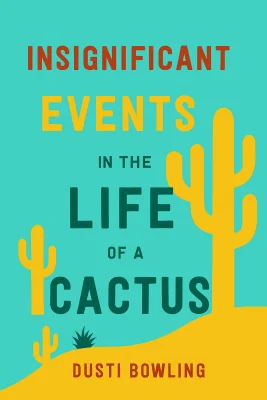
Insignificant Events in the Life of a Cactus
Categories
Fiction, Audiobook, Mystery, Young Adult, Contemporary, Disability, Realistic Fiction, Childrens, Middle Grade, Friendship
Content Type
Book
Binding
Hardcover
Year
2017
Publisher
Sterling Children's Books
Language
English
ISBN13
9781454923459
File Download
PDF | EPUB
Insignificant Events in the Life of a Cactus Plot Summary
Introduction
Thirteen-year-old Aven Green had always known she was different—born without arms, she'd spent her entire life proving she could do anything. But when her parents lose their jobs and uproot her from Kansas to manage a failing Wild West theme park in the Arizona desert, Aven faces her greatest challenge yet. Stagecoach Pass is a crumbling relic of faded dreams, populated by eccentric employees and haunted by mysterious absences. The Cavanaugh family, who owns the park, has vanished without explanation, leaving behind only empty picture frames and locked storage sheds. As Aven navigates a new school where curious stares follow her every move and eating lunch becomes an ordeal of hiding in bathroom stalls, she discovers an unlikely kinship with Connor, a boy whose Tourette's syndrome makes him bark uncontrollably, and Zion, who seeks refuge from cruel comments about his weight. Together, they uncover a decades-old mystery that will force Aven to confront not only the truth about her own origins, but the courage to step out of the shadows and embrace who she's meant to become.
Chapter 1: Uprooted and Replanted: A New Life in the Desert
The rusted wagon wheel sign reading "Stagecoach Pass" emerged from the desert heat like a mirage. Aven pressed her face against the car window, squinting at the brown expanse that would become her new home. No grass. No sidewalks. Just dirt and wooden buildings that looked ready to collapse under the blazing Arizona sun. Her father David had lost his restaurant management job six months ago when the business failed. When Joe Cavanaugh contacted him about managing this western-themed amusement park, it seemed like salvation. What they found was a dying attraction surrounded by urban sprawl, with seventeen empty storefronts and attractions that barely functioned. The apartment above the steakhouse was cramped and humble. From her bedroom window, Aven could see the entire park spread below like a movie set abandoned mid-production. The rodeo arena stood silent, the old stage gathering dust. A few tourists wandered the dirt paths, looking lost among the faded facades. Gary, the park's accountant with his pointy gray mustache, helped them settle in. When Aven's parents asked about meeting the owner, his response was cryptic: "Oh, no one ever meets Joe. Not around here much." The words carried an odd finality, as if Joe Cavanaugh had simply evaporated into the desert air. That first night, as the player piano's tinny melody drifted up from the saloon below, Aven lay awake wondering what force had brought them to this strange place. Outside her window, the desert stretched endlessly under a star-filled sky she'd never seen in Kansas. Tomorrow would bring Desert Ridge Middle School, a thousand students who'd never seen a girl without arms, and the challenge of starting over in a place that felt like the edge of the world.
Chapter 2: Finding Kindred Spirits: The Outsiders' Alliance
Desert Ridge Middle School loomed like a fortress of glass and steel, three times larger than Aven's old school in Kansas. She slipped through the hallways, navigating stares and whispered conversations, until lunch period drove her to hide in a bathroom stall with her peanut butter and jelly sandwich. The humiliation burned, but facing a cafeteria full of watching eyes felt impossible. In the library, she discovered Connor Bradley—a boy whose involuntary barks echoed through the quiet space. When he noticed her missing arms, his response was refreshingly direct: "Whoa! You don't have any arms." No flinching, no awkward pretending not to notice. Just honest curiosity. Connor's Tourette's syndrome made him an exile too. The barks, eye blinks, and shoulder shrugs were beyond his control, drawing mockery from classmates who didn't understand. His parents had divorced over the stress of his condition, his father unable to accept that Connor couldn't simply "stop it." Now Connor lived with his overworked mother in a sparse apartment, spending most of his time alone with video games. Their friendship began with Aven's elaborate stories about her missing arms—circus accidents, alligator wrestling, trapeze disasters that ended with her partner holding severed limbs while blood showered the screaming audience. Connor laughed at each increasingly ridiculous tale, understanding the need for humor in the face of difference. Soon they discovered Zion, a quiet boy who ate lunch alone on the sidewalk behind the office building, hiding from classmates who made cruel comments about his weight. His parents were science fiction enthusiasts who'd named him after a character in The Matrix, but their love couldn't shield him from the daily humiliation of being watched and judged for how much food he consumed. The three outcasts formed an unlikely alliance, sharing meals in secret corners and protecting each other from the casual cruelty of middle school. In their hidden friendship, each found something they'd thought lost forever—acceptance without conditions, laughter without shame, and the radical notion that being different might not be a curse after all.
Chapter 3: Mysterious Absences: Hunting for the Cavanaughs
The mystery began with empty picture frames in the museum. Where photographs of the Cavanaugh family should have hung, only blank spaces remained, their nameplates still reading "The Cavanaughs, Stagecoach Pass, 2004." Even stranger was Joe Cavanaugh's complete absence from his own business—an owner who never visited, never appeared, existed only as a name on legal documents. Henry, the ancient soda shop keeper with advancing dementia, provided cryptic clues between bouts of confusion. He constantly mistook Aven for someone else, calling her by name as if they'd known each other for years. When she insisted she'd never been to Stagecoach Pass before, he'd wave dismissively and say, "You can't fool me, Aven." The breakthrough came when Aven discovered a storage shed behind the buildings, secured with seven "DO NOT ENTER" signs and a broken padlock. Connor's hands proved essential as they pried open the warped wooden doors, revealing decades of accumulated secrets—boxes of documents, old props, and most intriguingly, items that suggested someone with a deep fascination for tarantulas had once lived here. Inside a water-damaged box marked with faded letters "A-V-N," they found sketchbooks filled with drawings of horses, the park, and detailed studies of spiders. An old guitar bore the carved initials "A.B.C." Most mysterious of all was a sketch of a distinctive turquoise necklace that seemed to call to Aven from the yellowed page. Henry's confused ramblings took on new significance when he mentioned that the desert's tarantulas had disappeared in 2004—"They left with her," he said in a rare moment of clarity before his mind clouded over again. The coincidence of dates couldn't be ignored: 2004, the year the Cavanaughs vanished from the photographs, was also the year Aven was born. As they searched through decades of accumulated mysteries, a disturbing possibility began to emerge. What if the Cavanaughs hadn't simply left Stagecoach Pass? What if something had happened to them—something that required their complete erasure from the park's history? The storage shed held more secrets, but finding them would require keys that had been missing for years.
Chapter 4: Uncovering Roots: The Truth of Aven's Heritage
The silver and turquoise necklace emerged from the desert dirt like a message from the past. Aven discovered it on the hill behind Stagecoach Pass, buried where desert winds and monsoon rains had nearly claimed it. When she matched it to the sketch in the old book, the pieces of the mystery began arranging themselves into an impossible pattern. The photograph they found next stopped time. A black and white image of a girl who was unmistakably Aven—same face, same hair, same defiant smile—but this Aven had arms and wore the turquoise necklace. The date stamped on the back read 1973, nearly thirty years before Aven was born. Her parents' carefully controlled reactions told her they'd suspected something like this. They'd tried contacting the adoption agency, but Aven's birth records were sealed, her past deliberately obscured. The photograph in her hands suggested a connection to Stagecoach Pass that went deeper than coincidence or her father's job opportunity. Josephine Oakley, the sharp-tongued waitress who'd worked at the steakhouse for sixty years, held the final pieces of the puzzle. When Aven confronted her with the photographs, the older woman's composed facade crumbled. The truth spilled out in a torrent of long-held grief: the girl in the 1973 photograph was Aven Cavanaugh, Josephine's daughter and Aven's birth mother. Aven Cavanaugh had been a performer—a guitarist, singer, and horse rider who loved being the center of attention. She'd died in a riding accident just weeks after giving birth, leaving behind a daughter with no arms and an aging mother who felt unequipped to raise a special needs child. In her grief and practical fear, Josephine had placed the baby for adoption, then spent thirteen years regretting the decision. The revelation hit like a physical blow. Josephine wasn't just a longtime employee—she was Joe Cavanaugh, the mysterious owner who'd orchestrated their move to Arizona. She'd hired a private investigator to track Aven's progress over the years, and when she learned that David had lost his job and the family faced foreclosure, she'd seen her chance to bring her granddaughter home to the desert where her mother's ashes rested on a hill beneath the stars.
Chapter 5: Stepping into the Light: The Festival of Courage
The Stagecoach Pass Arts Festival bloomed from Aven's vision like desert flowers after rain. She'd convinced her parents to transform the failing theme park, filling empty storefronts with local artisans and food trucks, booking the Flap-Jackeroos—a country-western breakfast entertainment band fallen on hard times—to play on the renovated stage. At Desert Ridge Middle School, Aven had finally found her footing. She'd made the soccer team, where her footwork skills translated into athletic prowess that amazed her teammates. Jessica and the other girls welcomed her not as a curiosity but as a friend, inviting her to team parties and bus ride pranks. The bathroom stall lunches became cafeteria meals shared with Connor and Zion, their table a safe harbor for misfits who'd learned to celebrate their differences. But success brought its own challenges. Connor's Tourette's worsened in crowds, making the festival an impossible dream. When someone filmed him during a rare solo trip to the store, posting the video online with mocking comments, he retreated completely. Their friendship fractured when he accused Aven of denying her own limitations, while she fired back that he was surrendering to self-pity. The festival day arrived with Connor still absent. Aven moved through the crowds in a pink spaghetti-strap dress that would have been unthinkable months earlier, her mother's restored turquoise necklace catching the desert light. Vendors displayed their artwork, families explored the attractions, and the Flap-Jackeroos filled the air with music that carried across the desert. When they called her to the stage, Aven faced her greatest fear. She climbed the stairs carrying her birth mother's guitar, its strings newly replaced, its body polished to a warm glow. The crowd below included her parents, her soccer teammates, curious strangers who'd come because of her blog, and Josephine watching from the back with tears in her eyes. As she began to play "Tumbling Tumbleweeds," her feet finding the strings with practiced grace, something magical happened. The crowd's attention didn't feel invasive or judgmental—it felt like recognition, like light meeting light. And there in the center of the audience, no longer hiding from the world, stood Connor. His tics had quieted in the presence of music, and his smile told her that some fears were worth conquering together.
Chapter 6: The Insignificant Event: Making a Lasting Impact
The fireworks painted the desert sky in brilliant colors as Aven, Connor, and Zion climbed the hill behind Stagecoach Pass. At the summit, beside the ancient saguaro cactus that had witnessed over two centuries of human drama, they watched the city lights spread below like fallen stars. Aven had once thought herself insignificant in the cactus's long existence—a momentary blip in its patient watching. But sitting there with her closest friends, wearing her mother's necklace and still glowing from her performance, she understood something fundamental had shifted. Significance wasn't measured in years or size, but in the light you brought to others' darkness. The changes at Stagecoach Pass reflected her inner transformation. Five new shops had signed lease agreements based on festival contacts, bringing life back to the abandoned storefronts. A splash pad with an Old West theme was planned for the summer heat, complete with water-pumping windmills and shaded picnic areas. The park that had been dying was learning to bloom again under the vision of a thirteen-year-old girl who refused to accept limitations. Connor's journey paralleled her own. His mother had started attending the Tourette's support group meetings, learning to see her son's condition as something they could manage together rather than a burden that divided them. Music therapy was helping him find moments of peace, and he'd even started learning guitar from Aven. His willingness to attend the festival, surrounded by hundreds of strangers, proved that courage could grow from the smallest seeds. Josephine had moved to the Golden Sunset Retirement Community, but not before deeding Stagecoach Pass to Aven for her eighteenth birthday. The gift came with no strings attached—Aven could sell the valuable desert land or continue building her vision. She chose the harder path, the one that honored both her mother's memory and her own dreams of creating something lasting from the ruins of abandonment.
Summary
In the end, Aven Green's story becomes a testament to the radical power of refusing to hide. From the bathroom stalls of Desert Ridge Middle School to the spotlights of her own festival stage, she learned that difference isn't disability—it's possibility wearing an unexpected form. Her friendship with Connor and Zion proved that outcasts who find each other can create their own gravity, drawing others into orbits of acceptance and understanding. The desert had taught her its most essential lesson: what appears barren often holds the deepest reserves of life, waiting for the right conditions to flourish spectacularly. Stagecoach Pass, like Aven herself, had seemed insignificant—a failing business in the middle of nowhere, a girl without arms in a world designed for the fully limbed. But significance isn't about fitting in; it's about shining so brightly that others find the courage to step into their own light. As the ancient saguaro had stood witness to history while reaching its seven arms toward heaven, Aven had learned to embrace her unique place in the vast desert of human experience, no longer insignificant but essential, no longer hiding but illuminating the path for others who dared to bloom where they were planted.
Best Quote
“I think Connor would be the last person to label you like that. You shouldn't get so offended if someone calls you disabled, Aven. You DO have extra challenges that others don't have. It DOES take you longer to do most tasks. Your movements ARE limited. There's a big difference between saying you're disabled and saying you're incapable.” ― Dusti Bowling, Insignificant Events in the Life of a Cactus
Review Summary
Strengths: The book is praised for its funny and lighthearted tone, inspiring story, and relatable characters. The protagonist, Aven, is admired for her courage and understanding of people's curiosity. The setting in Desert City, Arizona, is vividly described, enhancing the reader's immersion. The book is considered eye-opening and enjoyable for young readers. Weaknesses: The reviewer notes that Aven's voice seems younger than a typical teenager, and the reliance on her feet is not entirely convincing. The dialogue and thought processes of the characters are deemed more suitable for younger children. Overall: The review is positive, highlighting the book as an inspiring and informative read for middle-grade audiences. It is recommended for its engaging narrative and valuable life lessons, despite some concerns about character portrayal.
About Author

Dusti Bowling
Bowling reframes the landscape of middle-grade literature by weaving authentic Arizona settings with narratives tackling complex themes such as trauma and bullying. Her novels, like "Insignificant Events in the Life of a Cactus", not only serve as compelling stories for children but also as entry points into understanding challenging life issues. Bowling's focus on middle-grade readers stems from her background in psychology and education, allowing her to address difficult themes in an accessible manner while maintaining emotional depth.\n\nHer writing method combines realism with engaging storytelling, creating books that resonate with young audiences facing serious issues. For example, "Across the Desert" and "24 Hours in Nowhere" explore resilience and friendship amid adversity, encouraging readers to connect with the characters' journeys. This method of blending educational themes with storytelling ensures that her works are both entertaining and enlightening, making them valuable tools for young readers navigating their own experiences.\n\nReaders benefit from Bowling’s literature through its ability to foster empathy and understanding. Her books have not only gained critical acclaim, winning awards such as the Reading the West Award, but also have been recognized as best books of the year by institutions like the Chicago Public Library and Kirkus. This recognition underscores the impact her works have on children, educators, and parents alike, offering them stories that both reflect and challenge their perceptions of the world. As a contemporary author, Bowling continues to enrich the literary landscape with her impactful narratives.
Read moreDownload PDF & EPUB
To save this Black List summary for later, download the free PDF and EPUB. You can print it out, or read offline at your convenience.
Insignificant Events in the Life of a Cactus
by Dusti Bowling
