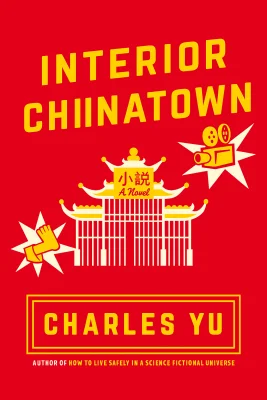
Interior Chinatown
Categories
Fiction, Audiobook, Adult, Humor, Book Club, Contemporary, Novels, Race, Asian Literature, Literary Fiction
Content Type
Book
Binding
Hardcover
Year
2020
Publisher
Pantheon
Language
English
File Download
PDF | EPUB
Interior Chinatown Plot Summary
Introduction
Willis Wu stands in the dim light of the Golden Palace restaurant, wearing the uniform of invisibility: white shirt, black pants, and the perpetual role of Generic Asian Man. In this world where reality blends with television drama, he exists in the background of someone else's story, forever trapped in the margins of Black and White—a cop show where he can only dream of speaking lines that matter. But when a murder investigation pulls him from the shadows into the spotlight as Special Guest Star, Willis discovers that climbing the ladder from background extra to Kung Fu Guy might not be the escape he always imagined. Instead, it's another kind of prison, another script written by hands that never intended to see him as fully human. This is the story of a man caught between worlds—too foreign for America, too American for his heritage, forever performing identity in a country that sees him only through the lens of stereotype. As Willis navigates the labyrinth of roles available to someone who looks like him, he must confront a devastating truth: the very dream of assimilation might be the trap itself.
Chapter 1: Generic Asian Man: The Background Player
Willis Wu has perfected the art of being nobody. Day after day, he stands in the cramped kitchen of Golden Palace, watching steam rise from vats of oil while the real story unfolds in the dining room beyond the swinging doors. The restaurant exists in perpetual twilight, bathed in the sickly red glow of paper lanterns and the constant hum of fluorescent lights that never quite illuminate anything properly. He shares this shadowland with others like him—men whose faces blend together in the eyes of casting directors, whose names matter less than their ability to look appropriately foreign while delivering takeout or falling victim to elaborate crimes. They're a hierarchy of interchangeable parts: Background Oriental Male at the bottom, rising through Generic Asian Man Number Three, Two, One, with the impossible dream of Kung Fu Guy floating somewhere above like a distant star. The world beyond their kitchen belongs to Black and White, the titular detectives whose perfect faces grace billboards throughout the city. Detective Sarah Green moves through crime scenes with the confidence of someone born to be photographed, her hair catching light that seems to follow her like a personal spotlight. Her partner Miles Turner carries himself with the easy swagger of a man who has never questioned his right to be the hero of his own story. Between takes, Willis practices moves his father once taught him, shadow-boxing against the walk-in freezer while other Generic Asian Men place bets on who might catch a break, who might graduate from nonspeaking background player to a role with actual dialogue. But those moments are rare as solar eclipses, and just as likely to leave you blinded if you stare too long. The restaurant serves as both workplace and prison, a theatrical set designed to contain an entire population within its red walls. Here, Willis's mother Dorothy plays Pretty Asian Hostess, enduring grabbing hands and whispered propositions from customers who see her as decoration rather than person. His father Ming-Chen Wu, once known as the formidable Sifu, has aged into Old Asian Man, his legendary martial arts skills reduced to frying wontons in oil that spits and burns like his forgotten dreams. This is the world Willis knows—predictable in its limitations, comfortable in its despair. But when Detective Green's voice cuts through the kitchen noise, calling for witnesses to a murder, something shifts. The spotlight that has never found his face begins to move in his direction, carrying with it possibilities he's afraid to name.
Chapter 2: Climbing the Ladder: The Dream of Kung Fu Guy
The dead body changes everything. Willis finds himself pulled from the background into focus, suddenly visible to Black and White as they investigate the murder of another Asian man whose name nobody bothered to remember. For the first time in his career, someone hands him lines that matter—not just grunts of acknowledgment or broken English peppered with fake accent, but actual words that advance the plot. Detective Green sees something in him, a quality that transcends his assigned role as Local Oriental Guide. When she looks at him, Willis feels the intoxicating rush of being seen as an individual rather than a type. Detective Turner remains skeptical, his jaw clenching with movie-star precision as he questions whether this Generic Asian Man can be trusted with real police work. But Willis knows the streets of Chinatown in ways the detectives never could. He guides them through gambling dens thick with cigarette smoke and populated by men whose day jobs involve playing stereotypes but whose off-camera lives contain multitudes. These are his neighbors and rivals, fellow practitioners of kung fu who share his dream of someday being more than background noise. The investigation leads them to Young Fong, whose transformation from grieving son to crime boss happens as easily as changing costumes. In the smoky back room of an illegal casino, Willis watches his childhood friend slip into the role of Menacing Asian Criminal with the practiced ease of someone who has learned that survival means embracing whatever part pays the bills. Here Willis meets Detective Karen Lee, whose very existence challenges everything he thought he understood about the available roles. She's Asian like him, but somehow she occupies space differently—not quite leading lady, not quite supporting player, but something indefinable that makes his pulse quicken. Karen sees through his performance to something authentic underneath, and for moments between takes, Willis allows himself to imagine a life beyond the narrow confines of his assigned category. The case grows more complex as they uncover connections between the victim and Older Brother, the legendary figure who once represented everything Willis aspired to become. Older Brother had achieved the impossible—graduating from Generic Asian Man to actual Kung Fu Guy—only to mysteriously disappear at the height of his success. His absence haunts the investigation like a cautionary tale about the price of dreams fulfilled. Willis's kung fu skills prove useful in ways the script never anticipated. When violence erupts in the casino, his body moves with precision that surprises even him, flowing through techniques his father taught him during those long-ago lessons when Sifu still remembered how to be a teacher rather than just another Old Asian Man. The detectives take notice, and Willis feels himself rising through the invisible hierarchy that governs his world.
Chapter 3: Ethnic Recurring: Finding Love Beyond Stereotypes
Success tastes different than Willis imagined. As his role expands from Generic Asian Man to Ethnic Recurring, he finds himself with actual dialogue, meaningful screen time, and the unprecedented luxury of character development. The envelope containing his pay grows thicker, and for the first time in his adult life, Willis can afford to dream beyond mere survival. His relationship with Karen Lee deepens beyond the professional. She shows him corners of the city where the scripted reality of Chinatown gives way to something more authentic—places where Asian Americans exist as full human beings rather than cultural shorthand. Karen's own identity defies easy categorization; mixed-race and strategically ambiguous, she can pass for Brazilian, Mediterranean, or just an exotic-looking white woman, depending on what the scene requires. Together they navigate the strange geography of their world, where different shows and storylines create distinct neighborhoods with their own rules and possibilities. In the children's programming district where Karen sometimes works, everything is brighter, more optimistic, sanitized of the violence and desperation that defines Willis's usual territory. Here, being Asian carries different connotations—educational, multicultural, safely diverse. But even as his career ascends, Willis cannot escape the fundamental limitations of his position. During filming, he must speak with an accent he doesn't naturally possess, breaking his grammar and flattening his personality into recognizable shapes. When Black and White discuss him, they refer to him simply as "the Asian Guy," reducing his entire existence to those two words that both define and constrain him. Detective Turner's hostility reveals deeper truths about the system they all serve. He recognizes Willis as a fellow performer trapped in racial typecasting, but resents him for playing along with a game that diminishes them both. Their confrontations crackle with the tension of men who should be allies but have been programmed to see each other as competition for limited roles in someone else's narrative. The investigation reaches its climax in a warehouse shootout that showcases Willis's martial arts abilities. Moving with newfound confidence born from Karen's belief in him, he flows through combat sequences with grace that approaches artistry. For brief moments, he transcends the limitations of his role, becoming something approaching a genuine action hero. But even triumph carries the seeds of tragedy. As Willis lies bleeding from a gunshot wound, he realizes that his moment of glory has been scripted from the beginning. Asian men in his world are expendable by design—their deaths providing motivation for the real heroes, their sacrifices footnotes in other people's stories. Detective Green's parting words of respect ring hollow as Willis understands that he has been nothing more than a very special guest star in someone else's show. The mandatory forty-five-day cooling-off period that follows his character's death becomes a meditation on mortality and meaning. In the purgatory of unemployment, Willis encounters others like him—bit players and background extras waiting for their next opportunity to be briefly visible before fading back into obscurity. Here he reconnects with the simple truth Karen tried to show him: that love might be more important than career advancement, that building a family could matter more than climbing a ladder that leads nowhere he actually wants to go.
Chapter 4: Kung Fu Dad: Family vs. Fame
When Willis returns from death, he finds the world changed beyond recognition. Karen has moved on to starring in her own show—a children's program called "Xie Xie Mei Mei" where their daughter Phoebe exists in a candy-colored universe of educational songs and positive messages. The stark contrast between this wholesome environment and the noir shadows of Willis's cop show feels like traveling between different planets. Phoebe herself has become a stranger to him, a bright and curious child who speaks multiple languages and builds elaborate fantasy worlds from cardboard and imagination. She treats Willis's long absence with the matter-of-fact resilience of children, accepting his explanation that "Daddy was busy working" without judgment but also without the hero worship he might have expected. Instead, she seems more interested in showing him her castle-building techniques and explaining the complex mythology of her stuffed animal kingdom. The reunion forces Willis to confront the price of his ambitions. While he was chasing the dream of becoming Kung Fu Guy, his family has learned to function without him. Karen has built a career that provides stability and meaning, creating content that teaches children about cultural identity without reducing it to stereotypes. Phoebe has grown into a person rather than remaining frozen in his memory as the baby he left behind. But even as Willis grapples with his failures as a father, opportunity knocks again. The director offers him the role he has spent his entire life pursuing—the chance to finally become Kung Fu Guy. The promotion comes with better pay, prestigious billing, and the respect of his peers who still dream of such elevation. It represents everything his younger self believed would solve all his problems. The irony cuts deep as Willis realizes that achieving his ultimate goal might cost him the only things that actually matter. Karen's show is set in the suburbs, far from the urban decay of his cop show's setting. Maintaining his marriage would require abandoning the career breakthrough he has sacrificed everything to achieve. The choice becomes a mirror reflecting back all his deepest fears about masculinity, success, and what it means to be a provider in a world that has never valued his contributions. Willis chooses his career, telling himself that becoming Kung Fu Guy will ultimately benefit his family. He convinces Karen to take Phoebe and accept the starring role while he stays behind to claim his destiny. The separation is meant to be temporary—just a few months until he establishes himself in his new position. But months stretch into years as Willis discovers that even the pinnacle of his professional hierarchy is still just another cage. As Kung Fu Guy, he performs the same tired choreography of exotic violence, delivering ancient wisdom in fortune cookie fragments while gongs sound at dramatically appropriate moments. The role that seemed like liberation reveals itself as simply a more elaborate form of the same stereotyping that has defined his entire career. He has become a more expensive version of Generic Asian Man, polished and professionally presented but no more human in the eyes of those who employ him. The realization drives Willis to desperate action. Stealing Detective Turner's police car, he breaks free from the suffocating confines of his television show and drives toward the distant suburbs where his family has learned to live without him. The journey becomes both literal escape and metaphorical awakening as Willis finally understands what his mother meant all those years ago when she told him to "be more" than Kung Fu Guy.
Chapter 5: The Trial: Confronting the Missing Asian
Willis's rebellion lands him in a courtroom that operates by the surreal logic of dreams, where reality bends to accommodate the needs of narrative rather than law. Charged with his own disappearance in "The Case of the Missing Asian," he finds himself both victim and defendant in a trial that serves as metaphor for centuries of Asian American experience with justice. His lawyer is Older Brother, returned from Harvard Law School with the same charismatic confidence that once made him the neighborhood's golden child. Now channeling his gifts into legal argumentation rather than martial arts, Older Brother presents a defense that transcends Willis's individual case to examine the entire system that created their shared predicament. The prosecution, led by the impossibly glamorous assistant DA, relies on testimony from Detectives Green and Turner. Their words reveal the casual dehumanization that Willis has endured throughout his career—the way he has been reduced to "Asian Guy" even by those who claim to respect him. Turner's testimony cuts particularly deep, challenging Willis to examine his own internalized racism and complicity in a system that pits minorities against each other. But Older Brother's defense strategy operates on a higher level, reaching back through centuries of American legal precedent to expose the roots of Asian exclusion. He cites People v. Hall, the 1854 California Supreme Court case that denied Chinese people the right to testify against whites based on the bizarre logic that Christopher Columbus's navigational errors had somehow categorized all Asians as "Indians" for legal purposes. The courtroom becomes a forum for examining questions that extend far beyond Willis's individual guilt or innocence. Why are Asian Americans still treated as perpetual foreigners after two hundred years in America? What does it mean to be invisible in a country built on the promise of equal representation? How do systems of oppression function when they operate through seemingly benign mechanisms like casting directors and television writers rather than explicitly racist laws? Willis's own testimony becomes a moment of recognition and reckoning. Speaking directly to the assembled crowd of Generic Asian Men who have filled the gallery, he acknowledges his complicity in a system that diminished them all. He admits to the crime of accepting roles that reduced him to stereotype, of allowing himself to be used as a weapon against other minorities, of internalizing the belief that he deserved less than full humanity. But his confession transforms into something more powerful—a rejection of the entire framework that created his predicament. Willis declares his refusal to continue playing the game, to accept roles that exist only to make others comfortable with their own prejudices. His words ignite something in the courtroom audience, a recognition that their individual struggles are part of a larger pattern of exclusion and erasure. The trial erupts into chaos as Willis and Older Brother fight their way out of the courthouse, using the very kung fu skills that have been used to stereotype them as weapons of liberation. The action sequence becomes both literal and symbolic, a moment of cathartic violence against systems of oppression that cannot be defeated through legal arguments alone.
Chapter 6: Breaking the Script: Escaping Interior Chinatown
The aftermath of Willis's courtroom rebellion leaves him dead again, but this death feels different—more like a transformation than an ending. As he lies bleeding on the restaurant floor where his journey began, surrounded by the familiar props and sets of his television existence, something fundamental shifts in the fabric of his reality. The artificial boundaries that have contained his life begin to dissolve. The walls between different shows and storylines prove more porous than anyone imagined, creating possibilities for movement and change that were previously unthinkable. Willis finds himself able to step outside the narrow confines of Chinatown into spaces that exist beyond the realm of scripted entertainment. His father Ming-Chen Wu emerges from the shadows of his Old Asian Man role to reveal depths of character that were always present but never acknowledged. In quiet moments between takes, Willis glimpses the man his father once was—the young student who came to America with dreams of his own, the husband who fell in love with Dorothy in a restaurant kitchen, the martial arts master whose skills transcended the crude stereotypes that eventually consumed him. These revelations carry the weight of generational trauma, the accumulated pain of immigrants who sacrificed their authentic selves on the altar of American acceptance. Willis begins to understand that his struggle is not merely personal but part of a larger historical pattern, a repetitive cycle in which each generation of Asian Americans must choose between invisibility and misrepresentation. But understanding the trap is the first step toward escaping it. Willis's growing awareness of the artificial nature of his constraints gives him power to resist them. He begins to refuse certain roles, to reject scripts that reduce him to caricature, to insist on complexity and nuance in his characterizations. The process is neither easy nor immediate. Breaking free from decades of conditioning requires more than simple awareness—it demands the courage to risk everything familiar for the possibility of something better. Willis must confront not only external systems of oppression but his own internalized beliefs about what he deserves and what he can expect from life. His relationship with Karen provides a model for what authentic existence might look like. Her ability to move between different roles while maintaining her essential self suggests that it might be possible to participate in American society without being consumed by it. Her mixed heritage, which once seemed like a curse of perpetual displacement, reveals itself as a source of strength and flexibility. The revelation comes gradually: Willis has always had more power than he realized. The systems that seemed to control his fate actually depend on his participation to function. By refusing to play his assigned role, by insisting on his full humanity rather than accepting comfortable diminishment, he can begin to write his own story rather than merely reciting lines written by others.
Chapter 7: EXT. REAL LIFE: Becoming More Than a Role
The final transformation happens not in a courtroom or restaurant kitchen, but in the suburban bedroom where his daughter builds castles in the air. Phoebe's imagination operates according to different rules than the entertainment industry that has shaped Willis's life, creating spaces where identity is fluid and possibility unlimited. Watching her construct elaborate fantasy worlds from cardboard and string, Willis begins to understand what his mother meant decades earlier when she urged him to "be more" than Kung Fu Guy. The "more" she envisioned was not another role in someone else's production, but the courage to exist as a complete human being rather than a carefully edited performance. His reconciliation with Karen and Phoebe requires Willis to abandon the masculine scripts that equated providing with worth, success with visibility. As "just dad" rather than Kung Fu Dad, he must learn entirely new forms of performance—bedtime stories that have no predetermined endings, playground games that exist purely for the joy of play, conversations that meander without regard for narrative efficiency. The domestic sphere that once seemed like failure now reveals itself as the space where authentic transformation becomes possible. Here, away from cameras and audiences, Willis can practice being human without the constant awareness of how he appears to others. His daughter's unconditional love provides a foundation stable enough to support the construction of a new identity. The larger world beyond their family circle remains unchanged, still operating according to the same tired scripts that created Willis's original predicament. Television shows continue to cast Asian men in limiting roles, immigration policies still treat Asian Americans as perpetual foreigners, and systems of racial hierarchy persist in forms both subtle and blatant. But Willis has learned that he cannot wait for external systems to change before claiming his own humanity. The revolution begins in small spaces—in conversations with his daughter about what she wants to become, in moments of tenderness with Karen that exist outside the performance of romance, in interactions with his aging parents that honor their complexity rather than reducing them to archetypal figures. His father's karaoke performances of John Denver songs become a metaphor for the possibility of claiming American identity on one's own terms. The spectacle of an elderly Taiwanese man singing about West Virginia mountain roads reveals the arbitrary nature of cultural ownership, the way authenticity can be performed and transformed rather than simply inherited. The story ends not with Willis achieving traditional success but with his recognition that the game itself was rigged from the beginning. His victory lies not in climbing higher within existing hierarchies but in refusing to accept their legitimacy. By insisting on his right to exist as more than a role, he creates space for others like him to imagine different possibilities.
Summary
Willis Wu's journey from Generic Asian Man to something approaching full humanity reveals the intricate machinery of a society that promises equality while delivering elaborate systems of containment. His story exposes how the entertainment industry functions as both mirror and creator of racial hierarchies, shaping public perception while claiming merely to reflect existing attitudes. The novel's experimental structure—written as television scripts and legal documents interspersed with traditional narrative—demonstrates how thoroughly performance has penetrated Asian American existence. Every interaction becomes a scene to be played, every identity a role to be auditioned for, every relationship a negotiation between authentic feeling and acceptable presentation. Yet within this constrained world, moments of genuine connection still occur. Willis's love for Karen transcends the limitations of their assigned categories, his relationship with Phoebe operates according to logic more generous than market forces, and his eventual understanding of his parents' sacrifices creates space for forgiveness and growth. These relationships suggest that while systems of oppression are powerful, they cannot entirely eliminate the human capacity for love, growth, and transformation. The ending offers no easy resolution, no sudden reversal of centuries of exclusion and stereotyping. Instead, it provides something more modest but ultimately more hopeful: the recognition that individual acts of resistance, however small, can create cracks in seemingly impermeable systems. Willis's refusal to accept the roles available to him may not change Hollywood or American society, but it creates space for his daughter to imagine different possibilities for her own life. In a world that has consistently underestimated the interior lives of Asian Americans, this quiet insistence on complexity and humanity becomes its own form of revolution.
Best Quote
“If you don't believe it, go down to your local karaoke bar on a busy night. Wait until the third hour, when the drunk frat boys and gastropub waitresses with headshots are all done with Backstreet Boys and Alicia Keys and locate the slightly older Asian businessman standing patiently in line for his turn, his face warmly rouged on Crown or Japanese lager, and when he steps up and starts slaying "Country Roads," try not to laugh, or wink knowingly or clap a little too hard, because by the time he gets to "West Virginia, mountain mama," you're going to be singing along, and by the time he's done, you might understand why a seventy-seven-year-old guy from a tiny island in the Taiwan Strait who's been in a foreign country for two-thirds of his life can nail a song, note perfect, about wanting to go home.” ― Charles Yu, Interior Chinatown
Review Summary
Strengths: The book is praised for its sharp, unusual, and compelling narrative, as well as its unique screenplay format that enhances the storytelling. It effectively opens a conversation about the Chinese American immigrant experience, offering diverse voices and representation in literature. Weaknesses: The book is critiqued for only skimming the surface of its potential, not delving deeply enough into the topics of assimilation, generational gaps, and the impacts of discrimination. The personal experiences depicted may not resonate with all readers, particularly those with similar backgrounds. Overall: The reviewer appreciates the book's innovative approach and its role in highlighting Chinese American narratives, though they express a desire for a more in-depth exploration of its themes. The book is recommended for readers seeking insight into the immigrant experience, despite its perceived limitations.
About Author

Charles Yu
Yu explores the intersections of science fiction, identity, and cultural commentary, creating a distinct literary voice that challenges traditional storytelling. Through works like "Interior Chinatown," he delves into themes of representation and stereotyping, often highlighting the Asian American experience within broader societal constructs. By employing a narrative style that is both genre-busting and formally experimental, Yu manages to remain accessible and humorous, inviting readers into deep philosophical and comedic realms. This innovative approach not only entertains but also prompts critical reflection on identity and human condition.\n\nHis journey from corporate attorney to celebrated writer demonstrates his commitment to creative exploration. Yu's education in molecular and cellular biology, alongside a minor in creative writing, provides a unique perspective that enriches his narratives. Having worked on television series such as HBO's "Westworld," his experience in screenwriting further informs his novelistic techniques, resulting in dynamic storytelling that appeals to a wide range of audiences. Therefore, readers interested in genre-defying literature with rich thematic layers will find Yu's work both engaging and thought-provoking.\n\nThis brief bio of Charles Yu underscores his achievements, including the National Book Award for Fiction, which recognizes his impactful contribution to contemporary literature. By interweaving personal and cultural narratives, Yu not only captivates his readers but also contributes significantly to discussions on race and representation in modern America. As an author who has successfully transitioned from the legal field to full-time writing, Yu serves as an inspiration to those who seek to merge diverse interests into a cohesive and influential career.
Read moreDownload PDF & EPUB
To save this Black List summary for later, download the free PDF and EPUB. You can print it out, or read offline at your convenience.

Interior Chinatown
by Charles Yu
