
Intruder in the Dust
Categories
Fiction, Classics, Mystery, Literature, American, 20th Century, Novels, Southern Gothic, Literary Fiction, Southern
Content Type
Book
Binding
Paperback
Year
1996
Publisher
Vintage
Language
English
File Download
PDF | EPUB
Intruder in the Dust Plot Summary
Introduction
The rope was already being measured when sixteen-year-old Charles Mallison heard the truth from behind steel bars. Lucas Beauchamp, an elderly black man with the pride of a king and the stubbornness of granite, sat in Jefferson's jail accused of shooting white man Vinson Gowrie in the back. The whole county knew he was guilty—they'd caught him standing over the body with a smoking pistol. By midnight, they'd drag him from his cell and string him up for all to see. But Lucas looked Charles straight in the eye and spoke words that would shatter everything the boy thought he knew about justice, truth, and the blood-soaked soil of Mississippi. The old man claimed innocence, not with pleading or fear, but with the calm certainty of someone who had never learned to bow his head to any man, white or black. What followed would force a white boy, an elderly spinster, and a black teenager to dig up more than just a grave in the darkness—they would unearth the rotting truth that lay beneath their community's righteous fury.
Chapter 1: A Debt of Dignity: The Complex Bond Between Chick and Lucas
Four years earlier, young Charles had tumbled into an icy creek while hunting, emerging dripping and shivering to find Lucas Beauchamp watching him with those unflinching eyes. The black man offered no help pulling him from the water, simply ordered him to follow. At Lucas's cabin, Charles was fed hot food and warmed by the fire, then tried to pay for the hospitality with coins—seventy cents that Lucas's pride wouldn't allow him to accept. The rejection burned deeper than the cold water ever had. Lucas made the boy watch as other children picked up the scattered coins and returned them, a lesson in dignity that Charles couldn't forget or forgive. For years afterward, the debt festered like a wound. Charles sent Christmas gifts through intermediaries, trying to balance some invisible ledger, but Lucas always found ways to repay in kind, maintaining an equilibrium that drove the boy to rage. Now, staring through the jail cell bars, Charles saw that same implacable pride. Lucas didn't beg or bargain for his life. He simply stated facts with the patience of someone who had learned to expect nothing from white justice but had never stopped demanding it. The pistol that killed Vinson Gowrie wasn't his, Lucas claimed—his was a .41 Colt, and the murder weapon was something else entirely. The old man's certainty was maddening. He offered to pay Charles to investigate, treating their conversation like a business transaction between equals. It was exactly what Charles should have expected from someone who had spent sixty-odd years refusing to know his place, who called white men by their first names and never stepped off the sidewalk for anyone.
Chapter 2: The Specter of Injustice: A Black Man Accused in White Mississippi
The evidence seemed ironclad. Vinson Gowrie lay dead near Fraser's store with Lucas standing over him, the recently fired pistol still warm in the old man's pocket. Witnesses arrived within minutes. There was no question of guilt, only of whether the law would handle the execution or leave it to the gathering mob from Beat Four, the remote hill country where the Gowries bred and feuded and settled scores with blood. Sheriff Hampton brought Lucas to town under heavy guard, knowing that every mile of dusty road could become a killing ground. The Gowries were numerous and violent, their kin scattered across the county like seeds of vengeance. Old Nub Gowrie had lost more than a son—he'd lost face, and in Beat Four, that was a debt paid only in kind. The town braced itself for what was coming, windows shuttering, decent folks finding urgent business elsewhere. But Charles's uncle Gavin Stevens, a lawyer with too much education and too many principles, agreed to represent Lucas despite the hopelessness of the case. Stevens believed in justice as an abstract concept, something clean and logical that existed in law books. He couldn't see what Charles was beginning to understand—that truth and justice were sometimes different things entirely, and that Lucas might be innocent not because he was good, but because he was too proud to lie. The mob would come at midnight, everyone knew it. They'd drag Lucas from his cell, douse him with gasoline, and light him up like a bonfire while decent Christian folk looked the other way. It was the way of things, the natural order, the price of keeping peace between the races. Unless someone proved Lucas innocent before the sun went down.
Chapter 3: Midnight Excavation: Three Unlikely Heroes Dig for Truth
Miss Eunice Habersham had been there when Lucas was born, had known his family for three generations. When Charles reluctantly sought her help, the seventy-year-old spinster didn't hesitate. She appeared at the rendezvous with shovels and determination, ready to desecrate a grave if that's what justice required. Aleck Sander, Charles's black friend since childhood, came too despite every instinct screaming at him to run. The three of them drove through the darkness to Caledonia Church, where Vinson Gowrie had been buried with flowers and tears just twenty-four hours earlier. The pine-scented hills watched them work, their shovels ringing against the rocky soil as they dug deeper into consecrated ground. Charles's hands blistered and his back ached, but he kept digging, driven by something he couldn't name—duty, guilt, or maybe just the need to prove that Lucas's debt to him hadn't been canceled by death. When they finally reached the coffin and pried open the lid, the corpse inside wasn't Vinson Gowrie. It was Jake Montgomery, a small-time crook from across the county line, his skull caved in by some blunt instrument. Someone had murdered Jake and put him in Vinson's grave, which meant Vinson's body was somewhere else entirely. More importantly, it meant Lucas was telling the truth. They filled the grave back up, replaced the flowers as carefully as they could, and drove back to town with their impossible knowledge. Three people had seen the evidence, but who would believe them? A boy, an old woman, and a black teenager claiming that the most notorious family in Beat Four had been harboring secrets that went far beyond simple murder.
Chapter 4: Bodies in Quicksand: Unraveling Crawford Gowrie's Betrayal
Sheriff Hampton listened to their story with the weary patience of a man who'd seen too much human folly to be surprised by anything. He assembled a small party and returned to the church at dawn, digging up Jake Montgomery's body again while the Gowrie family watched in stony silence. Old Nub Gowrie arrived with his sons, armed and dangerous, ready to defend his boy's grave from desecration. But when they followed the tracks down to the creek bottom and found Vinson's real grave in the quicksand, everything changed. The body that emerged from the sucking mud told a different story entirely—Vinson had been shot with a German Luger pistol, not Lucas's antique Colt. The same type of weapon that Crawford Gowrie, Vinson's own brother, had acquired years earlier in a trade for hunting dogs. The truth unraveled like rotted rope. Crawford and Vinson had been partners in a timber business, buying logs from old Sudley Workitt and selling them downstate. But Crawford had been stealing from the operation, moving lumber at night and pocketing the profits. When Lucas discovered the theft and threatened to expose him, Crawford saw a solution that would silence the witness and eliminate his business partner in one stroke. Old Nub Gowrie stood over his son's mud-caked corpse with an expression of grief so terrible it seemed to age him decades in moments. He'd been ready to lynch Lucas for a crime his own blood had committed, ready to burn an innocent man to preserve the family honor. Now he faced a choice between justice and kinship, between the truth and the comfortable lie that had almost claimed another victim.
Chapter 5: The Faces of the Mob: Confronting Collective Shame
Word spread through the county like wildfire—Lucas was innocent, the Gowries had been harboring a murderer, and three citizens had risked everything to uncover the truth. The mob that had been gathering to witness a lynching found itself facing an uncomfortable reality: they had been wrong, catastrophically and shamefully wrong. Rather than celebrate Lucas's vindication or acknowledge their error, the crowd simply melted away. Cars and trucks streamed out of Jefferson in every direction, carrying their passengers back to farms and crossroads where they could pretend none of this had ever happened. The brave men who had been ready to watch a burning became cowards fleeing from their own shame. Charles watched them go with a mixture of relief and disgust. These were his people, his neighbors, the community that had shaped him since birth. Yet when confronted with their own capacity for evil, they chose denial over redemption, flight over facing the consequences of their bloodlust. The boy who had risked everything for justice found himself wondering if justice was worth preserving for people who would abandon it so quickly when it became inconvenient. Miss Habersham sat in the jail, calmly mending socks while the exodus continued around her. She had done what needed doing without regard for thanks or recognition, driven by a code of behavior that transcended race or class. Her quiet dignity stood in sharp contrast to the mass cowardice unfolding in the streets outside.
Chapter 6: Beyond Color Lines: The Moral Courage of Youth and Age
The real heroes of the night had been unlikely ones—a privileged white boy, an elderly spinster, and a black teenager who had every reason to stay home and let events take their course. They had acted not from any grand philosophy but from simple human decency, the recognition that truth mattered more than comfort, that one man's life was worth preserving even at the cost of disturbing the community's peace. Uncle Gavin explained the larger forces at work—how the South was caught between its own conscience and the pressure of outside judgment, how change would have to come from within or be imposed from without with bayonets and federal marshals. But Charles was beginning to understand that change happened one person at a time, in moments when individuals chose courage over fear, truth over convenience. Lucas had never asked to be saved. His dignity wouldn't allow him to beg for his life, even when the rope was being measured. He had simply stated the facts and waited for someone with enough integrity to investigate them. That someone had turned out to be three people who had learned that justice wasn't something that happened in courtrooms—it was something you had to dig up with your own hands in the darkness. The boy who had once tried to pay for kindness with coins now understood that some debts could only be settled through action. He had evened the score with Lucas not through money but through risk, proving that the dignity the old man had tried to teach him beside a cabin fireplace years earlier had finally taken root.
Chapter 7: Settlement of Accounts: Lucas Beauchamp's Enduring Dignity
Crawford Gowrie never faced trial for his crimes. Trapped in the jail cell where Lucas had awaited lynching, he used a smuggled pistol to end his own life rather than face the shame of prosecution. His suicide spared the county a difficult trial but left many questions unanswered, many accounts unsettled. The timber theft, the murders of both Vinson and Jake Montgomery, the near-lynching of an innocent man—all of it would fade into local legend, half-remembered and distorted by time. Lucas emerged from his ordeal exactly as he had entered it—proud, unbowed, asking nothing of anyone. When Uncle Gavin refused payment for legal services he hadn't provided, Lucas insisted on settling his account anyway. He counted out exactly two dollars in mixed coins and crumpled bills, payment for a fountain pen damaged during the lawyer's frustrated attempts to make sense of the case. The old man's insistence on paying his debts, even symbolic ones, represented everything he had fought to preserve throughout his life. He would not be beholden to white charity or mercy. He would maintain his dignity even in the face of injustice, perhaps especially then. Charles watched him count out the money with the same careful precision he'd shown years earlier in refusing charity, and finally understood what he'd been witnessing all along.
Summary
In the end, justice had been served not by institutions or laws but by three individuals who chose to act when action was dangerous, to seek truth when lies were more comfortable. Charles Mallison had learned that heroism came in unexpected forms—sometimes it looked like an old woman with a pickup truck and a talent for mending, sometimes like a black boy who risked everything for a friend's conscience, sometimes like an elderly man who would rather die with dignity than live with shame. The South that Charles inherited was complicated beyond easy judgment, scarred by history but not doomed by it. Change would come, his uncle predicted, but it would have to come from within—from individuals willing to dig up graves, literal and metaphorical, to find the truth buried beneath generations of fear and hatred. The burden of that truth was heavy, but Charles had learned to carry it, one shovelful at a time, in the darkness where real justice was born.
Best Quote
“Some things you must always be unable to bear. Some things you must never stop refusing to bear. Injustice and outrage and dishonor and shame. No matter how young you are or how old you have got. Not for kudos and not for cash: your picture in the paper nor money in the bank either. Just refuse to bear them.” ― William Faulkner, Intruder in the Dust
Review Summary
Strengths: The review highlights Faulkner's ability to capture the harsh realities of racial and social issues in the 1940s American South, particularly through vivid scene-setting and landscape descriptions. The writing in certain scenes, especially those set in darkness or around the cemetery, is praised for its evocative quality. Weaknesses: The novel "Intruder in the Dust" is criticized for its mechanical plot and self-indulgent, opaque passages. The reviewer notes Faulkner's tendency to use complex vocabulary unnecessarily and repetitive constructions, which detracts from the reading experience. The novel is considered weaker compared to Faulkner's earlier works. Overall: The reader appreciates Faulkner's thematic exploration and descriptive prowess but advises against starting with "Intruder in the Dust" for new readers due to its stylistic flaws. The recommendation is to begin with Faulkner's earlier, more accessible works.
About Author
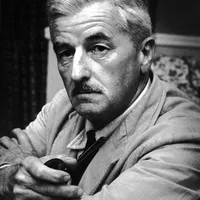
William Faulkner
Faulkner probes the human condition through the lens of Southern identity, using his works to explore themes of memory, decay, and social tensions. These explorations are vividly embodied in his fictional Yoknapatawpha County, a microcosm representing the cultural and historical complexities of the American South. Faulkner’s narratives, such as "The Sound and the Fury," reflect his mastery of stream-of-consciousness technique, while "Light in August" showcases his skill in weaving psychological depth with social critique. This author’s innovative narrative structures and multiple perspectives invite readers to engage with his books not just as stories but as intricate tapestries of human experience.\n\nFaulkner’s method of intertwining narrative innovation with deep psychological insight allows readers to confront the ambiguities of human nature and the societal constructs that shape individual destinies. For example, in "Absalom, Absalom!" Faulkner employs multiple narrators to unravel the haunting legacy of the South, demonstrating his ability to render complex family sagas with nuance and empathy. This approach, while challenging, enriches the reader's understanding of identity and memory, making his works essential for those interested in the intersection of history and literature. His bio is further distinguished by his ventures into screenwriting, where his storytelling prowess extended beyond novels to enrich cinematic narratives.\n\nReaders who engage with Faulkner's body of work benefit from his profound insights into the intricacies of Southern life and human psychology. His recognition with the Nobel Prize in Literature in 1949 underscores his significant impact on modern American literature. Therefore, for academics, literature enthusiasts, and those seeking to understand the American South's cultural landscape, Faulkner's works offer a rich, immersive experience. This makes his contribution not only a pivotal point in literary history but also a continuous source of reflection and inspiration.
Read moreDownload PDF & EPUB
To save this Black List summary for later, download the free PDF and EPUB. You can print it out, or read offline at your convenience.

Intruder in the Dust
by William Faulkner
