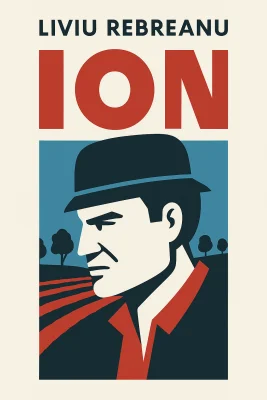
Ion
Categories
Fiction, Classics, Historical Fiction, Literature, School, 20th Century, Novels, Read For School, Romanian Literature, Romania
Content Type
Book
Binding
Hardcover
Year
1964
Publisher
Dufour Editions
Language
English
ASIN
0720646502
ISBN
0720646502
ISBN13
9780720646504
File Download
PDF | EPUB
Ion Plot Summary
Introduction
# The Hunger of the Earth: A Soul's Descent into Possession In the rolling hills of Transylvania, where the Hungarian Empire pressed its iron fist upon Romanian souls, the village of Pripas slumbered beneath an autumn sky. Here, among weathered wooden crosses and fields that stretched toward distant mountains, Ion Glanetașu stood at the crossroads of desire and destruction. The son of a drunkard bellringer, Ion possessed nothing but burning ambition and a hunger that gnawed at his very bones—not for love, not for God, but for land. Rich, black, fertile land that would transform him from a despised pauper into a man of substance. Across the village square, Ana Baciu watched him with the devotion of a moth drawn to flame, unaware that her father's vast fields had already marked her as prey in Ion's calculating mind. The earth itself seemed to whisper promises of power to those bold enough to seize it, and Ion had already decided that no price—not honor, not love, not even human life—would be too high to pay for his slice of eternity carved in soil.
Chapter 1: The Landless Son: Ion's Burning Desire
The morning mist clung to Pripas like the breath of sleeping ghosts when Ion first pressed his face against the boundary stones of Vasile Baciu's land. His calloused fingers traced the markers with the reverence other men reserved for holy relics. Here lay forty acres of the richest soil in the valley, black earth that could make a man's fortune or drive him to madness with wanting. Ion's father, Alexandru Glanetașu, had squandered their family inheritance on drink and foolish ventures, leaving his son with nothing but shame and a burning determination never to be powerless again. The village children still called Ion "the bellringer's boy," their voices carrying the particular cruelty reserved for those who had fallen from even modest grace. At twenty-five, Ion possessed the lean strength of a man who had worked for others his entire life, his dark eyes holding depths that made women shiver and men step aside. But strength meant nothing without land to work, respect without property to command it. In the rigid hierarchy of rural Transylvania, a landless man was barely a man at all. Vasile Baciu emerged from his stone house like a feudal lord surveying his domain, his thick frame moving with the confidence of someone who had never known want. Behind him trailed his daughter Ana, thin and pale as a winter birch, her eyes finding Ion with the desperate hunger of someone drowning who glimpses a distant shore. Ion straightened, meeting Baciu's suspicious glare with calculated deference. The older man had built his fortune through shrewd marriages and ruthless business dealings, transforming himself from a landless peasant into one of the wealthiest farmers in three villages. He recognized ambition when he saw it, especially the dangerous kind that burned behind Ion's steady gaze. "Good morning, Domnule Baciu," Ion called out, his voice carrying just the right mixture of respect and confidence. "Fine weather for the harvest." Baciu grunted, his small eyes never leaving Ion's face. He had heard the rumors, seen how his daughter's cheeks flushed whenever the young man passed their gate. Ana was his only child, his heir, and the key to his carefully constructed legacy. He would not see her thrown away on a landless dreamer, no matter how strong his back or steady his gaze. But Ion had already begun to weave his web, understanding that in this game of acquisition, Ana was not the prize but merely the path to it. The real seduction would be of the land itself, and Ion was prepared to court it with a patience and passion that would have shamed lesser men.
Chapter 2: Calculated Love: The Seduction of Ana Baciu
The Sunday dance at Todosia's courtyard pulsed with the wild energy of harvest celebration, fiddles screaming their ancient melodies while couples spun in the dust-choked air. Ion moved through the crowd like a predator selecting prey, his eyes cataloguing every eligible woman with the cold precision of a livestock dealer. Ana Baciu stood pressed against the walnut tree's trunk, her thin frame nearly invisible in her faded dress, watching Ion with the desperate intensity of someone witnessing their own salvation. When he finally approached, extending his hand with a smile that never reached his eyes, she trembled like a captured bird. "Dance with me, Ana," he said, his voice pitched low enough to seem intimate while carrying clearly to her father's ears across the courtyard. Their first dance was a declaration of war. Vasile Baciu's face darkened with rage as he watched his daughter bloom under Ion's attention, her plain features transformed by hope into something approaching beauty. The other villagers whispered behind their hands, recognizing the ancient drama unfolding before them—the landless suitor pursuing the heiress, ambition masquerading as romance. Ion played his role with masterful calculation, alternating between passionate attention and calculated neglect, keeping Ana's emotions in constant turmoil. He would appear at her father's gate with wildflowers picked from the roadside, speaking of love and destiny while his eyes measured the boundaries of Baciu's property. Then he would vanish for days, leaving Ana to pace her father's house like a caged animal, her heart breaking with each hour of silence. The village schoolmaster, Zaharia Herdelea, watched this courtship with growing unease. A gentle intellectual struggling to raise three children on a teacher's meager salary, Herdelea had recognized Ion's intelligence years earlier and tried to guide him toward education rather than obsession. His own family faced constant financial pressure—his son Titu dreamed of becoming a poet in free Romania, his daughter Laura had married a postal clerk, and young Ghighi still needed dowry money. "Be careful with that girl's heart," Herdelea warned Ion one evening as they walked past Baciu's fields. "Love is not a crop you can harvest at will." Ion's laugh was sharp as winter wind. "Love is a luxury for men who inherit their land, domnule învățător. The rest of us must be more practical." The seduction accelerated through autumn's dying days. Ion began appearing at Ana's window after midnight, his whispered promises mixing with the scent of ripening apples and the distant sound of her father's drunken snoring. Ana, starved for affection and terrified of spinsterhood, surrendered to Ion's calculated passion with the desperation of someone grasping at their last chance for happiness. By winter's first snow, Ana carried Ion's child, and the trap was finally sprung. Vasile Baciu's rage shook the village like thunder, but the ancient laws were clear—pregnancy demanded marriage, and marriage meant dowry. Ion had won his first victory in the war for land, though the true battle was only beginning.
Chapter 3: Marriage as Transaction: Acquiring the Coveted Fields
The wedding negotiations unfolded like a siege, with Vasile Baciu's parlor serving as the battlefield where Ion's future would be decided. Father Belciug, the village priest whose own ambitions centered on building a grand new church, presided over the discussions with the weary authority of someone who had witnessed too many such transactions disguised as sacraments. Baciu sat hunched over his brandy glass, his weathered face twisted with the particular hatred reserved for those who had outmaneuvered him. Across the scarred wooden table, Ion waited with the patience of a hunter, his dark eyes never wavering from his prey. Between them, Ana's pregnancy swelled like an accusation, forcing the old man's hand with biological inevitability. "You think you're clever, don't you?" Baciu snarled, his words slurred by alcohol and rage. "Trapping my daughter like some village whore, forcing me to give you what you could never earn." Ion's face remained impassive, though his fingers tightened imperceptibly around his own glass. "I'm offering to give your grandchild a name and your daughter a husband. The terms are yours to set." The negotiations stretched through three bitter meetings, each more acrimonious than the last. Baciu fought to retain control of his lands, offering only promises of future inheritance. Ion countered with demands for immediate transfer of property, understanding that promises could be broken but legal documents endured. Father Belciug and Herdelea served as reluctant mediators, both men recognizing the ugly reality beneath the religious ceremony they were arranging. Herdelea's own troubles deepened during this period. His support for Ion in a minor legal dispute had attracted unwanted attention from Hungarian authorities already suspicious of Romanian nationalism. The schoolmaster faced potential dismissal, his family's security hanging by the same thread as Ana's reputation. "We're all trapped by circumstances beyond our control," Herdelea confided to his wife as they watched their savings dwindle. "Ion by his hunger for land, Ana by her condition, Baciu by his pride, and us by our principles." The final agreement was hammered out on a February morning when snow lay thick enough to muffle even the sound of breaking hearts. Baciu would transfer half his holdings immediately as Ana's dowry, with the remainder to pass to Ion upon the old man's death. In exchange, Ion would marry Ana and legitimize her child, binding himself to a woman he had never loved for the sake of soil he worshipped. The wedding itself was a grim parody of celebration. Ana, her pregnancy visible beneath her traditional dress, moved through the ceremony like a sleepwalker. Ion spoke his vows with the mechanical precision of someone reciting a business contract. Baciu drank himself into a stupor before the feast ended, while the village guests whispered about the bride's condition and the groom's obvious satisfaction. That night, as Ana wept silently in their marriage bed, Ion slipped outside to walk alone through the moonlit fields that were finally, legally his. He knelt in the frozen earth, pressing his face against the soil with an intimacy he had never shown his wife, breathing in the rich scent of ownership like a man inhaling the perfume of his beloved. The land was his at last, but the price was only beginning to be paid.
Chapter 4: The Price of Possession: Ana's Despair and Village Tensions
Spring arrived in Pripas with cruel irony, bringing new life to everything except Ana's withered heart. She gave birth to a son in the small hours of an April morning, her labor witnessed only by the village midwife and the sound of Ion plowing his newly acquired fields. When the child's first cries pierced the dawn air, Ion barely paused in his work, his attention focused on the furrows that would yield his first harvest as a landowner. The baby, named Petrișor after Ana's dead mother, became another burden in a marriage already weighted with resentment and calculation. Ana nursed him mechanically, her hollow eyes reflecting the emptiness that had consumed her since discovering the true nature of her husband's affections. Ion showed no interest in his son beyond ensuring the child's existence secured his legal claim to Baciu's inheritance. Village life continued its ancient rhythms, but beneath the surface, tensions simmered like water before boiling. Herdelea's troubles with the Hungarian authorities had escalated, forcing his family to relocate to the nearby town of Armadia while he faced potential criminal charges for his nationalist activities. The schoolmaster's departure left a void in the village's intellectual life, filled temporarily by a young teacher named Zăgreanu whose loyalty to the Hungarian state was beyond question. Ion threw himself into farming with the obsessive intensity of a man possessed. He worked from before dawn until after dusk, driving himself and his hired laborers with ruthless efficiency. His fields became the most productive in the region, their yield a testament to his single-minded devotion to the soil. But success brought its own complications, attracting the attention of tax collectors and government officials who viewed prosperous Romanian farmers with automatic suspicion. Ana's father, Vasile Baciu, had retreated into alcoholism and bitterness, spending his days at Avrum's tavern cursing the son-in-law who had stolen his life's work. The old man's decline was painful to witness, his once-formidable presence reduced to rambling complaints and empty threats. When sober enough to visit his daughter, he found her transformed into a ghost of her former self, her thin frame growing thinner, her rare smiles never reaching her eyes. The village women whispered about Ana's condition with the mixture of pity and satisfaction that accompanied the downfall of those who had once been envied. They brought her small gifts—eggs, preserves, hand-me-down clothes for the baby—while discussing her situation in voices carefully modulated to carry just far enough. "She got what she wanted," they murmured. "A husband and his name for her child. If she's not happy, well, happiness was never part of the bargain." Ion's transformation from landless laborer to substantial farmer had altered his position in the village hierarchy, but not in the way he had anticipated. Respect came grudgingly, tainted by knowledge of how he had acquired his property. Men who had once dismissed him now sought his opinion on agricultural matters, but their deference carried an undertone of wariness, as if they were dealing with something dangerous that might turn on them without warning. The isolation of his success began to weigh on Ion as autumn approached. He had achieved his primary goal but found himself cut off from the simple pleasures that had once sustained him. Even his visits to Avrum's tavern brought no relief, the other patrons falling silent when he entered, their conversations resuming in whispers after he found a corner table to drink alone. Only one person in Pripas still looked at Ion with undisguised warmth, and she was the one person he could never have—Florica, the village beauty who had married George Bulbuc while Ion was courting Ana's inheritance. Their paths crossed regularly at the market, at church, at village celebrations, each encounter a reminder of the road not taken and the price of choosing ambition over desire.
Chapter 5: Blood and Betrayal: The Fatal Pursuit of Florica
The harvest moon hung like a bloodshot eye over Pripas when Ion's carefully constructed life began to unravel. Florica had blossomed into full womanhood during her marriage to George Bulbuc, her beauty ripening like fruit that had been denied to Ion in his moment of choosing. Their encounters at the village well, at Sunday mass, at the autumn market, crackled with unspoken desire that grew more dangerous with each passing day. George Bulbuc, the prosperous farmer's son who had won Florica's hand through patience rather than calculation, began to notice the way his wife's eyes followed Ion across the village square. A decent man cursed with imagination, George tormented himself with visions of what might be happening during his long days in the fields, his jealousy fed by village gossips who delighted in stirring marital discord. Ana observed her husband's renewed obsession with the detached interest of someone watching a play performed in a foreign language. Her spirit had been so thoroughly broken that Ion's obvious desire for another woman barely registered as additional pain. She moved through her days like a sleepwalker, caring for Petrișor with mechanical efficiency while her mind retreated to some unreachable place where hurt could not follow. The confrontation came on a October evening when the air carried the scent of burning leaves and approaching winter. Ion had been drinking at Avrum's tavern, his usual solitary consumption made more bitter by watching George and Florica share a quiet meal at a corner table. When the couple rose to leave, Ion followed them into the street, his footsteps echoing off the wooden houses like a drumbeat of approaching disaster. "Florica," he called out, his voice carrying the authority of someone accustomed to being obeyed. "I need to speak with you." George stepped protectively in front of his wife, his normally gentle face hardening with resolve. "You have nothing to say to my wife, Ion. Go home to your own family." The words hung in the cool air like a challenge. Ion's hand moved instinctively to the knife at his belt, the gesture not lost on George, who had his own blade ready. For a moment, the two men faced each other in the empty street, their shadows stretching long and dark in the moonlight, while Florica pressed herself against the nearest wall, her eyes wide with fear and something that might have been excitement. "She was mine before she was yours," Ion said quietly, his voice carrying the particular menace of absolute certainty. "She'll be mine again." The fight that followed was brief and brutal. George, despite his reputation for gentleness, fought with the desperate fury of a man defending everything he held dear. But Ion had been hardened by years of labor and sharpened by months of frustration, his knife finding its mark with the precision of someone who had slaughtered countless animals for food. George fell in the dust of the village street, his blood mixing with the earth that had witnessed so many other small tragedies. Florica's scream shattered the night silence, bringing villagers running from their homes to find Ion standing over his rival's body, the knife still gleaming in his hand. Father Belciug arrived to administer last rites, his face grim with the knowledge that he was witnessing the inevitable conclusion of forces he had helped set in motion. The priest had performed the marriage ceremony that bound Ion to Ana, blessed the union that had given him access to Baciu's lands, and now he knelt beside another victim of the hunger that consumed his parishioner's soul. Ion made no attempt to flee or deny his crime. He stood quietly as the village men bound his hands, his eyes fixed not on George's cooling corpse or Florica's tear-streaked face, but on the distant fields that had cost him everything and given him nothing but emptiness in return.
Chapter 6: Death in the Soil: Ion's End and the Land's Indifference
The trial in Bistrița lasted three days, a formality that concluded with the inevitable sentence of death by hanging. Ion sat in the dock with the same impassive expression he had worn throughout his adult life, showing neither remorse for his crime nor fear of its consequences. When asked if he had any final words, he spoke only of the land—how it had called to him, possessed him, and ultimately betrayed him with its false promises of fulfillment. Ana attended the trial's final day, bringing Petrișor with her in a gesture that might have been loyalty or simply the inability to make any other choice. She sat in the gallery's back row, her thin frame nearly invisible among the curious spectators who had come to witness the conclusion of Pripas's most notorious scandal. When the judge pronounced sentence, she showed no reaction, her face as empty as her marriage had been. The execution was scheduled for a gray November morning when frost covered the ground like a burial shroud. Ion spent his final night in the Bistrița jail writing letters he would never send, his thoughts turning repeatedly to the fields that had driven him to murder. In his fevered imagination, he could see the black earth calling to him one last time, promising the eternal rest that life had denied him. Father Belciug arrived before dawn to hear Ion's final confession, a ritual that lasted nearly an hour behind the closed door of the condemned man's cell. When the priest emerged, his face was ashen, his hands trembling as he clutched his prayer book. Whatever sins Ion had confessed would remain forever sealed by the sanctity of the sacrament, but their weight seemed to have aged Belciug by years in the space of minutes. The hanging took place in the prison courtyard, witnessed by a small crowd of officials and curiosity seekers. Ion walked to the gallows with steady steps, his eyes fixed on the horizon where his beloved fields lay hidden beyond the town's rooftops. His last words, spoken to the executioner with perfect clarity, were about the soil: "Tell them the land remembers everything. It will outlive us all." The rope snapped his neck cleanly, ending a life that had been consumed by hunger from its very beginning. His body was returned to Pripas for burial in the village cemetery, where it was laid to rest in a grave dug from the same black earth he had coveted and killed for. Ana survived her husband by less than a year, her death coming quietly in the spring when Petrișor was learning to walk. The village women said she had simply lost the will to live, though the doctor attributed her passing to consumption. She was buried beside Ion in the cemetery, their shared headstone bearing only names and dates, the story of their tragic union reduced to carved numerals that would weather away with time. Vasile Baciu reclaimed his lands through legal proceedings that dragged on for months, though he lived only long enough to see one more harvest before drink and bitterness claimed him. The property eventually passed to distant relatives who had no connection to its bloody history, the soil accepting new owners with the same indifference it had shown to all who had claimed it before.
Summary
In the end, the earth that Ion Glanetașu had worshipped with such desperate passion proved to be the most faithless of lovers. The fields he had schemed and murdered to possess continued their eternal cycle of seasons, indifferent to the human drama that had played out across their surface. New hands worked the soil, new crops pushed through the black earth, and new owners walked the boundaries that had once driven a man to destroy everything he touched in pursuit of ownership. The village of Pripas gradually forgot the details of Ion's story, though mothers still used his name to frighten children into obedience, and old men at Avrum's tavern would occasionally recall the landless boy who had risen so high and fallen so far. The land itself kept no record of his crimes or his passion, accepting the blood that had been spilled for its sake and transforming it into nutrients for future harvests. In the democracy of death and decay, Ion's remains fed the same soil he had killed to possess, his body finally achieving the union with the earth that his soul had craved but never found in life. The hunger that had consumed him was at last satisfied, not through ownership but through the ultimate surrender of becoming one with the object of his obsession.
Best Quote
“Daca asta n-a fost iubire, atunci ce-i iubirea?” ― Liviu Rebreanu, Ion
Review Summary
Strengths: The review highlights the timeless relevance of the book "Ion," emphasizing its exploration of universal themes such as desire and ambition. The reviewer appreciates the objective storytelling of Rebreanu, noting that the narrative does not excuse the protagonist's actions but rather presents them impartially. The review also acknowledges the book's reflection of societal constraints and personal dilemmas that remain pertinent today. Weaknesses: The review criticizes the negative reception of the book and its film adaptation, particularly by students who dismiss it as outdated without engaging with its content. The reviewer expresses frustration with the perceived ignorance and lack of cultural appreciation among these critics. Overall: The review conveys a strong defense of "Ion," arguing for its continued relevance and depth. The reviewer recommends the book, suggesting that its themes are universally relatable and criticizing those who dismiss it without understanding its significance.
About Author

Liviu Rebreanu
Rebreanu investigates the complex dynamics of rural life and human psychology through his pioneering contributions to Romanian literature. His books, particularly his novel "Ion," explore themes of land ownership and the struggles of peasants, providing readers with deep insights into the socio-economic conditions of Transylvania. As an author, Rebreanu adeptly captures the psychological and social consequences of crime, guilt, and punishment, engaging readers in the internal conflicts of his characters.\n\nIn his bio, Rebreanu’s role as a journalist and a member of various literary circles in Bucharest significantly shaped his narrative style and thematic choices. He utilized his experiences and observations to write with a realistic portrayal of the human condition. His involvement in cultural institutions like the National Theatre of Bucharest and the Romanian Writers' Society further influenced his literary perspective. This dual approach of psychological realism and societal critique makes his work appealing to both literary scholars and readers interested in early 20th-century Romanian culture.\n\nReaders benefit from Rebreanu's works as they provide a window into the historical and social fabric of Romania during a time of change. His novel "Adam și Eva" and the drama "Plicul" showcase his versatility in exploring different genres while maintaining a focus on profound human experiences. Therefore, his literature serves as both an artistic and educational tool, bridging the past with contemporary understanding of societal issues.
Read moreDownload PDF & EPUB
To save this Black List summary for later, download the free PDF and EPUB. You can print it out, or read offline at your convenience.
Ion
by Liviu Rebreanu
