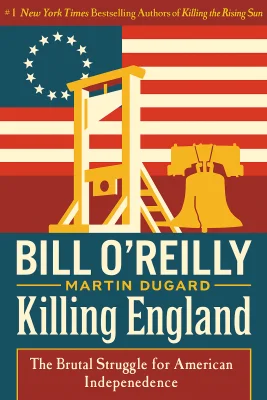
Killing England
The Brutal Struggle for American Independence
Categories
Nonfiction, Biography, History, Politics, Audiobook, Historical, American History, American Revolutionary War, War, American Revolution
Content Type
Book
Binding
Hardcover
Year
2017
Publisher
Henry Holt and Co.
Language
English
ISBN13
9781627790642
File Download
PDF | EPUB
Killing England Plot Summary
Introduction
# From Colonial Rebellion to Revolutionary Victory: The Birth of American Independence In the bitter winter of 1777, as George Washington's Continental Army huddled in the frozen wasteland of Valley Forge, few could have imagined that these ragged soldiers would ultimately defeat the world's most powerful empire. The story of American independence reveals how a collection of disparate colonies, bound together by little more than shared grievances against British rule, transformed themselves into a unified nation founded on revolutionary principles that would reshape the modern world. This extraordinary eight-year struggle illuminates timeless truths about leadership under pressure, the power of principled persistence, and the remarkable capacity of ordinary people to achieve the impossible when united by a common cause. Through the experiences of figures like Washington, who evolved from a young Virginia planter into the indispensable leader of a new republic, Benjamin Franklin, whose diplomatic genius secured crucial foreign alliances, and countless farmers and merchants who risked everything for an uncertain dream, we witness not merely the birth of America but the emergence of revolutionary ideas about human dignity, self-governance, and the relationship between rulers and the ruled that continue to inspire democratic movements worldwide.
Chapter 1: Seeds of Rebellion: Colonial Resistance to British Imperial Control
The roots of American revolution grew not from sudden inspiration but from decades of mounting tension between colonial aspirations and imperial control. The French and Indian War of the 1750s had taught colonists that British military might was not invincible, while simultaneously burdening London with massive debts that Parliament was determined to recover from American pockets. What seemed reasonable fiscal policy in Whitehall appeared as tyrannical oppression in Boston taverns and Virginia plantation houses. The Stamp Act of 1765 marked the first direct tax imposed by Parliament on the colonies, requiring revenue stamps on everything from newspapers to playing cards. Colonial resistance was swift and fierce, with merchants organizing boycotts and protesters taking to the streets under the rallying cry of "no taxation without representation." This phrase crystallized a fundamental principle that would define American political thought—the idea that legitimate government required the consent of the governed. When Parliament repealed the Stamp Act, colonists celebrated, but their joy proved short-lived as new taxes on tea, glass, and paper soon followed. The Boston Massacre of 1770 demonstrated how quickly policy disputes could escalate into deadly violence. British soldiers firing into a crowd of protesters created martyrs for the colonial cause, while skilled propagandists like Samuel Adams transformed a tragic confrontation into a symbol of British tyranny. The Boston Tea Party of 1773 represented a calculated act of rebellion that could not be ignored—the dumping of valuable tea into Boston Harbor was both economic warfare and political theater designed to force a crisis. Parliament's response through the Coercive Acts of 1774, dubbed the "Intolerable Acts" by outraged colonists, only deepened the constitutional crisis by closing Boston Harbor and effectively placing Massachusetts under military rule. By the time the First Continental Congress convened that autumn, the fundamental question was no longer whether Britain had the right to tax the colonies, but whether Americans would submit to what they increasingly viewed as arbitrary rule. The delegates who gathered in Philadelphia began to think of themselves not merely as Virginians or New Yorkers, but as Americans with common interests and shared grievances against a distant government that seemed deaf to their concerns.
Chapter 2: The Break from Britain: Declaration of Independence and Point of No Return
The Second Continental Congress convened in Philadelphia in May 1775 with the sound of musket fire still echoing from Lexington and Concord, yet many delegates clung desperately to hopes of reconciliation with the mother country. Even as they appointed George Washington commander-in-chief of a Continental Army, the Olive Branch Petition sent to King George III in July 1775 represented a final attempt to restore harmony within the empire while preserving colonial rights. The king's rejection of this petition and his declaration that the colonies were in open rebellion forced Americans to confront an uncomfortable truth—there could be no middle ground between submission and independence. Thomas Paine's pamphlet "Common Sense," published in January 1776, crystallized colonial thinking by arguing that reconciliation was not only impossible but undesirable. Paine's plain-spoken prose demolished the mystique of monarchy and hereditary rule, declaring that "the birthday of a new world is at hand." His arguments reached ordinary farmers and craftsmen who had never read political philosophy, transforming abstract constitutional disputes into a personal choice between freedom and slavery. The momentum toward independence accelerated through the spring of 1776, driven by military defeats that made compromise appear impossible and philosophical arguments that made independence seem inevitable. Virginia's Richard Henry Lee introduced the fateful resolution on June 7: "That these United Colonies are, and of right ought to be, free and independent States." While Congress debated this momentous proposition, a committee led by thirty-three-year-old Thomas Jefferson crafted the document that would justify this decision to a watching world. Jefferson's Declaration of Independence transformed a colonial rebellion into a universal struggle for human rights, proclaiming that "all men are created equal" and possess unalienable rights to "life, liberty, and the pursuit of happiness." The signing on July 4, 1776, marked the point of no return—as Benjamin Franklin reportedly observed, they must "hang together, or most assuredly we shall all hang separately." The delegates understood they were committing treason against the Crown, but they also recognized they were creating something unprecedented in human history: a nation founded not on conquest or inheritance, but on the revolutionary principle that governments derive their just powers from the consent of the governed.
Chapter 3: Darkest Hour: Washington's Army Survives Near-Total Collapse
The euphoria following the Declaration of Independence quickly gave way to the harsh realities of war against the world's most formidable military machine. General William Howe's British army, supported by Hessian mercenaries and the Royal Navy, systematically dismantled Washington's Continental Army through the catastrophic summer and fall of 1776. The devastating defeat at the Battle of Brooklyn in August demonstrated the vast gulf between colonial enthusiasm and professional military capability, forcing Washington into a desperate retreat that would test every assumption about American resolve. Washington's withdrawal across New Jersey in November and December 1776 marked the nadir of American fortunes. His army, which had numbered over 20,000 men in the summer, dwindled to fewer than 3,000 ragged soldiers as enlistments expired and desertion mounted. Thomas Paine captured the moment perfectly in "The American Crisis": "These are the times that try men's souls. The summer soldier and the sunshine patriot will, in this crisis, shrink from the service of their country." The cause of independence appeared doomed, with British forces controlling New York and preparing to occupy Philadelphia. Yet it was precisely in this moment of greatest despair that Washington demonstrated the leadership qualities that would make him indispensable to the American cause. Rather than surrender or retreat into winter quarters as European military convention dictated, he conceived a desperate gamble that would either revive the revolution or destroy what remained of his army. On Christmas night 1776, Washington led his men across the ice-choked Delaware River for a surprise attack on Trenton, where Hessian troops were celebrating the holiday in presumed security. The victory at Trenton, followed by another success at Princeton a week later, proved that the Continental Army could defeat professional European soldiers when properly led and motivated. More importantly, these victories restored American morale and convinced many wavering colonists that independence remained possible. Washington's willingness to risk everything when defeat seemed certain established him as more than just a military commander—he became the embodiment of American perseverance and the living symbol of republican virtue that would sustain the cause through even darker trials ahead.
Chapter 4: Diplomatic Triumph: Franklin Secures the Crucial French Alliance
The stunning American victory at Saratoga in October 1777 transformed a colonial rebellion into a global conflict that would ultimately reshape the balance of power across two continents. General John Burgoyne's surrender of nearly 6,000 British troops demonstrated that the Continental Army could not only survive against professional European forces but triumph decisively when circumstances favored American tactics and determination. This remarkable success provided Benjamin Franklin, serving as America's diplomat in the sophisticated courts of Europe, with precisely the leverage he needed to secure the foreign alliance that would prove decisive in winning independence. Franklin's mission to France required all his considerable skills as both diplomat and philosopher. The French court was naturally sympathetic to any cause that might weaken their British rivals, but King Louis XVI and his ministers needed concrete assurance that the Americans could sustain their rebellion long enough to justify French investment in men, money, and naval power. Franklin's careful cultivation of French intellectuals and politicians, combined with his shrewd understanding of European power politics and his genuine embodiment of Enlightenment ideals, gradually built a coalition of support for the American cause. The formal alliance signed on February 6, 1778, committed France to fight alongside the Americans until Britain formally recognized their independence. This agreement fundamentally altered the nature of the conflict, forcing Britain to defend not only against colonial rebels but against their most dangerous European rival. French naval power, in particular, would prove crucial in limiting British mobility and ultimately trapping Cornwallis at Yorktown, while French military advisors and financial support sustained the Continental Army through its most difficult periods. The French alliance also validated American independence in the eyes of other European powers, transforming the United States from a collection of rebellious colonies into a legitimate government worthy of diplomatic recognition. Spain, though not formally allied with America, provided crucial support, while other nations began treating American representatives as equals rather than rebels. Franklin's diplomatic triumph demonstrated that the American Revolution was not merely a local uprising but part of a broader struggle between the forces of monarchy and republicanism that would define the next century of world history.
Chapter 5: Betrayal and Loyalty: Arnold's Treason Tests American Character
No figure in American history embodies the complex loyalties and bitter personal divisions of the Revolutionary War more dramatically than Benedict Arnold, whose transformation from celebrated battlefield hero to notorious traitor revealed the intense pressures that the prolonged conflict placed on individual Americans. Arnold's heroic leadership at Saratoga, where his reckless courage and tactical brilliance turned potential defeat into stunning victory, should have secured his place among America's founding heroes. Instead, a toxic combination of financial desperation, wounded pride, and romantic obsession led him down a path that would forever link his name with betrayal and dishonor. Arnold's marriage to eighteen-year-old Peggy Shippen in April 1779 marked the beginning of his treasonous correspondence with British intelligence networks. Peggy, a Philadelphia socialite who had enjoyed the company of British officers during their occupation of the city, brought both Loyalist sympathies and expensive tastes to the marriage that Arnold's military salary could never satisfy. His determination to provide his young bride with the luxury she expected drove him deeper into debt and closer to treason, while his sense of being underappreciated by Congress and passed over for promotion in favor of less capable but more politically connected officers poisoned his commitment to the cause. The plot reached its climax when Arnold obtained command of West Point, the strategic fortress controlling the Hudson River that represented the key to American communications between New England and the southern states. His plan to surrender this vital position to the British would have split the rebellious colonies in two and potentially ended the war in Britain's favor. Only the accidental capture of British Major John André, carrying incriminating documents detailing the conspiracy, prevented the scheme's success and exposed Arnold's betrayal just hours before he could complete his treachery. The discovery of Arnold's treason sent shockwaves through the Continental Army and American society, with Washington's anguished question—"Whom can we trust now?"—capturing the sense of betrayal that many felt upon learning that one of their most celebrated generals had been willing to sell out the cause for British gold. Yet Arnold's betrayal, paradoxically, may have strengthened American resolve by demonstrating that the cause of independence was larger than any individual and that even the worst treachery could not destroy the spirit of liberty that animated the revolution.
Chapter 6: Southern Strategy: British Campaign Leads to Strategic Overextension
By 1780, British strategy had shifted dramatically from attempting to crush the rebellion in the North to exploiting supposed Loyalist strength in the Southern colonies, where royal governors promised that thousands of faithful subjects awaited only British protection to rally to the Crown. The capture of Charleston in May 1780, netting over 5,000 American prisoners in the largest American defeat of the war, seemed to validate this new approach and suggested that the South might provide Britain with the decisive victory that had eluded them in New England and the Middle Atlantic. Lieutenant Colonel Banastre Tarleton's brutal cavalry raids and the complete rout of General Horatio Gates at Camden appeared to confirm British expectations that Southern resistance would collapse once confronted with professional military force. Yet the harsh treatment of civilians by Tarleton's forces and the execution of prisoners who attempted to surrender created a cycle of violence that turned many previously neutral colonists into bitter enemies of the Crown. The massacre at the Waxhaws, where Tarleton's men continued killing Americans attempting to surrender, created a rallying cry that would echo through subsequent Southern battles. The tide began to turn with Daniel Morgan's brilliant tactical victory over Tarleton at Cowpens in January 1781, followed by Nathanael Greene's strategic retreat through North Carolina that exhausted Cornwallis's army while avoiding the decisive defeat that would have ended Southern resistance. Greene's famous observation that "we fight, get beat, rise, and fight again" captured the essence of American strategy in the South—avoiding catastrophic defeat while wearing down British forces through constant harassment, guerrilla warfare, and occasional sharp engagements that demonstrated continued American resolve. Francis Marion, the legendary "Swamp Fox," and other partisan leaders proved that the British could control the towns but never the countryside, where every march became a potential ambush and every supply convoy required heavy escort. Cornwallis's decision to march into Virginia in pursuit of the decisive victory that had eluded him in the Carolinas ultimately played into American hands, drawing his weakened army away from its bases and into a trap from which there would be no escape.
Chapter 7: Final Victory: Yorktown Ends the War and Secures Independence
The convergence of American, French, and British forces at Yorktown in the autumn of 1781 created the perfect conditions for the decisive battle that would end the Revolutionary War and secure American independence. Washington's strategic genius lay in recognizing that the arrival of the French fleet under Admiral de Grasse provided a unique opportunity to trap Cornwallis's army between allied land forces and French naval power, cutting off any possibility of evacuation or reinforcement from British bases in New York. The race to Virginia represented a calculated gamble that would either end the war in American victory or prolong the conflict indefinitely if Cornwallis managed to escape. Washington's decision to march his army south from New York, coordinating with French forces under Rochambeau while maintaining the deception that he intended to attack British-held New York City, demonstrated the sophisticated strategic thinking that had developed over six years of warfare against professional European armies. The siege of Yorktown showcased the Continental Army's remarkable transformation from the ragged band of farmers who had crossed the Delaware five years earlier into a professional military force capable of complex operations requiring precise coordination with foreign allies. The methodical construction of siege works, the disciplined assault on British redoubts, and the patient reduction of Cornwallis's defensive positions demonstrated how far American military capabilities had advanced under Washington's leadership and Baron von Steuben's rigorous training programs. The surrender ceremony on October 19, 1781, was carefully choreographed to emphasize American dignity and British humiliation while maintaining the respect due to brave enemies. When Cornwallis sent his second-in-command to surrender his sword, Washington pointedly directed him to his own deputy, General Benjamin Lincoln, who had been forced to surrender Charleston the previous year. The British army's march between lines of American and French troops, with their colors cased and drums beating the melancholy tune "The World Turned Upside Down," symbolized not only the end of British hopes for retaining their American colonies but the emergence of a new nation that had proven itself worthy of independence through eight years of sacrifice and determination.
Summary
The American Revolution represents one of history's most remarkable transformations—the evolution of thirteen disparate colonies into a unified nation founded on revolutionary principles that challenged the fundamental assumptions of eighteenth-century political order. The central tension throughout this eight-year struggle was between the established traditions of monarchy and empire against the radical new idea that governments derive their just powers from the consent of the governed, a concept that would inspire democratic movements worldwide for generations to come. The revolution's ultimate success depended on extraordinary leadership, particularly George Washington's ability to hold together a fragile coalition through the darkest hours of military defeat and political despair. His willingness to surrender power voluntarily after victory established a precedent that would define American democracy and demonstrate to a skeptical world that republican government could produce leaders who placed principle above personal ambition. Today's leaders can learn from Washington's example that true leadership requires maintaining hope in the face of overwhelming odds, building consensus among diverse groups with competing interests, and understanding that lasting change requires both moral authority and practical wisdom. The founders' commitment to creating institutions that could survive their own human frailties offers a timeless lesson about building sustainable democratic societies that can adapt and endure across generations while remaining true to their founding principles.
Best Quote
“Jefferson makes note of the date on which particular flowers bloom. Once autumn comes, he will record the migratory patterns of birds.4” ― Bill O'Reilly, Killing England: The Brutal Struggle for American Independnce
Review Summary
Strengths: The book is praised for its engaging narrative style, likened to a novel, and its ability to provide a broad overview of the American Revolutionary War. It is described as informative, easy to read, and a compelling introduction to the period. The detailed portrayal of the Founding Fathers and historical events is highlighted as a strong point. Weaknesses: The book is critiqued for lacking depth, offering a "Cliff Notes" version of history. It glosses over events without delving deeply into any particular topic, which may leave readers seeking more comprehensive information unsatisfied. Overall: The general sentiment is positive, with readers recommending the book as an accessible and informative read for those interested in American history. It is suggested as a good starting point for further exploration of the Revolutionary War era.
About Author

Bill O'Reilly
O'Reilly navigates the intersection of historical analysis and narrative storytelling, distilling pivotal moments into engaging accounts. His books often focus on significant historical events and figures, aiming to make history accessible to a broad audience. This method is evident in his well-known "Killing" series, where he co-authors with Martin Dugard to explore events like the assassination of Lincoln and the defeat of World War II Japan. By merging meticulous research with a captivating narrative style, O'Reilly presents history as a vivid tableau of power and moral complexity.\n\nThe author's work is characterized by a straightforward writing style that avoids academic jargon, appealing to readers seeking clarity and engagement. Themes of leadership, power struggles, and the impact of historical events are recurrent, illustrating how the past shapes contemporary society. While some critics point out factual inaccuracies and a slant towards propagandistic tones, O'Reilly's books, including "Killing the Mob," continue to resonate with readers interested in dramatized retellings of history.\n\nReaders benefit from O'Reilly's ability to render complex historical episodes into narratives that are both informative and compelling. His focus on American patriotism and valorization of military achievements offers a perspective that aligns with traditional conservative views. Despite controversies surrounding his career, including his departure from Fox News, O'Reilly's literary contributions remain influential in popular historical literature. His books not only inform but also provoke discussions on the moral intricacies of historical leadership, providing readers with a rich tapestry of insights into the human condition.
Read moreDownload PDF & EPUB
To save this Black List summary for later, download the free PDF and EPUB. You can print it out, or read offline at your convenience.
Killing England
by Bill O'Reilly
