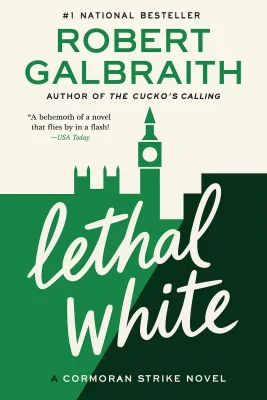
Lethal White
Categories
Fiction, Audiobook, Mystery, Thriller, Adult, Contemporary, British Literature, Crime, Mystery Thriller, Detective
Content Type
Book
Binding
Paperback
Year
2019
Publisher
Mulholland Books
Language
English
ASIN
0316422770
ISBN
0316422770
ISBN13
9780316422772
File Download
PDF | EPUB
Lethal White Plot Summary
Introduction
# Lethal White: Shadows of the Past and the Price of Buried Secrets The summer heat pressed down on London like a suffocating blanket when Billy Knight stumbled into Cormoran Strike's detective agency, his eyes wild with the kind of terror that comes from carrying unspeakable secrets. His clothes reeked of desperation, his hands trembled with an uncontrollable tic, and his words tumbled out in fragments about a strangled child buried in a pink blanket twenty years ago. The doctors called it delusion, his family dismissed it as madness, but something in Billy's fractured testimony felt too specific, too visceral to be mere fantasy. Days later, when Jasper Chiswell arrived at Strike's office with his own desperate plea for help, the threads of past and present began to weave together in ways neither detective nor client could anticipate. The Minister for Culture spoke of blackmailers circling like vultures, of photographs that could topple governments, of secrets buried so deep they had taken root in the very foundations of power. As Robin went undercover in the corridors of Westminster and Strike pursued leads through London's radical underground, they would discover that some truths refuse to stay buried, and that the price of silence can be measured in blood.
Chapter 1: The Disturbed Witness: Billy Knight's Haunting Testimony
The metal stairs leading to Strike's office rang like funeral bells under Billy Knight's unsteady feet. He burst through the door like a man fleeing demons, his skeletal frame swimming in clothes that reeked of unwashed desperation. Robin looked up from her desk, immediately recognizing the signs of someone balanced on the knife's edge of complete breakdown. Billy's story poured out in jagged fragments, each word torn from his throat like a confession under torture. Twenty years ago, as a child of five, he had witnessed something that had carved itself into his memory with surgical precision. A small figure going limp in adult hands. The panic in voices he recognized. The terrible weight of a secret that had grown heavier with each passing year. "I seen a kid killed," Billy gasped, his hand flying from nose to chest in a compulsive rhythm that spoke of deep psychological scarring. "Strangled. Up by the horse, where the chalk cuts into the hill. They wrapped the body in a pink blanket, carried it down to the dell behind our cottage." Strike listened with professional skepticism tinged by unease. Billy Knight was the younger brother of Jimmy Knight, a radical activist who had been making increasingly aggressive demands for money from government officials. The timing felt too convenient, yet something in Billy's desperate sincerity gave the detective pause. The detail of that pink blanket was too mundane, too specific to be the product of pure delusion. The interview ended as abruptly as it had begun. When Strike's temporary secretary mentioned that "they" were coming, meaning the police she had called for help, Billy's paranoia exploded into panic. He threw himself against the door with the strength of the truly desperate, fled down the metal stairs, and vanished into London's labyrinthine streets, leaving behind only the lingering stench of fear and the echo of his terrible testimony.
Chapter 2: Political Blackmail: A Minister's Desperate Gambit
The exclusive Pratt's Club reeked of old money and older secrets when Jasper Chiswell summoned Strike to its wood-paneled depths. The Minister for Culture looked like a man under siege, his coarse gray hair standing out from his head like wire, his small eyes darting nervously around the dining room as though expecting assassins to emerge from behind the stuffed fish that decorated the walls. Chiswell's predicament emerged between gulps of sherry and angry mouthfuls of roast beef. Two men were bleeding him dry, each wielding different weapons but united in their desire to see him destroyed. Jimmy Knight, Billy's charismatic older brother, demanded forty thousand pounds to keep quiet about something that had happened six years earlier. Geraint Winn, husband of the beloved Minister for Sport, wanted something far more valuable than money—he wanted Chiswell's complete political annihilation. "I refuse to believe there isn't anything dodgy about Winn," Chiswell snarled, his fat lower lip jutting out like a petulant child's. The minister's euphemistic language about photographs and "distinguishing marks" made Strike's imagination boggle, but the detective kept his questions to himself. He wasn't being paid to judge his client, only to find leverage against his tormentors. What troubled Strike was the connection to Billy's fractured testimony. When he mentioned the mentally ill man's claims about witnessing a child's murder, Chiswell's reaction was telling—not the horror of an innocent man, but the careful blankness of someone hearing familiar accusations. "I have no deaths on my conscience," Chiswell said firmly, but his hands shook as he lit his cigarette, and his next words carried the weight of terrible knowledge: "One cannot be held accountable for unintended consequences." As Strike left the gothic splendor of Westminster, he reflected on the strange alchemy that had brought these elements together. A madman's testimony, a politician's secrets, and two blackmailers circling like vultures—the game was afoot, but Strike had the uncomfortable feeling that he was missing crucial pieces of a puzzle that might cost more than money to solve.
Chapter 3: Undercover Deception: Robin Infiltrates the Corridors of Power
Robin stared at her reflection in the mirror of her Deptford flat, watching herself transform into someone else entirely. Gone was the Yorkshire detective with her practical clothes and honest eyes. In her place emerged Venetia Hall, a privileged young woman with cut-glass vowels and an expensive education. The hazel contact lenses changed everything, softening her features and masking the intelligence that might give her away. Parliament's gothic corridors welcomed Venetia with the casual indifference reserved for the well-connected. As Chiswell's goddaughter, she slipped seamlessly into the role of temporary assistant, her cover story accepted without question by those who moved in circles where nepotism was as natural as breathing. The ancient buildings thrilled her with their sense of history and power, but beneath the grandeur lay currents of corruption that ran deeper than she had imagined. Within hours, Robin had identified the key players in Chiswell's world. Geraint Winn proved to be exactly the type of man she had learned to despise during her years as a temp—a leering, self-important predator whose office reeked of inadequacy and stale ambition. His desk was covered in crumbs, his papers scattered in chaotic piles, and the orange logo of his wife's charity scattered everywhere like accusations of his own mediocrity. The breakthrough came when Robin intercepted a phone call between Winn and Jimmy Knight. Hidden in her handbag, the listening device captured Winn's wheedling voice as he tried to calm the increasingly agitated activist. "We're close to getting the pictures!" Winn promised, while in the background, his assistant Aamir Mallik protested that he couldn't guarantee access to the Foreign Office files they needed. But Robin's success came at a price. Mitch Patterson, a brutal ex-police officer now working for the Sun newspaper, had spotted her entering Parliament and begun asking questions. The walls were closing in, and Robin found herself caught between her cover identity and the growing suspicion that she was being watched by more than just her targets. The game of deception was becoming deadly serious, and one false step could destroy everything they had worked to build.
Chapter 4: Death in Belgravia: The Minister's Staged Suicide
The morning of July 13th dawned gray and oppressive, London's air thick with the promise of thunderstorms that never seemed to break. Robin arrived at the Ebury Street house precisely at ten, expecting to find Chiswell waiting with his usual irascible energy. Instead, she found the front door ajar, swaying gently in the humid breeze like an invitation to disaster. The scene that greeted her in the sitting room would haunt her dreams for years to come. Jasper Chiswell sat slumped in a Queen Anne chair, his head encased in a clear plastic bag connected to a helium canister by rubber tubing. The bag had collapsed around his features, creating a grotesque death mask that bore little resemblance to the proud man who had once commanded respect in the corridors of power. His hands dangled loosely at his sides, and a dark stain spread across his trousers where his bladder had released in death. Robin's training kicked in as she processed the scene with clinical detachment. The glass of orange juice on the coffee table, the scattered papers, the bent sword lying forgotten in the corner—each detail burned itself into her memory as she documented everything with her camera. A tube of homeopathic pills lay crushed beneath her feet, their contents scattered like tiny white seeds across the worn carpet. When Strike arrived minutes later, his face grim with understanding, they both knew they were looking at something more complex than suicide. The staging was too perfect, the details too convenient. Someone had wanted Chiswell's death to look self-inflicted, but they had made mistakes—small inconsistencies that would unravel their carefully constructed narrative. The front door hadn't been properly closed, suggesting someone unfamiliar with its peculiar mechanism had been the last to leave. A scratch on the dead man's face hinted at a struggle that had never made it into the official narrative. Most tellingly, the orange juice carton in the kitchen bin showed no traces of the antidepressants that had supposedly been used to sedate Chiswell before the final act. As police sirens wailed in the distance, Strike and Robin exchanged a look that said everything: their client was dead, but their investigation was just beginning.
Chapter 5: Excavating Truth: Secrets Buried Beneath the White Horse
The chalk figure carved into the Oxfordshire hillside had watched over the valley for millennia, its stylized form a reminder of older, darker times when blood sacrifice ensured good harvests and the gods demanded their due. Now, as Strike and Robin stood in its shadow with shovels and torches, they felt the weight of history pressing down on them like a physical force. The excavation in the dell behind Steda Cottage was backbreaking work. The ground was hard-packed and full of roots, requiring hours of careful digging in the darkness while dogs barked ominously from the direction of Chiswell House. Every scrape of metal against stone seemed amplified in the silence, and the distant sound of horses moving restlessly in their paddocks added an ominous soundtrack to their efforts. When they finally struck something solid, Robin's heart hammered against her ribs. The pink fabric was exactly as Billy had described, wrapped around something small and still. But as Strike carefully extracted their find, the truth proved both more mundane and more disturbing than anyone had expected. The skull that emerged from the earth belonged not to a human child but to a horse—a small, spotted pony that had been shot multiple times. The discovery reframed everything they thought they knew about Billy's traumatic memory. He had indeed witnessed a burial, but the violence he remembered had been directed at an animal, not a person. Yet the implications were no less significant. Someone had killed this innocent creature with deliberate cruelty, then enlisted Billy's father to help dispose of the evidence. As they stood in the dell with the pony's remains at their feet, Strike began to see the pattern that connected past and present. The same person who had terrified a five-year-old boy with casual violence had grown up to become capable of far worse crimes. The horse in the dell was not the end of the story but the beginning of a pattern of brutality that would culminate in murder. The white horse on the hillside seemed to mock their efforts, its ancient eyes holding secrets that predated their investigation by thousands of years, yet somehow connected to the very modern sins that had destroyed Jasper Chiswell.
Chapter 6: Hidden Fortune: A Masterpiece Worth Killing For
The breakthrough came through careful observation of what others had overlooked. In the spare bedroom of Chiswell House hung a painting that the family had dismissed as worthless Victorian sentimentality—a mare mourning her dead foal, painted with anatomical precision that spoke of scientific as well as artistic interest. Robin's contact at Christie's auction house provided the crucial insight that would crack the case wide open. The painting bore all the hallmarks of George Stubbs, the eighteenth-century master whose works commanded astronomical prices at auction. If authentic, "Mare Mourning" could be worth upward of twenty-two million pounds, making it one of the most valuable paintings in private hands. The revelation cast new light on the complex web of relationships surrounding Chiswell's death, suggesting motives that had nothing to do with political scandal or family secrets. Someone with sufficient knowledge to recognize the painting's potential value had been positioning themselves to benefit from its sale. The timing was crucial—Chiswell's financial difficulties were well known throughout his social circle, and his wife Kinvara had been making discreet inquiries about selling family heirlooms to keep the estate afloat. The killer had played a long game, cultivating relationships and gathering information while waiting for the perfect moment to strike. Strike began to see how the various threads of the case connected in ways he had never imagined. The blackmail had been real enough, providing perfect cover for a more mercenary motive. While everyone focused on political scandal and buried secrets, the true prize had been hanging unnoticed on a bedroom wall, its value hidden behind decades of accumulated dust and family indifference. The painting's discovery also explained the rushed nature of certain aspects of the crime. Once Chiswell became suspicious of those closest to him, the timeline for murder had accelerated dramatically. What should have been a carefully planned operation had become a desperate race against exposure, leading to the small but crucial mistakes that would ultimately unravel the entire conspiracy. The mare in the painting mourned her dead foal with eternal grief, but soon she would bear witness to justice for crimes that had festered in darkness for far too long.
Chapter 7: Deadly Confrontation: Unmasking the Killer's Web of Lies
The trap was elegantly simple and nearly fatal. A series of text messages, apparently from her estranged husband Matthew, lured Robin to a secluded spot by the canal in Little Venice. By the time she realized the deception, she was already aboard the narrow boat where Raphael Chiswell waited with a gun and a confession that would chill her blood to the bone. Raphael's mask of charming roguishness had finally slipped, revealing the calculating predator beneath. He spoke of murder with the casual air of a man discussing the weather, detailing how he had seduced his stepmother Kinvara as part of an elaborate plan to inherit the Stubbs painting. The affair had been purely transactional, a means to an end that would have made him wealthy beyond his wildest imagination. The plan had been years in the making, its roots reaching back to childhood humiliations and perceived injustices that had festered in Raphael's mind like infected wounds. He had cultivated relationships with radical activists, feeding them information about his father's past involvement in controversial business dealings. He had manipulated Flick Purdue into becoming his father's cleaner, providing access to the house and the means to deliver the murder weapon disguised as expensive champagne. Every detail had been calculated to create the perfect storm of motive and opportunity. The blackmail scheme provided cover for his real intentions, while his affair with Kinvara gave him intimate knowledge of the house's routines and security measures. He had even planned her eventual murder once she had served her purpose, speaking casually of the villa in Capri he would buy with the proceeds from the painting's sale. As Robin sat trapped in the narrow confines of the boat, she realized that she was facing not just a murderer but a complete absence of human conscience. Raphael felt no remorse for his crimes, only frustration that his perfect plan had been discovered. In his mind, he was the victim, denied the wealth and status that he believed were rightfully his by an accident of birth and his father's stubborn refusal to acknowledge his worth. The gun in his hand trembled not with fear but with rage at a world that had failed to recognize his superiority.
Chapter 8: Justice and Consequence: The Unraveling of a Perfect Crime
The final confrontation played out against the backdrop of London's ancient waterways, where centuries of secrets had been swallowed by the Thames and its tributaries. Strike's arrival at the narrow boat came just as Raphael's carefully constructed facade finally crumbled completely, revealing the monster that had always lurked beneath the surface of his charm and good looks. The truth, when it finally emerged in all its ugly complexity, was both simpler and more horrifying than anyone had imagined. Raphael Chiswell had murdered his father not for political reasons or family honor, but for the most prosaic of motives—greed. The Stubbs painting had been his obsession for years, its potential value growing in his imagination until it became the solution to all his problems and the key to the life he felt he deserved. The method had been diabolically clever, exploiting his father's known weaknesses and the political pressures that surrounded him. The helium and plastic bag had been chosen to mimic a method of suicide that was becoming increasingly common among the elderly and desperate. The antidepressants had been administered in champagne, their bitter taste masked by the alcohol and Chiswell's own expectations of what expensive wine should taste like. But Raphael's greatest talent had been for psychological manipulation, turning those closest to his father into unwitting accomplices in the murder plot. Kinvara's affair had provided him with inside information and emotional leverage, while his cultivation of radical activists had created a ready-made pool of suspects with clear motives for wanting Chiswell dead. Even his own reputation as a charming wastrel had worked in his favor, making him seem too frivolous and self-absorbed to be capable of such calculated violence. The arrest, when it finally came, was almost anticlimactic. Faced with overwhelming evidence of his guilt, Raphael's arrogance crumbled into self-pity and rage. He ranted about injustice and unfairness, unable to comprehend that his actions had consequences or that others might judge him by standards different from his own inflated sense of entitlement. The golden boy who had always been able to charm his way out of trouble had finally encountered a situation where his looks and breeding counted for nothing.
Summary
The case of Jasper Chiswell's murder revealed the dark underbelly of privilege and power, where casual cruelty bred monsters and money trumped morality at every turn. Raphael Chiswell's elaborate scheme had been undone not by brilliant detection but by the small human errors that inevitably accompany great crimes—his inability to close a door properly, his stepmother's nervous mistakes, and his own arrogant assumption that he could manipulate everyone around him without consequence. The resolution brought no real peace to those left behind to pick up the pieces. Billy Knight had his answers but remained haunted by memories that no explanation could fully heal, his fractured mind still carrying the weight of traumas that stretched back decades. The Chiswell family faced the destruction of their reputation and the loss of their ancestral home, their name forever associated with scandal and murder. Kinvara Chiswell, perhaps the most tragic figure of all, had to live with the knowledge that her love had been nothing more than a tool in her husband's murder, her grief compounded by betrayal and shame. In the end, the white horse of Uffington continued to gallop across its ancient hill, unchanged by the human dramas that had played out in its shadow. The chalk figure had witnessed countless generations of violence and betrayal, and would outlast many more. Some secrets, once buried, refuse to stay hidden, and the past has a way of demanding payment for old debts with interest compounded by years of silence and denial. The only constant is the enduring human capacity for both cruelty and justice, locked in their eternal dance across the landscape of memory and consequence.
Best Quote
“Pretending you're OK when you aren't isn't strength.” ― Robert Galbraith, Lethal White
Review Summary
Strengths: The review highlights the book's ability to create intrigue through its depiction of complex relationships, particularly involving manipulative characters and romantic tension. The use of specific historical events as a backdrop adds depth to the narrative. Weaknesses: The reviewer expresses dissatisfaction with the pacing and structure, noting an unusually long prologue and short chapters. There is also criticism of character development, particularly regarding Matthew, and a perceived over-reliance on unresolved romantic tension across multiple books. Overall: The reader's sentiment is generally positive, with an 81% rating indicating a very good impression. However, there is a desire for more resolution in the romantic subplot, suggesting a moderate recommendation level for those interested in character-driven intrigue.
About Author

Robert Galbraith
Rowling explores the intricate layers of human experience and societal issues through the dual lenses of fantasy and crime fiction. Her work as Robert Galbraith, a pseudonym that enables her to venture into the crime genre without the shadow of her Harry Potter fame, focuses on the Cormoran Strike series. These books delve into themes of trauma and resilience through the character of Cormoran Strike, a war veteran turned private investigator. The author crafts a vivid tapestry of London's atmosphere while unfolding complex plots that combine classical whodunit elements with contemporary social issues.\n\nIn her writing, Rowling's method involves creating rich character dynamics, particularly between Strike and his assistant, Robin Ellacott. This focus on relationships allows readers to explore the depth of human interaction and emotional growth. For example, in "The Cuckoo’s Calling," the foundation of their partnership is laid, which develops further throughout sequels like "The Silkworm" and "Troubled Blood," the latter receiving a nod from the Crime Writers' Association. By adopting the Galbraith persona, Rowling situates herself in a unique position to experiment with crime narratives, drawing readers who appreciate intelligently plotted mysteries with layered characters.\n\nRowling's bio as Galbraith highlights her ability to navigate different literary genres and appeal to diverse audiences. Her crime series offers a different kind of intrigue compared to the fantastical elements of her earlier work, catering to readers who seek a blend of mystery, psychological depth, and societal reflection. This dual exploration of genres not only broadens her literary reach but also reinforces her status as a versatile and compelling author.
Read moreDownload PDF & EPUB
To save this Black List summary for later, download the free PDF and EPUB. You can print it out, or read offline at your convenience.
Lethal White
by Robert Galbraith
