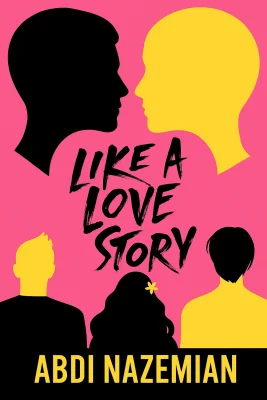
Like a Love Story
Categories
Fiction, Audiobook, Historical Fiction, Romance, Young Adult, Historical, Contemporary, LGBT, Queer, Gay
Content Type
Book
Binding
Unknown Binding
Year
2019
Publisher
Balzer + Bray
Language
English
ASIN
B0DN3VN65Z
File Download
PDF | EPUB
Like a Love Story Plot Summary
Introduction
# Hearts in the Time of Plague: A Coming-of-Age Story The year is 1989, and Manhattan's elite prep school corridors echo with secrets that could destroy lives. Reza Hashemi sits in an orthodontist's chair, blood pooling in his mouth as he rips his own braces out with bare hands. He's desperate to smile without metal, desperate to catch the attention of Art Grant—the purple-haired rebel whose photograph in the yearbook has haunted his dreams since arriving from Iran. Across the city, Art himself stands in a community center pulsing with rage and grief, his camera capturing activists whose faces bear the purple marks of Kaposi's sarcoma. At seventeen, he's the youngest person in rooms where men disappear like ghosts, claimed by a plague the government refuses to name. Between them moves Judy Bowman, stitching together worlds with her sewing machine, creating beauty from scraps while her heart yearns for love that might never come. When these three souls collide in hallways thick with privilege and pretense, they'll forge bonds that transcend friendship and test the very meaning of loyalty. In a world where loving the wrong person means death, where families disown their children, and where the powerful watch young men vanish without lifting a finger, they must choose between safety and truth, between survival and the revolutionary act of living authentically.
Chapter 1: Three Strangers, One City: When Lives Collide in Manhattan
The first day of school arrives like a verdict. Reza clutches his schedule with sweaty palms, his newly braceless smile feeling foreign on his face. The hallways of Manhattan's most exclusive prep school stretch before him like a gauntlet, filled with the children of senators and CEOs who've never had to reinvent themselves in a new country, never had to swallow their father's revolution and pretend it never happened. Judy Bowman spots him immediately. She's a vision in yellow, her handmade dress catching light like captured sunshine, and when she sees this beautiful boy with caramel eyes looking lost, something maternal and hungry stirs in her chest. "You must be new," she says, approaching with the confidence of someone who's learned to make her own luck. "I'm Judy." Art Grant watches this introduction unfold from across the hall, his camera hanging around his neck like a talisman. Through his cracked lens, he sees what Judy sees—the careful way the new boy holds himself, the expensive clothes that can't quite hide his discomfort. But Art sees something else too, something that makes his finger hesitate on the shutter. Recognition. The same isolation that's followed him through seventeen years of being different in a world that demands conformity. When their eyes meet across the crowded hallway, something electric passes between them. Reza feels his carefully constructed composure crack, while Art experiences the vertigo of falling without warning. Neither understands what's happening, but both know their carefully ordered worlds have just shifted on their axis. The triangle forms without ceremony. Judy, generous with her friendship, pulls Reza into her orbit. Art, drawn by forces he can't name, follows. They become an unlikely trio—the designer, the immigrant, and the rebel—bonded by the particular loneliness of teenagers who've learned that being different is both a gift and a curse. In Stephen's apartment across town, Judy's uncle sorts through photographs of men who danced until dawn and died before sunset. The disease is winning, but he's not finished fighting. Soon, he knows, these children will need the lessons only the dying can teach—that love is worth any price, that authenticity is the only currency that matters, and that sometimes the most important revolutions begin in the human heart.
Chapter 2: Icons and Identities: Finding Truth Through Madonna's Mirror
The poster goes up first—Madonna in her wedding dress, "Boy Toy" emblazoned across her belt like a battle cry. Reza's bedroom transforms into a shrine, each image stolen from magazine stands with money pilfered from his stepfather's wallet. His mother discovers the collection during one of her surprise inspections, studying the "Express Yourself" poster with the bewildered expression of someone trying to decode a foreign language. "Why does she have to show her armpit?" she asks, genuine confusion creasing her features. "I like it," Reza says, and for the first time in his life, he means it completely. Madonna represents everything he can't say aloud—the hunger for authenticity, the refusal to apologize for desire, the courage to express yourself when the world demands silence. Art understands this obsession better than anyone. He's been living his own rebellion through music and protest, his lavender hair a middle finger to every expectation his parents have ever harbored. When he discovers Reza's Madonna collection during a study session, something clicks into place like a key finding its lock. "You should join the fan club," Art tells him, handing over a CD like a sacred text. "You get a magazine in the mail. And dibs on concert tickets." But it's more than fandom—it's recognition. In Madonna's refusal to choose between virgin and whore, between sacred and profane, they see their own struggle to exist in a world of false binaries. She's like a prayer and like a virgin simultaneously, embracing contradiction as truth. Judy watches this connection form between her new crush and her best friend with a mixture of joy and unease. She designs clothes inspired by Madonna's fearless fashion choices, creating a shirt for Reza that blends Persian miniatures with contemporary rebellion. The fabric tells a story of ancient beauty meeting modern defiance, much like Reza himself. When she presents the finished piece to him, watching him transform in front of her mirror, she sees something she's never witnessed before—Reza becoming himself. The shirt fits like identity made manifest, all oranges and blues and gold, turning him from a scared refugee into a young prince reclaiming his throne. "You look like a rock star," she breathes, and for a moment, all three exist in perfect harmony—the designer, the muse, and the photographer capturing it all through his cracked lens. But harmony, like youth, proves fragile. In the distance, the sound of protest drums grows louder, calling them toward choices that will test every bond they've built.
Chapter 3: The Triangle Forms: Love, Lies, and Hidden Desires
The flower appears like a confession made manifest—a single pink rose thrust toward Reza outside a Korean deli in the East Village. Art's hands shake as he offers it, his usual confidence cracking like his camera lens. "A present," he says, but his voice carries the weight of everything he can't say aloud. Reza stares at the rose, understanding flooding his features like sunrise. This isn't friendship. This isn't casual kindness. This is Art laying his heart bare on a sidewalk that smells of kimchi and possibility. "I understand," Reza whispers, and for a moment, the world narrows to just the two of them, breathing the same air, sharing the same dangerous secret. But fear proves stronger than desire. "I am sorry," Reza says, each word cutting deeper than the last. "I think you are mistaken." He watches Art's face crumble, watches hope die in those defiant eyes, and hates himself for choosing safety over truth. The rose ends up in Judy's hands instead, transformed into a bouquet of yellow blooms—her favorites, as Art had mentioned during their first real conversation. Reza presents them to her like an apology for thoughts he's never spoken, for desires he can't name. "These are for you," he says, and Judy's face lights up like Times Square at midnight. "How did you know yellow roses were my favorite?" she asks, clutching the flowers to her chest. "Art told me," Reza admits, and the irony tastes bitter on his tongue. His best friend has become his wingman in a romance that feels like elaborate theater, with Reza playing a role he was never meant for. Their first real date unfolds on Saint Mark's Place, that carnival of freaks and artists where Judy feels most at home. She leads him through punk shops and record stores, her yellow dress bright as hope against the gritty backdrop. When she kisses him outside the subway station, pressing her body against his with desperate hunger, Reza feels nothing but the cold metal of his zipper against her searching hands. The triangle completes itself in Stephen's apartment during Sunday movie night, that sacred ritual of old Hollywood glamour and chosen family. But tonight, Reza suggests they go out instead, just the two of them, and Judy agrees with the breathless excitement of a girl in love. Art watches them leave together, his heart breaking in real time, while Stephen adds two more jelly beans to his memorial jar—two more friends claimed by the plague that stalks their community like a biblical curse.
Chapter 4: When Truth Breaks Everything: The Cost of Authenticity
The lingerie hangs on Judy's body like armor made of silk and desperation. She's sewn it herself, copying Madonna's "Express Yourself" video with meticulous care, transforming her bedroom into a stage for seduction. Tonight, she decides, will be the night she and Reza finally become lovers instead of just pretending. But when he arrives, when she reveals herself in the slip and garter that took hours to perfect, his eyes go somewhere else entirely. He looks at her like she's a beautiful painting he can admire but never touch, never possess, never truly want. "You look just like Madonna in the 'Express Yourself' video," he says, and the compliment feels like a knife between her ribs. She doesn't want to look like Madonna. She wants to be desired like Madonna, wanted with the kind of desperate hunger that makes men cross oceans and start wars. She guides his hand to her breast, pressing his palm against her heart that's beating like a trapped bird. Nothing. No heat, no electricity, no sign that her body affects him at all. When she moves his hand lower, searching for evidence of arousal, she finds only disappointment and the terrible understanding that love can't be manufactured, no matter how desperately you want it. "Judy," he whispers, pulling away, his face a mask of shame and sorrow. "I can't do this to you anymore." The truth comes out in fragments, each piece cutting deeper than the last. Art. The flower. The feelings he can't fight anymore. The realization that he's been living a lie, using her as a shield against his own desires. "You like men, or you like Art?" she demands, her voice sharp as broken glass. "Because one of those options is a lot worse than the other." "I like men, and I like Art," he admits, and with those words, her world collapses like a house of cards in a hurricane. She throws him out, her heart breaking in real time, and sits alone in her parents' apartment wearing lingerie designed for a love that was never real. When Art finally appears at her door hours later, Stephen lets him in with the weary resignation of someone who's seen too much heartbreak for one lifetime. They walk through the winter streets, their breath forming clouds between them like the ghosts of all the words they should have said sooner. The friendship that began in childhood, that survived adolescence and family drama and the daily cruelties of high school, finally breaks apart on a sidewalk in Manhattan, two teenagers walking away from each other into uncertain futures.
Chapter 5: Revolution in the Cathedral: Activism as Awakening
The cathedral rises before them like a monument to hypocrisy, all Gothic spires and stained glass hiding centuries of shame and silence. Art stands with Stephen and the other activists outside Saint Patrick's, their breath forming clouds in the December cold, preparing to invade this fortress of denial with nothing but truth as their weapon. Inside, Cardinal O'Connor speaks of morality while men die in the streets. He preaches family values while families disown their children. He invokes God's love while practicing God's hatred, and Art's camera captures it all—the pageantry, the protest, the moment when silence finally breaks. Reza appears like an answered prayer, slipping into the pew beside Art with the quiet desperation of someone who's finally stopped running from himself. "Hi," he whispers, and that single word contains multitudes—apology, confession, surrender. "What are you doing here?" Art asks, hardly daring to believe. "I don't know," Reza admits, but they both know that's a lie. He's here because he can't stay away anymore, because the pull between them has grown stronger than fear, stronger than family expectations, stronger than the threat of death that hangs over every gay man in America. When the protesters lie down in the aisle like corpses, Art photographs them through his cracked lens, each image bearing the scar of violence, the mark of a world under assault. Stephen is among them, playing dead to protest a church that would rather see them actually dead than acknowledge their humanity. The chaos erupts like a dam bursting. Activists scream about condoms and needle exchanges while worshippers clutch their pearls and pray for deliverance from this invasion of truth. Art grabs Reza's hand and they run together, two boys fleeing toward a future they can barely imagine. Outside, the media swarms like vultures. Art seizes the microphone with the confidence of someone who's finally found his voice. "My name is Bartholomew Emerson Grant the Sixth," he declares, using his full name like a weapon, "and I am here protesting the Catholic Church's policies, which are a direct attack on the lives of gay men and women." When the reporter turns to Reza, he covers his face and turns away. But when the police come, when Art is dragged away in handcuffs, Reza finds his voice at last. "Art!" he screams across the chaos. "I came here for you." Those words echo through the winter air like a benediction, like a prayer finally answered, like the sound of a closet door swinging open at last.
Chapter 6: Death as Teacher: Learning Love Through Loss
Stephen's apartment becomes a shrine to the dying and the dead. Judy moves through the rooms like a ghost herself, tending to her uncle with the fierce devotion of someone who knows she's losing the last person who truly sees her. His body betrays him daily—the lesions spreading like dark flowers across his skin, his breath coming in gasps that sound like drowning. But his mind remains sharp, cutting through the fog of medication and pain to orchestrate one final act of love. The Madonna concert tickets appear like magic, six seats to the Blond Ambition tour that he can't use but refuses to waste. "Take them," he whispers to Jimmy, his chosen family, his fellow survivor. "Take them all." The arena throbs with the energy of twenty thousand people desperate to forget their troubles for two hours. Art, Judy, and Reza find themselves seated together by Stephen's design, their months of silence suddenly irrelevant in the face of his generosity. When Madonna takes the stage, something shifts in the space between them. The music becomes a language they all speak fluently—the anthems of outsiders and misfits, the battle cries of those who refuse to apologize for existing. Judy reaches for Reza's hand during "Like a Prayer," and he doesn't pull away. Art captures them both in his viewfinder, but for once, he lowers the camera to simply experience the moment. They sing together, their voices joining twenty thousand others in a chorus of defiance and joy. The hurt is still there—it will always be there—but it's joined by something stronger. The recognition that they are family, chosen and complicated and real. When they return to Stephen's bedside, he sees the change in them immediately. His eyes, sunken but still bright with mischief, move from face to face, cataloging the subtle shifts in their body language, the way they stand closer together now. The weeks that follow are a masterclass in letting go. Stephen teaches them how to say goodbye—not just to him, but to the versions of themselves they've outgrown. He shares his stories, his wisdom, his collection of index cards filled with the names and histories of their community's heroes and martyrs. When the end comes, it's both sudden and inevitable. Judy holds one hand, her mother the other, while Art and Reza keep vigil from the floor. The last thing Stephen sees is their faces, young and beautiful and alive, carrying forward the love he's given them into whatever comes next.
Chapter 7: Separate Paths, Shared Legacy: Growing Up and Moving On
The memorial service transforms a nightclub into a cathedral of memory. Art's photographs line the walls—images of protests and die-ins, of Stephen and José in happier times, of a community that refused to disappear quietly into the night. The pictures tell a story of love and loss, of ordinary people doing extraordinary things in the face of indifference and hate. Judy stands at the podium in a dress of her own design, black silk shot through with silver threads that catch the light like tears. Beside her, Art reads from Stephen's index cards—brief biographies of the forgotten and the famous, the heroes and the heartbroken. Their voices weave together, creating a tapestry of remembrance. In the audience, Reza sits with his family, his mother's hand finding his as the speeches continue. She doesn't understand everything she's hearing, but she recognizes love when she sees it—the fierce devotion of chosen family, the way grief can become a bridge instead of a wall. The dancing that follows is both celebration and mourning, bodies moving to music that speaks of survival and joy and the terrible beauty of being alive in a world that wants you dead. Art and Reza find each other on the dance floor, their bodies speaking a language their words haven't yet learned. When they kiss, surrounded by the ghosts of the dead and the hopes of the living, it feels like coming home. They make love for the first time in borrowed sheets that smell of possibility and fear. It's awkward and beautiful and real—not the polished fantasy of movies but the messy, complicated truth of two people learning to trust each other with their most vulnerable selves. But even in this moment of connection, the future pulls at them with different gravitational forces. Art's acceptance letter to Berkeley waits at home, a golden ticket to a new life on the other coast. The airport departure lounge becomes a stage for their final act, Art's suitcase holding everything he owns—clothes, cameras, and Stephen's index cards, the inheritance of a generation that refused to be erased. "San Francisco," Art says, as if the name itself is a prayer. "The gayest city in the world." The final photograph is taken not by Art but by a stranger, capturing the three of them in their last moment together. They're holding hands, their faces turned toward each other instead of the camera, creating a circle of connection that no distance can truly break. When Art disappears into the security line, Judy and Reza stand watching until he's just another figure in the crowd. Then they turn to each other, these two survivors of love and loss, and begin the slow work of learning to be friends without him.
Summary
In the end, they all become who they were meant to be, though not in the ways they expected. Art finds his voice as a photographer and activist in San Francisco, documenting the ongoing struggle for dignity and recognition. Judy builds a fashion empire on the principle that everyone deserves to feel beautiful, her designs becoming armor for the misfits and the misunderstood. Reza becomes a teacher and father, passing on the stories of those who came before to students who need to know they're not alone. The plague that defined their coming-of-age eventually retreats, defeated by the very activism they witnessed and joined. But the lessons remain—that love is both fragile and indestructible, that families can be chosen as well as born, that the price of authenticity is always worth paying. Stephen's index cards scatter across the country, carried by the three young people whose lives he helped shape, ensuring that the stories of the forgotten will never truly die. In coffee shops and classrooms, in galleries and design studios, the echoes of resistance continue to sound, a reminder that every generation must choose between silence and truth, between safety and love, between existing and truly living.
Best Quote
“Tell your story until it becomes woven into the fabric of our story. Write about the joys and the pain and every event and every artist who inspires you to dream. Tell your story, because if you don't, it could be wiped out. No one tells our stories for us. And one more thing. If you see an elderly person walking down the street, or across from you at a coffee shop, don't look away from them, don't dismiss them, and don't just ask them how they're doing. Ask them where they have been instead. And then listen. Because there's no future without a past.” ― Abdi Nazemian, Like a Love Story
Review Summary
Strengths: The review highlights the book's emotional depth and its ability to resonate with readers both young and adult. It praises the novel's portrayal of hope, community, and courage amidst the AIDS crisis, and its celebration of queerness, activism, and self-expression. The narrative is described as both gutting and tender, capable of evoking strong emotional responses. Overall: The reviewer expresses a highly positive sentiment, recommending "Like a Love Story" as a powerful and moving read. It is described as a love letter to marginalized communities and a critique of historical neglect, suggesting it is a significant and impactful novel.
About Author

Abdi Nazemian
Nazemian delves into complex intersections of identity, family, and history, weaving his Iranian heritage and queer experiences into a rich tapestry of young adult and adult fiction. His novels often explore the Iranian diaspora and queer identity, using emotionally charged storytelling to highlight themes of cultural and personal discovery. In "Like a Love Story," he delves into the AIDS crisis of the 1980s, earning a Stonewall Honor and recognition from Time magazine as one of the best YA novels of all time. Meanwhile, "Only This Beautiful Moment" intertwines intergenerational narratives of queer Iranian history, garnering both the 2024 Stonewall Award and Lambda Literary Award for Young Adult Literature. These accolades underscore his ability to blend historical contexts with personal narratives, providing readers with profound insights into marginalized communities.\n\nThrough his writing process, Nazemian often prioritizes character development over rigid plotting, allowing the narrative to unfold organically. This method infuses his work with authenticity and emotional depth, engaging readers who appreciate nuanced storytelling. His debut, "The Walk-In Closet," marked a significant breakthrough, winning the Lambda Literary Award for LGBT Debut Fiction and setting the stage for his subsequent works. Beyond his novels, Nazemian has also made notable contributions to screenwriting, working on films like "The Artist’s Wife" and television series such as NBC's "Ordinary Joe." This versatility enriches his narrative voice, offering a multidimensional perspective on the experiences of queer and Iranian diasporic communities. Through these efforts, Nazemian's books resonate deeply with audiences seeking diverse stories that reflect a broad spectrum of human experience.
Read moreDownload PDF & EPUB
To save this Black List summary for later, download the free PDF and EPUB. You can print it out, or read offline at your convenience.
Like a Love Story
by Abdi Nazemian
