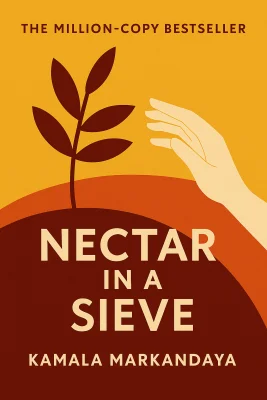
Nectar in a Sieve
Categories
Fiction, Classics, Historical Fiction, Literature, India, School, Historical, Indian Literature, High School, Read For School
Content Type
Book
Binding
Mass Market Paperback
Year
2001
Publisher
Signet
Language
English
ASIN
0451528239
ISBN
0451528239
ISBN13
9780451528230
File Download
PDF | EPUB
Nectar in a Sieve Plot Summary
Introduction
In the fading twilight of colonial India, an old woman sits with her memories scattered like grain across the dusty ground. Her weathered hands, once strong enough to plant rice and birth children, now tremble as they sort through the remnants of a life lived close to the earth. This is Rukmani, and her story unfolds like the seasons themselves—brutal summers of famine, monsoons of change, and the quiet winters of acceptance. At twelve years old, she was married to Nathan, a tenant farmer whose hands knew the language of soil and seed. Together they built a life from mud and hope, watching their village transform as the modern world crept in with the thunderous machinery of progress. The tannery arrived like a fever, bringing jobs and chaos, prosperity and ruin. Through it all, Rukmani learned that survival demands more than love—it requires the fierce determination to bend like grass in the wind rather than break like brittle stalks of pride.
Chapter 1: Roots in the Earth: Rukmani's Marriage and Early Village Life
The bullock cart creaked through the morning heat, carrying twelve-year-old Rukmani toward a destiny she could barely comprehend. Her stomach churned with wedding nerves and motion sickness, but Nathan's gentle voice steadied her trembling. The man who would become her husband spoke of harvests as if they were prayers, his calloused hands already mapping out their shared future in furrows and seasons. Their mud hut stood modest against the green backdrop of paddy fields, thatched with coconut fronds and blessed with mango leaves across the doorway. Nathan had built it himself, brick by brick, while neighbors whispered that such devotion might spoil a young bride. But when Rukmani saw the careful way he had smoothed each wall, the precision with which he had aligned each beam, she understood that this was not just shelter—it was a love letter written in earth and straw. The village women welcomed her with knowing smiles and practical wisdom. Kali, robust and loud, taught her the rhythms of rural life. Janaki, worn thin by childbearing, showed her which vegetables thrived in their soil. Even Kunthi, beautiful and distant, became part of the tapestry of daily existence. At the river where they washed their clothes, Rukmani learned that marriage was not just about two hearts joining, but about finding her place in the ancient dance of women who had bent their backs to this same earth for generations. In the evenings, Nathan would sit beside her as she practiced her letters, never jealous of knowledge he couldn't share, only proud that his wife could read and write. Their first child, Irawaddy, arrived like a morning flower—beautiful and unexpected in its perfection. As Rukmani held her daughter against her breast, watching Nathan's face transform with wonder, she felt the deep satisfaction of a life taking root in good soil. But even in those golden early years, change rustled at the edges of their contentment like wind through rice stalks, bringing news of a world beyond their village boundaries.
Chapter 2: Seeds of Change: The Tannery's Arrival and Shifting Fortunes
The bullock carts appeared on the horizon like a dusty invasion, loaded with bricks and iron sheeting, driven by men who spoke their language with foreign accents. The villagers gathered to watch as the first foundations were dug in their sacred maidan, where children had played and festivals had been celebrated since memory began. The tannery would bring jobs, the officials promised, prosperity for everyone who embraced progress. Nathan watched the construction with the wariness of a farmer reading storm clouds. He had seen the earth scarred by progress before, witnessed how quickly the old ways could be buried under new ambitions. But their neighbors saw opportunity in the chaos. Families began calculating how much their sons might earn, how many mouths those wages could feed through the lean months between harvests. The transformation came swift and merciless. Streets widened to accommodate the heavy machinery. The air grew thick with chemical smells that made the children cough and the birds flee to cleaner skies. What had once been a village where everyone knew their neighbor's name became a bustling town where strangers outnumbered friends. Prices doubled overnight as demand outstripped supply, and suddenly the vegetables from Rukmani's garden, once grown for her table, became precious currency in the new economy. Young men who had worked alongside their fathers in the fields now reported to factory supervisors who cared nothing for the ancient rhythms of planting and harvest. They earned more money than their families had ever seen, but they came home reeking of chemicals and speaking of unions and strikes. The very language of labor was changing, and with it, the relationships that had held their community together. Rukmani watched her sons Arjun and Thambi drawn into this vortex of change like iron filings to a magnet. They spoke of fair wages and workers' rights with the passion their father reserved for discussing rainfall and soil conditions. The tannery had planted different seeds in their minds—ideas that would grow into choices no parent could have foreseen.
Chapter 3: Drought and Famine: The Land's Bitter Harvest
The monsoon failed like a broken promise, leaving the sky blue and merciless above withering crops. Day after day, Nathan scanned the heavens for clouds that never came, while the paddy fields transformed from emerald promises to brown stubble that cracked underfoot like broken bones. The river shrank to a muddy trickle, then disappeared entirely, leaving only a scar in the earth to mark where life had once flowed. Rukmani's carefully tended vegetable garden became a graveyard of hope. The pumpkin vines curled and blackened, the chili plants drooped like mourners at a funeral. She stood among the ruins of her small domain, feeling the cruel irony that the earth which had given them life now seemed determined to reclaim it. Even the well, which had never failed in living memory, offered nothing but dust and the echo of their desperate prayers. The family's meager reserves dwindled grain by grain, measured out in portions that grew smaller each day. Rukmani developed the terrible arithmetic of famine—calculating how many handfuls of rice remained, how many days they could stretch what little they had. The children's laughter faded first, replaced by the listless quiet of those whose bodies were learning to conserve energy for mere survival. In the town, merchants like Biswas grew fat on desperation, charging outrageous prices for moldy rice and spoiled grain. Those who had savings found them worthless when a handful of rice cost more than a day's wages. The tannery workers, with their steady paychecks, became a new aristocracy while farming families like Nathan's discovered that expertise in growing food meant nothing when no food would grow. When the rains finally came, they arrived too late to save the crops but just in time to mock the hollow-cheeked survivors who stood in the downpour, too weak to dance, too grateful not to weep. The earth drank deeply, but the damage was done—another year of hunger stretched ahead, and the circle of want would continue its relentless turning.
Chapter 4: Children of Necessity: Diverging Paths and Painful Choices
The failure of the harvest scattered Nathan's sons like seeds on barren ground, each seeking survival in directions their father had never imagined. Arjun and Thambi, who had tasted the promise of industrial wages, returned to the tannery with the desperation of men who had seen their families starve. But the owners, sensing weakness, cut their pay and extended their hours until the work became less employment than bondage dressed in the language of opportunity. When the brothers finally rebelled, organizing their fellow workers in a strike for basic dignity, the response was swift and crushing. The owners simply recruited new workers from the endless stream of displaced farmers, men so desperate they would accept any terms. Arjun and Thambi found themselves cast out, blacklisted from the only source of steady income their generation had ever known. The defeat broke something in their spirits. They began to speak of distant places where opportunity might still exist for men willing to work. Ceylon beckoned with promises of tea plantation jobs and wages paid in real money, not the hollow tokens of hope their father's generation had learned to accept. Nathan, watching his sons plan their exodus, felt the ancient pain of parents everywhere who must watch their children choose between loyalty and survival. Rukmani's beautiful daughter Ira faced choices that cut even deeper. Married young to a promising farmer, she endured five childless years before being returned to her parents like damaged goods. In a culture where a woman's worth was measured in sons, barrenness marked her as fundamentally broken. The family that had celebrated her wedding with such joy now struggled to find words of comfort that didn't sound like accusations. When Kenny, the foreign doctor, offered hope through modern medicine, Rukmani grasped at the possibility like a drowning woman clutching driftwood. But hope, when it finally arrived, came wrapped in shame—for by the time Ira conceived, her methods of earning money to feed her youngest brother had already marked her as something the village could never fully accept again.
Chapter 5: Uprooted: The Loss of Land and Journey to the City
The morning Sivaji arrived with eviction notice, Nathan's face crumbled like sun-baked mud under sudden rain. Thirty years of marriage to this patch of earth, thirty harvests wrested from its reluctant soil, and now it would all be swept away by papers signed in distant offices by men who had never felt dirt under their fingernails. The tannery's expansion demanded their rice fields, and tenant farmers had no legal standing against industrial progress. Rukmani moved through their hut like a sleepwalker, touching objects that had accumulated the weight of decades—the grinding stone where she had prepared countless meals, the wooden chest that had held her wedding saris, the corner where each of her children had taken their first steps. Everything that couldn't be carried would be left behind, including the intangible things that mattered most: the familiarity of knowing which path led to the river, which neighbor could be trusted with a secret, which season brought the sweetest mangoes. The decision to seek their son Murugan in the distant city felt less like choice than surrender. Nathan, his body already weakened by years of inadequate nutrition, would never find another landlord willing to rent to an aging tenant farmer. Their remaining sons had chosen their own paths—Selvam committed to his medical training, Arjun and Thambi vanished into the anonymity of indentured labor. Only Murugan, working as a servant in a prosperous household, offered the possibility of shelter for his displaced parents. The bullock cart that carried them away from everything they had known lurched over roads that seemed to lead not toward hope but toward the dissolution of identity itself. Behind them, their village—already transformed beyond recognition by the tannery's relentless growth—continued its evolution into something neither rural nor truly urban, a hybrid creature that belonged fully to neither past nor future. As the familiar landscapes gave way to the alien geometries of the city, Rukmani understood that they were not just traveling toward their son, but crossing a threshold from which there would be no return. The life they had known was ending not with drama but with the quiet finality of a door closing on an empty room.
Chapter 6: The Final Return: Gathering What Remains of Life
The city swallowed them like a great beast, indifferent to their confusion and contempt for their innocence. Streets twisted in directions that defied rural logic, filled with traffic that moved according to rules Nathan and Rukmani had never learned. The noise never stopped—a cacophony of horns, bells, shouting voices, and machinery that made conversation impossible and sleep a luxury stolen in brief moments between the urban assault on their senses. When they finally found Murugan's household, they discovered that their son had already vanished into the city's anonymity, leaving behind only a bitter daughter-in-law and grandchildren who stared at them like unwelcome ghosts. Ammu, worn thin by abandonment and responsibility, made it clear that her resources could barely support her own children, let alone two aging in-laws who brought nothing but additional mouths to feed and hearts full of rural expectations. The temple became their refuge, joining the legion of displaced souls who gathered each evening for the single meal that stood between them and starvation. Here, Rukmani learned the cruel mathematics of urban poverty—how to position oneself in the queue for maximum efficiency, how to make a handful of rice last an entire day, how to sleep on stone floors while guarding the few possessions that represented the difference between destitution and absolute despair. Nathan's health, already compromised by years of inadequate nutrition, began to fail under the assault of city life. The rheumatism that had been manageable in their village became crippling in the damp, crowded temple corridors. Fever came and went like an unwelcome visitor who refused to leave permanently, each episode leaving him weaker and more disconnected from the urban struggle for survival. In the stone quarry where they found work breaking rocks for construction projects, Nathan's body finally surrendered to the accumulated weight of hardship. One evening, as the monsoon rains turned the city streets into rivers of mud and misery, he collapsed beside the road that had become as familiar as their old village paths. Rukmani held him as his gentle spirit withdrew, whispering words of love that the rain washed away even as they were spoken.
Chapter 7: New Growth: Finding Family Beyond Blood
The journey home began with a child's compassion. Puli, the fingerless boy who had appointed himself their guide through the urban maze, became the son that necessity and affection created from the ruins of their old life. His practical wisdom and street-hardened resilience bridged the gap between Rukmani's rural innocence and the harsh realities of survival in a world that showed no mercy to the weak or unprepared. Together, they made their way back to the village that had been transformed in their absence. The hospital Kenny had envisioned was finally taking shape, rising from the red earth like a promise that suffering might someday find adequate answer in human compassion and scientific knowledge. Selvam, no longer the uncertain young man who had struggled to choose between tradition and progress, had found his calling in the careful art of healing bodies that poverty and neglect had broken. Ira welcomed them with the quiet strength of a woman who had learned to create stability from whatever materials life provided. Her son Sacrabani, marked by albinism but cherished by his mother's fierce love, represented hope's ability to flourish even in circumstances that seemed designed to crush it. The unconventional family they formed—grandmother, daughter, adopted son, and grandchild—proved that blood relationships, while powerful, were not the only bonds capable of sustaining life through its inevitable trials. In the evenings, as they sat together sharing simple meals prepared with ingredients grown in their own small garden, Rukmani felt something she had not experienced since Nathan's death: the contentment that comes from being surrounded by people who choose to care for each other. Puli's laughter mixed with Sacrabani's tentative questions, Ira's gentle corrections, and Selvam's quiet observations about his patients and his hope for the future. The hospital, when it finally opened, became a symbol of what human determination could accomplish when guided by compassion rather than mere profit. Kenny's vision, sustained through years of frustration and setback, offered concrete proof that suffering was not inevitable—that knowledge and care, properly applied, could ease the burdens that had seemed like permanent features of rural life.
Summary
Rukmani's story closes not with triumph but with the deeper satisfaction of survival transformed into wisdom. The land that had seemed like the foundation of all security had proven as changeable as the monsoons, but the human capacity for adaptation and love had endured through every transformation. Her family, scattered and regathered in new configurations, demonstrated that resilience grows not from rigid adherence to tradition but from the willingness to bend without breaking. The arrival of modernity, embodied by the tannery that had disrupted their village's ancient rhythms, had brought genuine hardship alongside its promised benefits. But it had also created opportunities for those brave enough to embrace change without surrendering their essential humanity. Selvam's medical career, Ira's determination to protect her son despite social judgment, and Puli's street-smart survival skills all represented different strategies for navigating a world where the old certainties no longer provided reliable guidance. In learning to harvest hope from seasons of despair, they had discovered that the human spirit, like the earth itself, possesses an inexhaustible capacity for renewal when tended with patience and watered with love.
Best Quote
“For where shall a man turn who has no money? Where can he go? Wide, wide world, but as narrow as the coins in your hand. Like a tethered goat, so far and no farther. Only money can make the rope stretch, only money.” ― Kamala Markandaya, Nectar in a Sieve
Review Summary
Strengths: The review highlights the book's vivid depiction of rural Indian life in 1954, emphasizing the realistic portrayal of poverty and the impact of nature on the characters' lives. The narrative's exploration of societal changes, such as the introduction of a tannery and a British doctor's clinic, adds depth to the story. The enduring love between the main characters is noted as a poignant element. Weaknesses: The review suggests a lack of significant change over time, questioning the progress in rural India. The portrayal of the British doctor as an "Ugly European" may imply a stereotypical depiction, potentially detracting from the narrative's complexity. Overall: The review conveys a sense of admiration for the book's honest portrayal of hardship and resilience, though it questions the extent of societal progress. The book is recommended for its emotional depth and insightful themes.
About Author

Kamala Markandaya
Markandaya interrogates the cultural clash between Indian urban and rural societies, emphasizing themes of identity, modernity, and tradition. Her work frequently explores the tension between Eastern traditions and Western modernity, providing a critical lens on colonialism's impact on Indian society. This dual perspective allows readers to understand the complexities of cultural alienation and the challenges of urbanization, poverty, and the quest for independence. Her debut novel, "Nectar in a Sieve", illustrates the struggles of rural farmers, which resonated internationally, whereas "Nowhere Man" addresses issues of identity and rootlessness, a recurring theme in her books.\n\nMarkandaya's literary method involves portraying characters caught between two worlds, reflecting her diasporic experience. This approach allows readers to engage with the intricate social distinctions and economic class challenges faced in post-colonial India. For instance, "A Silence of Desire" delves into the inner turmoil of its characters as they navigate these cultural intersections. Moreover, her ability to address environmental and societal problems brought by globalization showcases a prescient awareness that benefits readers interested in the socio-political dynamics of the time.\n\nThis bio of Kamala Markandaya, the esteemed author, highlights her influence as a pioneering Indian novelist writing in English. Her works, often compared to contemporaries like R.K. Narayan, are essential for those interested in understanding the post-colonial literary canon. Despite setbacks later in her career, such as the reception of her book "Shalimar", Markandaya's contributions continue to impact readers and scholars, offering invaluable insights into the cultural and historical narratives of modern India.
Read moreDownload PDF & EPUB
To save this Black List summary for later, download the free PDF and EPUB. You can print it out, or read offline at your convenience.
Nectar in a Sieve
by Kamala Markandaya
