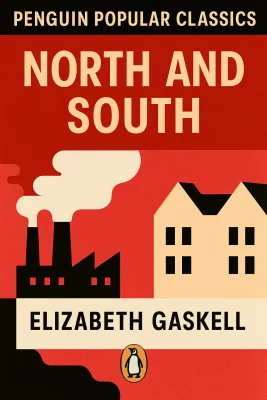
North and South
Categories
Fiction, Classics, Audiobook, Historical Fiction, Romance, Historical Romance, Literature, 19th Century, Historical, Victorian
Content Type
Book
Binding
Paperback
Year
1994
Publisher
Penguin Books
Language
English
ASIN
0140620192
ISBN
0140620192
ISBN13
9780140620191
File Download
PDF | EPUB
North and South Plot Summary
Introduction
# Hearts Divided: A Tale of North and South The morning Margaret Hale learned her world was ending, she stood in her father's study watching him pace like a caged animal. Outside, the Hampshire countryside bloomed in gentle perfection, but inside the Helstone parsonage, Reverend Hale's voice cracked as he spoke the words that would shatter everything: "I can no longer remain a minister in the Church of England. We must leave this place." His crisis of faith would drag them from their pastoral paradise to Milton-Northern, an industrial town where cotton mills belched smoke into gray skies and the air tasted of coal and ambition. There, in that alien landscape of machinery and soot, Margaret would collide with John Thornton—a mill owner whose iron will matched her own fierce pride. He was everything she despised about the industrial North: hard, calculating, a man who spoke of workers as if they were merely components in his great machine. She was everything he mistrusted about the genteel South: refined, idealistic, quick to judge what she had never struggled to understand. Their battle would rage across the divide between two worlds, while around them a strike brewed that would test every principle they held sacred. In this crucible of conflict, where tradition clashed with progress and hearts were forged in fire, neither could foresee that their mutual hatred masked something far more dangerous.
Chapter 1: Exile from Eden: The Hale Family's Journey to Milton
The train's whistle shrieked through the morning air as Margaret pressed her face to the window, watching the green hills of Hampshire dissolve into memory. Beside her, Mrs. Hale wept quietly into her handkerchief while Mr. Hale stared ahead with the hollow eyes of a man who had lost his way. The crisis had come suddenly—her father's doubts about church doctrine crystallizing into an impossible choice between silence and exile. Milton assaulted Margaret's senses from the moment they stepped onto the platform. The air hung thick with smoke and the metallic taste of industry. Workers streamed through the streets like human rivers, their faces marked by exhaustion and something harder than anything she had known in the gentle South. The women touched her shawl boldly, commenting on its quality with a familiarity that made her cheeks burn, while the men's open stares and crude compliments shocked her southern sensibilities. Their new home in Crampton felt like a prison after the spacious parsonage they had abandoned. The walls pressed close, the rooms dark with perpetual soot, while outside the constant thunder of machinery created a heartbeat that never ceased. Mrs. Hale took to her bed immediately, claiming the northern air disagreed with her constitution, though Margaret suspected deeper wounds were festering beneath her mother's genteel complaints. Mr. Hale threw himself into his new role as private tutor, grateful for any distraction from his spiritual crisis. Among his pupils was John Thornton, a mill owner who came twice weekly to study classics. Margaret's first glimpse of this man came when she answered the door to find him waiting—tall and broad-shouldered, with dark eyes that seemed to calculate the value of everything they surveyed. His bearing spoke of command, of a man accustomed to being obeyed without question. The transformation was complete. They were no longer the respected family of Helstone parsonage, but strangers in a strange land where worth was measured by different standards entirely. Margaret felt the ground shift beneath her feet like sand, knowing that everything familiar had been stripped away, leaving only the harsh reality of their new existence in this alien world of smoke and steel.
Chapter 2: Collision of Worlds: Margaret Meets the Industrial North
Margaret's education in Milton's ways began on the streets, where she encountered the human machinery that fed the great mills. Walking to find servants, she was swept up in streams of workers flowing through narrow lanes like blood through arteries. Their boldness startled her—women who touched her dress to feel its quality, men whose appreciative comments made her burn with indignation, though she sensed no real malice in their rough familiarity. When John Thornton finally appeared in their modest drawing room, the contrast struck her like a physical blow. Here was no crude mill hand but a gentleman in bearing if not birth, his manners formal yet somehow lacking the easy grace she had known in Hampshire society. He spoke of his business with quiet authority, but Margaret detected something colder beneath—a philosophy that seemed to reduce human relations to mere arithmetic. Their first real conversation crackled with mutual incomprehension. Thornton defended Milton's industrial progress with passionate conviction, describing how trade lifted men from poverty and gave them purpose. Margaret countered with memories of southern gentility, questioning how such harsh expressions could mark the faces of his workers if industry truly blessed them. Each word seemed to widen the gulf between them—she the daughter of faded gentry, he the self-made master of machinery and men. The evening ended with both convinced of the other's fundamental wrongness. Thornton left certain that Margaret was a proud, disagreeable girl who looked down on honest industry from the comfort of her ignorance. Margaret remained equally sure that he was a hard man who valued profit above human feeling, who had forgotten that his workers possessed souls as well as hands. Yet something had passed between them in that charged atmosphere, something neither quite understood. In challenging each other, they had found an intensity of engagement that neither had encountered before. The very force of their opposition suggested depths worth exploring, though neither would have admitted such a thing. The battle lines were drawn, but the war itself had only just begun.
Chapter 3: Battle Lines Drawn: Class, Principle, and Growing Attraction
The strike came like a gathering storm, and Margaret first learned of its approach through Nicholas Higgins, a mill worker whose daughter Bessy lay dying from lung disease caused by cotton fluff. In their cramped house in Frances Street, she witnessed poverty that made her comfortable complaints seem petty. Bessy spoke of dreams and visions while her father raged against masters who would grind workers into dust for the sake of profit margins. Thornton's perspective emerged during dinner conversations with her father, where he spoke of trade as warfare and competition as natural law. When workers struck for higher wages, he saw rebellion against the order that kept civilization functioning. His own rise from draper's assistant to mill owner proved that merit could triumph over circumstance, so why should others not follow the same path through discipline and determination? Margaret found herself caught between these worlds like a woman standing on shifting ground. At the Thorntons' dinner party, she sat among mill owners who discussed machinery and markets with religious fervor, while her heart ached for Bessy's suffering and the desperate children she had seen in the workers' districts. The contrast was brutal—crystal gleaming in candlelight while families starved mere streets away. The philosophical battle between Margaret and Thornton intensified with each encounter. She accused him of treating workers like machines, caring only for profit while ignoring human cost. He countered that sentiment without understanding was useless—that hard decisions required hard hearts, and those who flinched from necessity would see everyone suffer. Each conversation left them more convinced of their own righteousness and more frustrated by the other's apparent blindness. Yet something was shifting beneath their antagonism like tectonic plates preparing to rupture. Margaret began to recognize the weight of responsibility Thornton carried, the genuine concern beneath his harsh words. He, despite himself, found his certainties shaken by her passionate advocacy for the powerless. Neither would admit it, but they were beginning to see the world through each other's eyes, and the view was more complex than either had imagined.
Chapter 4: Crisis and Sacrifice: The Strike and Margaret's Intervention
The explosion came on a sweltering afternoon when desperation finally overwhelmed restraint. Margaret, walking to borrow a water bed for her dying mother, found herself caught in a human tempest as striking workers surrounded Marlborough Mills like an army laying siege. Their faces were twisted by hunger and rage, their voices rising in a roar that seemed to shake the very foundations of the building. At the center of the storm stood Thornton, calm and resolute despite the fury pressing against his gates. He had brought in Irish workers to break the strike, and now faced the consequences of that decision. The crowd surged forward, stones flying, voices screaming for justice or revenge—the distinction had long since been lost in the heat of their desperation. Margaret found herself trapped in the mill yard as violence erupted around her. Thornton, seeing her danger, tried to speak to the crowd from an upper window, but his words were swallowed by their rage. A stone struck him, blood flowing down his face, and Margaret acted without thought or consideration of consequence. She stepped beside him at the window, her presence somehow calming the fury below. The sight of a lady risking herself for their master's sake shamed the mob into momentary silence, creating a space where reason might penetrate the madness. In that crucial moment, the authorities arrived and the crowd began to disperse, but not before another stone caught Margaret on the temple, sending her crashing unconscious into Thornton's arms. The crisis passed, but its aftermath lingered like smoke in still air. Margaret's intervention had consequences she hadn't foreseen—Thornton, seeing her risk herself for his sake, began to hope that her feelings toward him might be changing. But Margaret, horrified by what her impulsive action might be thought to mean, withdrew into cold formality that wounded him more than any physical blow. The very act that should have brought them together instead drove them further apart, each misunderstanding the other's response to their moment of shared danger.
Chapter 5: Shadows of Truth: Family Secrets and Moral Compromises
The shadow that had followed them from Helstone finally revealed its true shape when Dr. Donaldson spoke the words Margaret had been dreading: Mrs. Hale was dying, her illness beyond any cure that medical science could provide. The knowledge sat like lead in Margaret's chest as she watched her mother fade, knowing she must somehow shield her father from the full horror until he was ready to bear it. In the midst of this private tragedy came an unexpected visitor. Frederick, Margaret's brother, arrived under cover of darkness, his naval uniform replaced by civilian clothes that could not disguise his military bearing. Years of exile had hardened him, but his love for his family remained unchanged. He had risked everything to see his mother one last time, knowing that his presence in England could mean arrest, court-martial, and death. The secret of Frederick's visit weighed on Margaret like a physical burden. He had been branded a mutineer after leading his fellow sailors in rebellion against a brutal captain, and though she knew the justice of his cause, the law saw only treason. She helped him navigate the dangerous days in Milton, arranging meetings with lawyers and planning his eventual escape back to the continent where he had built a new life. The crisis came at the railway station, where Frederick was to catch the train that would carry him to safety. As they waited on the platform, a drunken man recognized him and attempted to make an arrest. In the struggle that followed, the man fell and struck his head—an accident that would later prove fatal. Frederick escaped, but not before John Thornton had ridden past and seen Margaret with a strange man in the gathering dusk. When the police inspector called at Crampton Terrace, Margaret faced an impossible choice. To tell the truth would expose Frederick's presence in England and potentially destroy his chances of ever clearing his name. To lie would violate every principle her father had taught her about honesty and moral courage. In the end, love triumphed over principle, and she denied being at the station that night. The lie came easily to her lips, but it poisoned her conscience and created a barrier between herself and Thornton that seemed impossible to bridge.
Chapter 6: Hearts in Exile: Misunderstanding and Separation
Thornton's manner toward Margaret changed completely after that night at the railway station. Where once there had been warmth, even passion, now there was only cold politeness that cut deeper than any harsh word. He had seen her with another man in circumstances that could only appear compromising, and now he knew she had lied about it. The woman he had placed on a pedestal had fallen, and the fall was complete and irreversible in his eyes. Margaret found herself trapped in a web of her own making, unable to explain without revealing Frederick's secret, unable to bear Thornton's silent condemnation. She had sacrificed her reputation, her integrity, her standing in his eyes, all to protect a brother whose safety had never truly been in question. The irony was bitter beyond measure—her lies had been unnecessary, but their consequences were all too real. The aftermath of the strike brought unexpected developments that might have bridged their divide under different circumstances. Nicholas Higgins, proud despite defeat, came to Thornton seeking work—not for himself, but to honor his promise to care for Boucher's orphaned children. The confrontation between master and man, mediated by Margaret, revealed depths in both that surprised her. Thornton's eventual decision to employ his former enemy showed a capacity for forgiveness she hadn't expected, while Higgins' swallowing of his pride demonstrated strength of a different kind. Margaret began to see that Milton's harsh realities demanded harsh responses—that Thornton's seeming coldness might mask a deeper compassion, one that looked beyond immediate kindness to longer-term consequences. Yet even as her understanding of him deepened, the gulf between them seemed to widen. Every attempt at normal conversation was stilted, weighed down by unspoken accusations and explanations that could never be given. Margaret felt the loss like a physical ache, knowing that something precious had been destroyed by circumstances beyond her control. When her father announced they would be leaving Milton for Oxford, she felt both relief and a grief she dared not examine too closely.
Chapter 7: Reconciliation: Love Conquers Pride and Prejudice
The letter from London arrived like a bolt from a clear sky, informing Margaret that Mr. Bell, her father's old friend and her godfather, had died suddenly, leaving her his entire fortune. The sum was staggering—enough to make her wealthy beyond anything she had ever imagined, and with it came properties, investments, and most ironically, ownership of mills in the very district where she had first encountered the harsh realities of industrial life. Margaret's newfound wealth changed everything and nothing. The money could not restore her parents to life or erase the lies she had told to protect Frederick. It could not bridge the gulf that had opened between her and Thornton, who had grown distant and formal since learning of her deception. She was now a woman of property and influence, yet she felt more isolated than ever from the human connections that gave life meaning. When news reached her of Thornton's financial troubles, Margaret felt the cruel irony of their reversed circumstances. The man who had once commanded Milton's industrial landscape with such confidence was now reduced to seeking employment as a manager in someone else's mill. His pride, the very quality that had first attracted and infuriated her, would never allow him to accept charity from the woman who had deceived him. Yet she could not bear the thought of his talents being wasted in some subordinate position where his vision and intelligence would be constrained by lesser men's limitations. When Henry Lennox, her legal advisor, suggested a business arrangement that might benefit them both, Margaret seized the opportunity with desperate hope. She could provide the capital Thornton needed to restart his operations, while he could offer the expertise that would make her investment profitable. The meeting in her aunt's London drawing room crackled with the same tension that had marked their first encounters in Milton. Thornton listened to her proposal with controlled courtesy, but she could see the struggle playing out behind his careful expression. When she finished speaking, the silence stretched between them like a bridge neither dared to cross. Then, in a moment that seemed to suspend time itself, the barriers they had built around their hearts finally crumbled. The business proposal became irrelevant as they acknowledged the truth that had been growing between them since that first day at the mill gates—that their love had survived misunderstanding, pride, deception, and loss, emerging stronger for having been tested by fire.
Summary
In the smoky embrace of Milton's industrial landscape, Margaret Hale discovered that love could flourish in the most unlikely soil. Her journey from southern gentility to northern pragmatism had stripped away the comfortable assumptions of her youth, replacing them with a harder but more authentic understanding of human nature. The mill owner who had once seemed the embodiment of everything she despised had revealed himself to be a man of principle and passion, while she had learned that her own moral certainties were more fragile than she had ever imagined. The story of their courtship was also the story of a changing England, where ancient class divisions were being challenged by the democratic forces of industry and commerce. In choosing each other, Margaret and Thornton chose to bridge not only the gap between North and South, but between the old world of inherited privilege and the new world of earned achievement. Their love became a symbol of reconciliation, proving that understanding could triumph over prejudice when hearts were brave enough to remain open to transformation, and that even the deepest wounds could heal when truth finally conquered pride.
Best Quote
“I know you despise me; allow me to say, it is because you do not understand me.” ― Elizabeth Gaskell, North and South
Review Summary
Strengths: The review highlights the depth of John Thornton's character, emphasizing his emotional investment in the relationship, which is rare for male love interests. The reviewer appreciates Elizabeth Gaskell's skillful language and the thoughtful inclusion of epigraphs. The detailed analysis of specific scenes, such as Thornton's first meeting with Margaret and his persistence in shaking her hand, showcases the nuanced character development. Overall: The reviewer expresses a strong admiration for both the character of John Thornton and Elizabeth Gaskell's writing style. The review is enthusiastic and recommends the book highly, particularly for its relatable and well-developed characters.
About Author

Elizabeth Gaskell
Gaskell delves into the intricate social dynamics of Victorian England through her novels, focusing on themes of social justice and industrialization. Her writing offers a vivid portrayal of various societal strata, including the working class, as seen in her breakthrough book, "Mary Barton". The author’s interest in the tension between industrial progress and traditional values is further explored in "North and South", where she contrasts the industrial North with the pastoral South of England. Her works provide both literary enjoyment and critical social commentary, making them invaluable resources for understanding the complexities of 19th-century British society.\n\nGaskell's method of integrating gothic elements into her narratives, particularly in her ghost stories, sets her apart from her contemporaries. This approach is complemented by her candid examination of moral and social issues, as demonstrated in the controversial novel "Ruth", which challenged societal norms regarding morality. Her exploration of character and setting not only entertains but also prompts readers to reflect on social issues, making her works relevant to both literature enthusiasts and social historians. Additionally, her "The Life of Charlotte Brontë" is notable for being the first biography written by a woman novelist about another, offering a unique perspective on Brontë's life and work.\n\nAs a highly-regarded Victorian novelist, Gaskell's literary contributions have gained increasing recognition over the past few decades. Her ability to weave social issues into compelling narratives continues to engage academics, literary theorists, and general readers alike. Her novels, while reflective of their time, also offer timeless insights into human nature and society, making her body of work a significant part of the Victorian literary canon. This brief bio highlights the impact of her storytelling on both historical and contemporary audiences.
Read moreDownload PDF & EPUB
To save this Black List summary for later, download the free PDF and EPUB. You can print it out, or read offline at your convenience.

North and South
by Elizabeth Gaskell
