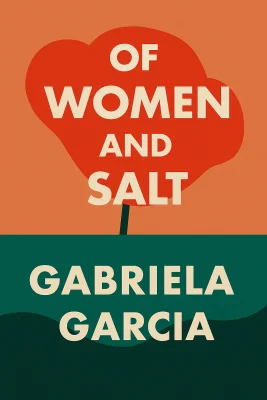
Of Women and Salt
Categories
Fiction, Audiobook, Feminism, Historical Fiction, Adult, Book Club, Historical, Contemporary, Literary Fiction, Latinx
Content Type
Book
Binding
Hardcover
Year
2021
Publisher
Flatiron Books
Language
English
ISBN13
9781250776686
File Download
PDF | EPUB
Of Women and Salt Plot Summary
Introduction
The acrid smoke of burning tobacco leaves filled María Isabel's lungs as she bent over her rolling station in colonial Cuba, 1866. Outside, Spanish soldiers prepared for another massacre. She touched her swollen belly and whispered prayers to saints she wasn't sure existed, while her husband Antonio read revolutionary words from the lectern above—words that would soon cost him his life. More than a century later, another woman named Gloria would grip her daughter Ana's hand in a Texas detention center, watching children play on industrial playground equipment behind razor wire. The same blood that had pumped through María Isabel's revolutionary heart now coursed through Gloria's veins as she faced deportation to El Salvador—a country that had tried to kill her once before. Between these two moments stretched generations of women who crossed borders, survived violence, lost children, and carried forward the ancient knowledge that survival sometimes requires the most brutal choices. Their stories intertwine like smoke from those long-ago cigars, drifting across time and geography to reveal how trauma passes from mother to daughter like an inheritance nobody wants but everyone must claim.
Chapter 1: Seeds of Resistance: María Isabel's Defiance in Colonial Cuba
María Isabel was the only woman in the tobacco workshop, her fingers stained brown from years of rolling cigars while the lector Antonio read aloud from his elevated platform. She had learned to hide her cough—showing weakness would give the foreman Don Gerónimo another excuse to dock her already meager wages or worse, to grab her by the neck as he had before, leaving finger-shaped bruises that lasted weeks. The year was 1866, and revolution crackled through Cuba like wildfire through dry cane. When Antonio read Victor Hugo's letter to the Cuban women—"Who are we? Weakness. No, we are force"—María Isabel felt something ancient stir in her chest. But Porteños, the workshop owner, snatched the papers away and forbade such readings. The Spanish colonial government had no patience for revolutionary sentiment, especially not in the mouths of tobacco workers. María Isabel had married Antonio because she needed protection after her parents died of yellow fever. Her mother, weakening by the day, had made finding a husband María Isabel's urgent mission. Antonio was gentle, educated, a man who treated her mind as something worth cultivating. During lunch breaks, he taught her to read, holding her hand as she traced letters across parchment. When he gave her gifts—a book, a small brooch—she hid them from Don Gerónimo's predatory gaze. The gift that changed everything was a novel: Cecilia Valdés, the story of a mulata woman navigating Cuba's racial hierarchies. María Isabel couldn't read it herself, but she treasured it as a symbol of the knowledge Antonio believed she deserved. She pressed it between the pages of her life like a flower, something beautiful to preserve against the coming storm. When the Spanish soldiers finally came for the underground reading circles, when they found Antonio with his revolutionary books and his dangerous ideas, María Isabel held that novel against her chest as she went into labor, her screams mixing with the crack of rifles in the distance. The baby arrived as her husband died, both emerging into a world soaked in Spanish blood and Cuban dreams. María Isabel named her daughter Cecilia and whispered the words that would echo through generations: "We are force." She tucked the novel into a hollow in the wall, where it would wait for another pair of hands to discover its secrets more than a century later.
Chapter 2: Fractured Bonds: Carmen and Jeanette's Shared Wounds
Carmen sat at her mahogany dining table in Coral Gables, arranging place settings for fifteen family members she barely tolerated. Thanksgiving 2016, and her daughter Jeanette was coming to dinner for the first time in years—fresh out of rehab, supposedly sober, bringing along Mario, the man who had introduced her to heroin in the first place. The irony wasn't lost on Carmen that she, descendant of revolutionaries, had become everything her ancestors fought against: wealthy, insulated, perfectly coiffed in her Ralph Lauren suit while her own daughter dissolved into addiction mere miles away. She had banned Jeanette from family gatherings for three years, believing that cutting off love might somehow save her. The strategy had failed spectacularly. Across the street, strange growls emanated from her neighbor's house—sounds that made Carmen think of caged predators. She tried to focus on the turkey browning in her oven, on the hibiscus blooms she had arranged just so, but the sounds pulled at something primitive in her chest. When Mario stepped outside for a cigarette, Carmen followed and confronted him, certain he carried pills that would drag her daughter back into hell. The growls grew louder. That night, after her guests had left and Jeanette had departed in tears, Carmen broke into her neighbor's house and discovered the source: a young panther, beautiful and deadly, pacing in a metal cage. For long moments, woman and predator stared at each other through the bars. Carmen understood what she saw—the futility of caging wild things, the way captivity breeds rage. She thought of her own daughter, of the cage addiction had built around Jeanette's life, of the bars that love could never bend. The panther's muscles rippled beneath its sleek coat as it hissed at her presence. Carmen felt an inexplicable urge to open the cage, to let them both run wild into the humid Florida night. Instead, she fled back to her sterile house, carrying the secret like a weight in her chest. Five years later, the panther would escape and maul its owner, just as Carmen's own caged beast—the truth about her late husband's abuse of Jeanette—would finally break free and destroy what remained of their fractured bond.
Chapter 3: Borders and Cages: Gloria and Ana's Forced Separation
The ICE agents came in the middle of the night, their badges glinting like teeth in the darkness. Jeanette watched from her bedroom window as they led her neighbor Gloria away in handcuffs, leaving seven-year-old Ana behind to knock on a door that would never open again. Jeanette had been clean for six months, living in the suffocating quiet of sobriety, when she heard Ana's small fist pounding on her mother's door. The child stood in purple leggings and a flowered polo, clutching a pink backpack, staring up at windows that would remain dark. Against every instinct screaming danger, Jeanette opened her own door and invited the girl inside. For three days, they lived in limbo—Ana watching cartoons while Jeanette called immigration lawyers who quoted impossible fees and spoke in acronyms that revealed nothing. Ana had made the journey from El Salvador twice, once as a baby and again at four, traveling in a car trunk because deportation had torn her from the only home she remembered. Now she faced separation again, this time from the mother who had risked everything to bring her back. The lawyers explained the system's cruel mathematics: Ana's mother was detained in Texas, lost in a bureaucratic maze where families disappeared into separate facilities across the country. Some children waited months to be reunited with parents; others aged out of the system before ever seeing family again. Ana drew pictures while Jeanette made call after call, her sponsor's warnings about emotional relapse echoing in her head. When Jeanette's probation officer arrived for his scheduled visit, Ana was still there, still drawing houses and birds in blue ink. Jeanette had run out of options and excuses. She called the police herself, watching as they led Ana away with the same bureaucratic efficiency that had claimed her mother. The child didn't cry or resist—she had learned too young that cooperation was sometimes the only form of resistance available. That night, Jeanette relapsed for the first time in six months, the needle sliding into her vein like a key into a lock she thought she had thrown away forever.
Chapter 4: Ghosts of the Past: Dolores's Hidden Violence
New Year's Day, 1959. Fidel Castro's revolution had triumphed, and Daniel Hernández returned from the mountains with blood under his fingernails and revolution burning in his eyes. His wife Dolores set coffee on the stove and wondered if the man who had killed for freedom would finally stop killing her. For years, Daniel's fists had been her most intimate enemy. He would lock their daughters Carmen and Elena in their bedroom while he beat Dolores with the systematic precision of a man destroying sugarcane. The revolution had not gentled him—if anything, tasting power over other men's lives had sharpened his hunger for dominance at home. On the night of celebration, while all of Cuba danced in the streets, Dolores mixed rum and Coca-Cola until Daniel passed out on their sofa. She had hidden a machete behind the guava bush for weeks, sharpening its edge on stolen whetstones, practicing the swing that could fell a man as easily as a stalk of cane. The mind protects us from our own capacity for violence, and Dolores remembered nothing of the killing itself—only Daniel's screams cutting through the night like a blade through silence. She remembered dragging his body on the blood-soaked couch into their backyard, remembered the gasoline catching fire like liquid starlight, remembered watching her husband's face disappear into ash and smoke. But seven-year-old Carmen had witnessed it all from the back door, had seen her father consumed by flames while her mother stood silhouetted against the blaze like an angel of vengeance. The secret burrowed into Carmen's chest like a parasite, feeding on her silence for sixty years. She never spoke of what she had seen, even when she fled Cuba, even when she built her own cage of secrets in Miami, even when her own daughter begged her to explain why love felt so much like violence. Dolores told everyone that Daniel had died a martyr in the mountains. She waved at Castro's victory parade and danced in the streets, a widow celebrating liberation. The truth crumbled to ash with Daniel's bones, but secrets have their own gravity—they bend everything around them, including the children who inherit them like genetic code.
Chapter 5: Addiction's Shadow: Jeanette's Spiral into Darkness
The first OxyContin was pink like a ballet slipper, dissolving on Mario's tongue before he scraped the coating off with his thumbnail. Jeanette watched him crush the pill with a hose clamp stolen from an auto store, transforming medicine into powder, powder into escape, escape into the only love she had ever trusted completely. This was 2006, when pain clinics bloomed across Florida like a plague of neon flowers. Mario worked as a dispensary tech, slipping pills into his socks with the casual efficiency of a man who had found his calling. The doctors barely looked up from their prescription pads; the patients lined up outside in rental cars with out-of-state plates, already sweating and shaking from withdrawal. The Oxy highway ran from Florida to Kentucky, from desperation to temporary relief and back again. Jeanette had met Mario in rehab, drawn to his intelligence and his absolute certainty that addiction existed on a spectrum—that they could manage their use, maintain control, avoid becoming like the hollowed-out ghosts who haunted the clinic waiting rooms. She was nineteen and beautiful, raised in wealth but starving for the kind of love that devoured everything in its path. At the department store where she worked, Jeanette watched a broken woman named Isabel shop for face creams that promised to erase time's damage. Isabel's husband called her stupid and handed Jeanette fifty-dollar tips while his wife looked away in shame. Jeanette recognized something familiar in Isabel's red-rimmed eyes, the tremor in her hands as she fumbled with credit cards and promises. They were both drowning in different substances, both trying to buy their way back to the surface. The pills stopped working long before they stopped taking them. What began as floating in warm cotton became a daily battle against sickness so brutal it felt like dying from the inside out. Mario lost his job; Jeanette lost her ability to care about anything beyond the next fix. Her mother's desperate phone calls became background noise to the sound of her own disintegration, love letters written in a language she could no longer understand. When Isabel's husband returned a product to Jeanette's counter—something he had never purchased from her store—Jeanette finally found her voice. "You didn't buy that here," she said, her words cutting through years of silence. It was a small rebellion, but it tasted like freedom. That night, she went home and shot heroin for the first time, chasing the ghost of her first high into the darkness that would claim the next decade of her life.
Chapter 6: Return Journey: Ana Seeks Roots in Unfamiliar Land
At thirteen, Ana stood waist-deep in the Rio Grande, garbage bag held above her head while Border Patrol vehicles swept the opposite shore with searchlights. The pollero had warned them about the mud that could swallow a child whole, but Ana wasn't afraid of drowning—she had already survived watching her mother die of cancer in a Mexican clinic, had already learned that death came in small increments rather than single dramatic moments. The dozen migrants sharing her tire-assisted crossing were mostly children like her, kids whose parents had sent them north with prayer beads and phone numbers written on their arms in ballpoint ink. The little girl beside Ana whimpered about the cold water, about missing her mother who waited somewhere in America's maze of detention centers and broken promises. When Border Patrol rounded up the other children, Ana hid in the brush and watched through mesquite branches as they loaded her fellow travelers into white vans. She had learned patience during four years in Mexico, working alongside her mother in Nancy's house, polishing floors and preparing meals that scorched the tongue because Nancy liked everything burning hot, liked proof that someone cared enough to hurt themselves in service of her comfort. The train journey to Miami took three days of transfers and terminal bathrooms that served as improvised shower stalls. Ana carried everything she owned in a single backpack: documents wrapped in plastic, a cell phone with an American SIM card, and the address of a woman she remembered only as J-something, a neighbor who had taken her in for three nights after ICE first separated her from her mother. The Kendall neighborhood had shrunk in her memory, become grubbier and more cramped than childhood had painted it. When she knocked on the familiar door, the woman who answered was not Jeanette but Carmen, Jeanette's mother, hollow-eyed and brittle as autumn leaves. "I know you," Carmen gasped, leading Ana inside to a house stripped of everything but the most essential furniture. Over Cuban croquetas that tasted like a childhood Ana could barely remember, Carmen told her the truth: Jeanette had died of an overdose two years earlier. The woman who had sheltered Ana as a lost child was gone, another casualty of the opioid epidemic that had harvested a generation. Carmen lived in her dead daughter's rental house now, unable to return to her own mansion in Coral Gables, sustained by guilt and the desperate hope that caring for Ana might somehow balance the cosmic ledger of her failures as a mother.
Chapter 7: Inheritance of Survival: Women Bearing Their Ancestors' Weight
Carmen gave Ana the book for her fifteenth birthday—a first-edition copy of Les Misérables that had traveled from Cuba in Jeanette's luggage, rescued from the walls of a crumbling house where revolutionaries had once hidden their treasures from Spanish soldiers. In the margins, three generations of women had written the same words in different handwriting: "We are force." María Isabel had first inscribed those words in 1866, copying Victor Hugo's letter to Cuban women while her husband lay dying for the revolution and their daughter was born into a world of Spanish bullets and broken dreams. Her great-great-granddaughter Dolores had traced the same phrase the night she murdered her abusive husband, watching his body burn like a liberation bonfire in their backyard. Carmen had never written in the margins, but Jeanette had added her own message below her ancestors' declarations: "We are more than we think we are." Now Ana held the book and wondered what words she might add to the family palimpsest of survival. At fifteen, she worked nights washing dishes while attending the same high school Jeanette had once navigated, walking the same hallways where teenage dreams had first curdled into adult disappointments. She sent money to distant relatives in El Salvador, paid rent to Carmen with cash earned from scalding dishwater and grease burns, built a life from the materials her scattered family had left behind. The women in her bloodline had crossed oceans and borders, had killed and been killed, had lost children to violence and addiction and the bureaucratic machinery of nations that consumed families like fuel. They had rolled tobacco leaves and cleaned rich women's houses, had hidden revolutionary books in walls and secrets in silences that echoed across generations. But they had also endured. María Isabel's granddaughter had survived revolution; Dolores had outlived dictatorship; Carmen had buried her child and continued breathing; Ana had crossed the Rio Grande at thirteen and learned to live with ghosts for company. The book in her hands contained more than Hugo's words about justice and redemption—it held the accumulated wisdom of women who had discovered that survival itself was a form of resistance, that continuing to exist in a world designed to erase them was its own quiet revolution.
Summary
The novel traces five generations of women whose lives span from colonial Cuba to modern Miami, each carrying forward the trauma and resilience of those who came before. María Isabel's revolutionary dreams in 1866 Camagüey echo through her descendant Ana's border crossing in 2019, connecting two moments of desperate hope separated by more than a century of violence, displacement, and survival. Their stories reveal how historical forces—colonialism, revolution, migration, addiction—reshape individual lives across generations, but also how women find ways to resist even when resistance seems impossible. Carmen's wealthy exile in Coral Gables cannot protect her from the inherited wounds that claim her daughter Jeanette, just as borders cannot contain the violence that drives Gloria and Ana from their homes. Yet each woman leaves something behind for the next: a hidden book, a moment of kindness, the knowledge that survival itself is an act of defiance. In the end, Ana holds not just Hugo's novel but the weight of all their choices, preparing to add her own words to the margins of history, carrying forward the revolutionary truth that women are indeed more than the world thinks they are—more than victims, more than survivors, more than the sum of their inherited traumas.
Best Quote
“That there are no real rules that govern why some are born in turmoil and others never know a single day in which the next seems an ill-considered bet. It’s all lottery, Ana, all chance. It’s the flick of a coin, and we are born.” ― Gabriela Garcia, Of Women and Salt
Review Summary
Strengths: The reviewer appreciates the novel's beautiful language and its nature as a generational saga. The intention to include Central American characters is noted as thoughtful, aiming to address the lack of representation. Weaknesses: The reviewer criticizes the novel for presenting linear and one-dimensional stories, using trauma as a plot device rather than exploring resilience. The Central American characters, Gloria and Ana, are perceived as underdeveloped and reduced to mere plot devices within the Cuban American narrative, lacking authentic representation of their experiences. Overall: The review reflects a mixed sentiment, acknowledging the novel's literary qualities but expressing disappointment in its execution of character depth and representation. The recommendation is cautious, suggesting potential readers consider other perspectives, such as Lorraine Avila's review.
About Author

Gabriela Garcia
Garcia interrogates the multifaceted narratives of women across generations, employing her interdisciplinary background in sociology and media studies to deepen the emotional resonance of her stories. Her work is shaped by her upbringing in a matriarchal household and her commitment to social justice, which collectively influence her focus on women's perspectives. This focus is vividly illustrated in her acclaimed book, "Of Women and Salt," which traces the lives of Cuban and Cuban American women alongside an El Salvadorian family. By weaving together their stories with diverse narrative styles, Garcia enriches the discourse on intergenerational trauma, migration, and survival.\n\nBeyond her narrative content, Garcia's methods set her apart as a contemporary author. She intentionally moves away from traditional Western storytelling to embrace a structure that reflects the fragmented and subjective nature of memory and history. Her narratives unfold through episodic moments and shifting perspectives, allowing for a richer exploration of how events are experienced and interpreted differently depending on context and viewpoint. This approach invites readers to engage more deeply with the complexities of her characters' experiences, prompting reflection on the often-unseen forces that shape women's lives.\n\nGarcia's contributions have not gone unrecognized; her novel "Of Women and Salt" is a New York Times bestseller and has received accolades such as the International Latino Book Award. Her writing has appeared in prominent publications like Best American Poetry and Tin House, solidifying her status in contemporary literature. For readers seeking narratives that challenge conventional forms and focus on the nuanced realities of women's lives, Garcia's work offers both insight and inspiration.
Read moreDownload PDF & EPUB
To save this Black List summary for later, download the free PDF and EPUB. You can print it out, or read offline at your convenience.

Of Women and Salt
by Gabriela Garcia
